
Cross Cultural Communication in Business Guide
A guide to cross cultural communication in business. Learn strategies to avoid common pitfalls and lead diverse teams with confidence.


At its heart, cross-cultural communication in business is all about how people from different backgrounds share information and ideas in a professional setting. But it goes way deeper than just language. It’s about understanding the invisible rulebook that culture writes for everything we do—from how we lead a team to the way we close a deal.
Getting this right isn't just a "nice-to-have." In today's global economy, it’s the key to building trust, sidestepping expensive mistakes, and genuinely connecting with people.
Why Cultural Fluency Is Your New Superpower

In a world where your next client or team member could be anywhere, cultural fluency is less of a soft skill and more of a strategic advantage. Think of it this way: if your business is a game, you need to know the rules. But what if your counterpart is playing with a completely different rulebook? Without cultural awareness, you're essentially playing chess while they're playing Go—a recipe for confusion and missed opportunities.
This isn't just about avoiding awkward moments. Solid cross cultural communication in business has a direct impact on the bottom line. It’s what prevents simple misunderstandings from blowing up a million-dollar negotiation or causing a high-performing team to fall apart. When you can read the room, adapt to different norms, and anticipate how your message will land, you build real trust.
The Real-World Impact on Your Business
The benefits aren't just theoretical; they show up in concrete ways across your entire organization. Great cross-cultural skills can turn a point of friction into a source of strength, making your team’s diverse perspectives a powerful asset.
Here's how this plays out in a few key areas:
- Team Collaboration: Diverse teams are proven to be more innovative, but that only happens when people feel safe and understood. Cultural fluency helps leaders create an environment where every voice is actually heard.
- Client Relationships: Knowing a client's cultural approach to things like deadlines, hierarchy, and decision-making is what separates a transactional relationship from a true, lasting partnership.
- Market Expansion: You can't just copy-paste your business model into a new country. Success depends entirely on tailoring your marketing, sales, and service to fit local expectations.
Let’s look at how this breaks down across the company. Strong cross-cultural skills create a competitive edge, while a lack of them introduces significant risk.
Impact of Cross-Cultural Competence Across Business Functions
| Business Function | Impact of High Competence | Risk of Low Competence |
|---|---|---|
| Leadership | Builds inclusive, high-trust teams. Motivates a diverse workforce effectively. | Alienates employees, causes high turnover, and fosters a non-inclusive environment. |
| Sales & Marketing | Creates resonant messaging. Builds strong client rapport. Successfully enters new markets. | Launches ineffective or offensive campaigns. Fails to connect with the target audience. |
| Negotiations | Understands hidden cues and priorities. Builds consensus and closes better deals. | Misinterprets intentions, leads to deadlocks, and results in unfavorable agreements. |
| Customer Service | Resolves issues with empathy. Builds customer loyalty and brand reputation. | Creates frustrating customer experiences, leading to churn and negative reviews. |
As you can see, this isn't a minor skill—it’s woven into the very fabric of how a modern business succeeds or fails.
A Skill Recruiters Actively Seek
Employers get it. They know this skill is critical, and they're actively looking for it in candidates. In fact, a staggering 81% of global recruiters now say that cross-cultural competence is the single most important communication skill they look for. You can explore more in these workplace communication statistics to see just how much this is shaping hiring priorities.
Cultural fluency is the bridge between good intentions and great results. It’s the ability to not just hear what someone says, but to understand what they mean within their cultural framework.
Developing this ability allows you to walk into any complex global situation with confidence. Whether you’re managing a distributed team, negotiating with an international partner, or just trying to provide great service to a diverse customer base, cultural competence is what lets you connect with clarity and impact.
It’s the superpower that truly unlocks global success. Here at TalkEasy, we focus on helping you build these exact practical speaking skills, so you're ready for any real-world business scenario.
Decoding Unseen Cultural Signals

Have you ever walked out of a meeting with an international colleague feeling like you were speaking different languages, even though you were both using English? It’s a common and unsettling feeling. This happens because so much of our communication is driven by invisible cultural rules that dictate everything from how we build trust to how we interpret a simple pause.
A great way to think about this is the classic iceberg analogy. The part you see above the water—language, food, and how people dress—is just the tip. The real power is in the massive, hidden part below the surface: the values, social norms, and communication styles that quietly guide behavior. Getting good at cross cultural communication in business is all about learning to see what’s going on beneath the surface.
The Blueprint: High-Context vs. Low-Context Cultures
One of the most useful tools for understanding these hidden differences is the concept of high-context and low-context cultures. It’s not a strict binary but a spectrum that explains how different cultures convey meaning.
In a low-context culture, like those in the United States, Germany, or Australia, communication is expected to be direct, explicit, and clear. The words themselves hold the primary meaning. If you think of a technical manual—precise, logical, and leaving no room for doubt—you've got the right idea. What is said is exactly what is meant.
On the other hand, a high-context culture, common in Japan, China, and many Middle Eastern nations, operates very differently. Here, meaning is woven into the context of the conversation—the relationship between people, shared history, and non-verbal cues are just as important as the words. The message is often implied, not spelled out. It’s a bit like an inside joke; if you don't have the context, you'll miss the point entirely.
This single distinction has huge implications. A low-context manager giving feedback might say, "This report is too long; it needs to be more concise." A high-context manager with the same feedback might ask, “Do you think we have highlighted the most critical points for the executives here?”
Understanding this fundamental difference is like being given the secret decoder ring for global business. It allows you to listen not just to the words being said, but to the entire context surrounding them, preventing countless misunderstandings.
Reading the Unspoken Language
What we do with our bodies often speaks louder than our words, and these non-verbal cues change dramatically from one culture to another. A gesture of respect in one country can be deeply offensive in another. These are often the biggest tripwires because we react to them instinctively, without even thinking.
Let’s look at a few common areas where things get tricky:
- Eye Contact: In North America and much of Europe, direct eye contact signals honesty and confidence. In parts of East Asia and Africa, however, holding someone's gaze for too long can be seen as aggressive or disrespectful, especially toward an elder or a superior.
- Personal Space: The bubble of space we consider our own varies wildly. What feels like a perfectly normal conversational distance in Latin America might feel uncomfortably invasive to someone from Japan or Northern Europe.
- Gestures: A simple "thumbs-up" means "great!" in the U.S. but is a deeply offensive insult in parts of the Middle East and West Africa. Hand gestures are never universal.
- Silence: In a fast-paced, low-context environment, silence often feels awkward, like something has gone wrong. But in many high-context cultures, silence is valued as a sign of respect, thoughtfulness, and careful consideration.
Tuning in to these signals is a crucial skill. It’s about observing body language, listening to tone, and noticing the pauses to get the complete message.
Hierarchy and the Meaning of "Yes"
Another powerful cultural signal is how people approach hierarchy and authority. In some cultures, titles, seniority, and formal channels are paramount. In others, a flatter, more egalitarian structure encourages open communication between all levels.
This has a direct impact on how people agree and disagree. In a culture with high respect for authority, an employee might say "yes" to a manager’s request. This "yes" may not mean, "I agree and will do it," but rather, "I hear you and respect your position." It’s an acknowledgment, not necessarily an agreement.
This can cause real problems when a manager from a direct, low-context culture takes that "yes" at face value. They might walk away thinking a task is on track, only to discover later that the employee had serious reservations they were culturally programmed not to voice. Effective cross cultural communication in business means learning to probe deeper, ask clarifying questions, and create a safe space for honest feedback, regardless of someone's position.
By decoding these unseen signals, you graduate from simply hearing words to truly understanding people.
Navigating Cross-Cultural Communication Breakdowns
Let's be realistic: in global business, misunderstandings aren't a matter of if, but when. No matter how good your intentions are, the complex dance of cross-cultural communication means that wires will eventually get crossed. The good news? These breakdowns don't have to derail projects or damage relationships.
When handled correctly, they can actually become powerful learning moments. The key is to anticipate the common friction points and have a plan. Knowing how to react when a simple gesture is misread or a direct email comes across as rude can turn a potential disaster into a moment of genuine connection. This is where theory hits the pavement.
Common Friction Points in Global Teams
Certain areas are practically magnets for cultural misinterpretation. If you know where to look, you can prepare yourself to handle these situations with grace and clarity, stopping minor issues from snowballing into major conflicts.
Here are three of the most common trouble spots:
- Clashing Views on Time: In some cultures, a deadline is a sacred promise, and showing up on time is a non-negotiable sign of respect. In others, time is more fluid, and schedules are seen as a general guide. This mismatch can cause immense frustration when one person feels their colleague is constantly late, while the other sees absolutely no problem.
- Different Ways of Giving Feedback: Imagine a manager from a direct, low-context culture saying, “This section of your report is unclear and needs a complete rewrite.” To an employee from a high-context culture, that can feel incredibly harsh and demotivating. They're likely used to feedback that’s softened with positive language to maintain harmony.
- Varying Paths to Building Trust: For some, trust is all about performance. It's built slowly, through proven competence and delivering results. For others, trust starts with a personal connection—sharing a meal, talking about family, and getting to know each other before business begins. Rushing to "get down to business" can feel cold and untrustworthy in these relationship-first cultures.
These subtle differences are often the real source of major workplace tension. Without a shared playbook, teams can quickly find themselves working at cross-purposes, leading to stalled projects and a total breakdown in collaboration.
How to Repair Communication Breakdowns
When a misunderstanding happens, the goal isn't just to fix it—it's to repair the connection and clarify expectations for the future. Ignoring the problem is the worst thing you can do; it just lets resentment simmer. A direct but empathetic approach works wonders.
First, always assume positive intent. Most cross-cultural mistakes come from a lack of awareness, not malice. Frame the conversation with genuine curiosity, not blame. For example, instead of accusing someone of being unprofessional, you could try, "I've noticed we seem to have different ideas about meeting start times. Could you help me understand your team's approach?"
A breakdown in communication is an opportunity to build a stronger bridge. By addressing misunderstandings with empathy and a willingness to learn, you can turn a moment of friction into a foundation of deeper trust and mutual respect.
That simple shift from accusation to inquiry opens the door to a real conversation. From there, you can work together to establish clear, mutually agreed-upon "rules of engagement" for your team. This might mean creating a team charter that outlines expectations for email response times, meeting agendas, or how to give feedback. For more on this, check out our guide on writing professional emails for any situation.
The link between effective cross-cultural communication and business success is undeniable. Companies that invest in cultural awareness see better collaboration and more innovation across the board. By putting these strategies into practice, you’re not just fixing a single problem—you’re building a more resilient, adaptable, and culturally intelligent team for the long haul.
Actionable Strategies for Global Teams
Knowing about cultural differences is one thing, but actually putting that knowledge to work is what gets results. Truly effective cross-cultural communication in business isn't about memorizing theories; it's about being deliberate and tactical in your day-to-day interactions. You have to move from simply knowing to actively doing—adjusting how you run meetings, tweaking your emails, and shifting your approach to negotiations to build real, lasting global partnerships.
The strategies below are a practical playbook for navigating your most common international business scenarios. Think of them not as rigid rules, but as flexible guidelines meant to build clarity, show respect, and create mutual understanding. When you adopt them, you can turn potential moments of cultural friction into opportunities for much stronger teamwork.
This visual shows how communication breakdowns often start small, rooted in mismatched expectations around everyday things like managing time, giving feedback, and building trust.
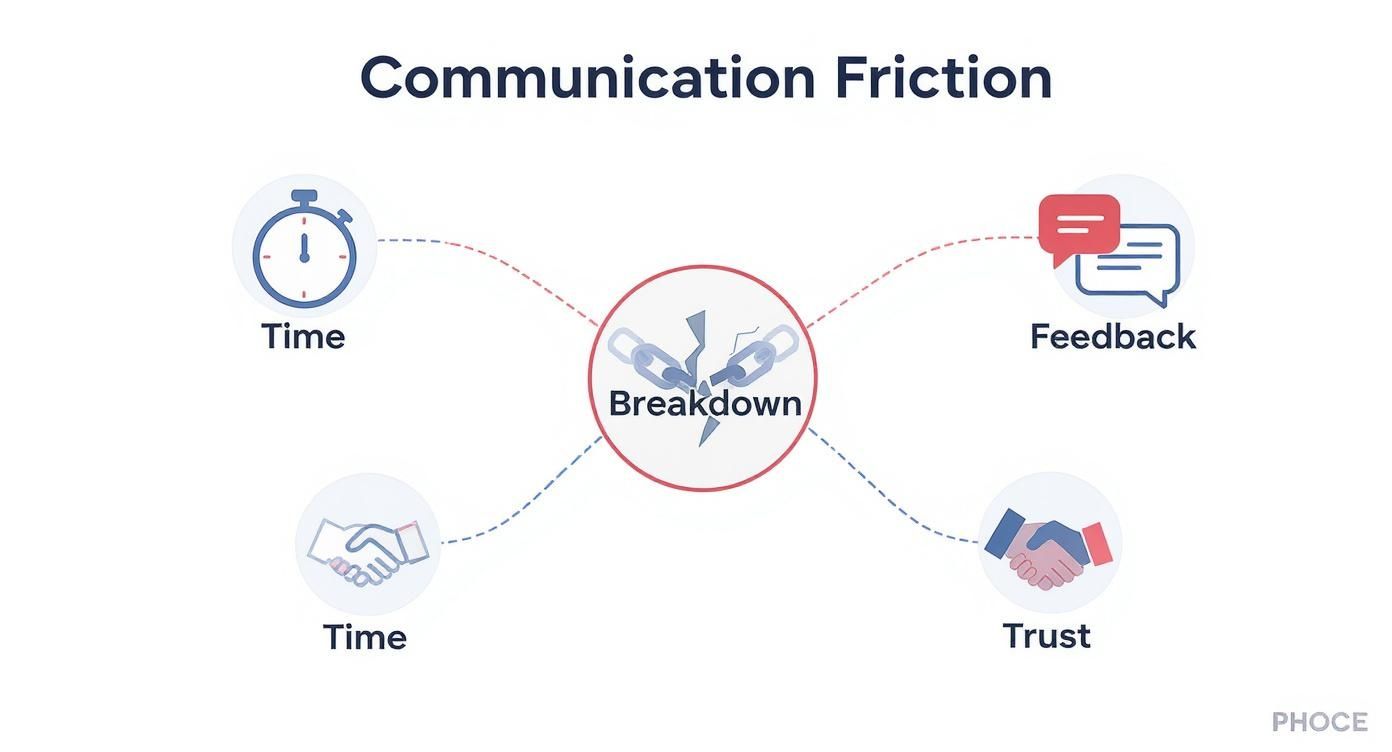
It’s a great reminder that a major communication failure is rarely a single event. It’s usually the result of several interconnected cultural tensions building up over time, slowly eroding a project's momentum and damaging professional relationships.
Running More Inclusive Global Meetings
Global meetings are ground zero for cultural misunderstandings. A style that one person finds efficient and direct can easily come across as dismissive or exclusionary to another. To make sure everyone feels heard, you have to intentionally design a more inclusive meeting experience from the start.
An easy and powerful first step is to send out a detailed agenda at least 24 hours ahead of time. Make sure it includes the key discussion points and attaches any documents people need to review. This simple action gives non-native speakers and more reflective team members the time they need to process the information and gather their thoughts, which levels the playing field for participation.
Here are a few more practical tips:
- Set Clear Ground Rules: Kick off the meeting by stating the goal and briefly explaining how you'll handle participation. It creates a shared roadmap and manages expectations.
- Rotate the Facilitator: Don't let one person run every meeting. Allowing different team members to lead accommodates a variety of communication styles and prevents a single cultural norm from taking over.
- Actively Solicit Input: Instead of a generic "Any questions?" that often gets crickets, try a more direct approach. Respectfully invite specific people to share their views. For example, "Maria, what potential challenges do you see from your team's perspective?"
Crafting Emails That Connect Across Cultures
When we write, we lose all the crucial context we get from tone of voice and body language. This makes email a minefield for misinterpretation. An email that seems perfectly fine to you could be seen as abrupt, demanding, or just plain confusing to a colleague from another culture.
The goal is always to write with clarity and respect. This means ditching the idioms, slang, and complicated jargon that just don't translate well. So, instead of writing "let's hit a home run on this," go for something more universal like, "let's aim for a very successful outcome on this project."
When you're writing for a global audience, clarity trumps cleverness every time. A simple, well-structured message that is easy to understand will always be more effective than a beautifully written one that causes confusion.
Also, think about the level of formality. Some cultures expect emails to start with warm, personal greetings, while others get straight to business. If you're unsure, it's usually safest to start with a slightly more formal tone and then adapt based on the replies you get. And don't forget that simple formatting, like bullet points and bold text, can make your message much easier to scan and understand, no matter the language.
Navigating these differences between direct and indirect styles is crucial. This table shows how you might adapt your approach in common business situations.
Adapting Communication Styles Across Cultures
| Scenario | High-Context Approach (Indirect) | Low-Context Approach (Direct) |
|---|---|---|
| Giving Feedback | Focus on the group's success. Use "we" instead of "you." Offer suggestions gently. | Be specific, objective, and focus on the individual's performance and behavior. |
| Making a Request | Start with a polite preamble and explain the context before making the ask. | State the request clearly and concisely at the beginning of the message. |
| Negotiating | Prioritize relationship-building first. Listen for subtle cues and what is left unsaid. | Focus on facts, figures, and the terms of the deal. Lay all cards on the table. |
| Disagreeing | Express disagreement subtly, perhaps by asking questions or proposing alternatives. | State your counter-argument clearly and back it up with data or logical reasoning. |
As you can see, the "right" way to communicate depends entirely on the cultural context. Being flexible is your greatest asset.
Building Trust in Global Negotiations
Negotiations are tricky enough when everyone's from the same background. Add a cross-cultural layer, and the stakes get even higher. But it’s not all bad news—research from Harvard shows that cross-cultural teams who figure out how to communicate well often reach more creative and valuable agreements than teams from the same culture. The trick is managing those communication barriers.
The biggest shift you can make is moving from a purely transactional mindset to a relationship-focused one. In many cultures around the world, trust isn't built on a contract; it's built through personal connection.
Here are a few ways to adjust your approach:
- Invest Time in Small Talk: Don't dive straight into business. Taking the time to build rapport by chatting about neutral topics like travel, food, or family lays a positive foundation for everything that follows.
- Listen More Than You Speak: Pay close attention to what's being said—and just as importantly, what isn't. Silence isn't always disagreement; it can be a sign of thoughtful consideration.
- Clarify, Don’t Assume: If you're unsure about something, ask open-ended questions. Saying, “Can you help me understand why this point is so important for your team?” works much better than jumping to a conclusion.
- Know Your Counterpart: Do your homework on the person, not just their cultural stereotype. Their professional background, experience, and personality matter just as much as where they're from.
Ultimately, mastering these strategies is about developing versatile communication habits. You can learn more about building these core competencies in our guide to effective communication skills in the workplace. By consistently applying these practical tactics, you can lead your global team with more confidence and foster a truly collaborative and successful work environment.
How to Practice and Build Your Confidence
https://www.youtube.com/embed/HYj-rLygIZU
Reading about cultural frameworks is a great start, but true confidence in cross cultural communication in business comes from doing, not just knowing. Think of it like learning an instrument. You can study music theory for months, but you won't make music until you actually pick up the guitar and start practicing.
This is a practical skill, and you build it through repetition. The good news is, your training ground is your everyday work. Every email, meeting, and casual chat is a chance to refine your approach. You're essentially building muscle memory for navigating those crucial global interactions.
Turning Theory into Practical Skill
So, how do you bridge that gap between knowing what to do and actually feeling comfortable doing it? You start practicing. This doesn't mean you need a formal training course—it just requires a mental shift from being a passive learner to an active participant.
It means listening a little more intently in conversations. It means getting more curious and asking more thoughtful questions. Most of all, it means being okay with stepping outside your comfort zone and trying a new communication style, even if it feels a bit clumsy at first.
The goal of practice isn't to be perfect overnight. It's about making steady progress. Each conversation is an opportunity to listen better, adapt your approach, and forge a stronger connection. That consistent effort is what builds real, unshakable confidence.
By taking these small, deliberate steps every day, you'll steadily build the poise you need to handle even the most complex cross-cultural situations.
Start with Active Listening and Better Questions
One of the simplest yet most effective ways to practice is to really dial in your active listening skills. This isn't just about hearing the words someone says; it's about trying to understand the full picture—the intent and the context behind them. When you're talking with a colleague from a different culture, pay attention to what isn't being said, too.
Notice their tone, the pauses they take, or their body language. Then, follow up with open-ended questions to make sure you're on the same page and to show you're genuinely engaged.
- Instead of asking, "Do you agree?" try something like, "What are your thoughts on this approach?"
- Rather than, "Is the deadline clear?" ask, "What challenges do you see with this timeline?"
Questions like these open the door for a real conversation, helping you catch potential misunderstandings before they grow. They signal respect and a true desire to connect, which is the cornerstone of any strong business relationship. If you want more tips on projecting assurance, check out our guide on how to build confidence at work.
Rehearse Difficult Conversations in a Safe Space
Of course, some conversations are too high-stakes to use as your first-ever practice round. You wouldn't want your first time giving critical feedback or navigating a major negotiation to be the real thing. For these moments, you need a place to rehearse without any real-world risk.
This is where tools designed for practice can be a game-changer. For instance, platforms like TalkEasy give you a safe, AI-powered space to run through these exact scenarios. You can simulate tough business conversations, get immediate feedback on your wording and tone, and sharpen your skills without the pressure of a live audience.
By running these drills, you’re not just building competence—you’re building genuine confidence. When the real situation arises, you won't be winging it. You'll be ready to respond with a calm, well-practiced approach, prepared for whatever comes your way.
Your Path to Becoming a Global Communicator
Think of mastering cross-cultural communication less like a destination and more like a journey. It’s a continuous process of learning, adapting, and growing with every new person you meet and every new team you join. Success isn’t about memorizing a checklist of rules for every country; it's about building a mindset rooted in curiosity, empathy, and flexibility.
This is what turns a potential clash into a genuine connection. It’s what transforms a moment of confusion into an opportunity for real understanding.
The way forward is to put the core strategies we've discussed into action. Start by looking for those unseen cultural signals, remembering that what's spoken aloud is often just the tip of the iceberg. When breakdowns happen—and they will—learn to navigate them with grace, assume the best intentions, and treat every misunderstanding as a lesson.
Your Commitment to Continuous Practice
At the end of the day, becoming a skilled global communicator really comes down to one thing: consistent practice. Every single interaction is a chance to sharpen your skills.
Effective cross-cultural communication is less like a finished painting and more like a garden. It requires constant attention, patience, and a willingness to learn from both successes and failures to truly flourish.
When you actively apply these principles, you’re doing more than just getting better at your job. You're building stronger, more resilient relationships and creating an environment where people feel truly included. So, step into this journey with an open mind, ready to listen and adapt. This approach won't just move your career forward; it will shape you into a more insightful and empathetic leader in our connected world.
You can start today with one small, deliberate action. Maybe it’s asking a better question in your next global meeting or rehearsing a tricky conversation on a platform like TalkEasy. Your path to becoming a confident global communicator starts with that single step.
Frequently Asked Questions
When you start digging into cross-cultural communication, a lot of practical questions come up. Here are some straightforward answers to the ones we hear most often, designed to help you put these ideas into practice.
What’s the Very First Thing I Should Do to Improve My Team's Cross-Cultural Communication?
Start with awareness. The single best first step is simply to get your team talking about communication itself.
A great way to do this is to introduce a simple framework, like the difference between high-context and low-context styles. The goal isn't to label anyone, but to give the team a shared vocabulary for discussing their preferences without judgment. Open up a conversation where people can share how they like to receive information or what’s worked for them in the past. This creates a foundation of understanding and a safe space to talk about norms before they turn into problems.
The most impactful first step isn’t a new rule, but a new conversation. Creating a space where your team can openly discuss communication preferences is the foundation for building true cultural fluency.
How Should I Handle a Mistake That Happened Because of a Cultural Misunderstanding?
When a mistake pops up, the key is to address it directly but with a lot of empathy. First things first: always assume good intent. Most cross-cultural slip-ups are completely unintentional.
Try to understand where the other person is coming from by asking open-ended questions that don't sound like an accusation. For instance, you could say, "Could you walk me through your thinking on this task?" This shows you respect their perspective and genuinely want to learn.
Acknowledge the mix-up without pointing fingers. Something as simple as, "I think we had a miscommunication on the deadline; let's map out our process for next time," can make all the difference. Your focus should be on finding a better way forward together, not on assigning blame for what already happened.
Are Cultural Stereotypes Ever Helpful?
Honestly, no. Leaning on stereotypes is one of the biggest mistakes you can make. While cultural frameworks offer helpful clues about general tendencies, stereotypes are rigid, oversimplified, and often negative labels.
Think of cultural knowledge as a starting point—a hypothesis, not a conclusion. In fact, research shows that negotiators who get too hung up on stereotypes tend to misread the room because they stop seeing the actual person in front of them. The best communicators use cultural insights as a guide but always pay closer attention to the individual they're speaking with, adapting as they go.
What's the Best Way to Give Feedback Across Different Cultures?
The best approach is to adapt your style to the person receiving the feedback. If you're not sure what their preference is, it's usually safest to start with a more indirect method.
Here are a few ways to adapt:
- For indirect or high-context cultures: Try framing the feedback positively, maybe by focusing on the team's shared goals. Using "we" can be effective, like saying, "I think we can make this section even stronger" instead of a blunt "You need to fix this."
- For direct or low-context cultures: Be clear, specific, and stick to the facts. Talk about the work or the behavior, not the person, and offer concrete examples of what could be improved.
No matter the culture, always give constructive feedback in private. It’s a universal sign of respect that helps maintain trust and makes the other person far more likely to hear what you're saying. Building strong cross cultural communication in business really boils down to making people feel valued, especially during tough conversations.
Ready to build the speaking skills and confidence you need for any global business conversation? TalkEasy provides a safe, AI-powered space to practice real-world scenarios, from negotiating deals to giving feedback. Start your journey to becoming a more effective global communicator today at https://www.talk-easy.com.