
How to Handle Rude Customers Like a Pro
Discover how to handle rude customers with proven de-escalation scripts and self-care tips. Turn negative interactions around and stay professional.


It’s tempting to write off a rude customer as just another part of a tough day. But the truth is, these moments are much more than a fleeting annoyance. They’re a direct threat to your brand, your customer loyalty, and ultimately, your bottom line. When these conversations spiral, the damage is real and it lasts.
The True Cost of a Rude Customer
A poorly handled interaction doesn’t just mean you’ve lost one customer. It creates a ripple effect. That unhappy person is far more likely to vent online or tell their friends, poisoning the well for potential new customers.
This is why learning how to navigate these encounters isn't just a "soft skill"—it's a core business strategy. The stakes are incredibly high, and these tough moments directly impact:
- Brand Loyalty: It only takes one bad experience to break a relationship that took years to build.
- Revenue and Churn: Unresolved problems send customers straight into the arms of your competitors.
- Employee Morale: Facing constant negativity is a fast track to burnout and high turnover for your team.
The Numbers Don't Lie
The financial fallout from bad customer service is staggering. By 2025, poor service is on track to put an estimated $3.8 trillion in global revenue at risk. That isn't just some abstract figure; it's made up of real people making real choices about where to spend their money.
Think about this: studies show that 80% of customers have switched to a competitor after a negative service experience. Even more shocking, 43% will walk away after just one bad interaction. This data really drives home why every single conversation matters and why arming your frontline teams with the right skills is non-negotiable. For a deeper dive, check out more crucial data in our detailed breakdown of customer service statistics at Talk-Easy.
Every difficult conversation is an opportunity. It's a chance to turn a frustrated customer into a loyal advocate by showing them you genuinely care and are committed to fixing their problem.
This guide is your playbook for turning these high-stakes situations around. We'll go beyond vague advice and give you concrete de-escalation techniques, practical scripts, and a solid framework for keeping your cool when things get heated.
De-escalation in the First 30 Seconds
The first half-minute of a heated conversation is everything. It’s your one and only shot to steer the interaction away from a full-blown conflict and toward a calm, productive resolution. How you handle these initial moments dictates what happens next.
Forget about solving the problem right away. When a customer is seeing red, they aren't looking for a solution just yet—they want to be heard. Your immediate goal is to manage the emotion in the room. This requires a conscious shift from a defensive posture to one of controlled, professional calm.
Mastering the First Interaction
Your tone of voice, the speed at which you speak, and the words you choose are your most powerful tools. Projecting a neutral, composed demeanor is non-negotiable, no matter what’s being thrown your way. If you speak calmly and deliberately, you can often subconsciously encourage the customer to mirror your state, bringing the temperature down a few notches.
This is where the Listen, Acknowledge, Validate (LAV) method comes in. It's a simple, yet incredibly effective, framework for disarming anger and building a bridge toward actually fixing the issue. You aren't agreeing with their rudeness; you're just showing them you understand their frustration.
Never forget that a single negative interaction can have a ripple effect, damaging brand loyalty and, ultimately, the bottom line.
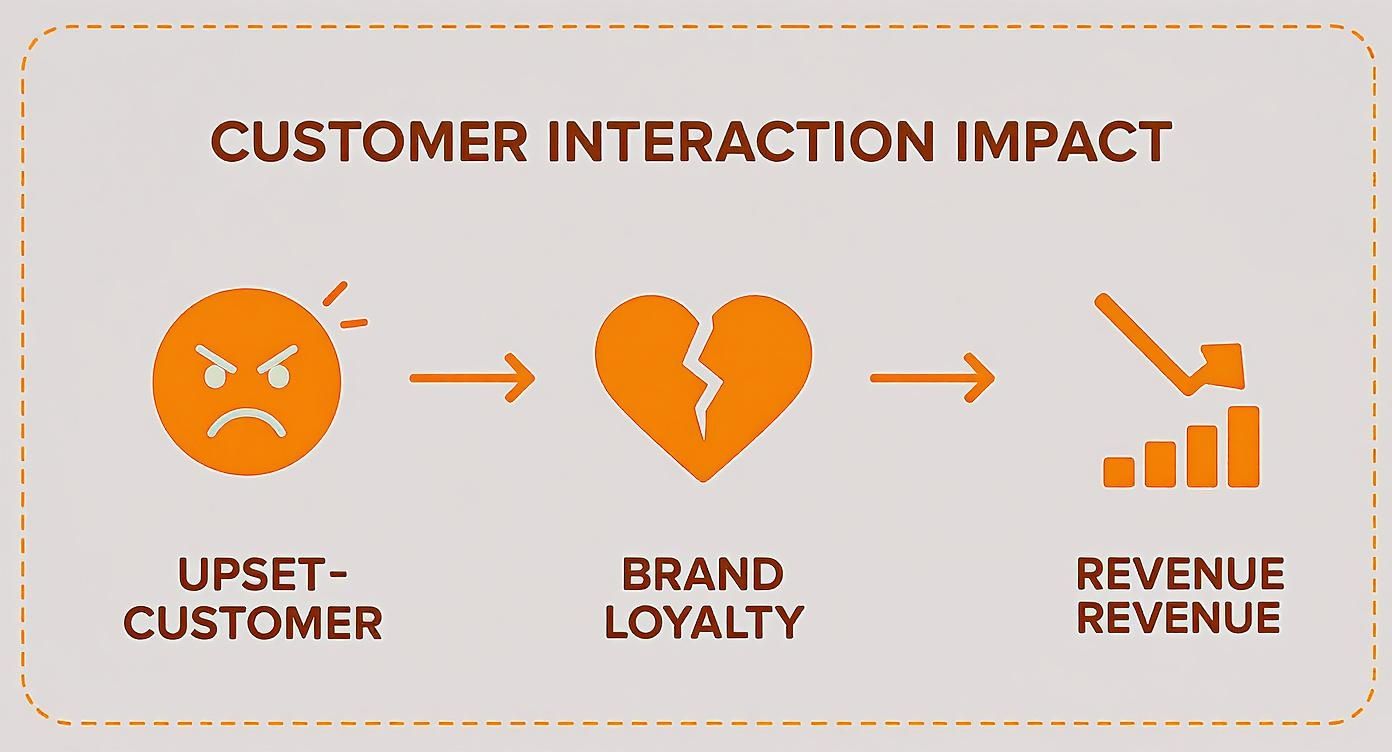
As you can see, the stakes are high. That first 30-second interaction isn't just about one conversation; it's about protecting your brand's reputation and financial health.
Let's look at how your initial words can either fuel the fire or put it out. Many common, almost instinctual, responses do more harm than good.
Initial Response Comparison: Effective vs. Ineffective Phrases
| Scenario | Ineffective Response (What to Avoid) | Effective Response (What to Say) |
|---|---|---|
| Customer is yelling and interrupting. | "You need to calm down." | "I can hear how frustrating this is, and I want to help. Let's work through this together." |
| Customer is complaining about policy. | "I'm sorry, but that's just our policy." | "I understand that policy is frustrating. Let's see what we can do within the guidelines." |
| Customer is using aggressive language. | "There's no need to be rude." | "I want to resolve this for you. To do that, I'll need us to communicate calmly." |
| Customer demands to speak to a manager immediately. | "Fine, I'll get them." (with an annoyed tone) | "I can certainly see if a manager is available. First, could you let me try to help you directly?" |
Choosing the right words from the very beginning shows you're in control of the situation and ready to assist, not argue.
The LAV Method in Action
The LAV method is your go-to game plan. It’s a three-part approach designed to address the customer's feelings before you dive into the facts of the problem.
- Listen: Let them talk. Don't interrupt. Give them the space to vent and really listen for the core issue buried under all that anger. Your only job in this phase is to absorb the information, not to plan your rebuttal.
- Acknowledge: Once they've finished, briefly summarize their complaint. Saying something like, "Okay, so just to be clear, you were charged twice for the order, and it still hasn't shown up," proves you were paying attention and takes the wind out of their sails.
- Validate: This is the magic step. You must validate their feeling, not their behavior. Simple phrases work wonders here. "I can absolutely understand why you're so frustrated by this," or "You have every right to be upset."
Using validation isn't about admitting fault. It's about acknowledging their emotional reality. This single act is the key to defusing tension and earning their permission to solve the problem.
This approach transforms a tense confrontation into a collaborative problem-solving session. For more in-depth strategies, our guide on dealing with difficult customers at Talk-Easy offers additional powerful techniques.
By mastering the LAV method, you build a foundation of trust that makes everything else smoother. You're no longer an obstacle; you're their ally.
Proven Scripts for Difficult Conversations
When a conversation starts to get heated, knowing exactly what to say can be a game-changer. It’s not about sounding like a robot; it’s about having a few solid phrases in your back pocket to help you regain control and steer things back toward a solution. These are the tools that help you keep your cool when a customer is losing theirs.
Think of these scripts less as rigid lines to memorize and more as a flexible framework. The real magic happens when you adapt the language to your own voice while holding onto the core de-escalation principles. The right words at the right time can build a bridge over even the most troubled waters.
Language for Unreasonable Demands
We've all been there. A customer asks for something that’s simply impossible, whether it’s against company policy or just not technically feasible. The trick is to say "no" gently without shutting down the conversation. It all comes down to explaining the limitation and immediately pivoting to what you can do for them.
- Try this: "I understand you're looking for a full refund, but since the item was used, our policy doesn't allow for that. However, what I can do is offer you a 25% discount on your next purchase."
- Or this: "I really wish I had a different answer for you, but that feature isn't available at the moment. I can, however, personally submit this as a feature request to our development team for you."
This approach does two things beautifully: it shows you heard them, but it also clearly and kindly states the boundary before redirecting their attention to a positive alternative.
Handling Personal Insults and Profanity
When a customer's frustration turns into personal insults, the goal is to immediately de-personalize the attack. Firing back or getting defensive will only pour fuel on the fire. Instead, you need a calm, firm redirect that brings the focus back to the actual problem.
Here’s a simple two-step process:
- Acknowledge and Redirect: Start by saying something like, "I can hear how frustrated you are, but personal comments won't help us solve this. Let's focus on the issue with your account so I can find a resolution for you."
- State the Boundary Clearly: If they keep at it, you have to be more direct. "I genuinely want to help you, but I can't continue the conversation if you use that kind of language. We need to be respectful to move forward."
This gives the customer a clear opportunity to course-correct while establishing that you won't tolerate abuse.
Role-Play for Building Confidence
Just reading these phrases isn't enough. You have to practice them until they feel like your own words. Grab a coworker for a few minutes and run through some quick scenarios. The goal is to build that muscle memory so the right response comes out naturally, even when you're under pressure.
- Scenario 1: A customer is livid about a shipping delay and demands you personally drive their package to their house. Practice pivoting to what’s actually possible.
- Scenario 2: A customer blames you for their computer crashing and calls you incompetent. Practice setting a boundary and redirecting the conversation back to the issue.
A powerful tool I’ve used for years is the 'broken record' technique. It’s perfect for customers who just won't take "no" for an answer. You simply, and calmly, repeat a key phrase, like "Our policy requires a receipt for a full refund." It keeps you from getting pulled into a pointless argument.
Mastering these techniques is a huge part of professional growth. If you want to dive deeper, our guide on how to improve customer service skills at Talk-Easy offers even more frameworks. A little practice goes a long way in building the confidence to handle any situation with control.
Empathy Isn't Weakness—It's Your Secret Weapon
Let's be honest: when a customer is being rude, your first instinct probably isn't to be empathetic. But this isn't about just being nice; it's about using empathy as one of the most powerful de-escalation tools you have. Think of it as strategic empathy.
This approach allows you to step back and see the situation clearly, separating the person from the problem they're having. Their frustration is almost never about you. It’s usually tied to a broken promise, a feeling of being unheard, or a small issue that has snowballed. Understanding this shifts your mindset from being defensive to being a problem-solver.
Separate the Person from the Problem
The real trick is to validate their feelings without necessarily agreeing with their behavior. A customer can be completely wrong about the facts of a situation but entirely justified in how frustrated they feel. Your first job is to acknowledge that emotional reality.
The second a customer feels genuinely heard, their guard drops. Their anger often starts to dissipate. This is the moment you earn their trust to pivot from managing emotions to actually fixing the issue.
This skill is more critical than ever. Customer interactions are, frankly, getting worse. Forrester's 2025 Global Customer Experience Index found that 21% of brands in North America saw their customer experience quality drop for the second year straight. With customer loyalty on shaky ground, a single moment of real human connection can be what keeps them from walking away.
How to Show Empathy When You're Under Fire
Projecting empathy when you’re stressed out and on the spot isn’t easy. It takes practice and a few concrete techniques. It's about showing the customer you're on their side, not just saying it.
One of the most effective ways to do this is by mirroring their language.
If a customer says, "I'm incredibly frustrated that my delivery is late," a bland "I'm sorry for the inconvenience" just won't cut it. Instead, try mirroring them: "I totally get why you're incredibly frustrated about the late delivery. Let's find out exactly where it is for you right now."
Using their own words shows you were listening—truly listening—and it instantly builds a connection.
Here are a few other phrases that work wonders:
- Acknowledge Their Effort: "It sounds like you've already spent a lot of time on this." This simple line shows you respect the hassle they've been through.
- Use Team-Oriented Language: Words like "we," "us," and "together" make you an ally, not an opponent. Try saying, "Let's see what we can figure out to get this sorted."
- Express Gratitude: A simple, "Thank you for bringing this to my attention," can completely reframe the interaction. It turns their complaint from an attack into valuable feedback.
These subtle shifts in language are at the heart of building rapport. Mastering them is a core part of developing effective communication skills in the workplace and can turn a potential disaster into a moment that actually strengthens a customer's loyalty.
When to Escalate or End the Conversation
While your main goal is to de-escalate, some situations just can't be fixed on the frontline. Knowing your limits isn't a sign of failure; it’s a mark of a true professional. The real skill is spotting the moment a customer’s behavior crosses the line from simply rude to genuinely abusive.
Let's be clear: dealing with a frustrated or rude customer is often part of the job. Enduring abuse is not.
When an interaction veers into personal insults, threats, or discriminatory language, your well-being and safety immediately become the priority. Trying to continue a conversation like that isn't just unproductive—it's harmful.
Your job is to solve problems, not to be a punching bag for personal attacks. Setting a firm boundary protects you and upholds the professional standard for your entire team.
This is where having a clear company policy is your safety net. These guidelines should give you a simple, direct protocol for when and how to escalate, so you aren't left guessing what to do when the pressure is on.
Knowing When to Draw the Line
So, what's the tipping point? When do you call in a manager or decide it's time to disengage? While every situation has its own flavor, there are some undeniable red flags that signal a conversation has gone off the rails.
It’s time to escalate or end the interaction if the customer:
- Gets Abusive: This isn't just frustration. We're talking about profanity, personal insults, or racist, sexist, and other discriminatory remarks.
- Makes Threats: Any hint of physical harm—whether aimed at you, your colleagues, or company property—is a zero-tolerance issue. This is non-negotiable.
- Refuses to Cooperate: You've tried everything, but they're stuck in a loop of yelling, interrupting, and flat-out refusing to listen to any of the solutions you offer. At this point, you can't help them.
- Makes Impossible Demands: They're demanding something that is miles outside of company policy (like a full refund for a product they’ve used for a year) and won’t even consider reasonable alternatives.
How to Escalate Gracefully
Escalating a call should never feel like you're just dumping a problem on someone else. It's a strategic move to bring in a person with the authority to resolve things. The trick is how you frame it.
Always present the escalation as a benefit to the customer. This simple shift in language makes all the difference.
Instead of saying, "I can't help you," try something like this:
"It sounds like what you need is something I'm not authorized to provide. Let me get my manager, who has more options and can explore a better solution for you."
This approach reframes the handoff as a positive, proactive step toward getting them what they need, rather than making it feel like you're dismissing them. You're not passing the buck; you're bringing in a bigger gun to help win the battle.
Protecting Your Own Well-Being

Let's be honest: constantly absorbing other people's frustration is exhausting. While learning how to handle rude customers is part of the job, protecting your own mental health is what allows you to do it long-term without burning out. Think of self-care not as a perk, but as a core professional skill.
After a really tough call, the worst thing you can do is carry that negativity into your next conversation. Taking just a moment to consciously hit the reset button can make all the difference.
Quick Mental Reset Techniques
You don't need a lot of time to shed the stress from a difficult encounter and get your head back in the game. These are simple, immediate things you can do right at your desk or in a break room.
- The 2-Minute Reset: Seriously, just two minutes. Step away from your screen, close your eyes if you can, and take a few deep, slow breaths. Focus on nothing but the feeling of air coming in and going out. This physical act alone can slow your heart rate and quiet the noise in your mind.
- Mental Reframing: This one is crucial. You have to consciously tell yourself, "That wasn't about me." The customer was angry about their problem, not you as a person. Detaching their frustration from your professional identity is how you stop their negativity from sticking to you.
Self-care isn't selfish. It’s the necessary maintenance that allows you to show up as your best self for the next customer who needs your help.
Don't underestimate the power of a quick chat, either. Debriefing with a manager or a trusted colleague can be a fantastic release valve. Just talking through what happened validates your feelings and reminds you that you’re not alone—you're part of a team.
It’s also worth noting how technology is changing this dynamic. The rise of AI in customer service is helping by filtering out some of the more routine, repetitive issues, which can free up human agents for more complex problems. Companies are trying to strike a balance, hoping to manage costs without sacrificing empathy, a trend you can read more about in this great breakdown of customer support trends for 2025 on talk-easy.com.
Frequently Asked Questions
Even with the best game plan, some situations will leave you scrambling. Let's tackle a few common questions that pop up when dealing with difficult customers, reinforcing the core ideas we've covered.
What Should I Do if a Customer Is Rude Immediately?
It's jarring when a customer comes out swinging from the very first sentence. Your gut reaction might be to get defensive, but that’s a trap. Fight that instinct.
Instead, take a deep breath and immediately shift into your de-escalation framework. Let them vent without interruption. Once they pause, jump in with a validating phrase. Something like, "It sounds like this has been an incredibly frustrating experience. I want to fully understand what happened so I can help you." This simple sentence can completely change the dynamic, showing them you're on their side, not an obstacle.
How Do I Respond to Personal Insults?
When a customer's complaint turns into a personal attack, it’s tough not to take it personally. The trick is to professionally redirect the conversation back to the actual problem. You need to be firm, but not aggressive.
Try a statement like this: "I understand you're upset, but the personal comments aren't helping us get to a solution. Let's focus on the issue at hand so I can find a resolution for you."
If they keep coming at you with insults, it's time to set a clear boundary. Say, "I am not going to be able to help you if the personal attacks continue." If that doesn't stop it, it's time to follow your company's protocol for escalating the situation.
Is It Ever Okay to Hang Up on a Rude Customer?
Hanging up should be your absolute last resort, and it must be done according to a strict protocol. You can't just slam the phone down. First, you have to give a clear, final warning.
For example, say: "I cannot continue this conversation if you continue to use that language."
If the behavior doesn't change, state your next action calmly and clearly: "As I've already mentioned, I am ending this call now." Immediately after, you need to document the entire interaction in detail and let your supervisor know what happened. This isn't just about covering your bases; it's about protecting yourself and the business.
Navigating tough conversations is a skill that gets better with practice. At Talk-Easy, we help you build the confidence to communicate clearly and professionally, no matter the situation. Our AI-powered platform gives you a space for real-time practice to master these techniques. Start speaking more confidently today.