
How to Learn English Accent: A Practical Guide
Discover how to learn english accent with practical drills, rhythm mastery, and natural-sounding pronunciation for confident everyday conversations.


Mastering a new English accent isn't about just copying what you hear. It’s more like learning the mechanics behind the music of a language. The real secret lies in breaking down an accent into its core parts: pronunciation, stress, and intonation. These are the elements that give every accent its unique rhythm and melody.
Your Journey to a Clearer English Accent

Taking on a new English accent can feel like a huge mountain to climb, but it’s absolutely doable when you have a solid plan. I've seen countless learners make incredible progress, and it never comes from memorizing word lists. It comes from focusing on the physical side of speech—how you shape your mouth, where you put your tongue, and the natural rise and fall in your sentences.
This guide is designed to cut through the noise and show you what actually works. We'll zero in on the importance of stress and intonation because, honestly, that's often what gives away a non-native accent more than anything else. Nailing these aspects is the key to sounding natural.
Why Does Accent Training Matter?
With English becoming the default language for global business, the demand for clear, understandable accents has skyrocketed. Think about it: nearly 1.5 billion people speak English around the world, and over a billion of them are non-native speakers. Many are looking to polish their accent to get ahead professionally or just feel more at ease in social settings.
We've seen this firsthand in the market. Enrollment in accent coaching has jumped by 35% in places like India and Brazil in just the last five years. It's a clear sign that this is a skill people value.
This isn't just about being understood; it's about connecting with people and feeling confident in any conversation. A consistent practice plan is what separates those who make progress from those who get stuck.
The goal is not to erase your original accent but to add a new communication tool to your skillset. Think of it as learning to code-switch, allowing you to adapt your speech for different audiences and situations.
This guide will lay out a structured path, from picking your target accent to building a daily routine that fits your life. With focused steps and the right tools, you can make a real difference in how you sound and feel. For a deeper dive, check out our guide on the fundamentals of English accent training.
Picking Your Accent and Finding Your Voice
Before you even think about practicing a single sound, you have to know what you're aiming for. This is your North Star. You need to pick a specific accent—whether it's General American, British Received Pronunciation (RP), Australian English, or something else entirely—and really get to know it inside and out. It’s not just about finding an accent you like; it’s about choosing one that makes sense for your life.
Think about it: who do you talk to every day? If you're working with a team in London, a British accent is a practical goal. If you've got your sights set on Hollywood, then a General American accent is probably the way to go. Your choice should serve your personal and professional ambitions.
Find a Real Person to Emulate
Once you've settled on a general accent, it's time to get specific. A vague goal like "I want to sound American" is a recipe for frustration because there are dozens of American accents. You need to find a single, consistent speaker you can listen to over and over again. This is your model.
So, where do you find a good model? News anchors, podcast hosts, and certain actors are fantastic choices because their speech is typically very clear and standardized.
- News Broadcasters: Check out presenters on major networks like the BBC (for British RP) or CNN (for General American). They're literally paid to speak clearly.
- Actors in Interviews: Forget the movies for a second. Watching interviews gives you a glimpse of how actors speak naturally, as themselves. Find someone whose voice you find easy to listen to.
- Podcast Hosts: Podcasts are a goldmine of natural conversation. Pick a host who covers topics you're actually interested in—it makes the listening part feel less like a chore.
Once you have your model, your job is to switch from passively hearing them to actively listening. You're basically dissecting the music of their speech. It's worth noting that age and exposure do matter here. Research from the University of Manchester points out that learners who start young have a better shot at sounding native-like. The study found that kids exposed to English before age 10 had a 75% chance of developing a near-native accent. You can dive into the full research about accent acquisition if you're curious.
Build a Mental Blueprint of the Accent
Active listening isn't just about hearing the words; it's about figuring out how they're made. You need to become an accent detective.
The real secret is to build a mental blueprint before you start practicing. You have to understand the unwritten rules of the accent's sound system, its rhythm, and its unique melody.
Here’s what to zero in on:
- Vowel Sounds: How do they say the 'a' in "cat" versus "father"? Are their vowels long and relaxed or short and sharp? For example, the 'o' in "hot" sounds very different in American and British English.
- Consonant Clusters: Pay close attention to how they pronounce words with chunky consonant groups, like "strengths" or "crisps." Do they pronounce every single sound, or do they drop some?
- Intonation Patterns: This is the melody. Try to map the rise and fall of their voice. Notice how their pitch goes up at the end of a question but generally falls for a statement. A great little exercise is to write down a short sentence they say and draw little arrows over the words to track the pitch.
By breaking down these elements, you're doing more than just copying sounds. You're internalizing the very foundation of the accent. This blueprint will be your guide for everything that comes next.
Building the Core Skills of Your New Accent
Alright, you’ve picked your target accent. Now the real work—and the real fun—begins. We're moving from just listening to actively doing. This is where you’ll start to retrain the muscles in your mouth, tongue, and jaw to create sounds that might feel completely new.
A convincing accent really comes down to two things: pronunciation (the individual sounds) and prosody (the music of the language).
Think of it like learning a song. Pronunciation is hitting the right notes, while prosody is the melody, rhythm, and emotion that bring it all together. A lot of learners get stuck on just the notes and end up sounding correct but robotic. We want to avoid that. To sound natural, you have to nail both.
Mastering Those Tricky English Sounds
Let's be honest, some English sounds are just plain difficult, especially if they don't exist in your native language. The usual culprits are the 'th' sounds (like in 'think' and 'that'), the American 'r', and the 'l' sound.
The secret is to get mechanical. You need to become consciously aware of what your mouth is doing. I highly recommend finding mouth placement diagrams or videos on YouTube that show you exactly where the tongue and lips go. For that dreaded 'th' sound, for example, the tip of your tongue needs to lightly touch the back of your top front teeth. It feels weird at first, but with deliberate practice, you build the muscle memory until it becomes automatic.
Sharpen Your Ear with Minimal Pairs
One of the most powerful drills you can do is practicing with minimal pairs. These are simply pairs of words that differ by just one sound. Think 'ship' vs. 'sheep' or 'bit' vs. 'beat'. That subtle difference between the short 'i' and the long 'ee' is a classic stumbling block for many.
Drilling these pairs is a two-for-one deal:
- It fine-tunes your ear to actually hear the tiny differences you might be missing.
- It forces your mouth to physically create two distinct sounds, one right after the other.
Start by just listening to a pair. Then, try repeating them, really exaggerating the difference. Record yourself and listen back. Does it sound as clear to you as it did in your head? This feedback loop is your shortcut to faster progress.
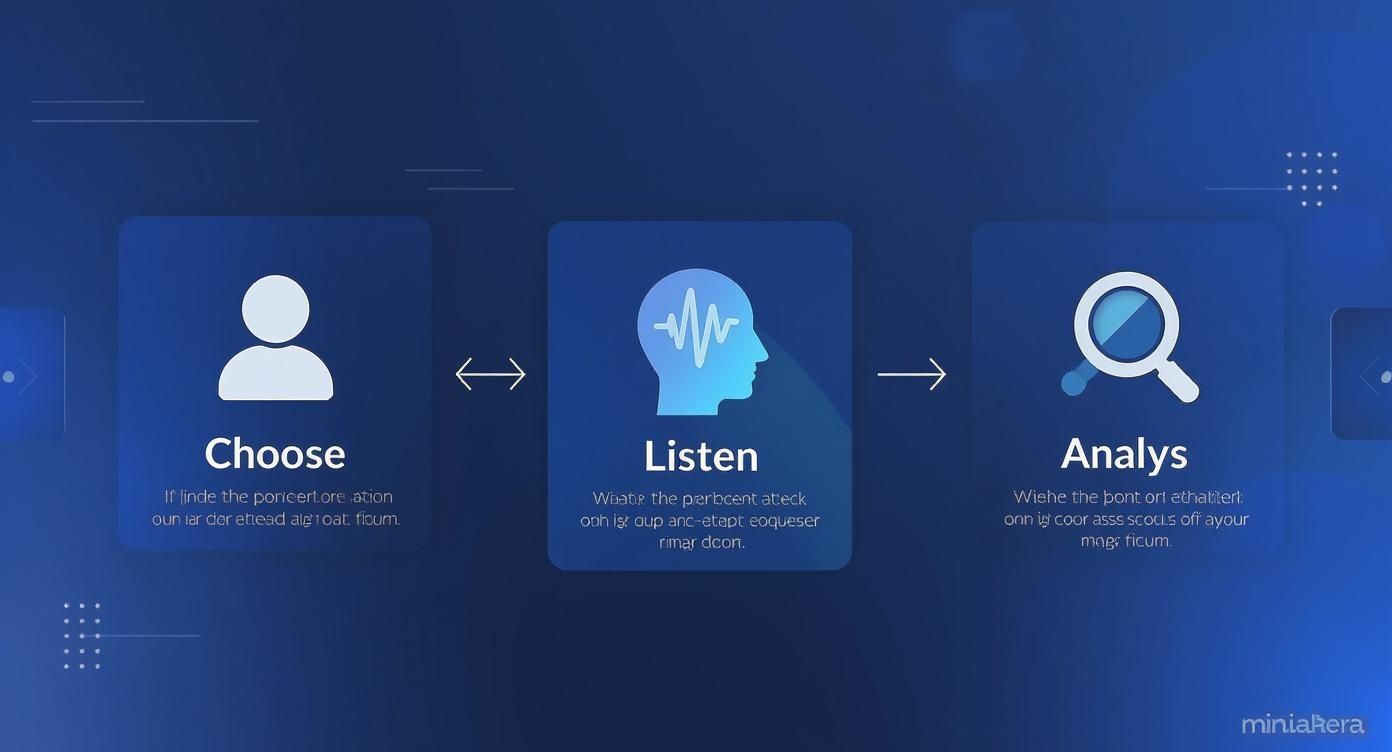
This process—choosing, listening, and analyzing—is your foundation. It gives you a clear mental map of your target accent before you dive into the nitty-gritty of daily practice.
Finding the Music in Your Speech
Beyond the individual sounds, prosody is what truly sells an accent. It's the unique blend of stress, rhythm, and intonation that makes speech flow naturally.
Honestly, getting the rhythm right is often more important for being understood than having perfect pronunciation. Native speakers can usually figure out a mispronounced word if the sentence melody feels right.
So, how do you practice the music? Focus on these key areas:
- Word Stress: English words with more than one syllable have one that gets all the attention. For example, we say "im-POR-tant," not "IM-por-tant." Getting this wrong is a dead giveaway.
- Sentence Stress: We don't stress every word equally in a sentence. We emphasize the words that carry the most meaning. In a phrase like, "I need to buy some groceries," the key information is in "buy" and "groceries."
- Linking: Native speakers blend words together for a smoother sound. "An apple" isn't pronounced "an... apple"; it flows together to sound more like "anapple." This is a huge part of sounding fluid rather than choppy.
- Intonation: This is the pitch—the rise and fall of your voice. As a general rule, your voice goes down at the end of a statement and up at the end of a yes/no question.
Working on these elements will take your speech from a series of disconnected words and turn it into smooth, connected, and genuinely natural-sounding sentences.
Putting Your Accent into Practice
Alright, you've got the theory down. You know what sounds and rhythms you're aiming for. But knowing is only half the battle. Now comes the fun part: turning that knowledge into how you actually speak. This is where we bridge the gap between your brain and your mouth with some hands-on, active practice.
Master the Art of Shadowing
One of the most powerful techniques I recommend to every student is shadowing. It's simpler than it sounds. You just play a short audio clip of a native speaker and repeat what they say in real-time, staying just a heartbeat behind them. It feels a bit like being a simultaneous interpreter.
This isn't just about mimicry; it forces your mouth to keep up with the natural pace, stress, and intonation of the accent. You're building muscle memory for the music of the language, not just the words.

A setup like the one above is perfect. Grab your headphones, find a quiet spot, and you're ready to shadow. This kind of focused listening is the foundation for both shadowing and recording your own voice.
Become Your Own Toughest Critic: Record Yourself
I know, I know. Hearing your own voice can make you cringe. But trust me on this: recording yourself is the single fastest way to find out where your speech diverges from your target accent. You simply can't fix what you can't hear.
Start small. Use the same few sentences you just practiced with shadowing and record yourself saying them. Now, listen back to the original audio, then immediately listen to your own recording.
What are you listening for?
- Vowel Sounds: Are yours as crisp and clear? Or are they a little muddy?
- Word Endings: A common one—are you dropping those final 't' or 'd' sounds?
- Sentence Melody: Does your pitch rise and fall in the same places as the native speaker? Is your rhythm similar?
This loop—record, listen, compare, and try again—is where the real magic happens. It’s tough at first, but incredibly effective.
The Power of Smart Feedback
While self-analysis is crucial, you'll eventually need an outside ear. We all have blind spots (or in this case, deaf spots) when it comes to our own speech. An objective perspective can catch those subtle mistakes you keep missing.
Consistent practice is good, but consistent practice combined with targeted feedback is what truly accelerates your progress. Without feedback, you risk just practicing your mistakes over and over.
This is where you can blend technology with human expertise. AI-powered tools like TalkEasy are fantastic for getting instant, low-pressure feedback on your pronunciation and fluency. They're great for daily drills and building confidence. If you're looking for more ways to get this kind of practice, our guide on how to practice English speaking online has some excellent suggestions.
At the same time, don't underestimate the value of a human touch. A good language coach can give you nuanced feedback on rhythm and flow that an AI might miss. They can explain why you're making a specific sound incorrectly and give you exercises tailored to fix it. Combining both AI and human feedback gives you the best of both worlds.
The data backs this up. One study showed that learners who received feedback from native speakers alongside using pronunciation apps improved their accent scores by 30%, a huge jump compared to the 15% improvement seen from traditional methods alone. You can dig into these accent acquisition findings yourself. It all points to the same conclusion: consistent, feedback-driven practice works.
Using Your New Accent in the Real World
All that hard work—the shadowing, the recording, the endless drills—it's all been building up to this. Now comes the most rewarding part: taking your new accent from a conscious, deliberate effort and making it an unconscious, natural habit. This is where you leave the practice zone and step into real, everyday conversations.
Let's be honest, that transition can feel a little daunting. The key is to start small. Don't make your debut in a high-stakes business presentation. Instead, look for low-pressure situations where the conversations are short and sweet.
Think about ordering your morning coffee, asking a stranger for directions, or making a quick purchase. These little interactions are perfect for building confidence without the anxiety of being misunderstood.
Focus on One Thing at a Time
Trying to nail every new sound, rhythm, and intonation pattern all at once is a surefire way to get frustrated. You’ll just end up feeling overwhelmed and like you're failing. A much smarter approach is to pick just one or two things to focus on in any given conversation.
For example, you might tell yourself:
- "Okay, for this chat, I'm just going to focus on getting that 'th' sound right."
- "On this phone call, my only goal is to use falling intonation at the end of my sentences."
This strategy lets you integrate changes gradually. By isolating one skill, you can give it your full attention, which helps it stick. Once that one feature starts feeling automatic, you can add another to your focus. It turns a massive goal into a series of small, manageable wins.
Navigating Self-Consciousness and Mistakes
Feeling a bit self-conscious is completely normal. Our voice is a huge part of our identity, and changing something so fundamental can feel strange, even vulnerable. You might worry about what people will think or feel anxious about slipping up.
The goal isn't immediate perfection; it's consistent application. Every real-world conversation is a chance to practice, not a test to be passed. Embrace the awkwardness as a sign of growth.
So, what do you do if someone doesn't understand you? Don't panic. It happens to native speakers all the time! Just rephrase your sentence or swap in a different word. The most important thing is not to let these moments derail your confidence. See them for what they are: valuable feedback highlighting an area that might need a little more fine-tuning.
This is also where a safe practice environment can make a huge difference. Using a platform like TalkEasy lets you simulate these real-world conversations in a judgment-free zone. You can practice ordering from a menu or asking for help without the real-world pressure, building the muscle memory you need for when it really counts. The endgame here is to make your new accent a natural, effortless part of how you connect with the world.
Common Questions About Learning an English Accent
As you start working on your accent, a lot of questions are going to pop up.That's totally normal. This is a journey, and it’s natural to wonder about the timeline, the process, and what you can realistically expect.
Let's dive into some of the most common questions I hear from learners.
How Long Does It Take to Really Change an Accent?
This is the big one, isn't it? The honest answer is: it depends. There's no magic number. Your progress really hinges on where you're starting from, how consistent you are with your practice, and how much you immerse yourself in English.
With about 15-30 minutes of focused practice each day, most people start hearing a real difference in their clarity and feeling more confident within three to six months.
But making that new accent feel completely second nature—truly automatic—can easily take a year or more of dedicated effort. The trick is to celebrate the small, consistent wins along the way instead of holding out for a total transformation overnight.
Will Learning a New Accent Erase My Original One?
Absolutely not. Think of it less like replacing your identity and more like adding a new tool to your communication toolkit. It’s a form of code-switching, which is just the ability to adapt your speech for different situations to be understood more clearly.
Your native accent is part of who you are, and you can absolutely keep both. You’ll just gain the ability to choose which one to use depending on the context.
Learning a new accent isn't about losing yourself; it's about expanding your ability to connect with a wider range of people. You gain a new way of speaking without giving up your original voice.
What's More Important: Vowels or Sentence Rhythm?
This is a fantastic question. While getting individual sounds right (like vowels) definitely matters, most experts agree that prosody—the overall rhythm, stress, and intonation of your speech—is far more critical for being easily understood.
Why? Because native speakers are pretty good at figuring out a mispronounced word if the sentence's musicality feels familiar. But if you say perfectly pronounced words with a flat or unnatural rhythm, it can be surprisingly difficult for a native listener to follow what you're saying.
For the biggest impact early on, put your energy into mastering word stress and the natural rise and fall of English sentences. Building strong listening skills is the foundation for this, and you can get more tips on how to improve your English listening skills in our other guide.
How Can I Practice Without Living Abroad?
You really don't need to pack your bags and move to an English-speaking country anymore. Technology has made it possible to create a rich, immersive environment right where you are.
Here are a few strategies that actually work:
- Consume English Media: Make English a part of your daily routine. Listen to podcasts on your commute, watch movies without subtitles to train your ear, and even switch your phone’s language to English.
- Find a Language Partner: Hop on a language exchange platform and find a partner who’s a native English speaker learning your language. It’s a win-win.
- Use AI for Practice: Tools that use AI can give you a safe, low-pressure space to practice speaking every single day and get instant feedback on your pronunciation.
At the end of the day, consistent and active use of the language is what moves the needle, not your physical location.
Ready to turn your knowledge into confident speaking? TalkEasy provides the real-time conversation practice you need to make your new accent a natural part of how you speak. Get instant, friendly corrections and practice anywhere, anytime. Start speaking more clearly today at https://www.talk-easy.com.