
how to learn to speak fluent english: quick, proven tips
how to learn to speak fluent english: unlock a practical daily routine, smart AI tools, and proven methods that turn practice into fluent conversation.


If you've ever felt like your English is "stuck" in textbooks, you're not alone. The biggest hurdle for most learners isn't a lack of vocabulary or grammar knowledge; it's the gap between knowing English and actually speaking it with confidence.
That feeling—the hesitation before you speak, the search for the right words—is what we're going to fix. This isn't about memorizing more rules. It's about building a practical, active skill.
From Studying to Speaking
Think of it like learning to play the guitar. You can read all the music theory in the world, but you'll never play a song until you physically pick up the instrument and practice every single day. Speaking English is exactly the same. The goal is to make it a natural, daily habit, not a stressful academic exercise.
This guide gives you a clear path to do just that. We're going to focus on:
- Consistency over intensity: You’ll see why 15 minutes of focused daily practice beats cramming for hours once a week.
- Actionable drills: I'll give you specific, practical exercises you can start today to improve your pronunciation, phrasing, and conversational flow.
- Smart practice tools: We'll explore how to use AI conversation partners like TalkEasy for unlimited, judgment-free speaking practice whenever you want.
The secret to fluency isn't cramming; it's consistency. Small, daily efforts compound into massive gains over time. It's a marathon, not a sprint.
The Global Drive for Spoken English
The desire to speak English is a worldwide movement. It's estimated that by 2025, nearly 1.5 billion people will speak English. But here's the reality check: while many people learn the basics for work or travel, only about 20% of non-native speakers ever achieve true fluency. You can find more details on these trends in this global English usage report.
What separates that 20% from everyone else? It almost always comes down to consistent, active speaking practice.
That’s the habit this guide will help you build, starting right now. Let's get you speaking.
Build Your Core Speaking Habit in 15 Minutes a Day
If there's one thing I've learned from helping countless English learners, it's this: consistency beats intensity every single time. You don't get fluent by cramming for hours on a Sunday. You get there by showing up, even for just a few minutes, every single day.
Think of speaking English less like studying for a test and more like learning to play the guitar. It’s a physical skill. You have to build up the “muscle memory” in your mouth, tongue, and brain. A focused 15-minute daily commitment does exactly that, training you to produce English sounds and phrases more automatically without the risk of burnout.
This small, daily investment is what creates a powerful compounding effect. It’s the bridge that takes you from feeling stuck and hesitant to speaking with confidence.
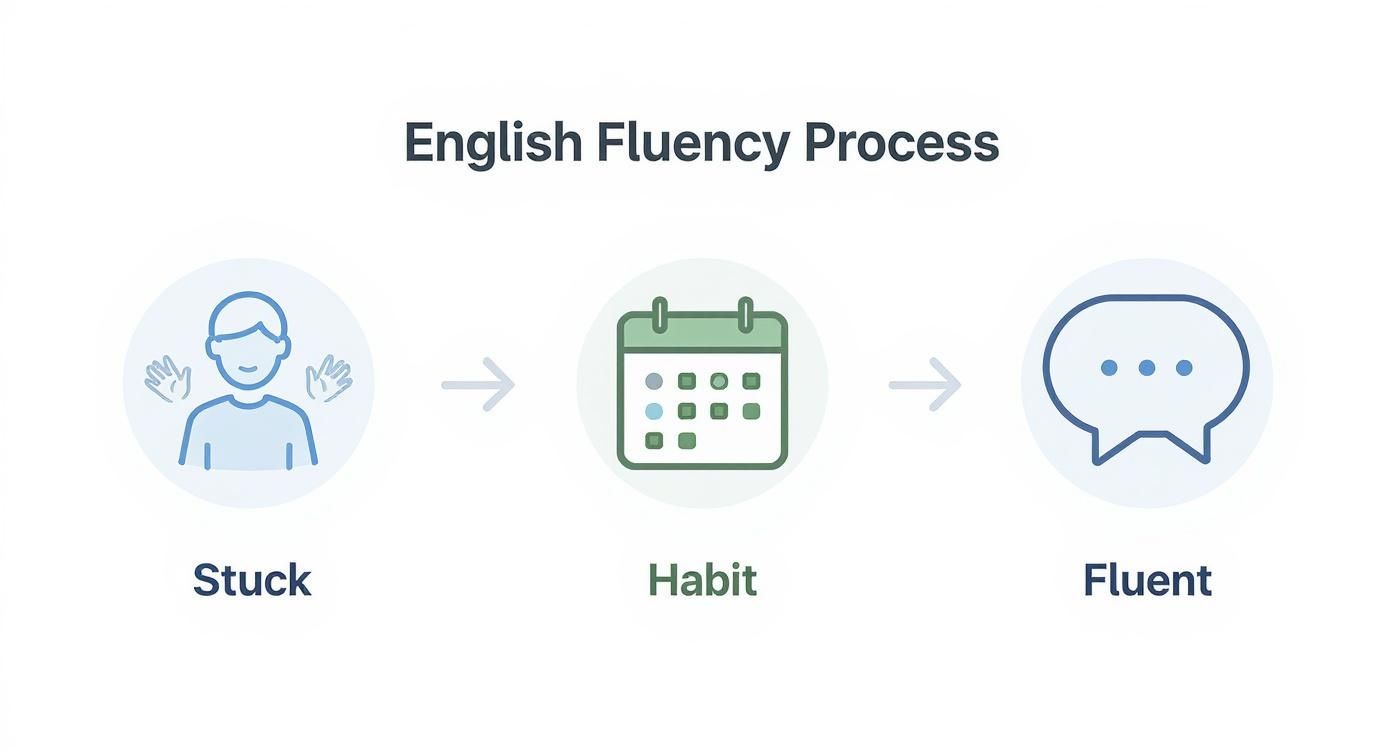
As you can see, that habit is the critical turning point. So, what does this actually look like in practice? Let's lay out a simple, powerful weekly schedule that you can start today.
Your 15-Minute Weekly Speaking Plan
This routine is designed for maximum impact by targeting a different core skill each day. Remember, the goal is just to show up for your 15 minutes. Don't worry about being perfect.
Monday: Pronunciation Drills
Today is all about warming up your speech muscles. Spend your 15 minutes on tongue twisters and sounds that you find tricky. The point isn't speed—it's clarity. You want to physically feel your mouth moving in new ways.
- Example Drill: Say "Peter Piper picked a peck of pickled peppers" five times, really focusing on that crisp "p" sound. Then, switch to "She sells seashells by the seashore," and exaggerate the "sh" and "s" sounds so you can feel the physical difference in your mouth.
Tuesday: Phrase Mastery
Fluent speakers don't think in single words; they think in chunks and phrases. Pick five common phrases for a specific situation (like ordering at a café or sharing your opinion in a meeting) and say them out loud until they roll off your tongue.
- Example Phrases: Try "Could I get a large latte, please?" or "I see your point, but have we considered...?" Repeat them over and over, playing with different intonations to make them sound natural.
Wednesday: AI Conversation
This is your chance to practice in a completely safe, judgment-free zone. Fire up a tool like TalkEasy and have a real conversation for 15 minutes. You can talk about your day, a movie you just saw, or any topic you're interested in.
The real win here isn't having a perfect conversation. It's the act of reacting and responding in real-time, building your conversational stamina without the pressure of a human listener.
Thursday: Self-Correction and Review
Grab your phone and record yourself speaking for just two minutes. You could summarize a news article you read or just talk about your weekend plans. Now, listen back and find just one or two mistakes that you tend to repeat. Maybe it's a grammar slip-up or a word you always mispronounce.
By focusing on a couple of specific errors, you make improvement feel much more manageable. If you want to go deeper on this, our guide on the best way to learn English has more advanced self-correction techniques.
Friday: Script Practice
Get ready for the real world. Think of a specific scenario you might face, like a job interview or making a dinner reservation over the phone. Spend your 15 minutes practicing the key lines you'll need to say.
- Sample Scenario (Job Interview): Practice your answer to "Tell me about yourself" out loud three times. This time, focus less on the words and more on sounding clear and confident. This kind of active rehearsal makes the real thing far less intimidating.
This structured weekly routine takes the vague idea of "practice" and turns it into a concrete action plan. It's the simplest way to build the powerful speaking habit that truly leads to fluency.
Master Real-World Conversations with Targeted Scripts
Daily speaking drills are great for building your core skills, but the real test comes when you’re thrown into a real-life conversation. That's often when the anxiety hits—the job interview, the big team meeting, or even just trying to order a coffee without fumbling over your words.
The secret to staying calm and confident in these moments is all in the prep work. Instead of just hoping for the best, you can use conversation scripts to build a solid foundation. These aren't lines you memorize like an actor. Think of them more like a conversational road map.
By practicing the general structure and key phrases ahead of time, you free up so much mental energy to actually listen and respond in the moment. You're not scrambling for words because you've already laid the groundwork.
This is a huge deal, especially now. As of 2025, an estimated 1.75 billion people are learning or using English, and with enrollment rates in some regions jumping by over 20% each year, being able to handle specific situations is a massive advantage. You can find more details on these global English learning trends on globalenglishtest.com.
Deconstructing the Job Interview Script
Let's break down a classic high-stakes scenario: the job interview. Most interviews follow a pretty predictable flow. Once you know the pattern, you can prepare for each stage and walk in with your confidence soaring.
Here’s what that flow usually looks like:
- The Opening (Small Talk): The interviewer starts with easy questions to break the ice.
- Try this: "I'm doing well, thank you. I was really looking forward to our conversation today."
- The "Tell Me About Yourself" Prompt: This is your moment to shine. Have a sharp, concise intro ready.
- Try this: "I'm a [Your Profession] with over [Number] years of experience in [Your Industry]. I specialize in [Your Key Skill], and I was drawn to this role because..."
- Behavioral Questions (STAR Method): This is where they ask for real-world examples.
- Try this: "A great example of that was when I [Situation]. The task was to [Task], so I [Action], and the result was [Result]."
- Your Questions for Them: Asking smart questions shows you’re genuinely interested.
- Try this: "Could you tell me more about the team's biggest priorities for the next quarter?" or "What does success look like for someone in this position?"
Saying these phrases out loud is key. It helps get the language off the page and into your muscle memory, so it comes out smoothly when it matters.
The goal isn't to sound like you're reading a script. It's to build a mental map of the conversation so you're never caught completely off guard. This preparation gives you the freedom to be authentic.
From the Office to a New City
This script-based approach works for just about any conversation that has a predictable pattern. Think about leading a team meeting, negotiating a contract, or just navigating a new city on vacation.
Here are a few more quick examples:
- Leading a Team Meeting: Practice phrases for setting the agenda ("Today, we're going to cover..."), keeping things on track ("Let's table that for now and circle back later"), and assigning next steps ("So, [Name] will handle...").
- Travel Conversations: Get your scripts ready for checking into a hotel ("I have a reservation under the name..."), asking for directions ("Could you tell me how to get to...?"), or ordering at a restaurant ("I'd like to try the..., please.").
The magic really happens when you move from just reading these scripts to actively practicing them. This is where an AI partner like TalkEasy comes in handy. It gives you a safe, judgment-free space to rehearse your delivery, tweak your wording, and repeat those key phrases until they feel completely natural.
This kind of active rehearsal is the bridge between knowing what to say and actually being able to say it with confidence when you're face-to-face with a real person.
Fine-Tune Your Pronunciation and Self-Correction
Knowing the right words is only half the battle. If people can’t understand what you’re saying, that vocabulary doesn’t do you much good. True fluency hinges on clear pronunciation and the ability to catch and fix your own mistakes. It's not just about what you say, but how you say it.
Forget the old-school method of drilling isolated sounds. Real clarity comes from mastering the "music" of English—the rhythm, stress, and intonation that native speakers use without even thinking about it. This is what makes your speech flow naturally instead of sounding stiff and robotic.
Embrace the Music of English
Fluent speakers don’t place equal importance on every single word. They instinctively stress the words that carry the most meaning, creating a rhythm that’s much easier for listeners to follow. Learning to hear and replicate this is a total game-changer.
Just think about the difference between "I don't think he's coming" and "I don't think he's coming." That tiny shift in emphasis completely changes the message. That's the musicality we're talking about.
A fantastic way to practice this is with shadowing. Find a short audio clip from a podcast or a movie scene. Listen to a single sentence, then immediately repeat it. Your goal isn't just to copy the words, but to mimic the speaker's exact tone, speed, and rhythm. You’re copying the music, not just the lyrics.
Of course, you also need to tackle those tricky sounds that might not exist in your native language—like the "th" in "think," the "r" in "rural," or the short "i" in "sit."
- For the 'th' sound: Lightly place the tip of your tongue between your front teeth and gently blow air. It’s a soft, hissing sound. Try practicing with phrases like "this, that, these, and those" or "thirty-three thousand thoughts."
- For the 'r' sound: The American 'r' is tricky because the tongue doesn't touch the roof of the mouth. Start by saying "eee," then slowly curl the tip of your tongue back without letting it touch anything. Drill it with words like "red," "river," and "around."
Getting the hang of these physical movements builds the muscle memory you need for clear, effortless pronunciation. For a deeper dive, you can learn more about how to refine your English accent in our detailed guide.
The Power of Self-Correction
Great speakers are often their own best coaches. You need a simple way to spot your mistakes without getting bogged down or discouraged. This is where a focused self-correction routine makes all the difference.
The goal is not to catch every single error. Honestly, that’s a quick path to frustration. Instead, just focus on one or two recurring issues at a time.
The most effective way to improve is by listening to yourself. Record a one-minute clip of yourself talking about your day. Play it back with one mission: find your most common mistake. Then, work on only that one thing for the next week.
This targeted approach creates small, manageable wins that build confidence and momentum. Maybe you notice you always forget the "s" on third-person verbs (saying "he go" instead of "he goes"). Great. For the next 7 days, that's your only focus.

This simple loop—speak, record, listen, correct—is incredibly powerful. It helps you identify and fix errors before they become permanent habits.
This is where a tool like TalkEasy can really speed things up. It’s designed to give you that crucial feedback in real-time. As you have a natural conversation with the AI, it provides instant, gentle corrections on your pronunciation and grammar. It takes the guesswork out of self-correction and turns every chat into a potent learning opportunity.
Level Up Your Fluency with an AI Speaking Partner
For so many English learners, the biggest hurdle isn't grammar rules or vocabulary lists. It's the simple, frustrating lack of people to talk to. Trying to find someone to practice with consistently can feel like a part-time job, and the fear of saying the wrong thing often keeps us silent. This is where modern tools have completely changed the game.
An AI speaking partner, like the one built into TalkEasy, smashes through these old barriers. It gives you a dedicated, infinitely patient practice tool that’s ready to go 24/7. You can rehearse a presentation, chat about your day, or practice small talk at 3 AM without worrying about waking someone up or feeling foolish. It's a completely judgment-free zone.

Why an AI Partner Often Works Better Than Traditional Methods
Finding a human language partner sounds perfect on paper, but the reality can be messy. You’re juggling time zones, dealing with people who ghost you, and often spending half the conversation teaching them your native language. Suddenly, your one-hour practice session is only 30 minutes of actual English speaking.
An AI partner, however, is designed with one single goal: helping you speak. It brings some serious advantages to the table:
- Always Available: Got a spare 15 minutes? You can practice. On your lunch break, during your commute, or late at night—it’s always ready.
- Zero Judgment: The fear of making mistakes is paralyzing. An AI doesn’t care if you stumble or forget a word. This freedom lets you experiment with new phrases and complex sentences without hesitation.
- Instant, Smart Feedback: A human partner might be too polite to correct you, or they might not even know how to explain the mistake. An AI provides immediate, gentle corrections on grammar and pronunciation, helping you fix bad habits before they stick.
This kind of focused, accessible practice is why the language learning market is exploding. It was valued at $61.5 billion** in 2023, and the English learning segment alone is projected to jump from **$16.01 billion in 2024 to an incredible $98.03 billion by 2033. This isn't just a trend; it's a reflection of the massive demand for better, more effective ways to learn. You can dig into these market statistics on EC English if you're curious.
Comparing Practice Methods: AI Partner vs. Human Partner
So, how does an AI tool truly stack up against a traditional language exchange partner? Both have their place, but it's important to understand where each one shines.
| Feature | TalkEasy AI Partner | Human Language Partner |
|---|---|---|
| Availability | 24/7, on-demand. | Limited by schedules and time zones. |
| Cost | Typically a subscription fee. | Often free, but requires you to teach your language in return. |
| Feedback Quality | Instant, consistent, and based on proven language models. | Can be inconsistent, subjective, or sometimes incorrect. |
| Conversation Focus | 100% on your English practice. | 50/50 split between your practice and theirs. |
| Judgment & Comfort | Zero judgment; a safe space to make mistakes. | Potential for shyness or fear of judgment. |
| Reliability | Always there, never cancels. | Can be unreliable or inconsistent. |
| Cultural Nuance | Can simulate scenarios but lacks genuine lived experience. | Offers authentic cultural insights and natural slang. |
While a human partner can offer real-world cultural exchange, an AI partner provides an unparalleled level of focused, efficient, and reliable practice to build your core speaking skills.
Getting The Most Out Of Your AI Partner
To really see your fluency take off, you can't just have aimless chats. You need a plan. Think of your AI partner as a personal trainer for your mouth, and use it strategically to build specific conversational muscles.
First, warm up with the basics. Use those scripted scenarios we talked about earlier—ordering coffee, checking into a hotel, or navigating a job interview. This builds a solid foundation of essential phrases in a controlled setting. Run through them until the words flow effortlessly.
Next, level up to guided discussions. Pick a topic you actually care about, like a new movie you saw or a fascinating article you read. The AI can ask you questions to keep the conversation moving, pushing you to explain your thoughts and defend your opinions. This is how you move from simple Q&A to real, nuanced communication. We have a great guide with more ideas on finding opportunities for English speaking practice online.
Finally, it’s time to go off-script with open-ended conversations. This is where true spontaneity is born. Start a chat with your AI with no plan at all. Just talk. Let the dialogue wander naturally, just as it would with a friend. This is the ultimate fluency workout, forcing you to think on your feet and pull vocabulary out of thin air.
Think of your AI partner as a personal fluency gym. The more you show up and put in the reps—moving from scripted practice to spontaneous conversation—the stronger and more automatic your speaking skills will become.
This progression—from structured to spontaneous—transforms the AI from a simple gadget into a powerful training system. It methodically prepares you for the predictable and the unpredictable, ensuring you’re ready for any conversation that comes your way.
Got Questions About English Fluency? Let's Clear Things Up.
As you get serious about speaking English fluently, you're bound to run into a few mental roadblocks. Everyone does. Let's tackle some of the most common questions I hear from learners so you can keep your momentum going.
How Long Does This Actually Take?
Look, there’s no magic number here. Anyone who tells you "you'll be fluent in X months" is selling you something. Your starting level, how different your native language is from English, and—most importantly—how consistent you are will shape your timeline.
But here’s a better way to think about it. Forget the vague, far-off goal of "fluency." It’s too big and can honestly be discouraging. Instead, focus on what you can achieve in the short term.
If you stick to the 15-minute daily speaking routine we've been talking about, you will feel a real, noticeable difference in your confidence and ability in just 3-6 months. The point isn't to cross some imaginary finish line; it's to build a sustainable habit that leads to steady, undeniable progress.
What if I'm Terrified of Making Mistakes?
This is probably the single biggest hurdle for most learners. The fear of sounding silly or getting a word wrong can be paralyzing. But silence is the enemy of progress. You can’t get better at speaking if you don’t speak.
The trick is to find a safe space to practice—a low-stakes environment where mistakes aren't just okay, they're the whole point.
Every mistake you make is just a piece of data. It tells you exactly what you need to work on next. When you see errors as signposts instead of failures, that fear starts to melt away.
This is exactly why practicing with an AI partner like TalkEasy is so effective. There’s zero judgment. You can stumble over words, try out new phrases, and get instant, private feedback without a hint of embarrassment. This builds a powerful feedback loop: you speak, get a gentle correction, and try again. That cycle builds both your skills and your courage for real-world conversations.
Can I Just Watch Movies to Become Fluent?
Watching movies and TV shows in English is fantastic for your listening skills. It’s a great way to pick up the natural rhythm, slang, and flow of the language. But it’s a passive activity.
To speak fluently, you have to be an active participant. Your brain and mouth need the physical practice of forming words and sentences. Listening alone simply won’t build the muscle memory you need to speak.
The good news is, you can turn passive screen time into active practice. Try these out:
- Shadowing: After an actor says a line, pause and repeat it. Try to match their tone, speed, and emotion exactly. You’re literally training your mouth to move like a native speaker’s.
- Quick Summaries: Watch a scene, then pause it and explain what just happened out loud, in your own words.
- Conversation Starters: Use the plot as a topic for your next practice session. Chat with an AI partner about why a character did what they did, or what you think will happen next.
If I Could Only Focus on One Thing, What Should It Be?
Grammar is important. Vocabulary is essential. Pronunciation is key. But the single skill that ties it all together and truly defines fluency is automaticity.
This is your brain’s ability to produce speech without consciously thinking about every single rule or translating from your native language. It’s what makes speaking feel natural and effortless.
And you don't develop automaticity from a textbook. You build it through one thing and one thing only: consistent speaking practice.
That’s why this entire guide circles back to a daily speaking habit. A dedicated 15-minute session where you are actively speaking—doing drills, running through scripts, or having a conversation—is infinitely more valuable than hours of passive study. It’s the repetition of producing the language that trains your brain to do it on autopilot. And that, right there, is the heart of fluency.
Ready to put all this into practice? The quickest way to build that speaking habit and get past the fear of mistakes is to have a partner who's ready whenever you are. TalkEasy offers that judgment-free zone for unlimited daily chats, giving you the real-time corrections and consistent practice you need to finally speak English with total confidence. Give it a try and start your real journey to fluency today at https://www.talk-easy.com.