
How to Order Food in English Like a Pro
Feeling nervous? Learn how to order food in English with confidence. Our guide covers essential phrases, real-world scripts, and tips for any dining situation.


Ordering food in English really just boils down to a few key phrases. The most natural and polite way to start is with "I'd like..." or "Could I have...", followed by whatever you're craving. For instance, you could say, "I'd like the chicken sandwich, please." Getting comfortable with these simple sentence starters will give you the confidence to order just about anywhere.
Your Essential Toolkit for Ordering Food in English

It’s completely normal to feel a bit nervous when ordering in a new language. A lot of learners worry about stumbling over words or not being understood. But here's the good news: you don't need a massive vocabulary to get a delicious meal.
Think of this section as your foundational toolkit. It’s packed with the essential, versatile phrases that work in almost any dining situation. We'll skip the complex grammar and focus on the practical, real-world language you'll actually use. The goal is to help you sound natural and polite, making the whole experience much smoother and way more fun.
Core Phrases for Any Situation
Whether you find yourself in a bustling cafe or a quiet sit-down restaurant, a handful of phrases will get you through the entire conversation. The number one rule? Be polite. A simple "please" and "thank you" go a long way and make all the difference.
Here are the most reliable ways to start your order:
- "I'd like..." (e.g., "I'd like the pepperoni pizza, please.") This is probably the most common and polite way to order.
- "Could I get..." (e.g., "Could I get a cheeseburger and a small coke?") This one is a little more informal but still perfectly polite and friendly.
- "I'll have..." (e.g., "I'll have the pasta special.") This sounds direct and confident—it’s great for when you’ve made up your mind.
You might notice that "I want..." isn't on the list. In English, it can sound a bit demanding or even rude in a service situation, so it's usually best to stick with the friendlier options above.
The Flow of a Typical Order
Most of the time, ordering food follows a very predictable script. The server or cashier asks questions, and you respond. Once you understand this back-and-forth rhythm, you’ll feel much more prepared. Nailing this conversational flow is a fantastic way to sharpen your speaking abilities, and for more tips, you can check out our guide at https://www.talk-easy.com/blog/improve-english-conversation-skills.
The whole process usually involves a greeting, placing your order, answering a few clarifying questions, and then paying. Since dining is just one of many social situations you'll encounter, you might also want to improve your overall conversation skills for even more confidence.
Key Takeaway: The structure of ordering food is almost always the same. By learning the sequence of questions and answers, you can anticipate what's next and respond confidently without feeling surprised or rushed.
To make this even easier, I've put together a quick reference table. It maps out the natural flow of a typical ordering conversation.
Quick Reference for Common Ordering Scenarios
This table summarizes some of the most common things you'll hear from staff and gives you simple, natural ways to respond. Practicing these little exchanges will help build your muscle memory so you can feel totally at ease.
| Situation or Staff Question | Your Polite and Natural Response |
|---|---|
| "Hi, are you ready to order?" | "Yes, I'd like the Caesar salad, please." |
| "What can I get for you?" | "Could I have a cappuccino and a croissant?" |
| "Would you like anything to drink?" | "Just a glass of water for me, thank you." |
| "For here or to go?" | "To go, please." / "For here, thanks." |
| "Will that be all for you?" | "Yes, that's everything. Thank you." |
Keep this little cheat sheet in mind, and you'll be ordering like a local in no time.
Navigating the Full Restaurant Experience

A meal at a sit-down restaurant is a whole different ballgame compared to grabbing a quick coffee. It’s really a series of small, polite conversations that get you from the front door to paying the final bill. Once you get the hang of this sequence, you'll feel incredibly confident, turning any dinner out into a relaxed, enjoyable event.
Let's break down the entire process, step by step. We'll cover everything from making a reservation and asking for a table to confidently sharing your needs and handling the payment.
Arriving and Getting Seated
Your dining experience kicks off the moment you walk through the door. If you're heading to a popular spot, it’s always a smart move to call ahead and make a reservation, especially for dinner or on the weekends.
When you call, you can keep it simple:
- "Hello, I'd like to make a reservation for two people for 7 PM tonight."
- "Could I book a table for four under the name [Your Name] for this Friday at 8?"
Walking in without a reservation? No problem. You’ll just need to chat with the host or hostess at the entrance. The conversation is usually very quick and straightforward.
When you approach the host stand, you can say:
- "A table for two, please."
- "Hi, do you have a table for three available?"
The host might ask if you have a seating preference. They could say, "Would you like a table inside or on the patio?" You can just respond with, "Inside would be great, thank you," or whatever works for you.
Understanding the Menu and Placing Your Order
Once you're settled at your table, your server will likely introduce themselves and ask if you'd like to start with some drinks. This is the perfect opportunity to ask questions if you're not sure about anything on the menu.
Don't be shy about asking for their recommendations! Servers know the menu inside and out. It not only helps you pick a fantastic dish but also builds a friendly rapport.
Pro Tip: Asking for recommendations is one of the best ways to practice your conversational skills. It shows you're engaged in the experience, and who knows—you might just discover your new favorite meal.
Here are a few handy phrases for this part of the meal:
- To order drinks: "I'll start with an iced tea, please."
- To ask for a recommendation: "What's the chef's special tonight?" or "What would you recommend?"
- To ask for more time: "We just need another minute, please."
When the server comes back, they'll ask, "Are you ready to order?" This is your cue. Use those polite phrases we've talked about, like "I'd like..." or "I'll have..." to state your choice clearly.
Communicating Special Needs or Preferences
Plenty of people have dietary restrictions, allergies, or just personal preferences. The key is to communicate these clearly for a safe and enjoyable meal. Don't ever worry about being "difficult"—restaurants handle these requests all the time.
Just state what you need simply and directly. For instance:
- For an allergy: "I have a serious gluten allergy. Is this dish safe for me?"
- For a customization: "Could I have the burger with no onions, please?"
- For a preference: "Is it possible to get the dressing on the side?"
Being direct and polite ensures the kitchen staff gets your request right the first time. It also helps to listen closely to the server's reply to confirm they've understood you. For more on this, check out our tips on how to improve English listening skills to better catch those important details.
During the Meal and Paying the Bill
After your food arrives, a good server will usually circle back once to make sure everything is okay. They might ask, "How is everything tasting?" A simple "It's delicious, thank you!" is the perfect response.
If you need something during your meal, like more water or some salt, just try to make eye contact with your server. When they're nearby, a polite "Excuse me," is all you need to get their attention. Then you can make your request: "Could we have some more water, please?"
When you’ve finished eating, the server typically won't bring the bill until you ask for it. This is a cultural norm in many English-speaking countries, as they don’t want to make you feel rushed.
Here’s how to ask for the bill (or "check" in the US):
- "Could we have the bill, please?"
- "Excuse me, we're ready for the check when you have a moment."
Once the bill arrives, look it over and place your cash or card in the folder. In many countries, like the US and Canada, tipping is customary. A tip of 15-20% is standard for good service at a sit-down restaurant. Some bills might already include a "service charge," which is the tip, so always check first. With that, you're ready to handle the entire experience with grace.
Ordering with Confidence at Cafes and Fast Food Spots
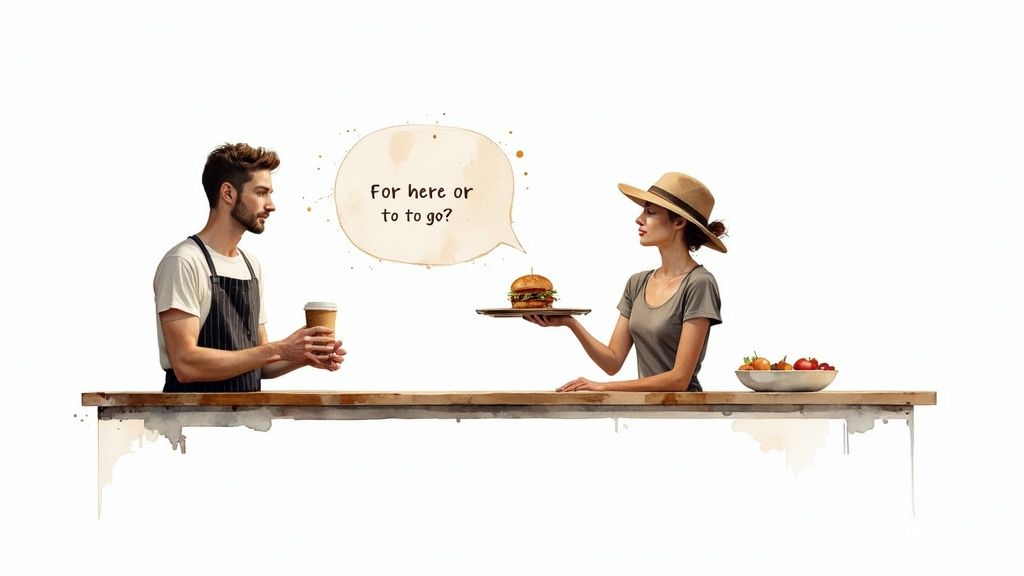
Unlike the relaxed vibe of a sit-down restaurant, cafes and fast-food joints are all about moving quickly. The way people talk is faster and more to the point, which can be a little jarring if you're not used to it. The trick is to walk in already knowing the specific words and phrases they use.
Once you get the hang of it, grabbing your morning coffee or a quick lunch becomes second nature. It’s all about anticipating the flow of the conversation and having your answers ready.
Mastering the Coffee Shop Order
Let's be honest, ordering coffee can feel like learning a new language. With all the options for size, milk, flavor, and temperature, it's easy to get flustered. But there's a simple formula that always works: start with the size, then the drink, and finish with any special requests.
Here's how that looks in the real world:
- "Could I get a large iced latte with almond milk, please?"
- "I'll have a medium black coffee."
- "Can I get a small cappuccino with an extra shot?"
The barista will probably repeat it back and ask for your name to call out when it's done. Knowing the basic structure helps a ton, especially when you're faced with unfamiliar options, like when you're decoding a Bangkok cafe menu.
Customizing Your Fast Food Meal
Fast-food counters have the same goal as cafes: be clear and be quick. People customize their orders all the time, so you should never feel shy about asking for exactly what you want. The magic phrases are often as simple as "no..." or "with extra...".
Check out these common examples:
- "I'd like the cheeseburger combo, but with no pickles, please."
- "Could I have the chicken sandwich with extra mayo?"
- "I'll get the number three, but can I swap the fries for a salad?"
Being direct but polite gets your order made right without holding up the line.
Crucial Tip: Always listen for the final read-back. Before you pay, the cashier will almost always repeat your order ("Okay, so that's one cheeseburger combo, no pickles..."). This is your golden opportunity to catch any misunderstandings before your food is even made.
Answering Common Counter Questions
In these fast-paced spots, the staff will fire off a few standard questions to get your order finalized. Knowing what’s coming makes the whole exchange smooth and stress-free.
Be ready for these classics:
- "For here or to go?" (Sometimes "To stay or to go?")
This just means "Are you eating in or taking it out?"
Your answer: "To go, please" or "For here, thanks." - "Would you like to make that a combo/meal?"
They're upselling you on a drink and a side (usually fries) for a bundled price.
Your answer: "Yes, please" or "No, just the sandwich is fine." - "Anything else for you today?"
This is the final check to see if you're done ordering.
Your answer: "No, that's everything" or "Yes, I'd also like a bottle of water."
Handling a Mistake with Your Order
It happens. When things are busy, orders can get mixed up. If you get the wrong thing or something's missing, just stay calm and be polite. Walk back up to the counter and catch an employee's eye.
A polite opening followed by a clear statement of the problem works best.
- "Excuse me, I think there was a mistake. I ordered a diet soda, but this is regular."
- "Hi, I'm sorry to bother you, but I was missing the fries from my order."
- "Excuse me, I asked for no onions, but there are onions on my burger."
Nine times out of ten, they'll apologize and fix it right away. A friendly approach is always the fastest way to solve the problem and get on with your meal.
Mastering Takeout and Delivery in English

Let's be honest, few things beat the convenience of having your favorite food show up at your front door. Ordering takeout or delivery has become just as common as dining in a restaurant, thanks in large part to the boom in food delivery apps.
This section is all about getting you comfortable with both old-school phone orders and modern app-based ordering. We'll break down everything you need to know to get your meal from the kitchen to your couch without a hitch.
How to Order Food Over the Phone
Calling a restaurant directly can feel a bit more pressure-packed since you can't just point at what you want. The good news? These calls almost always follow the same script. Knowing the basic flow before you even dial makes the whole process feel much less intimidating.
You'll want to start by stating your purpose clearly and politely. A simple, "Hello, I'd like to place an order for pickup/delivery, please" is the perfect way to kick things off. It immediately lets the person on the other end know exactly what you need.
From there, just follow their lead. They'll ask for your order, your name, and your address if it's for delivery. My biggest tip here is to speak slowly and clearly, especially when you're giving your address or phone number. It saves everyone from potential mix-ups.
Here’s a quick look at how that conversation usually goes:
You: "Hi, I’d like to place an order for delivery."
Restaurant: "Sure, what can I get for you?"
You: "I'd like one large pepperoni pizza and a small garden salad with ranch dressing."
Restaurant: "Okay. And what's the address for delivery?"
You: "[Your Street Address], [Your City]."
Restaurant: "And a name for the order?"
You: "It's for [Your Name]."
Restaurant: "Alright, your total is $24.50, and it should be there in about 45 minutes."
You: "Great, thank you so much!"
See? It's a straightforward exchange that covers all the bases.
Navigating Food Delivery Apps
Apps like DoorDash and UberEats have their own language. While they make ordering incredibly easy, some of the terms can be a little confusing if you haven't seen them before.
The most important part is getting your order just right. Look for sections labeled "Add-ons," "Special Instructions," or "Customizations." This is your chance to make specific requests, like "no onions" or "extra cheese."
This digital-first approach is hugely popular with younger crowds. In fact, studies show that in countries like the US, Canada, and Australia, a whopping 74% of Gen Z and over 60% of Millennials have used delivery apps to order trendy dishes they saw online. This makes knowing how to navigate these English-based apps—using phrases like ‘Could I get the spicy chicken wings?’ or finding the ‘vegetarian options’ filter—an essential skill. You can read more about the impact of these trends on the restaurant industry.
Let's break down some of the most common terms you'll run into.
Key Terms on Delivery Platforms
Getting familiar with this vocabulary will make ordering through an app a total breeze.
- Estimated Delivery Time: This is the app's best guess for when your food will arrive.
- Delivery Fee: This is what you pay the platform for the convenience of the delivery service.
- Service Fee: An additional fee the app charges for connecting you with the restaurant and driver.
- Minimum Order: Some places won't deliver unless you spend a certain amount of money.
- Checkout: The final screen where you confirm everything, add your payment info, and place the order.
- Track Order: A super useful feature that shows you your driver's location on a map in real-time.
Knowing what these terms mean helps you understand exactly what you're paying for and when to expect your food, so there are no surprises.
One last piece of advice: always give your cart a final once-over before you hit that order button. A quick check of the items, quantities, and any special notes you added can save you from a disappointing meal.
Sounding Natural and Polite When You Order
Knowing the right words is a great start, but it's only half the battle. When you’re ordering food in English, how you say things can be just as important as what you say. The small details in your tone and word choice can make the difference between a simple transaction and a genuinely friendly exchange.
Think about it this way: saying "I want a coffee" certainly gets the message across, but it can come off as a bit blunt or even demanding. Just a tiny tweak to "I'd like a coffee, please" or "Could I get a coffee, please?" sounds much more natural and polite. These little shifts are the secret to sounding like a native speaker and making every interaction go smoothly.
The Real Power of Polite Language
In most English-speaking cultures, a little politeness is baked right into everyday service interactions. Using words like 'could,' 'would,' and 'can' is a simple trick to soften your requests, turning them from commands into polite questions. And, of course, "please" and "thank you" are absolutely essential—they're the foundation of any courteous conversation.
Key Takeaway: This isn't just about being "nice." It’s about using language that shows respect. Phrases like "I would like..." frame your order as a request, not a demand, which is a big deal in any customer service setting.
This focus on polite phrasing has become even more important as so much of our ordering has moved online. The global online food delivery market is already huge, valued at around USD 288.84 billion, and it's expected to rocket to USD 505.50 billion by 2030. With millions of people using English-based apps every single day, mastering standard polite phrases like ‘I would like to order’ is key for clear, effective communication.
Mind the Gap: American vs. British English
One common hurdle for learners is the difference in vocabulary between American and British English. Don't worry, people will almost always figure out what you mean, but using the local terminology will help you blend in and avoid any minor confusion.
Here’s a quick rundown of some common food words you'll encounter:
| American English | British English | Meaning |
|---|---|---|
| Fries | Chips | Thin, deep-fried potatoes (what you get with a burger). |
| Chips | Crisps | The thin, crunchy potato snacks that come in a bag. |
| Check | Bill | The piece of paper that shows what you owe. |
| Appetizer | Starter | A small dish you eat before the main course. |
| Takeout | Takeaway | Food you order at a restaurant to eat somewhere else. |
Keeping these differences in mind can save you a moment of hesitation when you're looking at a menu or getting ready to pay.
It's Not Just What You Say
Your body language can speak volumes, too. When you’re ordering in person, making brief eye contact with the server or cashier shows that you're engaged and respectful. A quick, friendly smile also does wonders for creating a positive vibe.
You don't need to stare, but simply looking at the person you're speaking to signals confidence and politeness. It shows that you see them as a person, not just a part of the transaction.
What About Pronunciation?
Don't let tricky food names intimidate you! No one is expecting perfection, but practicing a little can give you a huge confidence boost. We all know words like croissant (kwa-son), espresso (es-press-oh), and focaccia (fo-kah-cha) can be a mouthful.
If you find yourself unsure, here are a few simple tricks:
- Listen First: Pay attention to how the staff or other customers pronounce things. It's the easiest way to learn.
- Just Point: If you're really stuck, it's completely fine to point at the menu and say, "I'd like this one, please."
- Practice at Home: Use online dictionaries or YouTube to hear the correct pronunciation of new words before you even leave the house.
How you pronounce words and phrases is a huge part of your accent. If you’re looking to get more comfortable and confident with your speech, you might find our guide on how to learn an English accent that feels natural really helpful. When you combine polite phrases, cultural awareness, and clear pronunciation, you won’t just get the food you want—you’ll have a much better experience doing it.
Got a Question? Let’s Troubleshoot Common Ordering Scenarios
Even when you've memorized all the key phrases, real-life situations can throw you a curveball. It’s completely normal to have a few lingering worries. But knowing how to navigate these tricky moments is what really builds confidence.
Think of this section as your cheat sheet for handling those "what if?" moments that pop up when you’re out to eat.
What If I Don’t Understand the Waiter or Cashier?
First off, don't panic. This happens to everyone, even native speakers. Restaurants get noisy, people have accents, and sometimes they just talk too fast. The most important thing is to remember that asking someone to repeat themselves is not rude—it's just part of a normal conversation.
Politeness is your best friend here. A simple, friendly phrase is all you need:
- "Sorry, could you repeat that, please?"
- "I didn't quite catch that. Could you say it again?"
- "Could you speak a little more slowly, please?"
Most servers and cashiers are happy to help. And if you're really stuck on a specific word or menu item, just point! The goal is to get your order right, and asking for a little help is always better than nodding along and ending up with something you didn't want.
How to Mention a Food Allergy or Special Request
This is a big one, and it's incredibly important to get it right for your health and your enjoyment of the meal. The good news? Restaurants deal with these requests all the time, so you never have to feel like you’re being a bother.
The key is to state your needs clearly and politely right at the beginning of your order. That way, the message gets to the kitchen immediately.
Crucial Safety Tip: If you have a serious allergy, it's always smart to double-check that your message got through. A quick follow-up like, "I just want to confirm the kitchen is aware of the severe nut allergy," adds an essential layer of safety and peace of mind.
Here are a few ways to phrase it:
- For an allergy: "I have a serious nut allergy. Is this dish completely nut-free?"
- For a dietary need: "Do you have any gluten-free options available?"
- For a preference: "Could I get the salad without onions, please?"
How Should I Handle Tipping?
Ah, tipping. This is probably one of the most confusing parts of dining in a new country because the "rules" are so different everywhere you go.
In the United States, for example, a tip of 15-20% of the bill (before tax) is the standard for service at a sit-down restaurant. It’s not just a bonus; it’s a major part of how servers earn their living.
But hop over to the United Kingdom or Australia, and the culture is completely different. Tipping is much less common and is usually seen as a reward for truly excellent service—maybe around 10%, but not an obligation. For fast-food places or coffee shops, tipping generally isn't expected, though you might see a jar by the register for your spare change.
One last tip: always check your bill for a "service charge" or "gratuity." Some restaurants add this automatically, especially for larger groups. If you're not sure, it's totally fine to ask, "Is a service charge already included in the bill?"
Keep building your English
TalkEasy is finding the right next step for your current learning status.