
How to Pronounce Business Confidently
Struggling with how to pronounce business? This guide breaks down the two-syllable sound with expert tips and audio examples to help you sound professional.


Let's break down how to pronounce "business" so you can say it with confidence every time. The most common mistake people make is pronouncing it with three syllables, like "bus-i-ness." The secret is to drop that middle 'i' entirely.
Think of it as a two-syllable word: BIZ-niss.
The stress falls squarely on that first syllable, BIZ. You'll want to use the short 'i' sound, the same one you hear in words like 'sit' or 'win'. The second part, 'niss', is much softer and quicker.
Why Mastering This One Word Matters
Getting "business" right isn't just a small fix—it’s a powerful signal of your English proficiency and attention to detail. Whether you're in a high-stakes meeting, giving a presentation, or just networking, nailing this fundamental word helps you sound more natural and authoritative. It's one of those words that, when said correctly, just makes everything else you say sound more fluent.
The spelling is what trips most people up. We see that 'i' in the middle and feel like we have to say it, but English pronunciation is full of these little traps. It’s a lot like other words where a vowel gets dropped. A perfect example is the word 'building'—another tricky one for learners. If you've been working on that, you'll see the same principle applies here. You can find a similar breakdown in our guide on how to pronounce building.
The Global Impact of Clear Pronunciation
In a world where English is the language of trade and commerce, clear communication is everything. It's not just about being understood; it's about being taken seriously. In fact, one industry analysis revealed that 85% of employees believe English will continue to dominate international business. With over 1.1 billion people speaking it at a useful level, a polished accent gives you a real competitive edge. You can dig deeper into these trends by exploring the global language learning market insights from Fortune Business Insights.
In a professional setting, clarity builds trust. When you pronounce core vocabulary like 'business' with confidence, your listeners focus on your message, not your delivery. It’s a small change that makes a big impact on how you are perceived.
For those of us who are visual learners, seeing the phonetic breakdown can make things click.
This guide shows the International Phonetic Alphabet (IPA) spelling, which confirms the two-syllable structure: /ˈbɪz.nəs/. That little symbol (') before the 'b' tells you the first syllable is stressed. Burning this BIZ-niss pattern into your memory is the first real step to getting it right every time.
A Physical Guide to Pronouncing 'Business'
Let's move past the abstract symbols and get physical. Think of pronunciation as muscle memory for your mouth. To really nail the pronunciation of 'business,' you have to feel the sounds, not just intellectualize them.
The real action happens in that first syllable: BIZ. This is where you put the emphasis. Your tongue should be high and forward in your mouth, but keep it relaxed. It’s the same short, sharp /ɪ/ vowel sound you hear in words like "sit" or "win." A very common mistake is to stretch this sound out into an /iː/ (like in "seat"), which makes your mouth tense up.
The First Syllable: BIZ
Here’s a quick exercise to get it right. Say the word "sit" out loud. Now, hold that vowel sound and notice exactly where your tongue is. That's the exact position you want for the first part of "business." It should feel identical.
- Jaw Position: Keep your jaw relaxed and slightly open. No clenching!
- Tongue Placement: The front of your tongue is high, sitting just behind your top front teeth without actually touching them.
- Lip Shape: Your lips should be neutral—not pulled back into a wide smile or rounded into an 'o'.
The Second Syllable: NISS
Now for the second, unstressed syllable: -niss. The secret here is the schwa sound (/ə/), which is the most common vowel in English for a reason—it's incredibly lazy. It's that neutral "uh" sound you hear in the 'a' of "about" or the 'o' of "computer." Your mouth should barely move to make it.
This is how those two distinct sounds flow together.
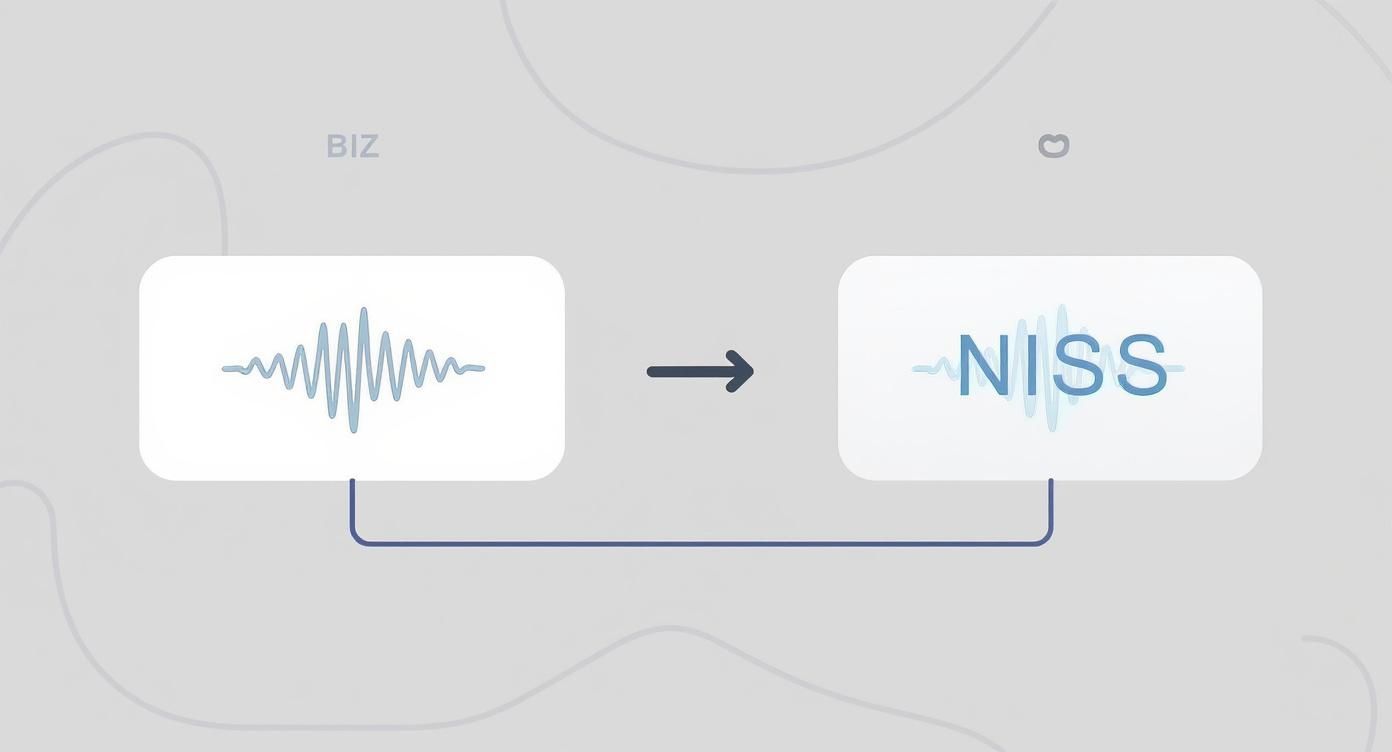
The image breaks down how the strong, stressed 'BIZ' gives way to the soft, unstressed 'NISS,' visually reinforcing that essential two-syllable rhythm. Getting this rhythm right is what makes your speech sound natural.
The key is to release all tension for that second syllable. Your tongue, jaw, and lips should do almost nothing. It’s just a quick, soft sound that tumbles right off the end of the first one.
This hands-on, physical approach is a cornerstone of accent training. By connecting the physical feeling of a sound with its pronunciation, you start building the muscle memory that leads to confident, automatic speech. For a deeper dive into these techniques, check out our complete guide on how to improve your English accent.
The Professional Impact of Clear Pronunciation
In any high-stakes professional setting, the small details often say the most about your competence. So, why put so much focus on a single word like 'business'? Because fumbling a core term, even slightly, can make your listener pause for just a moment.
That tiny bit of friction is enough to disrupt the flow. It can subtly undermine your authority during a tense negotiation, a big sales pitch, or that all-important job interview. When you speak with clarity, you eliminate those little distractions and let your ideas and expertise command the room. It’s less about sounding perfect and more about making sure your message is heard, loud and clear.
How Clear Speech Builds Credibility
Think about it: clear, confident pronunciation is a cornerstone of credibility. When you articulate key industry terms correctly, you send a powerful non-verbal signal that you belong there, that you’re comfortable and prepared.
That kind of self-assurance is contagious. When you sound like you know what you’re talking about, people are much more inclined to trust you and your message. This is especially true in international business, where crisp communication is the bedrock of every successful partnership.
The global demand for these skills is undeniable. The market for business English language training is projected to expand by a massive USD 4.90 billion in the near future. This isn't just a random trend; it's driven by professionals worldwide who recognize that clear communication is the key to unlocking cross-cultural success. You can see more data on this trend in Technavio's report on the rising demand for professional English training.
Mastering pronunciation frees up your mental energy. Instead of worrying about your delivery, you can focus entirely on your message, allowing your true expertise to shine through without any barriers.
Common Pronunciation Mistakes (And How to Fix Them)
English pronunciation has its share of quirks, and "business" is a classic example of a word that trips people up. It looks one way on paper but sounds completely different when spoken. Getting it right is a huge confidence booster, especially in professional settings. Let's break down the most common mistakes I see students make so you can avoid them.
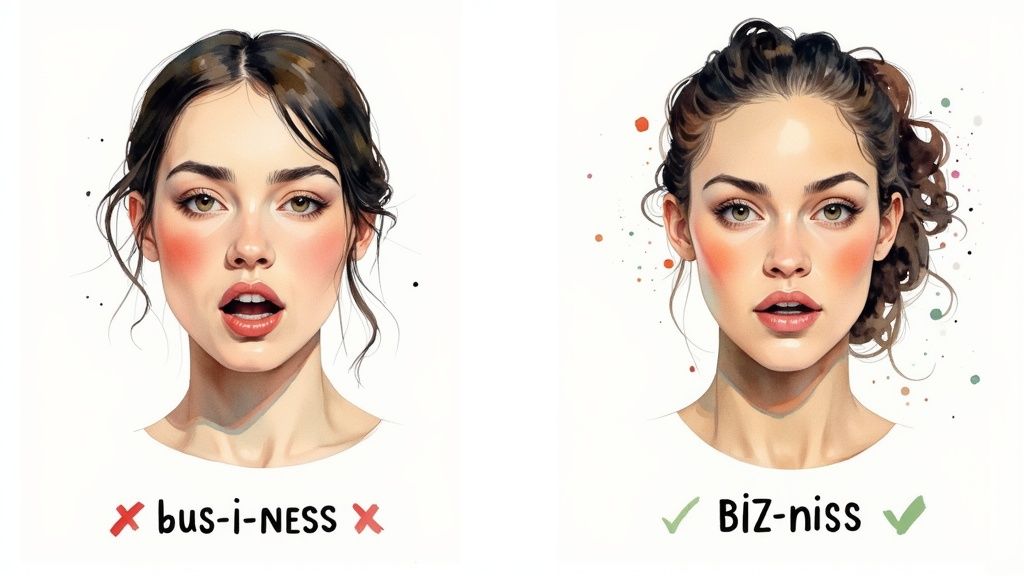
Honestly, this one word is such a frequent hurdle that it's a staple in pronunciation coaching. With a huge portion of English conversations today happening between non-native speakers, being clear and correct is more important than ever. It’s no surprise the global English language learning market is massive and continues to expand each year. You can see just how fast it's growing by checking out this report on the English learning industry from Meticulous Research.
The Three-Syllable Trap
The number one mistake, hands down, is pronouncing that silent 'i' in the middle. Our brains are wired to say what we see, so we instinctively want to turn "business" into three syllables: "bus-i-ness."
- The Mistake: Saying "bus-i-ness" or "bus-ee-ness."
- The Fix: This is all about muscle memory. Force yourself to skip that middle 'i'. It’s a two-part word: BIZ and niss. Say it out loud right now: "BIZ-niss." Do it five times, making it quick and smooth.
The Wrong Vowel Sound
Another common slip-up is the vowel sound in the first syllable. Many learners reach for a long /iː/ sound, like the 'ee' in "see," making it sound like "beez-ness."
- The Mistake: Saying "beez-ness" when it should be "biz-ness."
- The Fix: The sound you're aiming for is the short, relaxed /ɪ/, like the 'i' in "sit." Try saying these pairs: "seat, sit," then "beat, bit." Notice how the second word in each pair is quicker and more relaxed? Apply that exact feeling to "business."
Here’s a little mental shortcut I give my students: just think of the word "is" with a 'b' sound at the front. Put them together and you get "biz." That usually clicks right away.
The Buzzing 'S' at the End
Finally, let's look at the very last sound. The word should end with a crisp, soft /s/ sound, just like the one in "snake." A lot of people accidentally use a vibrating /z/ sound, like in "zoo."
- The Mistake: Letting the word end with a buzz, like "biz-nizz."
- The Fix: To get a feel for the right sound, hold that final 's' for an extra second: "biz-nissssss." This helps you concentrate on making that clean hissing sound instead of letting your vocal cords vibrate.
Putting It All into Practice: Using 'Business' in Real Scenarios

Knowing the mechanics of how to say a word is one thing, but actually using it confidently in a real conversation is another challenge entirely. The real goal is to get to a point where saying BIZ-niss feels completely automatic, without having to stop and think about where your tongue should be.
The best way I've found to build this "muscle memory" is to practice the word in the context of full sentences. This helps move the word from being just an isolated sound you're working on to a natural, integrated part of your professional vocabulary.
Contextual Practice Sentences
To get you started, I've put together a few common sentences you might hear or use in a professional setting. The idea is to say them out loud and focus on making the word 'business' flow smoothly with the rest of the sentence.
Here is a table of practical sentences you can use. Try reading each one aloud a few times.
| Scenario | Example Sentence |
|---|---|
| Starting a Meeting | "Okay everyone, let's get down to business." |
| Inquiring About Performance | "How's business been for you this quarter?" |
| Discussing a Colleague's Skills | "She has a real talent for business development." |
| Emphasizing a Point | "This isn't personal; it's strictly business." |
| Explaining a Company's Role | "We are in the business of providing solutions." |
Repeating phrases like these does more than just help you with the word itself; it gets you comfortable with the natural rhythm and intonation of professional English. If you're looking for more strategies to build this skill, our guide on how to practice English speaking has some fantastic daily exercises.
How to Practice Without Pressure
For many language learners, the biggest hurdle is the fear of making a mistake in front of another person. It's completely normal, but it can stop you from getting the practice you need. This is where a bit of technology can be a game-changer, giving you a safe space to get it wrong until you get it right.
Practicing with a conversational partner, especially an AI one, creates a judgment-free zone. You can repeat phrases as many times as you want, play with your tone, and get instant feedback without any of the anxiety.
Turning this theory into a solid habit comes down to consistent, interactive practice. Engaging with an AI tool like TalkEasy can transform this guide from a passive reading exercise into an active workshop. You can jump into simulated business conversations, receive immediate corrections on your pronunciation, and really solidify what you've learned in a supportive, practical way.
Common Questions About Pronouncing 'Business'
Let's clear up some of the most common sticking points people have with this word. Getting these details right will make a huge difference in how natural you sound.
Wait, Is It Really Just Two Syllables?
Yes, absolutely. Despite how it's spelled, 'business' is pronounced with just two syllables in standard English: BIZ-niss. That "i" in the middle? It’s completely silent.
Thinking of it as a three-syllable word ("bus-i-ness") is easily the most common pitfall for learners. The biggest leap you can make is to just drop that middle sound entirely. Once you do that, you're 90% of the way there.
How Different Is the American vs. British Pronunciation?
Honestly, the difference is so subtle that it’s not worth stressing over, especially when you're just trying to get comfortable with the word. No matter which accent you use, both American and British speakers will understand you perfectly. The core pronunciation—two syllables, with the stress falling on the first—is identical.
The tiny difference you might hear is in the vowel of the second syllable.
- American English tends to use a soft "uh" sound, the schwa (/nəs/).
- British English sometimes leans toward a short 'i' sound (/nɪs/), like the 'i' in "sit."
Again, this is a very fine point. Just focus on nailing the two-syllable rhythm.
How Can I Practice Without Feeling Self-Conscious?
This is a big one. The fear of making a mistake in front of someone can really hold you back. Luckily, technology offers a private, judgment-free zone to build your confidence.
An AI conversation partner is like a patient tutor that's available 24/7. You get to practice as much as you want and receive instant feedback, all without the pressure you'd feel in a live conversation.
Another fantastic technique you can do on your own is to record yourself on your phone. Try saying a few of the example sentences from this guide, then immediately listen to a recording of a native speaker saying the same thing. This kind of direct comparison is an incredibly powerful way to train your ear and adjust your own pronunciation.
Ready to put all this theory into practice? With TalkEasy, you can use the word "business" and thousands of others in conversations that feel real. Get immediate feedback in a supportive space and start speaking with more confidence today. Give it a try at https://www.talk-easy.com.