
How to Speak English Confidently
Learn how to speak English confidently with proven daily habits, real-world practice scenarios, and powerful mindset shifts to finally achieve fluency.


If you want to speak English confidently, the first step isn't memorizing more grammar rules. It's changing your entire approach. You need to shift your focus from perfection to connection and commit to a daily practice routine that actually works.
Confidence isn't some magical personality trait. It’s a skill you build, one small, targeted action at a time. This means practicing how words actually sound and learning phrases people use in real conversations—not just isolated vocabulary. This approach turns that nervous energy you feel into fuel for real progress.
The Real Foundation of Speaking Confidence
Looking at the goal of speaking English fluently can feel overwhelming, like staring up at a huge mountain. It's easy to assume that confident speakers just got lucky—born with a natural talent or a super outgoing personality. But the truth is much simpler and, frankly, more encouraging: confidence isn't something you have, it's something you build.
The whole process starts with a major mindset shift. So many learners get stuck in a nasty cycle of fear. They worry constantly about making a mistake, blanking on a word, or sounding "wrong" because of their accent. This "perfection-first" thinking is the single biggest roadblock to fluency because it keeps you from opening your mouth in the first place. When you're more concerned with perfect grammar than just getting your point across, you miss the entire purpose of language—to connect with another person.
Adopting a Communication-First Approach
The alternative? A "communication-first" mindset. With this approach, your main goal is incredibly simple: to be understood. Did the other person get your message? Yes? Then you succeeded. This simple shift frees you from the crushing pressure of being perfect and gives you permission to take risks, which is the only way you truly learn.
Think about it like learning to ride a bike. You wouldn't expect to hop on and pedal away perfectly on the first try. You’d wobble, maybe even fall a few times, but you'd get back on. Every attempt, successful or not, teaches you something. Speaking English is exactly the same. Every conversation, even the slightly awkward ones, strengthens your fluency muscles.
This isn't just a nice idea; it's backed by data. Across the globe, speaking is consistently the weakest skill for English learners. A major study that looked at 2.2 million adults found that speaking skills lag far behind reading and listening in more than half the countries they measured. This tells us one thing loud and clear: you can’t get confident by just listening and reading. You have to actively practice speaking. You can see all the data for yourself in the full EF English Proficiency Index report here.
Your Confidence Toolkit
Building real, lasting confidence takes more than just thinking positive thoughts. You need a practical toolkit filled with mental adjustments and achievable goals. It all starts with recognizing that your struggles are completely normal. Performance anxiety and the fear of being judged aren't signs you're failing—they're signs you're pushing yourself to grow.
Here’s what every good confidence toolkit should have:
- Set Tiny, Realistic Goals: Forget "become fluent." Aim to have one simple, two-minute conversation today. Small, achievable wins are what build unstoppable momentum.
- Celebrate the Small Wins: Did you successfully order a coffee in English? Understand a joke in a movie? You have to acknowledge and celebrate these moments. They matter.
- Reframe "Mistakes" as "Data": Every time you stumble over a word or use the wrong tense, you're getting valuable information about what you need to work on. It's not a failure; it’s a signpost pointing you toward improvement.
The two mindsets—perfection-first vs. confidence-first—create drastically different learning experiences. One leads to silence and frustration, while the other leads to connection and fluency.
Here’s a quick breakdown of how they compare:
The Confidence-First vs Perfection-First Mindset
| Focus Area | Perfection-First Mindset (Leads to Hesitation) | Confidence-First Mindset (Leads to Fluency) |
|---|---|---|
| Primary Goal | Avoid making any mistakes. Sound flawless. | Be understood. Connect with the other person. |
| View of Mistakes | Mistakes are failures and proof of inadequacy. | Mistakes are learning opportunities and data for improvement. |
| Speaking Behavior | Waits until 100% sure before speaking; often stays silent. | Speaks even when uncertain; embraces imperfection. |
| Source of Anxiety | Fear of judgment and not meeting an impossible standard. | Excitement to practice and test new skills. |
| Measure of Success | Perfect grammar and pronunciation. | Successful communication (the message was received). |
| Long-Term Outcome | Slow progress, high anxiety, and frequent burnout. | Rapid improvement, increased confidence, and enjoyment. |
Choosing the confidence-first path isn’t about being sloppy or ignoring grammar forever. It’s about prioritizing what matters right now: building the courage and habit of speaking.
The secret to lasting confidence isn't some single, dramatic breakthrough. It's the combined power of hundreds of small, brave decisions to speak, even when you're not totally sure you'll get it right.
Ultimately, your journey to speak English with confidence is less about cramming vocabulary lists and more about building a new relationship with the language itself—one based on curiosity, resilience, and a genuine desire to connect. The small, daily habits we’re about to cover are the true engine that will drive your long-term success.
Your 15-Minute Daily Speaking Workout
Forget those long, grueling study sessions that only lead to burnout. When it comes to learning how to speak English confidently, the real secret is consistency. A short, focused practice every single day builds powerful habits that compound over time, genuinely transforming your ability to speak without the grind.
This simple but effective 15-minute daily workout is designed to do just that. It’s split into three distinct five-minute drills that hit different, crucial aspects of spoken English. The best part? You can do them anywhere, anytime, turning those idle moments into truly productive practice.
The path from a hesitant mindset to confident fluency is paved with this kind of daily effort.
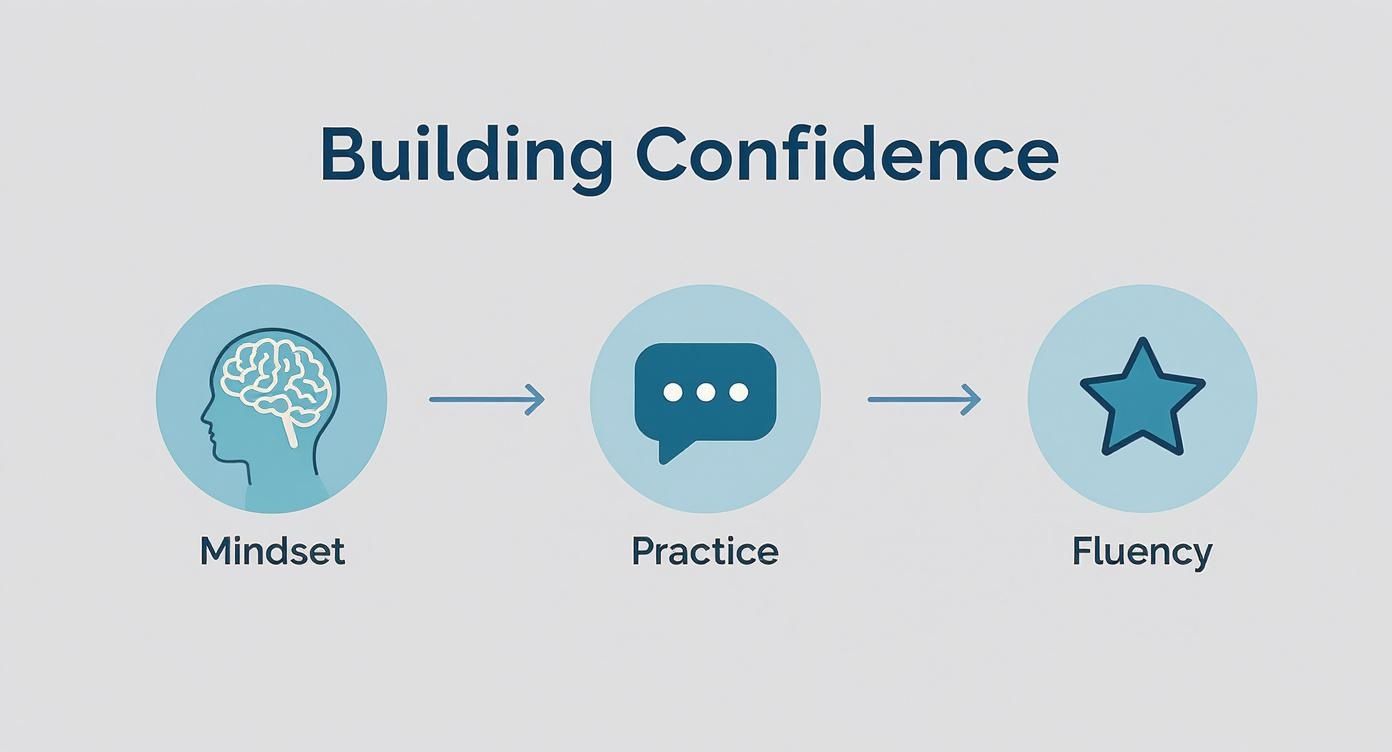
As you can see, it all starts with practice. Let's break down exactly what those 15 minutes look like.
Drill 1: Find Your Rhythm with Shadowing (5 Minutes)
First up is shadowing. This technique is incredible for mastering the natural music of English—the rhythm, intonation, and stress patterns that make you sound less like you're reading from a textbook and more like a native speaker. It’s less about understanding every single word and more about feeling the flow of the language.
Here’s how you do it:
- Find a short audio clip (1-2 minutes long). A podcast snippet, a quick YouTube video, or a news report works perfectly.
- Listen to it once just to get a feel for the speaker's pace and tone.
- Play it again and speak along with the speaker. Try to match their words, speed, and intonation exactly, like you're their shadow. Don't sweat it if you stumble; the key is to just keep going.
This exercise is like physical training for your mouth. You're building muscle memory, which is what allows you to speak smoothly without getting stuck overthinking every sound.
Drill 2: Start Thinking Directly in English (5 Minutes)
Next, we tackle a bad habit head-on: translating in your head. This is what causes those awkward, long pauses in conversation. The "Think Aloud" technique trains your brain to skip the translation step and form thoughts directly in English.
It's surprisingly simple: just narrate your own actions out loud as you do them.
- Making coffee? "Okay, I'm opening the cupboard now. Grabbing my favorite mug. Now, where's the coffee... ah, in the pantry."
- Getting dressed? "I think I'll wear the blue shirt today. That looks good with these pants. Right, where are my socks?"
It definitely feels a bit strange at first, but this little habit is a game-changer. It bridges the gap between knowing words and using them spontaneously, turning your brain into an English-speaking environment.
By narrating your daily life in English, you're not just practicing vocabulary. You're rewiring your brain to operate in the language, which is the foundation of true fluency.
Drill 3: Practice Speaking Off-the-Cuff (5 Minutes)
The final five minutes are all about building your ability to speak spontaneously with one-minute speeches. This drill trains you to organize your thoughts quickly and speak coherently on any topic without preparation—a core skill for any real-world conversation.
Here’s the plan:
- Pick a random topic. Use a random topic generator online or just look around the room for inspiration. Anything works, from "my favorite food" to "the benefits of waking up early."
- Set a timer for one minute.
- Speak about the topic for the full 60 seconds. The rule is: don't stop. Even if you make mistakes or have to pause for a word, the goal is to keep the speech flowing.
This exercise builds your mental agility to react and respond in real time. Before long, you’ll notice it becomes much easier to express your ideas on the spot, which is a massive confidence booster. For more ideas on how to frame your learning, exploring the best way to learn English can give you a broader framework to build on.
When you commit to this 15-minute routine, you create a powerful feedback loop. You practice, you see small wins, your confidence grows, and you're more motivated for tomorrow's session. This is how you build unstoppable momentum.
Mastering Real-World English Conversations
Practice drills and daily workouts are fantastic for building muscle memory, but the real test—and the biggest confidence boost—comes when you put your skills to work out in the wild. This is where theory meets reality. Navigating actual conversations is the fastest way to learn how to speak English confidently because it forces you to listen, adapt, and respond in real time.
The trick is to walk into these situations with a plan. Instead of just memorizing random vocabulary, you need functional phrases and mental roadmaps that can guide you through common scenarios. This kind of preparation turns what feels like an intimidating performance into a manageable, and even enjoyable, challenge.

Navigating Professional Conversations at Work
The workplace is often where the pressure to speak clearly feels the most intense. Whether you're in a formal meeting or just making small talk by the coffee machine, having a few go-to phrases ready can make all the difference.
For meetings, preparation is your best friend. Don't just show up and hope for the best; think ahead about what you might need to say.
- To share your opinion: "From my perspective..." or "If I could just add something here..."
- To ask for clarification: "Could you explain what you mean by [specific term]?" or "I'm not sure I follow. Could you elaborate on that point?"
- To agree with a colleague: "I completely agree with [Name]'s point about..." or "That's a great insight. I'd like to build on that."
Small talk, on the other hand, is all about building rapport. It feels more casual, but you can still use simple frameworks to get it right. Instead of asking a generic "How are you?", try asking a more specific, open-ended question.
A Quick Small Talk Fix:
- Instead of: "Did you have a good weekend?" (This usually just gets a 'yes' or 'no'.)
- Try: "What was the highlight of your weekend?" (This invites them to tell a story.)
This one tiny shift encourages a much more detailed response and keeps the conversation flowing.
Remember, the goal in any professional setting isn't to deliver a flawless speech. It's to contribute effectively. Arming yourself with a handful of useful phrases for meetings and small talk takes the pressure off and lets your ideas shine through.
Handling Everyday Travel Scenarios
Traveling is an amazing opportunity for low-stakes, high-reward speaking practice. From ordering at a cafe to checking into a hotel, these interactions are usually brief and follow a predictable pattern, which makes them perfect for building confidence.
Let's break down a common one: ordering at a restaurant.
A Simple Flow for Ordering Food:
- Get their attention: "Excuse me, we're ready to order."
- Ask a question (optional): "What do you recommend?" or "Could you tell me what's in the [dish name]?"
- Place your order: "I'd like the pasta, please." or "I'll have the chicken salad."
- Make a special request: "Could I get that without onions, please?"
- Finish up: "That will be all for us, thank you."
Checking into a hotel is just as straightforward. A few simple lines are all you need.
- "Hello, I have a reservation under the name [Your Name]."
- "Could I possibly have a room on a higher floor?"
- "What time is checkout?"
When you rehearse these simple exchanges, you remove the fear of the unknown. You can walk in knowing exactly what to say, which makes the whole thing feel less like a test and more like a normal part of your day.
Managing Service Interactions with Ease
What about less predictable situations, like making a customer service call? These can be tricky because you often have to explain a problem clearly and understand the instructions you're given. The key here is to structure your conversation before you even begin.
Jot down a few key points before you dial.
- Your Account Info: Name, account number, or order ID.
- The Problem: A simple, one-sentence summary. For example, "The product I ordered arrived damaged."
- Your Goal: What result do you want? "I would like to request a replacement."
Having these notes ready keeps you from getting flustered or forgetting important details. During the call, just use clear, direct language.
Sample Script for a Customer Service Call
"Hi, my name is [Your Name], and I'm calling about order number [12345]. When I opened the box, I found that the item was broken. I'd like to know how I can get a replacement sent out."
This simple script gets right to the point: it says who you are, what the problem is, and what you want. It keeps the conversation focused and efficient. For a deeper look at handling these kinds of interactions, check out our guide on how to improve your conversational skills.
Ultimately, getting comfortable with real-world conversations comes down to preparation and practice. By breaking down common scenarios into manageable scripts, you build a toolkit that empowers you to speak with confidence, no matter the situation.
Turning Mistakes into Your Greatest Teachers
Let's be honest. The biggest thing holding you back from speaking English confidently isn't your vocabulary or grammar. It's that gut-wrenching fear of making a mistake. We’ve all been there. The second you go to say something, that little voice in your head pipes up, "What if I get it wrong?"
This fear turns what should be a simple conversation into a high-pressure performance. Every slip-up feels like a total failure. But what if we could flip that script? Imagine if every mistake wasn't a reason to be embarrassed, but a clear signpost showing you exactly where you need to improve next.
Adopting this mindset is the secret to unlocking real, rapid progress. When you stop being terrified of mistakes, you start making them. And making mistakes is, without a doubt, the fastest way to learn.
Become Your Own Language Detective
Instead of cringing when you make a mistake, get curious. Start thinking of yourself as a language detective, and each error is a clue you need to solve. This simple switch transforms a moment of panic into a powerful learning opportunity.
A fantastic, easy way to do this is to record yourself. Just grab your phone and talk for a minute or two about your day. When you play it back, you’re not there to judge yourself. You're just a detective collecting data.
Listen for the patterns that emerge:
- Pronunciation: Are you always tripping over the "th" sound? Do "ship" and "sheep" come out sounding the same?
- Tense: Do you keep using the present tense when you're telling a story about yesterday?
- Word Choice: Do you find yourself pausing at the same spot, searching for the right word to express a common idea?
Once you spot a recurring pattern, you have a specific, targeted goal. This feels so much more empowering than the vague aim of just "getting better." It gives you something concrete and manageable to work on.
How to Ask for and Use Feedback
Fixing your own mistakes is great, but getting feedback from others is a goldmine. The tricky part is learning how to ask for it—and how to take it—without feeling completely deflated. Most of us shy away from feedback because even when it's meant to be helpful, criticism stings.
The secret is to guide the person giving you feedback. Don't ask a vague question like, "Was my English okay?" That's too broad. Instead, get specific. This makes it easier for your language partner to help you and way easier for you to absorb their advice.
Try asking targeted questions like these:
- "I'm really trying to get my past tense right. Did you notice any mistakes there?"
- "Was there a more natural way I could have said that last sentence?"
- "I know I stumbled on the word 'specifically.' Can you help me say it correctly?"
By focusing on specific patterns instead of isolated mistakes, you transform feedback from a personal judgment into a collaborative problem-solving session. This reframes the entire experience into something positive and productive.
There's a strong link between consistent practice and confidence. Research shows that learners who start English before age 10 are 30% more likely to achieve fluency and feel more confident speaking. With an estimated 375 million people learning English as a second language, it’s clear that sustained education is a cornerstone of confident communication. You can explore more English language learning statistics here to see the full picture.
The Journey Over the Destination
At the end of the day, embracing your mistakes means accepting that learning to speak a language is a journey, not a destination. Even native speakers have slips of the tongue or find themselves searching for the perfect word.
Fluency isn’t about reaching some state of flawless perfection. It's about being able to communicate what you mean, comfortably and effectively—mistakes and all.
Once you truly learn to see your errors as your best teachers, the fear starts to fade. Every conversation becomes less of a test and more of an experiment. That playful, curious mindset is what will finally let you relax, be yourself, and start speaking English with the confidence you’ve been working so hard to build.
Using Technology to Practice Speaking Anytime
Let’s be honest: finding someone to practice speaking English with can be the biggest hurdle. Schedules clash, conversation partners aren't always available, and sometimes, you're just not ready to speak with a real person. I've seen countless students get stuck here.
This is where technology becomes your secret weapon. It’s not about replacing human interaction, but about having a powerful, endlessly patient practice tool in your pocket, ready whenever you are.
Modern tools, especially AI-powered ones, have totally changed the game. They offer a private, safe space to build your skills without that crippling fear of judgment. Think about it—a conversation partner who's available 24/7, never gets tired, and gives you instant, helpful feedback. That's no longer science fiction; it's a reality.

The Power of an AI Conversation Partner
AI platforms like TalkEasy are built to solve this exact "no one to talk to" problem. These aren't just fancy flashcard apps. They simulate real, dynamic conversations, letting you actively practice speaking in a way that actually feels natural and sticks.
The advantages are huge:
- A True Judgment-Free Zone: You can mess up. You can stumble over your words, forget a phrase, and just try again. This freedom to fail without embarrassment is absolutely essential for building real confidence.
- Instant, Actionable Feedback: A human partner might be too polite to correct every little mistake. An AI, on the other hand, can gently point out grammar and pronunciation errors right away, helping you fix them before they become ingrained habits.
- Practice on Your Terms: Got five minutes before a meeting? Or an hour late at night? You can talk for as long or as short as you want. This kind of consistency is the fastest way to build fluency.
How to Structure Your AI Practice Session
To really squeeze the most value out of your time, go in with a plan. A random chat is fine, but a focused session will get you much further, much faster.
Here’s a simple but powerful framework for a 15-minute practice:
- Set a Clear Goal (2 minutes): First, decide what you're working on. Is it ordering coffee? Talking about your weekend? Prepping for a job interview? A specific scenario makes your practice targeted and immediately useful.
- Jump into a Role-Play (10 minutes): Start the scenario with your AI partner. For example, just say, "Let's role-play a job interview. You're the hiring manager, and I'm the candidate." Then, just let the conversation flow naturally.
- Review and Refine (3 minutes): Once you're done, look at the feedback. Notice any patterns? Maybe a recurring grammar mistake or a word you struggle to pronounce? Pick just one or two things to be mindful of for your next session.
This simple structure turns a casual chat into a targeted workout for your speaking muscles. For more great ideas, check out our guide on English speaking practice online for other effective strategies.
The real magic of an AI partner is simulating countless real-world scenarios on demand. You're building 'conversational muscle memory' for the exact situations you’ll face in life, from small talk at a party to handling a tricky customer service call.
Ultimately, technology smashes one of the most frustrating barriers for English learners. It puts consistent, quality speaking practice within everyone's reach, no matter their schedule, location, or budget. By weaving these tools into your daily routine, you give yourself an incredible advantage in building the confidence to speak English fluently, anywhere and anytime.
As you start putting these strategies into practice, you're bound to have questions. That's a good thing! It shows you're taking this seriously and thinking about how to make it work for you. Let's tackle some of the most common questions that pop up on the journey to speaking English with confidence.
How Long Until I Actually Feel Confident?
This is the big one, isn't it? The honest, no-fluff answer is that it's different for everyone. Confidence isn't a switch you flip; it's something that builds slowly and steadily with consistent effort.
That said, with a dedicated routine of just 15-30 minutes of speaking practice every day, most learners start to feel a real, noticeable shift in their confidence within four to six weeks.
The secret isn't locking yourself in a room for hours on a Saturday. It’s about creating a small, daily habit that you can actually stick with. Focus on the little wins—successfully ordering coffee, making small talk for a minute, or getting your point across in a meeting. Those small victories are what truly build momentum.
How Do I Get Over My Fear of Making Mistakes?
This fear is the single biggest confidence killer. The most powerful way to beat it is to reframe your goal. You’re not aiming for perfection; you're aiming for connection. Your goal is simply to be understood, not to deliver a flawless speech every time.
Start by speaking in places where the pressure is low. Think of it as a "safe zone"—this could be with a patient friend, a language partner who is also learning, or even an AI conversation tool.
When you see over and over again that people understand you despite your mistakes, your brain starts to rewire itself. The fear loses its power. Each time you speak, the anxiety gets a little quieter.
This process, known as gradual exposure, proves to you that small errors just aren't the catastrophe your brain makes them out to be.
Why Can I Understand Everything But Can't Speak Well?
Welcome to the club! This is an incredibly common frustration, often called the "passive vs. active skill gap." You've likely spent years absorbing English through listening and reading (passive skills), which is fantastic. But your brain hasn't had nearly enough reps actually producing the language (an active skill).
To bridge this gap, you have to force your brain to switch from receiving to producing.
- Think Aloud: Start narrating your everyday actions. "Okay, I'm making coffee now. I need to get a filter..." It feels silly at first, but it forces your brain to form sentences on the fly.
- Shadowing: Listen to a short clip of a native speaker and immediately repeat what they say, trying to copy their rhythm and intonation.
- Summarize Aloud: After watching a short YouTube video or a scene from a show, pause it and explain what just happened out loud, as if you were telling a friend.
There's no shortcut here. Your brain needs to practice retrieving words and building sentences in real time, and that only comes from active, consistent speaking.
Is Just Watching Movies in English Enough?
Watching movies is an excellent way to sharpen your listening skills and pick up new vocabulary and slang. But on its own, it's a passive activity. You’re consuming, not creating.
To make it an active practice, you need to interact with what you're watching.
- Repeat Memorable Lines: Hear a phrase you like? Pause and say it out loud a few times. Try to match the actor's delivery.
- Describe the Scene: Hit pause and describe what's happening on screen. "The main character is walking through a crowded market. He looks nervous."
- Discuss the Plot: Talk about the movie with a friend or use an AI partner to discuss it. Ask questions like, "What do you think she should have done?"
Listening builds the foundation, but it can't replace the physical and mental act of speaking.
Ready to put these answers into action? TalkEasy offers the perfect, judgment-free space to practice speaking every day, get past the fear of mistakes, and build the confidence you're looking for. You can start making real progress in just 15 minutes a day. Give it a try at https://www.talk-easy.com.