
10 Common Idioms of Money to Sound Like a Native Speaker
Master 10 essential idioms of money to sound fluent. This guide explains phrases like 'cash cow' and 'break the bank' with examples and practice tips.


Talking about money is a part of everyday life, from discussing project budgets to celebrating a personal win. However, native English speakers often rely on colorful phrases that can leave non-native speakers feeling lost. Understanding these common idioms of money is essential for participating fully in both professional and personal conversations, ensuring you grasp the nuances of financial discussions and can contribute with confidence.
This guide is designed to be a practical toolkit, not a dictionary. We will break down 10 of the most frequently used money idioms, moving beyond simple definitions. You will learn not just what they mean, but precisely how and when to use them correctly in meetings, casual chats, and negotiations.
For each expression, you’ll find:
- A clear, straightforward definition.
- Real-world conversation examples to see it in action.
- Usage notes to help you sound natural and avoid common mistakes.
- Short speaking prompts to help you practice immediately.
By mastering these phrases, you will enhance your vocabulary, better understand native speakers, and express your own thoughts about finance with greater precision and fluency. Let's get started.
1. Break the Bank
When an expense is so large it threatens to deplete all your funds, you can say it will break the bank. This common money idiom describes spending far more than you can afford, often to the point of financial difficulty. Its origins trace back to the high-stakes world of gambling, where a player winning more money than a casino had on hand was said to have "broken the bank."

Today, this phrase is widely used in everyday conversations about personal finance, budgeting, and shopping. It vividly illustrates the concept of an unaffordable cost in a way that is universally understood.
How to Use It
This idiom is particularly useful when discussing significant purchases or financial decisions. It can be used positively in its negative form to express relief that something was affordable.
- To describe an unaffordable expense: "I’d love to buy a designer handbag, but that would really break the bank right now."
- To express affordability (used with negation): "We found a great all-inclusive resort for our vacation. Luckily, it didn't break the bank."
Common Mistake: Avoid using "break my bank." The standard phrase is "break the bank," as it refers to a general reserve of funds, not just a personal one.
Speaking Practice
Think about a recent purchase you made. Was it expensive or a good deal? Describe it to a partner using this idiom. For example: "I needed a new laptop for work, but I was worried it would break the bank. Fortunately, I found a refurbished model that was much more affordable." Using idioms of money like this one will make your English sound more natural and fluent. For more personalized practice, consider working with an English tutor on Talk-Easy.
2. Cash Cow
A cash cow is a product, business, or investment that consistently generates a large amount of profit with little effort or expense required to maintain it. The idiom draws a parallel to a dairy cow, which produces milk reliably over a long period. In business and finance, a cash cow is a dependable source of income that can fund other ventures.

This term is frequently used in strategic planning and investment discussions to describe mature, stable assets. It highlights a key element of a successful business portfolio: a reliable revenue stream that provides financial stability and supports growth in other areas.
How to Use It
This idiom is perfect for describing established, profitable business units or investments. It helps distinguish between high-growth, high-risk ventures and steady, low-maintenance income sources.
- To describe a profitable business unit: "The company's software subscription service has become its main cash cow."
- To discuss a reliable investment: "My rental properties are a great cash cow, providing steady income each month."
Common Mistake: Avoid using "cash cow" to describe a new or unproven venture. The term specifically implies a long-standing and reliable source of profit, not a potential one.
Speaking Practice
Think about a well-known company or a product you use often. Can you identify its cash cow? Describe it to a partner. For example: "For that technology company, their flagship smartphone is the ultimate cash cow. It consistently sells millions of units and funds their new research projects." Mastering idioms of money like this one can make your business English sound more professional. For guided practice, find an English tutor on Talk-Easy.
3. Penny Pincher
A penny pincher is someone who is extremely careful with money and reluctant to spend it, often focusing on saving even the smallest amounts. While being frugal is a positive trait, this idiom can carry a slightly negative connotation, suggesting that someone might be overly stingy, sometimes to the point of sacrificing quality or enjoyment for the sake of saving. The phrase vividly paints a picture of someone pinching a penny so tightly they won't let it go.
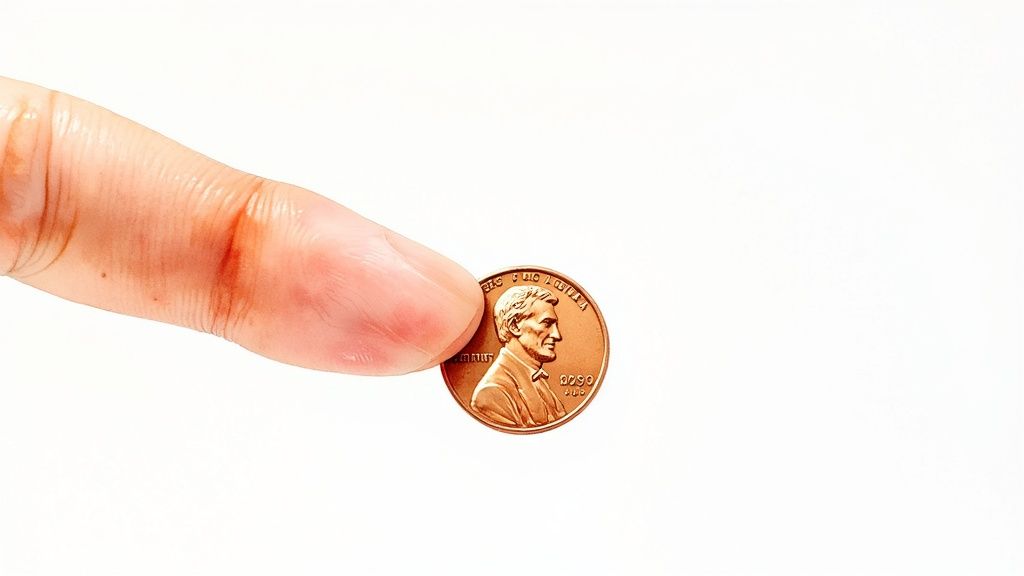
This term is common in conversations about personal finance, spending habits, and character traits. It can be used to describe someone's careful saving habits either with admiration or gentle criticism, depending entirely on the context and tone of the conversation.
How to Use It
This idiom is perfect for describing people's attitudes toward money in personal stories or casual observations. Be mindful of your tone, as it can be interpreted as judgmental.
- To describe extreme frugality: "My grandfather is such a penny pincher; he reuses tea bags and saves every rubber band."
- To advise against excessive stinginess: "Don't be a penny pincher when it comes to your health; buying fresh vegetables is a good investment."
- To highlight the positive results of saving: "She was a penny pincher for years, but it allowed her to retire at 50."
Common Mistake: Avoid using this term in formal business settings unless you are sure of the context. Describing a client as a "penny pincher" could be seen as unprofessional and offensive.
Speaking Practice
Think about your own spending habits or those of someone you know. Are you or they a penny pincher? Discuss a specific example with a partner. For instance: "I'm trying not to be a penny pincher on vacation, but I still find myself comparing prices for everything!" Mastering idioms of money like this one adds nuance to your vocabulary. For more practice with similar phrases, you can explore other money-related idioms and discuss them with a tutor.
4. Cost an Arm and a Leg
When a price is outrageously high or far more than expected, you can say it costs an arm and a leg. This classic idiom vividly expresses that something is extremely expensive, implying one would have to make a huge sacrifice to afford it. While its exact origins are debated, theories range from the price soldiers paid in war to old portrait painting practices where adding limbs increased the cost.
This phrase is a powerful and slightly informal way to complain or express shock about a high price. It is one of the most common idioms of money used in everyday English to emphasize the exorbitant cost of goods, services, or experiences.
How to Use It
Use this idiom to describe anything with a surprisingly steep price tag, from a simple meal to a major purchase like a car or house. It’s particularly effective for adding emotional emphasis to a statement about cost.
- To describe a very expensive item: "I wanted to buy the new smartphone, but it costs an arm and a leg."
- To complain about a high service fee: "Getting the plumbing fixed is going to cost an arm and a leg."
Common Mistake: This idiom is a fixed phrase. Avoid changing the body parts, for example, "cost an arm and a foot." The correct expression is always "an arm and a leg."
Speaking Practice
Think of something you recently decided not to buy because it was too expensive. Describe the situation to a partner using this idiom. For example: "We looked at houses in the city center, but they all cost an arm and a leg, so we are looking in the suburbs instead." Regular practice helps these phrases become a natural part of your vocabulary. For guided conversation practice, find an experienced tutor on Talk-Easy.
5. Money Doesn't Grow on Trees
This popular saying is a direct reminder that money is a limited resource that must be earned. When someone says money doesn't grow on trees, they are emphasizing that funds are not easily or endlessly available and should be spent with care. It's a foundational idiom often used to teach the value of work, budgeting, and financial responsibility.

While its exact origin is unclear, the phrase has been a staple of parental advice for generations. It serves as a gentle but firm check on frivolous spending, highlighting the effort required to acquire money and the importance of not wasting it.
How to Use It
This idiom is most effective in informal conversations, particularly when discussing budgets, spending habits, or teaching financial literacy. It’s a classic way to caution against taking money for granted.
- To discourage wasteful spending: "You can't buy a new video game every week. Money doesn't grow on trees, you know."
- To teach the value of work: "I know you want the latest smartphone, but remember money doesn't grow on trees. You'll have to save your allowance for it."
Common Mistake: Avoid using this phrase in a professional or formal setting, as it can sound condescending or overly simplistic. It's best reserved for close relationships, like with family and friends.
Speaking Practice
Think about a time you wanted to buy something but had to wait and save for it. How did you learn the value of that item? Describe the situation to a partner using this idiom. For example: "When I was younger, I wanted expensive sneakers, but my dad reminded me that money doesn't grow on trees and I had to work for them." Practicing idioms of money in real-world contexts will boost your confidence. For guided practice, you can connect with a tutor on Talk-Easy.
6. Hit the Jackpot
To hit the jackpot means to achieve a big, often unexpected, success, usually resulting in a significant financial gain. This idiom comes directly from the world of gambling, specifically slot machines, where the "jackpot" is the largest possible prize. While its roots are in winning money, the phrase is now used more broadly to describe any sudden and fortunate outcome.
Today, this idiom is one of the most popular idioms of money used to convey excitement about a lucky break. It perfectly captures the feeling of surprise and joy that comes with an unforeseen windfall, whether it's finding a rare item at a low price or a business venture becoming incredibly successful.
How to Use It
This expression is ideal for informal situations where you want to emphasize luck and great fortune. It can refer to literal cash winnings or any other type of major success that feels like a big win.
- To describe a sudden financial gain: "She really hit the jackpot when her lottery ticket won $2 million."
- To describe a fortunate business outcome: "He hit the jackpot with his startup investment, which is now worth ten times its original value."
- To describe a lucky find: "We hit the jackpot when we found that vintage car at a garage sale for just $500."
Usage Note: While this idiom is about a positive outcome, it heavily implies luck rather than skill or strategy. Avoid using it in formal business contexts where you want to emphasize hard work, such as in a financial report or performance review.
Speaking Practice
Think about a time you felt incredibly lucky, either financially or in another aspect of your life. Describe the situation to a partner. For example: "I was searching for a new apartment for months and thought I'd never find one in my budget. Then I found a perfect place with low rent, and I really felt like I'd hit the jackpot." Mastering such common American expressions will help you sound more natural in conversation. For focused practice, you can review these phrases with a tutor on Talk-Easy.
7. Tight with Money
When someone is very reluctant to spend money and keeps strict control over their finances, they can be described as being tight with money. This idiom suggests a protective, almost defensive, attitude toward one's funds. Unlike "penny-pincher," which often implies obsessive saving, "tight with money" can carry a tone of either admirable prudence or ungenerous stinginess, depending entirely on the context.
This phrase is a useful part of the vocabulary for idioms of money because it captures the nuance of financial caution. It can describe someone who is carefully managing their budget or someone who is simply unwilling to be generous, making it a very versatile, context-driven expression.
How to Use It
This idiom is best used when describing someone's general attitude toward spending rather than a single financial decision. The connotation can shift from positive (fiscally responsible) to negative (stingy), so be mindful of the situation.
- To describe reluctance to spend: "He's notoriously tight with money, so don't expect him to pick up the check."
- To describe careful budgeting: "Since losing her job, she has to be very tight with money to make ends meet."
- To describe selective spending: "He is tight with money when it comes to daily luxuries but surprisingly generous with gifts for his family."
Common Mistake: Avoid overusing this phrase in a negative way, as it can sound judgmental. Always provide context to clarify whether you mean the person is being financially wise or unpleasantly cheap.
Speaking Practice
Think about your own spending habits or those of someone you know. Do you consider yourself tight with money? Describe a situation to a partner where this quality was either a good or bad thing. For example: "My dad is tight with money, which used to annoy me. But now I realize his careful planning is why he can retire comfortably." For more focused practice on nuanced phrases, consider booking a session with an English tutor on Talk-Easy.
8. Sleeping Money
When funds are idle and not generating any returns, they are referred to as sleeping money. This evocative idiom describes cash that is sitting passively in a low-interest account or, even worse, stashed away where it cannot grow. It highlights the opportunity cost of not investing, as that money could be actively earning more through investments or high-yield savings.
The phrase personifies the money as being inactive or unproductive, urging the owner to "wake it up" by putting it to work. It's a key concept in financial planning, encouraging people to think about making their assets productive rather than just letting them sit.
How to Use It
This idiom is perfect for discussions about personal finance, investment strategies, and financial planning. It’s an effective way to talk about the importance of making your money work for you.
- To describe uninvested funds: "Leaving that inheritance in a checking account is just letting it become sleeping money."
- To suggest a financial action: "We need to find a good investment for this cash. I don't want to have $20,000 of sleeping money."
Key Insight: This term is often used to introduce a conversation about investment. It frames the lack of action as a missed opportunity, making it a powerful motivational phrase.
Speaking Practice
Think about your own savings. Is any of it "sleeping money"? Discuss with a partner what you could do to make it more productive. For example: "I realized I had a lot of sleeping money in my basic savings account, so I decided to move some of it into a mutual fund." Mastering idioms of money like this one can make your financial conversations sound more sophisticated. For guided practice, book a session with an expert tutor on Talk-Easy.
9. Filthy Rich
When someone possesses an extraordinary and almost unimaginable amount of wealth, they can be described as filthy rich. This colorful idiom uses the word "filthy" to intensify the meaning, suggesting a level of riches so vast it's almost obscene or excessive. The phrase is a modern slang term that adds a vivid, and often slightly irreverent, emphasis to the idea of extreme wealth.
While it can be used with a sense of awe or admiration, the tone can also imply envy, judgment, or that the money was gained through questionable means. Its informal nature makes it a powerful descriptor in casual conversations about wealth and social status.
How to Use It
This idiom is best suited for informal or casual settings when discussing people with vast fortunes. The context and your tone of voice will determine whether it sounds admiring, envious, or critical.
- To describe extreme wealth: "After he sold his tech company to a major corporation, he became filthy rich."
- To comment on a wealthy lifestyle: "She's filthy rich from her family's real estate empire and travels the world on a private jet."
Usage Tip: Be mindful of your audience. This is a very informal phrase and should be avoided in professional or business communications where a more neutral term like "very wealthy" or "affluent" would be appropriate.
Speaking Practice
Think of a famous celebrity or entrepreneur you know. How would you describe their wealth to a friend? Practice using the idiom in a sentence. For example: "The author of that fantasy series must be filthy rich; her books have sold hundreds of millions of copies." Incorporating idioms of money like this one adds color and nuance to your English. For more practice with informal expressions, book a session with an English tutor on Talk-Easy.
10. Rake It In
When someone is earning a large amount of money very quickly and seemingly without much effort, you can say they are raking it in. This idiom uses the metaphor of a rake, a gardening tool used to gather leaves, to paint a picture of someone easily collecting substantial sums of cash. Its origin is often linked to the world of gambling, where a croupier uses a rake to collect chips from the table.
Today, the phrase is widely used to describe successful businesses, high-earning individuals, or profitable ventures. It emphasizes not just the amount of money being made but also the speed and apparent ease with which it is accumulated.
How to Use It
This idiom is perfect for describing significant financial success or a period of high profitability. It adds a dynamic and slightly informal flair to conversations about business or personal earnings.
- To describe a profitable venture: "That new tech startup is really raking it in with their latest app."
- To talk about a successful person: "Ever since she became a top real estate agent, she’s been raking it in."
Context is Key: This phrase is generally positive but can sometimes imply envy or suggest that the success is almost too easy. The tone of voice is important when using it.
Speaking Practice
Think of a business or industry that is currently very successful. Describe its success to a partner using this idiom. For example: "With everyone ordering food online, delivery services are absolutely raking it in." Using idioms of money like this one makes your conversation more vivid and natural. For more ways to improve your conversational skills, check out these tips on how to practice English speaking.
Comparison of 10 Money Idioms
| Phrase | Usage complexity 🔄 | Resource / cost implication ⚡ | Expected outcome 📊 | Ideal use cases 💡 | Key advantage ⭐ |
|---|---|---|---|---|---|
| Break the Bank | Low — casual hyperbole; may sound dramatic | Implies very high cost or depletion of funds | Signals unaffordability or financial strain | Describing excessively expensive purchases or budget warnings | Vividly communicates excessive expense |
| Cash Cow | Low — business jargon, widely understood | Low ongoing effort once established; requires mature assets | Predictable, steady profits | Discussing mature products, divisions, or investments | Conveys reliable revenue generation |
| Penny Pincher | Low — tone-sensitive; can be pejorative | Minimal spending; high emphasis on saving | Highlights extreme frugality; may sacrifice value | Describing personal spending habits or anecdotes | Clearly signals conservative money behavior |
| Cost an Arm and a Leg | Low — vivid but potentially too dramatic | Indicates exorbitant, disproportionate cost | Emphasizes shock or frustration about price | Emphasizing unexpectedly high prices or fees | Strong emotional impact about expense |
| Money Doesn't Grow on Trees | Low — didactic; may sound preachy | Advocates cautious spending; highlights scarcity | Encourages financial responsibility | Teaching children, family budget talks, basic literacy | Simple, effective lesson in money management |
| Hit the Jackpot | Low — positive, luck-focused usage | Suggests sudden large gain with little prior investment | Conveys unexpected windfall or major success | Describing luck-based gains or surprise wins | Conveys excitement about big, sudden gains |
| Tight with Money | Low — descriptive but can offend if applied directly | Conservative spending and reluctance to lend/share | Signals guarded or defensive financial attitude | Character descriptions, family/relationship contexts | Distinguishes attitude toward money vs behavior |
| Sleeping Money | Medium — more technical/financial term | Idle capital with opportunity cost if left uninvested | Highlights unused funds and lost growth potential | Financial planning, investment strategy discussions | Emphasizes capital efficiency and opportunity cost |
| Filthy Rich | Low — casual and strong; may be crude | Implies extreme wealth and large resource base | Conveys vast wealth; may carry moral or cultural tone | Informal remarks about extreme wealth or luxury | Vividly communicates extraordinary wealth |
| Rake It In | Low — informal, action-oriented | Rapid, substantial income often implying ease | Signals fast, sizable earnings or revenue growth | Success stories, business wins, booming markets | Action-oriented phrase that implies momentum and profit |
Start Using These Idioms to Speak with Confidence
You've just explored a curated collection of ten powerful idioms of money, moving beyond simple definitions to understand their real-world application, common mistakes, and appropriate contexts. From identifying a lucrative cash cow in a business portfolio to cautioning a friend that money doesn't grow on trees, these phrases are the building blocks of natural, fluent English communication.
The journey from knowing an idiom to owning it is paved with practice. The true value of this list isn't just in recognizing phrases like cost an arm and a leg or break the bank; it's in having the confidence to use them accurately and spontaneously. Integrating these expressions into your vocabulary will significantly enhance your conversational skills, making you sound more authentic in professional meetings, academic discussions, and everyday social interactions.
From Passive Knowledge to Active Skill
To truly master these idioms of money, you must actively transition them from your reading vocabulary to your speaking vocabulary. Passive understanding is a great first step, but fluency is achieved through active use. Think of it this way: knowing the rules of a game is different from being a skilled player. The same principle applies here.
Here are some actionable next steps to cement your learning:
- Set a Weekly Goal: Choose one or two idioms from this list each week. Your goal is to use them correctly in a real conversation, whether with a colleague, a friend, or a language partner.
- Contextualize Your Practice: Don't just memorize the phrase; create a scenario. For your next team meeting, think about how you might describe a highly profitable project as a cash cow. When discussing vacation plans, consider whether a luxury resort might cost an arm and a leg.
- Listen Actively: Pay close attention to how native speakers use these phrases in movies, podcasts, and news reports. Notice their tone and the situations in which they use expressions like filthy rich or rake it in. This will help you internalize the nuances of each idiom.
The Broader Impact of Idiomatic Language
Mastering idioms of money does more than just expand your vocabulary. It demonstrates a deeper cultural and linguistic understanding, which is invaluable for building rapport and credibility. When you use an idiom correctly, you signal that you've moved beyond textbook English and can navigate the subtle, colorful expressions that enrich the language. This can be a significant advantage in any setting, from negotiating a business deal to simply making a stronger personal connection.
The confidence you gain from using these phrases effectively will ripple into all areas of your communication. You will find yourself speaking more decisively, understanding conversations with greater ease, and expressing complex ideas more vividly. The key is consistent, low-stakes practice that turns hesitation into instinct.
Ready to put these idioms into practice with instant, personalized feedback? TalkEasy offers a unique space to use new vocabulary in real conversations with an AI tutor, helping you build fluency and confidence in just 15 minutes a day. Start your journey toward mastering the art of conversation at TalkEasy.