
A Guide to Dealing with Difficult Customers
Transform tense situations with our guide on dealing with difficult customers. Learn proven de-escalation tactics and communication skills to build loyalty.


When you're face-to-face with a frustrated customer, it’s not just about solving their problem. It’s about turning a moment of high tension into one of genuine connection. The real skill lies in staying calm, truly hearing what they're saying, and steering the conversation toward a solution. Done right, you can transform a potential disaster into a moment that actually builds loyalty.
Why Handling Difficult Customers Matters
Anyone who's worked in a customer-facing role knows that sinking feeling. A conversation takes a wrong turn, the customer's voice gets louder, and a simple solution seems to vanish. These aren't just uncomfortable moments; they're make-or-break situations for your relationship with that customer and, by extension, your brand. A poorly handled complaint isn't just one lost sale—it's the start of a damaging ripple effect.
The numbers are staggering. Poor customer service costs businesses globally an estimated $3.7 trillion every single year. Here in the U.S., that figure is around $494 billion annually, mostly from customers who simply walk away. Think about this: nearly 64% of customers will ditch a brand after just one bad experience. That’s how fast things can go south, and it’s why getting these conversations right is non-negotiable.
The True Cost of a Bad Experience
When a customer feels ignored or dismissed, the damage goes far deeper than a single transaction. The real costs are often hidden, but they hit your bottom line hard.
Here’s what’s really at stake:
- Customer Churn: This is the most obvious consequence. You lose a customer, and it's far more expensive to find a new one than to keep the one you have.
- Brand Reputation: Unhappy customers talk. They tell their friends, their family, and they post reviews online. One negative story can poison the well for dozens of potential new customers.
- Employee Morale: Dealing with constant conflict is exhausting. It leads to burnout and high turnover on your team, which ultimately hurts the service everyone receives.
Investing in de-escalation skills isn't just damage control. It's a proactive strategy for building a brand that people trust and respect. Every difficult situation you resolve is another brick in the foundation of customer loyalty.
Shifting from Reactive to Proactive
Knowing the stakes is the first step. For teams in retail, for instance, targeted training can be a game-changer. You can check out our guide on retail customer service training to see what that looks like.
The real goal is to stop just reacting to anger and start proactively guiding these conversations to a better place. This guide will give you the practical strategies and exact words you need to turn tough moments into opportunities to prove you’re a brand that cares.
The Acknowledge and Align Method
Those first 30 seconds with an upset customer are everything. They set the tone for the entire conversation and can make the difference between a resolution and a lost customer. Before jumping to solutions, your first move has to be about de-escalating the tension.
This is where the Acknowledge and Align Method becomes your go-to play. It’s a simple, powerful framework that reframes the interaction from a confrontation into a collaboration. It’s not about just "staying calm"—it's about showing the customer you're on their side, ready to solve this with them.
Start by Acknowledging Their Frustration
First things first: you have to Acknowledge what the customer is feeling and how the problem is affecting them. This isn't about admitting fault or even agreeing with their every point. It’s about validating their experience. When someone is angry or frustrated, the first thing they want is to feel heard.
Using specific phrases that show you're actively listening and empathizing can instantly lower their guard.
You could try saying something like:
- "I can absolutely hear how frustrating this has been for you."
- "It sounds like this has caused a major disruption, and I completely understand why you're upset."
- "Thank you for flagging this for me. It’s clear this isn't the experience we wanted for you."
Getting this initial step wrong can have serious consequences. When customers feel unheard, their frustration builds, and that's a direct path to churn and, eventually, damage to your brand's reputation.
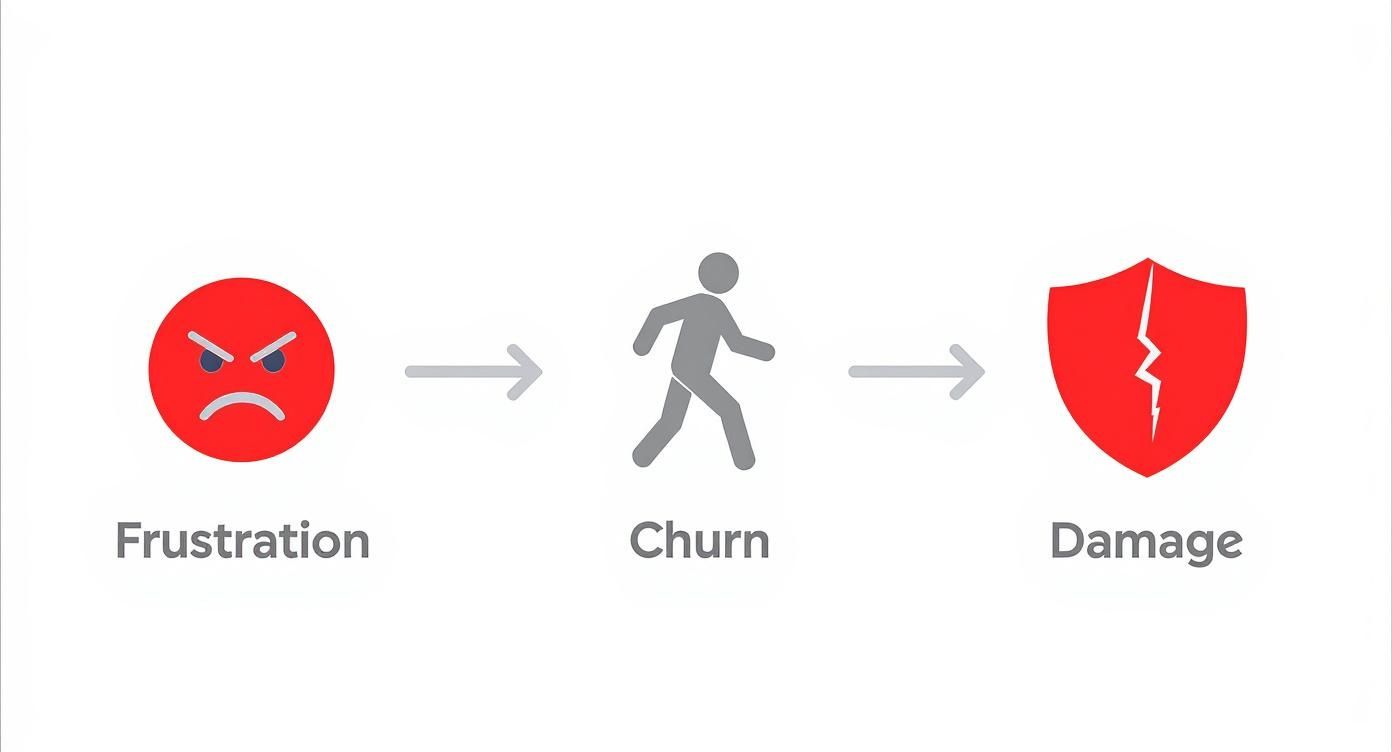
That's why acknowledging their reality is so critical—it stops that negative momentum in its tracks.
Next, Align with Their Goal
Once you've shown them you understand, it's time to Align with their objective. You need to pivot and position yourself as their ally, not a gatekeeper. Deep down, you both want the same thing: to get this problem fixed. This simple shift in framing—from "you vs. me" to "us vs. the problem"—is what opens the door to a real solution.
You’re not just closing a ticket; you're helping them get back on track. This builds immediate trust and makes them far more willing to listen to what you have to say next.
Let's see how this looks in a real scenario:
Customer: "Your software update completely wiped my project files, and my deadline is tomorrow! This is a disaster."
Your Response:
"I can only imagine how stressful that is, especially with a deadline breathing down your neck. (Acknowledge) My top priority right now is to help you recover those files and get this sorted out so you can hit your deadline. Let’s figure this out together. (Align)"
Notice how that response doesn't make excuses or get defensive. It validates their panic and instantly frames you as a partner. By mastering the Acknowledge and Align method, you can take control of the conversation from the first sentence and guide it toward a positive outcome.
Practical Language for De-escalation
We’ve all been there. A customer is upset, emotions are running high, and the conversation is on the verge of going completely off the rails. In that moment, knowing what to say—and what not to say—is everything. It’s less about theory and more about having the right words at your fingertips to turn a confrontation into a conversation.
Your goal is to shift from a defensive crouch to an open, problem-solving stance. This isn't just about being nice; it’s about being effective. The modern customer simply won't stick around after a bad experience. In fact, 72% of customers will jump ship to a competitor after just three (or fewer) frustrating interactions, as some recent data from Webex.com highlights. Loyalty is earned in these tough moments.
Move from Accusation to Collaboration
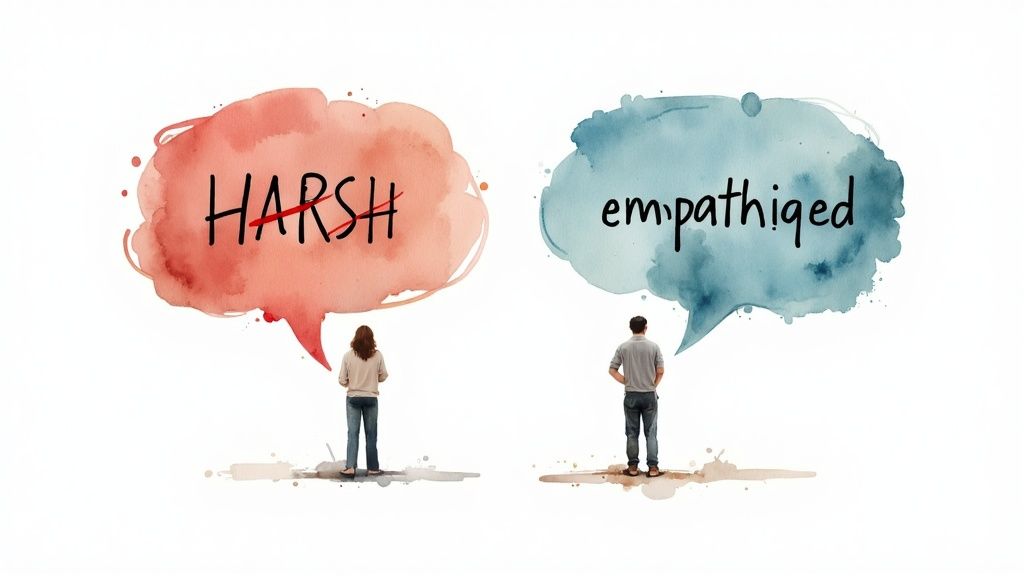
When a customer says something like, "Your company policy is ridiculous," our first instinct is often to defend it. Resist that urge. Defending the policy immediately puts you on the opposite side of the table. A better approach is to use language that sidesteps the conflict and zeros in on the customer's experience.
Imagine this common scenario:
- What Not to Say: "That's our standard policy, and there’s nothing I can do." This is a conversational dead end. It signals rigidity and, frankly, a lack of care.
- What to Say Instead: "I can see why that policy is so frustrating from your perspective. Let’s take a look together and see what’s possible here."
See the difference? The second response validates their feelings without trashing the company rules. It instantly reframes you as an ally who is there to find a solution, not just a gatekeeper for a rigid system.
Apologize with Real Authenticity
A real, heartfelt apology is one of the most powerful de-escalation tools you have. But a fake or badly phrased one? That’s like pouring gasoline on a fire.
The secret is to apologize for the impact the problem had on the customer, not necessarily to admit fault (especially if it wasn't yours).
- What Not to Say: "I'm sorry if you feel that way." This is a classic non-apology. It subtly implies the customer’s feelings are the actual problem.
- What to Say Instead: "I am genuinely sorry for the frustration and inconvenience this has caused you." This is specific, it’s empathetic, and it takes ownership of their negative experience.
An authentic apology isn’t about assigning blame. It’s about acknowledging the customer’s reality and showing you care. That simple act of validation can immediately lower the temperature in the room and start rebuilding a little bit of trust.
Swap Out Phrases That Escalate Tension
Having a few go-to phrases ready can make all the difference. Think of it as building conversational muscle memory. Here’s a quick-reference table to help you swap out common reactive phrases for more effective, empathetic alternatives.
Effective De-escalation Phrases
| Situation | What Not to Say | What to Say Instead |
|---|---|---|
| Customer is Angry About a Policy | "That's just our policy." | "I can understand why that policy feels unfair. Let's explore what options we have." |
| Customer is Frustrated and Venting | "You need to calm down." | "I hear you. It sounds incredibly frustrating. I'm here to help." |
| You Don't Have an Immediate Answer | "I don't know." | "That's a great question. Let me find out the right answer for you." |
| Customer Feels Ignored | "I'm doing the best I can." | "You have my full attention. Let's walk through this together." |
| The Customer is Wrong | "You're mistaken." | "Let me make sure I'm understanding correctly. I was under the impression that..." |
Keep these in your back pocket. Practicing them a few times will help them feel natural when you actually need them.
What to Say When You Don't Know the Answer
It’s going to happen—a customer will ask a question you can't answer right away. How you handle this moment is crucial. Just saying "I don't know" can sound dismissive and make an anxious customer even more worried.
Instead, frame your response with confidence and a clear path forward.
- What Not to Say: "I don't know the answer to that."
- What to Say Instead: "That's an excellent question, and I want to make sure I get you the correct information. Let me find that out for you right now."
This approach shows you're competent and actively working on their behalf. It reassures them that they're in good hands. This level of clear, confident communication is just as critical in writing, too. For more on that, you might find our guide on professional email writing examples useful.
By consciously choosing your words, you can build a toolkit that turns difficult conversations into successful outcomes.
Adapting Your Approach for Different Channels
Let's be real—the same script won't work for every difficult customer. A frustrated person on the phone needs a different touch than someone sending rapid-fire messages in a live chat. The key is to adapt your de-escalation strategy to the channel you're using.
How you come across on each platform completely shapes the customer's experience. It’s surprisingly easy to misread tone in an email or let your own stress creep into your voice on a call, turning a small problem into a huge one. Getting a handle on these nuances is what separates a good resolution from a bad review.

On the Phone: Mastering Vocal Cues
When you're on the phone, your voice is everything. You don't have facial expressions or body language to rely on, so your tone does all the heavy lifting. If a customer is yelling, the natural reaction is to match their volume, but that's like pouring gasoline on a fire.
Instead, make a conscious effort to speak a little softer and slower. This simple technique of tone modulation often has a calming effect, subconsciously encouraging the other person to mirror your demeanor.
Don't underestimate the power of a well-timed pause. After a customer unloads their frustration, wait just a moment before you jump in. It shows you were actually listening and are taking the time to form a thoughtful response, not just waiting for your turn to speak.
For Email and Chat: Precision Is Key
With text-based communication like email or live chat, every word is on the record and ripe for misinterpretation. A misplaced joke or a hint of sarcasm can backfire spectacularly. Here, clarity and precision are your best friends.
A few tips to keep in mind for written channels:
- Lead with empathy. Kick off your reply with phrases like, "I can absolutely see how frustrating this must be," or "I understand this is an urgent matter for you."
- Leave no room for doubt. Before hitting send, give your message a quick reread. Is it crystal clear? Could anything be taken the wrong way? Be direct about what you can do and what the next steps are.
- Keep them in the loop. In live chat, silence feels like you've disappeared. Simple updates like, "I'm just looking into this for you now," let them know you’re still actively working on their issue.
In today’s hyper-connected world, customers expect a seamless experience, regardless of the channel they use. This is where a unified approach becomes essential.
Customers today expect personalized and consistent support, and they notice when it's missing. Companies that provide a coordinated "omnichannel" experience across phone, chat, and email see customer satisfaction (CSAT) scores of 67%. That’s a massive leap from the 28% CSAT score for businesses with disconnected systems, according to data from Nextiva.com. This shows that consistency is just as vital as the conversation itself.
In-Person Interactions: Body Language Speaks Volumes
When you're face-to-face with an unhappy customer, what you don't say can be just as important as what you do. Your body language can de-escalate or inflame a situation before you even open your mouth.
Try to maintain an open, non-confrontational posture—uncross your arms, as that can come off as defensive. Gentle, steady eye contact shows you're engaged and taking them seriously.
If things are getting heated, it can be a good idea to move the conversation to a quieter, more private space. This helps the customer feel less like they're "on stage" and can create a calmer environment for finding a solution. Honing these non-verbal skills is a big part of what we cover in our guide on how to improve customer service skills.
Putting Your Skills Into Practice
Reading about how to handle a tough customer is one thing, but actually doing it when you’re under pressure? That's a completely different ballgame. The real trick is building the conversational muscle memory so you don't freeze up when things get heated.
This is where practice becomes your best friend. We're going to walk through three incredibly common role-play scenarios to help you bridge the gap between theory and reality. You'll get to rehearse your responses for the customers we all encounter: the one who demands a manager, the person who’s impossible to please, and the one who is just completely lost and frustrated.
This kind of active rehearsal is exactly what we focus on with the TalkEasy platform. It's all about building confidence through practice before you're in a live, high-stakes conversation.
Scenario One: "Get Me Your Manager. Now."
The Setup: A customer is fuming. A promo code they tried to use failed, and they’ve already explained the situation once. Now, they’re done talking to you. The first thing you hear is, “Just get me your manager. I'm not repeating myself again.”
Your Goal: Your mission is to respectfully de-escalate, acknowledge their frustration, and show them you’re the person who can solve this—without passing them off.
Practice Prompts:
- Align with their goal: "I want to get this sorted out for you just as quickly as my manager would. I have full access to the same tools and can fix this for you right now."
- Validate their frustration: "I completely understand why you're asking for a manager. It’s frustrating to have to repeat yourself, and I am so sorry this has been such a hassle."
Scenario Two: The Customer You Can't Seem to Please
The Setup: You’ve already done everything by the book. You offered a customer a full refund for a product that didn't work and even threw in a discount for their next purchase. Their response? "This isn't good enough. Your product ruined my entire afternoon, and that's all you can do?"
Your Goal: Hold your ground professionally. You need to stay calm, reinforce the value of the solution you’ve provided, and maintain a clear, respectful boundary.
Practice Prompts:
"I can see that even with a full refund and a discount for next time, you’re still feeling let down by this whole experience, and I'm genuinely sorry for that. While this is the most I'm able to offer under our company policy, I do want to make sure we get that refund processed for you immediately."
Scenario Three: The Confused and Overwhelmed Customer
The Setup: An older customer is trying to track their package on your website, and they are completely lost. You can hear the distress in their voice as they say, "I just don't understand any of this! Where is my order? I feel like I’ve clicked on everything!"
Your Goal: Slow everything down. You need to be a patient, reassuring guide who uses simple, clear language to walk them through it or, even better, take the work off their plate entirely.
Practice Prompts:
- Simplify and reassure: "I know the website can be a bit confusing, but don't you worry. We will figure this out together. Let’s start with the email confirmation you received right after your purchase. Do you happen to have that handy?"
- Offer to do it for them: "You know what? To make this much easier, I can look up the tracking information for you right now. All I need is your order number."
Questions We Hear All the Time
Even with the best game plan, some situations just pop up and demand a quick, sure-footed response. Let's walk through some of the most common questions I get asked about handling tough customer moments. Having a solid plan here will make all the difference.
What’s the Best Way to Handle a Yelling Customer?
Your first instinct might be to match their energy, but you have to do the exact opposite. Consciously lower your own voice. It’s a subtle trick, but it often encourages them to bring their own volume down to match you.
Immediately acknowledge what they're feeling. A simple, "I can hear how incredibly frustrating this is for you," shows you're listening to the person, not just the problem.
Then, just let them vent. Don't interrupt. Wait for a natural pause. Once you have it, validate their feelings without necessarily agreeing with their facts. Saying something like, "It sounds like this has been a really difficult experience," can instantly take the heat out of the conversation.
Finally, gently guide the conversation toward a solution. Try saying, "I want to help fix this. Can we walk through what happened from the beginning?" This simple pivot shifts the dynamic from a confrontation to a collaboration.
How Do You Say No to an Unreasonable Request?
Saying "no" without blowing up the situation is an art form. I've always found the "positive sandwich" method works wonders. You start with something empathetic that shows you get where they're coming from. For example, "I totally understand why you're asking for a full refund on an item you've used for six months."
Next, you deliver the "no" clearly but gently, framing it around a policy or limitation instead of making it about them. "Our return policy only covers the first 30 days," is direct but not aggressive.
The most important part is what comes next: immediately follow up with what you can do. This shows you're still on their side, trying to find a solution, even if it's not the one they demanded.
Here are a couple of ways you could frame it:
- "However, what I can do is offer you a 25% discount on your next purchase as a gesture of goodwill."
- "While I can't process that request, I can absolutely help you troubleshoot the issue you're having right now."
What Should I Do If a Customer Gets Personally Insulting?
Your safety and well-being come first. Period. You have every right to draw a line when a customer's language becomes abusive or threatening. The key is to remain professional and not get pulled into the mud with them.
State your boundary calmly and firmly. Something like, "I am here to help you, but I won't be able to continue if the personal insults continue," puts the ball back in their court. It makes it clear that their behavior is the only thing stopping you from helping.
If they keep it up, you need to clearly state your next move. A good follow-up is, "Since the insults haven't stopped, I am going to end this call now. You are welcome to call back when you're ready to discuss this calmly." Always, always follow your company's protocol for documenting and escalating these kinds of interactions afterward.
Mastering these conversations really just takes practice. At TalkEasy, we help you build the confidence to handle any customer interaction with our AI-powered speaking practice. Learn to speak more confidently with TalkEasy.