
How to Improve Your English Speaking Skill: A Practical Guide
Discover how to improve your English speaking skill with our practical guide. Learn daily habits, targeted exercises, and real-world tips to speak fluently.


If you're serious about improving your spoken English, you can't just jump into random exercises. You need a clear starting point. The best way to do this is to first figure out your specific challenges and then build a consistent practice routine around them. This targeted approach is what separates frustratingly slow progress from real, noticeable gains in fluency and confidence.
Building a Strong Speaking Foundation
Before you start drilling vocabulary or practicing tongue twisters, you have to get an honest look at where you stand right now. It's time to move beyond vague labels like "intermediate" and get specific. The goal here isn’t to be hard on yourself; it’s to gather some concrete data. Think of this as creating your own personalized roadmap—it'll show you exactly where to focus your energy for the biggest impact.
Skip this step, and you could waste months on generic drills that don't actually help you. You might spend all your time memorizing new words when your real problem is sentence rhythm, or you might practice speaking faster when unclear pronunciation is what’s really holding you back.
How to Conduct a Realistic Self-Assessment
So, how do you get an objective look at your own skills? Record yourself. I know, it can feel a little awkward at first, but it is hands-down the most powerful diagnostic tool you have.
Here’s a simple way to do it:
- Pick a simple topic. Choose something you can talk about for 1-2 minutes without much prep. You could describe your day, talk about your favorite hobby, or summarize a movie you just saw.
- Record yourself speaking. Just use the voice memo app on your phone. Don’t aim for perfection. The idea is to capture how you actually sound in a natural conversation.
- Listen back with a purpose. This is where the magic happens. As you listen, try not to just cringe at the sound of your voice (we all do!). Instead, put on your detective hat and listen for specific patterns.
Modern tools can really help structure this process. For instance, the dashboard in the TalkEasy platform organizes practice sessions by topic, which is a great way to approach your self-assessment recordings.
This kind of setup helps you keep your recordings organized so you can track your progress over time.
What to Listen For
When you review your recording, you’re looking for opportunities, not flaws. This isn't about being self-critical; it's about being strategic.
The key to effective self-assessment is listening for patterns, not just isolated mistakes. A single error is a slip-up; a repeated error is a system that needs a tune-up.
Use this checklist to guide your listening session:
- Fluency and Flow: Are you pausing a lot to search for words? Do your sentences feel choppy, or do they connect smoothly? Pay attention to how often you lean on filler words like "um," "uh," or "like."
- Pronunciation Clarity: Do you stumble over certain sounds or words? Are some words coming out mumbled or unclear? Maybe it’s the “th” sound or the difference between “ship” and “sheep.”
- Vocabulary Use: Do you find yourself falling back on the same simple words over and over? Do you have the right vocabulary to get your point across, or does it feel limited?
- Grammar in Action: Can you spot any recurring grammar mistakes? Maybe you consistently mix up past and present tenses or struggle with subject-verb agreement. Don't get bogged down in every little slip-up—just look for the big, repeating patterns.
The Daily Habit That Actually Builds Fluency
Now that you've got a handle on your specific speaking challenges, it's time to build a habit that sticks. Forget about those long, draining study sessions that just lead to burnout. The real secret to getting better at speaking English is weaving short, focused practice into your everyday life.
Lasting progress is all about consistency, not cramming. A dedicated 15-minute daily routine will do more for you than a two-hour marathon once a week. This approach makes speaking feel like a natural part of your day and builds the kind of momentum that leads to real, noticeable improvement.
Three Powerful 15-Minute Micro-Routines
To keep things interesting and effective, try rotating through three simple but incredibly powerful micro-routines. Each one hones a different part of your speaking, helping you build a well-rounded skill set. You don’t need to do all three every day—just pick one and give it 15 minutes of your full attention.
- The 'Think Out Loud' Technique: This is as simple as it sounds: turn your inner monologue into spoken English. As you go about your day, just narrate what you're doing, seeing, or thinking. Making coffee? Say, "Okay, I need to get the beans from the cupboard. I think I'll use the French press today." This little exercise trains your brain to form English sentences on the fly, without the pressure of having a conversation partner.
- The 'Shadowing' Method: Shadowing is my go-to recommendation for nailing pronunciation, rhythm, and intonation. Find a short audio or video clip of a native speaker—a 60-second podcast snippet or a scene from a TV show is perfect. Listen to a sentence, then immediately say it back, trying to mimic the speaker’s exact sounds and cadence. Don't worry about understanding every single word; the goal is to copy the music of the language.
- 'Topical Monologues': This routine is all about building confidence to speak on a particular subject. Pick a topic—a recent news article, a movie you just watched, your opinion on a current event. Set a timer for three to five minutes and just talk about it without stopping. The point is to keep your flow going and practice organizing your thoughts as you speak.
You can create a simple feedback loop for any of these exercises to check your progress. Just follow this simple process.
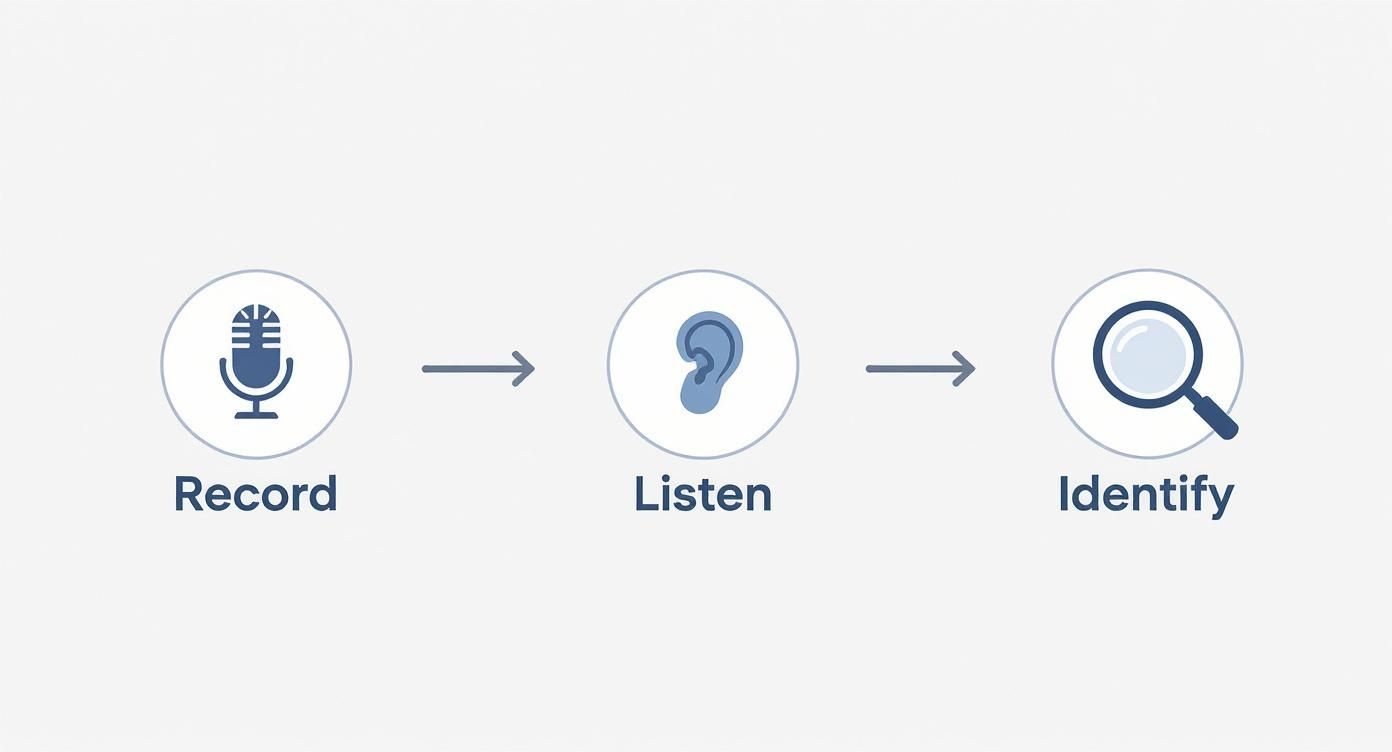
This cycle of recording, listening, and spotting patterns is how you turn unstructured practice into measurable growth.
Why Consistency Is Everything
When you commit to a short, daily habit, you tap into the power of compounding. Every day, you build just a little on yesterday's progress. Over weeks and months, these tiny gains add up to a massive leap in your ability to speak English fluently.
Don't aim for perfection in your daily practice. The goal is simply to show up and speak. Consistency is the engine of fluency, and every 15-minute session is fuel for that engine.
This isn't just a nice idea; it's backed by experience and research. Learners who speak English for at least 15–20 minutes per day improve their fluency 2–3 times faster than those who don't, especially when they get feedback. This is precisely why so many people find conversation partners or tutors—to create those daily opportunities.
The trick to making these exercises stick is to link them to your existing routine. You could try the 'Think Out Loud' technique on your morning commute or practice shadowing while you're doing the dishes. By connecting your English practice to something you already do, you make it an automatic, effortless part of your day.
Targeted Drills for Pronunciation and Vocabulary

A consistent daily practice routine is your engine for fluency. But if you want to really accelerate your progress, you need to add some high-performance fuel—and that’s where targeted drills come in.
To sound more natural and get your ideas across clearly, you have to fine-tune the mechanics of your speech. Think of this as a dedicated workout plan, but for your mouth and your mind. We'll zero in on two of the most critical areas: pronunciation and vocabulary.
Sharpening Your Pronunciation
Let's get one thing straight: great pronunciation isn't about losing your accent. It's all about clarity. The goal is simply to be understood without effort, which boosts confidence on both sides of the conversation.
One of the most powerful tools I’ve seen for this is the minimal pair drill. Minimal pairs are words that sound almost identical, differing by just a single sound, like 'ship' and 'sheep' or 'cat' and 'cut'. These exercises are fantastic because they train your ear to catch those subtle differences and teach your mouth how to form them correctly.
Here’s a simple way to use them:
- Find a list of minimal pairs that focuses on sounds you find tricky.
- Listen to a native speaker say each word. Pay close attention.
- Record yourself saying both words. Really focus on making the sounds distinct.
- Compare your version to the original. Can you honestly hear the difference?
And don't forget about the classic tongue twister. They’re more than just a bit of fun; they are intense workouts for your tongue, lips, and jaw.
For example, if the 'sh' sound trips you up, repeating "She sells seashells by the seashore" forces you to practice that specific sound over and over in a complex sequence. The trick is to start slowly, aiming for precision. Speed comes later.
Activating Your Vocabulary
Ever have that frustrating feeling where you know a word, but it just won't come out when you’re talking? That's the gap between your passive vocabulary (words you recognize when reading) and your active vocabulary (words you actually use when speaking). Our goal is to move more words from the passive list over to the active one.
A surprisingly effective method is word association. Instead of just memorizing a definition from a dictionary, you need to connect the new word to other words, ideas, and even personal experiences.
Let's say you learn the word "diligent." Don't just stop at its definition ("showing care and conscientiousness"). Link it to something real. You might think, "My coworker, Sarah, is very diligent; she always double-checks her reports." Now the word is anchored in a real-world context, making it much easier to recall later.
Try building a quick mind map or a simple list for new words:
- Target Word: Collaborate
- Synonyms: work together, partner, team up
- Related Concepts: project, meeting, communication, teamwork
- Personal Sentence: "I need to collaborate with the marketing team on this new campaign."
This turns vocabulary building from a passive chore into an active, engaging exercise. It primes your brain to grab these words right when you need them.
Getting Instant, Private Feedback
One of the biggest roadblocks to improving is the lack of immediate feedback. When you're practicing alone, how do you know if you're getting better or just cementing bad habits? This is where technology can be a game-changer.
Feedback is the breakfast of champions. Without it, you’re practicing in the dark. You need to know what’s working and what isn’t to make real, lasting improvements.
AI-powered platforms like TalkEasy are built to solve this exact problem. You can talk about different topics and get instant, private feedback on your pronunciation, fluency, and even your word choices. It gives you a safe space to experiment and make mistakes without the pressure of a live audience.
This immediate correction cycle is what helps you fine-tune your speech so much faster. To really dig into specific pronunciation goals, you can also find great resources on English accents training that explain the nuances of different speech patterns. When you combine targeted personal drills with smart tech, you create a powerful system for anyone serious about improving their spoken English.
Creating Your Own English Immersion Environment
To really get good at speaking English, you have to do more than just study it. You need to weave it into the fabric of your daily life. The fastest way to do that is through immersion—surrounding yourself with the language until it feels completely natural.
And no, you don't have to pack your bags and move across the globe. You can build a powerful, English-rich world right from home with a few smart adjustments.
The idea is to constantly expose your brain to English, even passively. This trains you to start thinking in English, which is the secret ingredient for fluid speaking. It all starts with listening.
Digital Immersion: Your Personal English Bubble
Let's be honest, we spend hours on our phones and computers every day. Why not turn that screen time into a powerful learning tool? You can transform your digital world into a personal English classroom without even trying too hard.
The easiest first step? Switch the language settings on all your devices. Your phone, your laptop, your social media apps—change them all to English. It forces you to navigate your daily life using practical, everyday vocabulary. It might feel a little strange for a day or two, but you'll adapt faster than you think.
From there, get intentional about the content you consume.
Here are a few simple swaps to make:
- Upgrade Your Commute: Ditch your usual playlist and put on an English podcast about something you genuinely find interesting—true crime, tech, comedy, whatever. Suddenly, that dead time in traffic becomes productive practice.
- Curate Your Feeds: Follow English-speaking creators on YouTube, TikTok, or Instagram who share your hobbies. This is how you pick up on natural slang, intonation, and conversational phrases that textbooks just can't teach you.
- Watch, Listen, and Learn: When you settle in for a movie or TV show, switch the audio to English. Start with English subtitles if you need a safety net, then challenge yourself to turn them off as your comprehension grows.
This kind of "virtual immersion" isn't just a neat trick; it gets real results. Research has shown that learners who spend just 10–15 hours per week consuming English media can boost their speaking confidence by 40% in as little as six months.
Physical Immersion: Bringing English into Your Home
While your digital life is a goldmine, don't forget about your physical space. Making English a tangible part of your environment connects the language to your daily routines in a powerful way.
The more you see and hear English around you, the less your brain has to strain to switch between languages. Immersion makes thinking in English the default, not the exception.
A classic but incredibly effective trick is to use sticky notes to label things around your house. Put a note that says "the kettle" on your kettle or "the mirror" on your mirror. This builds a direct connection between the word and the object, cutting out the mental step of translation.
You can also seek out conversation groups, either locally or online. Finding a low-pressure environment to practice with other learners or native speakers is invaluable. The TalkEasy community, for example, is a great place to find these supportive interactions. For even more ideas, our guide on how you can learn English at home is packed with additional strategies.
By blending these digital and physical tactics, you create a 360-degree immersion experience. English stops feeling like a foreign subject you're "studying" and starts becoming a natural part of how you live and think. This is where real, lasting fluency begins.
Taking Your English into the Real World
Practicing with apps and drills is great, but let's be honest—the real goal is to actually talk to people. This is where the rubber meets the road, and it can feel like a huge leap. But bridging that gap is a skill you can learn, just like any other.
The jump from solo practice to a live conversation isn't about knowing every single word. It’s about navigating the messy, unpredictable flow of a real chat. It's about confidence, connection, and knowing how to recover when you stumble.
Getting a Conversation Started (and Keeping It Going)
Every conversation needs a spark. Having a few go-to opening lines in your back pocket removes that initial awkwardness. You don't need a brilliant, witty remark—just something friendly and observant.
Picture yourself at a coffee shop or a networking event. You could try:
- Observing your surroundings: "This place is really buzzing today, isn't it?" or "I love the music they're playing. Do you know who this is?"
- Asking a simple, direct question: "Hi, is this seat taken?" or "That looks amazing. What did you order?"
These are low-pressure ways to invite a response. Once they reply, your job is to listen and ask good follow-up questions. This is how you turn a simple exchange into a genuine conversation.
Instead of just nodding along, ask "how" or "why." If someone mentions they just moved to the city, don't stop at "Oh, nice." Ask, "What brought you here?" or "How are you finding it so far?" It shows you're actually listening and are curious to learn more.
How to Handle Those "My Mind Just Went Blank" Moments
We've all been there. You're in the middle of a sentence, and a word you know completely vanishes. It’s right on the tip of your tongue, but it’s just gone. This happens to everyone, even native speakers. How you handle it makes all the difference.
Remember, the goal of a conversation is connection, not perfection. A small stumble doesn't have to derail everything if you know how to recover smoothly.
Instead of freezing up, try one of these simple tricks:
- Describe the word: Can't remember "spatula"? Try, "You know, that flat kitchen tool for flipping pancakes?" The other person will almost always jump in to help.
- Use a filler phrase: A quick "How do you say..." or "What's the word for..." signals you're searching for a word without killing the vibe.
- Ask for clarification: It's also totally okay to say, "Sorry, could you say that again?" or "I'm not sure I follow." Being an active, engaged listener is just as important as speaking well.
These little strategies show you're trying to connect, and people really appreciate that effort.
It's All About the Right Mindset
Ultimately, your success in real-world conversations boils down to your attitude. If you walk into every chat terrified of making a mistake, you'll sound hesitant and unnatural. But if you see every conversation as a chance to learn, the game changes.
Think of each interaction as gathering field notes. You're picking up new phrases, hearing how people really talk, and getting better at recovering from slip-ups.
Treat these everyday moments as your personal practice ground:
- Ordering coffee: A low-stakes interaction that's perfect for practicing clear pronunciation and simple questions. Listen to the phrases the barista uses.
- Small talk in a queue: A quick, two-minute chat is a great way to test your conversation starters without any real pressure.
- Asking for directions: This forces you to listen carefully to instructions—a crucial communication skill.
When you reframe these situations as practice, the pressure to be perfect disappears. Every "mistake" is just a clue telling you what to work on next. You can use a tool like TalkEasy to run through these scenarios first, giving you a safe space to rehearse before you try them out for real. This blend of safe practice and real-world experience is the secret to building genuine, lasting speaking confidence.
Got Questions About Speaking English? Let's Get Them Answered
As you start practicing, you're going to have questions. Everyone does. It’s part of the process. So, I’ve put together some straightforward answers to the questions I hear most often from learners.
Think of this as your personal FAQ for getting past those common roadblocks. Sometimes, just getting a clear answer is all you need to keep your motivation high and your focus sharp.
How Long Until I Speak English Fluently?
This is the big one, isn't it? Everyone wants to know when they'll "arrive." But the truth is, there's no magic number. Fluency is a moving target, and how long it takes depends entirely on you—your starting point, how often you practice, and what "fluent" even means to you.
But let's talk about real, noticeable progress. If you commit to a consistent 15–30 minutes of practice every single day, most people feel a major shift in their confidence and speaking ability within 3 to 6 months. You'll start to notice you're searching for words less and getting your ideas across more naturally.
The secret is to stop chasing a finish line called "fluency." Instead, focus on the journey of small, daily improvements. Every time you have a conversation you couldn't have had last week, that's a win. Celebrate it.
If you make speaking a daily habit, fluency isn't something you have to chase—it becomes the natural result of your hard work.
Should I Focus on Perfect Grammar or Just Speaking?
This is a classic tug-of-war for learners. Do you aim for perfect sentences, or do you just try to get the words out? Especially when you're starting out, the answer is simple: prioritize communication over perfection.
Obsessing over grammar rules can freeze you up. It’s called paralysis by analysis—you get so scared of making a mistake that you say nothing at all. This is the single biggest killer of progress. Your first goal should always be to build flow and the courage to simply express yourself.
Of course, grammar is important. But you don't learn it by memorizing a textbook. You learn it by using the language. Try this cycle instead:
- Speak Freely: Jump into conversations without worrying about every tiny error.
- Get Feedback: Record yourself or use a tool like an AI conversation partner to spot your common mistakes.
- Refine and Polish: Notice you keep mixing up tenses? Great. Now you have a specific, targeted thing to work on.
It’s like learning to ride a bike. You don't read a physics manual first. You get on, you wobble, you might even fall, but you learn by doing. The balance comes with practice.
How Can I Practice Speaking English if I Am Alone?
This is a huge—and totally valid—concern. What if you don't have a native speaker to chat with over coffee? The good news is, you absolutely don't need one to make incredible progress. Solo practice can be incredibly powerful if you know what to do.
You can literally just start talking to yourself. Narrate your day out loud as you make breakfast ("Okay, now I'm cracking two eggs into the bowl..."). Give your opinion on a movie you just watched to an imaginary friend. It sounds a little silly, but it works because it gets your brain thinking and forming sentences in English without any pressure.
Another killer solo exercise is the shadowing technique. You find a short audio clip of a native speaker and repeat what they say, word for word, trying to match their rhythm and intonation.
And today, technology gives you a massive advantage. AI-powered platforms are built for this exact problem. They let you have incredibly realistic conversations and get instant feedback, all without needing another person.
So no, being alone is no longer an excuse. Between simple self-talk and smart tools, you have everything you need to practice effectively.
What Is the Best Way to Reduce My Accent?
First, let's get one thing straight. An accent is not a flaw. It’s a part of who you are. The real goal shouldn't be to eliminate your accent but to develop clear pronunciation so people can understand you easily.
The fastest way to do that is to train your ear. It’s less about drilling sounds and more about listening to the music of English—the stress, the rhythm, the rise and fall of the voice.
Here are a few things you can start doing right away:
- Focus on One Sound at a Time: Don't try to fix everything at once. Is the "th" sound tricky? Spend a whole week just noticing and practicing that one sound.
- Record and Compare: Use your phone. Record yourself saying a sentence, then find a recording of a native speaker saying the same thing. Listen to them back-to-back. Your ear will start to pick up on the tiny differences.
- Shadowing, Shadowing, Shadowing: I mentioned it before, and I'll mention it again. Mimicking native speakers is one of the best ways to internalize the natural sound and flow of the language.
When you shift your goal from "accent elimination" to "clarity," you set yourself up for a much more realistic and rewarding journey.
Ready to put these answers into practice? The best way to improve your English speaking is to, well, start speaking. TalkEasy gives you a safe space to do just that. You get a non-judgmental AI partner available 24/7 to help you practice conversations and get instant feedback on your speech.
Begin your journey to speaking with confidence today at https://www.talk-easy.com.