
How Can I Learn English At Home A Practical Guide
How can I learn English at home? This guide provides actionable routines, tools, and real-world tips to help you build fluency on your own schedule.


Learning English from the comfort of your home has never been more achievable. The trick isn't cramming for hours on end; it's about building a balanced, immersive routine that weaves listening, speaking, reading, and writing into your daily life. With a consistent habit and smart tools like an AI tutor, you can make steady, sustainable progress that actually sticks.
Your Practical Blueprint For Learning English At Home
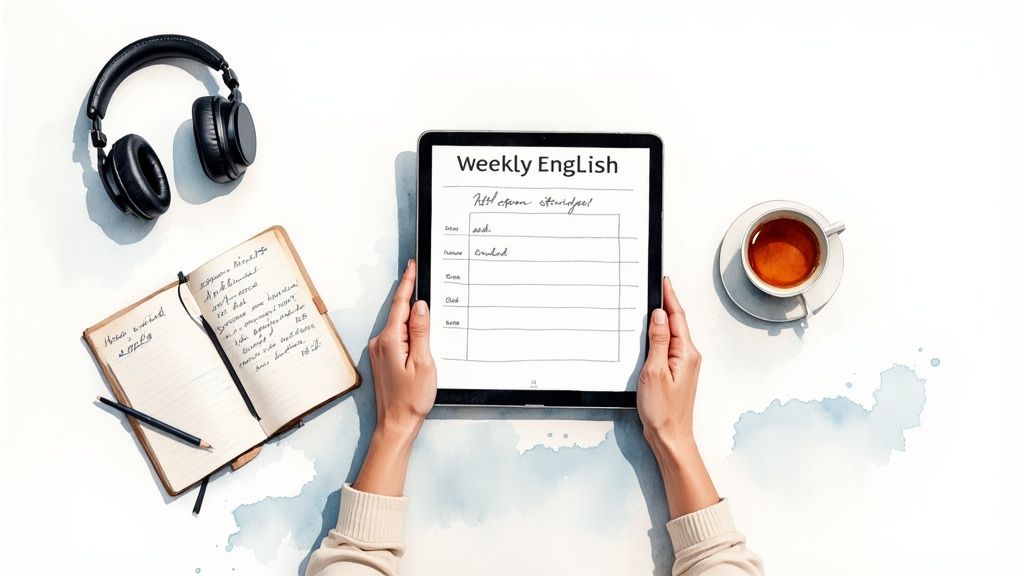
If you've ever asked, "how can I really learn English at home?" the answer is to shift your mindset. Forget about long, exhausting study sessions that you can only manage once a week. The real goal is to create a simple, repeatable framework that makes English a part of your everyday world. It’s all about active use, not just passively memorizing grammar rules.
This strategy is built on four pillars: listening, speaking, reading, and writing. When you dedicate small, manageable chunks of time to each skill every day, you create a powerful learning cycle. This approach keeps you from burning out and makes your progress feel almost automatic.
Building Your At-Home Learning Framework
Your framework doesn't have to be rigid. It’s more about spotting opportunities to practice that fit your existing schedule and personal interests. Here’s a breakdown of what that actually looks like:
- Daily Consistency Over Intensity: Seriously, 15-20 minutes of focused speaking practice every day is far more powerful than a two-hour grammar slog once a week. Consistency is what builds the neural pathways that make recall second nature.
- Active Engagement is Key: Don't just listen to an English podcast; try to summarize its main points out loud afterward. Instead of just reading an article, jot down a few sentences with your opinion on it. This small shift turns passive consumption into active learning.
- Technology as Your Partner: Modern tools have completely changed the game. An AI conversation partner, like the one we've built at TalkEasy, gives you a safe, judgment-free space to practice speaking whenever you have a spare moment. No scheduling, no pressure.
This home-based approach is so effective that the global digital English learning market is expected to grow by a staggering $14.37 billion between 2022 and 2026. This isn't just a trend; it's a fundamental shift toward flexible learning that delivers real results.
The most effective learners don't find time; they make time. By integrating small language habits into your daily routine—like listening to a podcast on your commute or practicing with an AI tutor during a coffee break—you make progress without overwhelming your schedule.
Structuring Your Week for Success
Having a plan is your best friend. It takes the guesswork out of what to study each day and ensures you’re building a well-rounded skill set. The idea is to mix up your activities to keep things fresh and cover all four core skills. If you want to go deeper on this, our guide on the best way to learn the English language has some great ideas.
To give you a concrete example, here’s a sample weekly schedule. Notice how it integrates short, focused activities into a typical day.
Sample Weekly At-Home English Learning Schedule
| Day | Listening (20-30 mins) | Speaking (15-20 mins) | Reading (15 mins) | Writing/Vocabulary (10 mins) |
|---|---|---|---|---|
| Monday | English news podcast during commute | TalkEasy session on daily routines | A chapter of a graded reader | Review 5 new vocabulary words |
| Tuesday | Watch a 20-min TED Talk (with subtitles) | Practice summarizing the talk out loud | Read a blog post on a hobby | Write a short comment on the blog post |
| Wednesday | Listen to an English pop song & look up lyrics | TalkEasy role-play (e.g., ordering food) | A news article from a major outlet | Journal entry about your day |
| Thursday | An episode of an English sitcom | Describe your favorite scene to your AI tutor | Read online reviews for a product | Add 5 new idioms to your flashcards |
| Friday | Listen to an audiobook chapter | TalkEasy debate on a simple topic | A short story or comic strip | Write a short email to a friend |
| Saturday | Watch a movie in English (start with subtitles) | Discuss the movie's plot with a language partner | Recipes or how-to guides online | Make a shopping list in English |
| Sunday | Relax with an English learning podcast | Review the week's conversations | Read anything you enjoy for fun | Plan the next week's goals |
This kind of structure makes learning feel less like a chore and more like a natural part of your week. You can adjust the times and activities to fit your own life, but the principle remains the same: a little bit of everything, consistently.
Build A Powerful Speaking Habit With AI

Let's be honest: the single biggest hurdle when you learn English at home is getting enough chances to actually speak. You can read articles and watch videos all day, but that won't build the muscle memory you need for a real conversation. This is where an AI conversation partner completely changes the game.
Forget the stress of finding a human practice partner or the high cost of a personal tutor. With a tool like TalkEasy, you suddenly have a patient, judgment-free partner available 24/7. It creates a safe space to just try things, make mistakes without cringing, and build real, unshakeable confidence.
We’re moving way beyond just repeating robotic phrases. You can have spontaneous conversations about topics you actually care about, which is the secret ingredient to staying motivated. The goal is to make daily speaking practice as automatic as checking your phone.
Make Your AI Practice Sessions Dynamic
To get the most out of it, you need to treat your AI chats as more than just a drill. The real magic happens when you simulate real-life situations that force you to think on your feet. This is how you turn passive knowledge into an active, usable skill.
For example, imagine you're getting ready for a trip. Instead of just memorizing a list of travel words, bring the scenario to life with your AI tutor.
- Scenario: You need to check into a hotel.
- Your Prompt: "Let's role-play. You are the hotel receptionist, and I am a guest trying to check into my room."
- The Conversation: This simple prompt opens up a natural way to practice asking questions, understanding directions, and using specific phrases about reservations, room keys, and payment.
This technique is incredibly versatile. You can rehearse for a job interview, practice ordering at a restaurant, or even debate the ending of a movie you just watched. Each scenario builds a practical vocabulary you can use right away.
A study from the University of Michigan found that students learning a language through conversational practice saw significantly faster results than those using traditional grammar and vocabulary exercises alone. Active speaking is the accelerator for fluency.
Using Prompts to Target Specific Skills
Think of your AI conversation partner as a precision tool. The better you know how to use it, the better your results. With specific prompts, you can zero in on any area you want to improve, whether it's mastering verb tenses or fixing your pronunciation.
Let's say you always get tripped up by past tense verbs. You can set up a conversation designed to make you use them over and over again. Try something like, "Let's talk about what I did last weekend. Ask me questions about my Saturday and Sunday."
This naturally prompts you to use verbs like went, saw, and ate in context. The AI can then give you instant feedback, helping you correct those small mistakes before they become bad habits.
Here are a few more ideas to get you started:
- Future Tense: "Let's discuss our plans for next year's vacation. Where should we go and what will we do?"
- Vocabulary Growth: "I just read an article about climate change. Let's talk about it so I can practice using words like 'sustainability,' 'emissions,' and 'renewable energy'."
- Pronunciation: After a chat, just ask, "Can you point out any words I mispronounced and help me say them correctly?"
These simple strategies turn every session into a focused lesson. For more inspiration, exploring different methods for English speaking practice online can give you a ton of creative scenarios to work with.
From Practice To Habit
At the end of the day, the goal is to make speaking English a daily habit. Consistency is what really separates learners who succeed from those who stay stuck. You don't need hours—just aim for 15 minutes of conversation with your AI tutor each day.
Find a small pocket of time that works for you. Maybe it's during your morning coffee, on your commute, or right before you go to sleep. A short, daily commitment is far more powerful than a long, draining session once a week.
By making AI-powered conversation a core part of your routine, you are finally solving the biggest challenge of learning English at home. You stop just studying the language and start living it, one conversation at a time.
Create Your Own English Immersion Environment
You don't need a plane ticket to immerse yourself in English. The real secret to getting that intuitive feel for the language is to weave it into the fabric of your daily life. It’s all about turning your home into a personal, low-pressure learning zone. When English is everywhere, it stops feeling like a chore and just becomes part of your world.
This isn't about a massive overhaul overnight. It’s about making small, consistent changes that add up to a ton of exposure over time. You’re essentially creating an environment where you’re constantly seeing, hearing, and using the language without actively trying to study. That passive intake is what builds the neural pathways you need for real fluency.
Start with Your Digital World
The easiest place to kick things off is with the devices you already use every single day. Think about it—most of us spend hours on our phones and computers, which makes them the perfect tools for effortless practice. This isn't about downloading a bunch of new apps; it’s about tweaking the settings of your existing digital life.
Just switching your phone’s system language to English is a game-changer. It forces you to learn practical, modern vocabulary that you'd never find in a textbook. Words like "notifications," "settings," and "connect" quickly become second nature. It might feel a bit weird for the first day or two, but trust me, you'll adapt faster than you think.
Then, take it a step further. Change the language settings on your most-used apps and social media platforms. Your favorite news app, your browser, your social networks—switch them all. This one simple action surrounds you with English text and commands, creating dozens of tiny learning moments all day long.
Curate Your Entertainment in English
Next up, let's turn your downtime into productive learning time. The trick here is to find content you actually like. If you try to force yourself to watch boring educational videos, you'll burn out and the habit will never stick.
Instead, lean into your hobbies and passions.
- Love music? Build a playlist of English songs and look up the lyrics. You'll start noticing idioms and slang, and singing along is a fantastic way to nail your pronunciation and rhythm.
- A total movie buff? Start watching films or TV shows in English. Begin with English subtitles to help you keep up, then challenge yourself to turn them off as your listening skills get sharper.
- Always curious? Find podcasts or YouTube channels that cover topics you're genuinely into, whether that's cooking, gaming, or history. Listening to native speakers talk about something you already understand helps you absorb new vocabulary purely from context.
The most effective immersion happens when you completely forget you're studying. By linking your English exposure to your personal interests, you absorb the language naturally because you're focused on the content, not the grammar.
This shift from just passively watching to actively engaging is so important. You’re not just consuming media; you’re training your ear to pick up on different accents, speaking speeds, and the natural flow of conversation.
Bring English into Your Physical Space
Beyond your screens, you can pull English into your physical environment. This makes the language feel more tangible and connects it directly to your everyday actions. It’s a simple strategy, but it’s surprisingly effective at keeping your brain in "English mode."
Start small. Grab some sticky notes and label common household items. A note that says "microwave" on the microwave or "bookshelf" on the bookshelf. It’s a constant visual reminder that helps cement everyday vocabulary without any real effort.
You can also weave English into your daily routines.
- Cooking: Next time you want to make a meal, find a recipe online and follow the instructions in English. You'll learn super practical vocabulary for food and actions, like chop, stir, and bake.
- Journaling: At the end of the day, try writing just three simple sentences in English about what you did. Perfection isn't the goal; you're just getting into the habit of expressing your own thoughts.
- To-Do Lists: Jot down your daily or weekly to-do lists in English. This is a great way to practice the verbs and nouns that are most relevant to your own life.
By creating this rich, multi-sensory environment, you're essentially mimicking what it's like to live in an English-speaking country. This constant, gentle exposure is one of the most powerful strategies for anyone wondering how can I learn English at home. It builds a deep, intuitive understanding of the language that goes way beyond what any textbook can teach you on its own.
Master The Four Core Language Skills From Home
Becoming truly fluent isn't about acing one skill—it's about building a solid foundation across all four core areas: listening, reading, writing, and speaking. When you're learning English on your own, the secret is to create a routine that methodically strengthens each one.
But here’s where the real magic happens: you don’t just practice them one by one. You create a powerful learning loop where one activity naturally flows into the next. This makes your study time at home feel less like a chore and more like a dynamic, effective part of your day.
Sharpen Your Listening Skills
Good listening skills are the bedrock of great pronunciation and a natural speaking rhythm. Your goal is to get your brain used to all kinds of authentic English, from the slow, clear dialogue in a learner's podcast to the fast-paced chatter of a real conversation. The key is to start with materials that match your level so you don't get discouraged.
Here are a few practical ways to get started:
- Learner-Focused Podcasts: Hunt down podcasts made for English learners. They usually feature slower speech, explain tricky words, and cover engaging topics in manageable chunks.
- Real-World News Clips: Once you feel more confident, tune into short news segments from sources like the BBC or NPR. This will get you comfortable with more formal language and a wider range of accents.
- Try Passive Listening: Just have English-language music or radio playing in the background while you cook or clean. You'd be surprised how much your ear picks up on the sounds and flow of the language, even when you aren't paying close attention.
If you're looking for more structured exercises, our guide on how to improve English listening skills is packed with specific techniques you can start using right away.
Boost Your Reading Comprehension
Reading is your direct line to a richer vocabulary and a gut-level understanding of English grammar and sentence structure. The trick is to pick material that stretches you just a little bit, but not so much that you're stopping to look up every other word. You should be able to follow the main plot.
Find something you genuinely want to read. That’s the secret sauce for making it a habit. Whether it’s a blog about gardening, a tech news site, or a gripping mystery novel, reading what you love keeps you coming back for more. A simple, practical start? Read online reviews for a product you're thinking about buying.
It's easy to feel intimidated, but remember this: the vast majority of people speaking English today are non-native. Of the 1.5 billion people who speak English globally, only about 380 million are native speakers. This global community has been built on effective at-home learning, with a recent survey showing that 65% of learners in Asia and Latin America actually prefer studying with digital tools from home. You can find more of these insights in this fascinating report from EC English.
Develop Your Writing Confidence
Writing is where everything you've learned from listening and reading comes together. It forces you to actively use your vocabulary and wrestle with grammar, locking that knowledge into your brain. You don't need to be writing award-winning essays, either. Short, consistent practice is what counts.
Start with something low-stakes. After watching a movie trailer, jot down a two-sentence summary. Or, the next time you visit a coffee shop, write a quick online review about your experience. These small, real-world tasks make the practice feel meaningful.
Put It All Together With An AI Tutor
Listening, reading, and writing are great solo activities, but speaking needs a partner. That's where an AI tutor from TalkEasy fits perfectly into your home-learning toolkit. It gives you a space to connect all your skills through active conversation.
This is how you create that powerful learning loop. For example, after you finish reading an interesting article, don't just close the tab. Open up your AI tutor and say, "I just read an article about space exploration, let's talk about it." Then, practice summarizing the main points and sharing your own thoughts out loud. Just like that, you've turned passive reading into active speaking.
To help you find the right tools for your at-home learning plan, here’s a quick comparison of some popular resources.
Resource Comparison For Core English Skills
| Skill | Free Resource Example | Paid Resource Example | Best For |
|---|---|---|---|
| Listening | BBC Learning English Podcasts | Audible subscription | Tuning your ear to different accents and speeds. |
| Reading | Project Gutenberg (free ebooks) | Blinkist (book summaries) | Expanding vocabulary and understanding sentence structure. |
| Writing | Grammarly (free version) | ProWritingAid | Getting instant feedback on grammar and style. |
| Speaking | Language exchange apps (e.g., Tandem) | TalkEasy AI Tutor | Building conversational fluency and confidence without pressure. |
Choosing the right mix of free and paid tools allows you to create a customized and budget-friendly routine that covers all your bases.
The infographic below neatly sums up how you can weave English practice into your everyday life using technology, hobbies, and simple home routines.
Ultimately, a successful home learning strategy is about blending structured practice with the things you already do. When you build a personal toolkit of resources for each skill and, most importantly, link them together, you create a self-sustaining system for growth. You stop being a passive student and start becoming an active, confident user of the English language—all from the comfort of your own home.
Stay Motivated and Track Your Progress
Let’s be honest: learning a language is a marathon, not a sprint. While having a great routine is half the battle, the real secret to success when you learn English at home is keeping your motivation alive. It's the fuel that gets you through those days when progress feels slow or you hit the dreaded plateau.
Staying engaged isn’t just about raw willpower; it's about being strategic. You need a system that keeps you inspired, celebrates your wins, and shows you—in black and white—how far you've come. The mental game of language learning is just as critical as the grammar drills and vocabulary lists.
Set Goals That Actually Work
Vague goals like "I want to be fluent" are motivation killers. They're overwhelming and impossible to measure. To actually make progress, you need to set targets that are specific, tangible, and, most importantly, achievable. I've seen it time and time again: learners who set clear, time-bound goals are the ones who stick with it. It’s all about building momentum through small, consistent victories.
The trick is to break down your big ambitions into smaller, bite-sized pieces. This makes the whole process feel less intimidating and gives you regular hits of that "I did it!" feeling.
- Short-Term Wins (Weekly): What can you accomplish this week? Aim to learn 10 new idioms and use them in a conversation with your AI tutor. Or maybe your goal is to watch a 20-minute episode of a show you like without any subtitles.
- Medium-Term Milestones (Monthly): Let's stretch a bit. Could you hold a continuous 15-minute conversation on a completely new topic by the end of the month? Or how about writing a 200-word product review online without reaching for a translator?
- Long-Term Vision (Quarterly): This is where you connect your daily grind to your bigger "why." A powerful goal could be to confidently join a 30-minute group video call at work within three months.
And here’s a pro-tip: celebrating these small wins isn't optional. It’s a core part of the strategy. When you nail a weekly goal, acknowledge it. This reinforces the habit and keeps you fired up for the next challenge.
Simple Ways to Track Your Progress
How do you know you're getting better? It's easy to feel like you're spinning your wheels if you don't have tangible proof of your progress. Tracking gives you that proof, keeping you motivated and showing you which study methods are actually paying off.
You don't need fancy software for this. Simple and consistent is always the most effective approach.
Here’s the single best piece of advice I can give you: record yourself speaking. Once a month, pick a simple topic—your weekend plans, your favorite movie—and record a two-minute audio clip. When you listen to your first recording three months later, the improvement in your fluency, vocabulary, and confidence will be undeniable.
Here are a few other powerful methods I've seen work wonders:
- The "Can-Do" Journal: Keep a running list of things you can now do in English that you couldn't do before. It could be as simple as "Understood a recipe," "Asked for directions and understood the answer," or "Debated a topic with my TalkEasy AI tutor."
- Vocabulary Visualization: Use a basic spreadsheet or a notes app to track the new words you're learning. Watching that list grow from 50 words to 500 is an incredible visual reminder of just how much you've accomplished.
Breaking Through Learning Plateaus
Every single language learner hits a plateau. You know the feeling—you’re putting in the hours, but you just don’t seem to be improving anymore. It's frustrating, but it's also a completely normal part of the journey. The key is knowing how to push through it.
When you feel stuck, it's a signal that your brain needs a new challenge. It’s gotten comfortable with your current routine and needs to be shaken up a bit.
Try one of these strategies to get things moving again:
- Switch Your Focus: If you've been hammering away at listening to podcasts, pivot to writing for a week. A change of scenery can activate different parts of your brain and spark new growth.
- Increase the Difficulty: It's time to step out of your comfort zone. Try reading an article from a major news publication intended for native speakers, or watch a movie you’ve never seen before without any subtitles at all.
- Find a Language Partner: Nothing beats a real-time conversation. Use a language exchange platform to connect with a native speaker. The dynamic, unpredictable nature of real conversation is the ultimate test.
Ultimately, staying motivated is about finding joy in the process. By setting smart goals, seeing your own growth, and knowing how to navigate the inevitable rough patches, you'll build the resilience you need to go all the way.
Your Top Questions About Learning English at Home, Answered
If you’re thinking about learning English from home, you probably have a lot of questions. That’s a good thing. Getting clear answers from the start helps you set realistic goals and build a routine that actually sticks. Let’s dive into some of the most common things learners ask.
Knowing what to expect can be the difference between sticking with it and giving up. A little bit of clarity turns that initial uncertainty into a solid plan, so you can start making real progress right away.
So, How Long Does It Take to Learn English at Home?
This is always the first question, and the honest answer is, "it depends." How quickly you learn hinges on where you're starting from, how much time you put in, and—most importantly—how consistently you practice. As a rough guide, moving from a true beginner (A1) to a solid intermediate level (B1) usually takes somewhere between 600 and 1,000 hours of focused study.
What does that look like in real life? If you can commit to a solid hour of practice every single day, you could find yourself holding comfortable conversations in about two years. But that timeline isn't fixed. You can seriously speed things up by making English a part of your daily life and making speaking practice an absolute priority.
The real secret isn't binge-studying on weekends. Progress comes from consistent, daily contact with the language. That’s what builds strong, lasting connections in your brain.
Can I Really Become Fluent by Only Learning at Home?
Yes, absolutely. Becoming fluent without ever stepping into a traditional classroom is more achievable now than ever before. Fluency isn't about memorizing the dictionary; it’s about being able to express yourself clearly and confidently, without struggling for every other word. And today’s tools make that possible right from your living room.
The trick is to create your own immersion environment, surrounding yourself with English every day. When you combine that with dedicated practice in all four core skills—listening, reading, writing, and especially speaking—you build a really well-rounded foundation. This is where AI conversation partners shine, giving you the endless, judgment-free practice you need to build that real-world confidence.
What's the Single Most Important Skill to Focus On?
All four skills are connected, but if I had to pick one, it would be speaking. For people learning at home, speaking is almost always the biggest hurdle. It’s the skill that ties everything else together, but it’s also the hardest one to practice on your own. Making active speaking a priority from day one will change everything.
Think about it this way: you listen to understand what people are saying, you read to get new ideas to talk about, and you write to organize your thoughts. But speaking is where it all comes together. It’s the active skill that makes all that passive learning stick. Committing to daily conversation with a tool like TalkEasy will fast-track your overall progress in a way that just reading or listening never can.
How Do I Know If I'm Actually Making Progress?
When you’re learning on your own, it’s easy to feel like you’re stuck. That’s why tracking your progress is so important for staying motivated. One of the simplest and most powerful ways to do this is to record yourself speaking.
Once a month, just pick a topic and talk about it for two minutes while recording on your phone. When you listen back to a recording from three months ago, you'll be amazed. The improvements in your fluency, vocabulary, and pronunciation will be right there.
You can also watch for "real-world" wins. These little victories are solid proof that your hard work is paying off.
- Watching a whole scene from a movie and understanding it without subtitles.
- Finding the information you need on a complicated English website.
- Having a 10-minute conversation with your AI tutor without feeling completely lost.
These are the moments that show you you’re really getting somewhere.
Ready to put these answers into practice? TalkEasy gives you the daily speaking practice you need to build real confidence and speed up your journey to fluency. Stop waiting for the perfect practice partner and just start talking.
Find out how you can get started with TalkEasy today.