
British Accent Classes: Your Guide to Confident Speech
Discover british accent classes to improve clarity, pronunciation, and confidence. Compare formats, costs, and find your ideal course today.


If you've ever wanted to speak English with a British accent, you've probably wondered where to even begin. The good news is, you don't have to figure it out alone. British accent classes are specialized courses designed to do one thing very well: teach you the pronunciation, rhythm, and intonation of British English.
Your Starting Point for Mastering a British Accent
Think of these classes less like a traditional language course focused on grammar and vocabulary, and more like music lessons for your voice. You already know the words; an accent coach teaches you how to shape those words to create the distinct "music" of a British accent.

This focused training helps you move beyond just mimicking sounds and starts building the muscle memory needed to speak clearly and confidently. The goal isn't to erase your native accent, but to give you the tools to be understood more easily and feel more at ease when speaking.
Who Are These Classes For?
People from all walks of life seek out accent coaching, often for very specific professional or personal reasons. You'll often find these classes are a great fit for:
- Professionals: Anyone working in a multinational company who needs to communicate clearly with British clients or colleagues.
- Students: Those aiming for high scores on speaking exams like the IELTS or who are preparing to study at a UK university.
- Actors and Voice-Over Artists: Performers who need to adopt an authentic British accent for a role.
- New UK Residents: People who have recently moved to the UK and want to feel more confident navigating daily conversations.
What Skills Will You Build?
A quality accent course goes much deeper than just repeating words. You'll learn the mechanics behind the sounds—how to position your tongue, lips, and jaw to produce vowels and consonants correctly. This kind of specialized training is in high demand; by 2025, an estimated 1.12 billion people were learning English as a second language, creating a huge need for effective pronunciation coaching.
Ultimately, these classes give you a practical skill set that makes a tangible difference in your day-to-day interactions. For some extra tips on where to start, you can dive into our guide on how to learn a UK accent.
Why a British Accent Can Be a Powerful Career Tool
So, what really pushes someone to sign up for British accent classes? It's rarely just for fun. More often than not, it's a strategic move, grounded in the real-world social and professional doors a specific accent can open. This isn't just about sounding different; it’s about how people perceive you in a global marketplace.
The global fascination with the British accent isn't just a quirky stereotype—it's a real thing with measurable effects. Accents like Standard British English, often called Received Pronunciation (RP), tend to be linked with education, authority, and professionalism. Whether fair or not, that perception can give you a leg up in fields like international business, diplomacy, and media.
For many professionals, accent training is a direct investment in their career. It’s a way to speak with greater clarity, build rapport more easily, and project confidence when the stakes are high—think client presentations, tough negotiations, or those all-important international video calls. When your message comes across clearly and with authority, people are simply more likely to listen.
Unlocking Professional Opportunities
In a crowded job market, every little advantage helps. A clear, easily understood accent can make a genuine difference in your employability and how quickly you climb the ladder. Think of it as another tool in your professional toolkit. You'd polish your resume and practice your interview skills, right? Refining your pronunciation is just another way to put your best foot forward.
A British accent is often seen as a marker of credibility. In the business world, this can translate into greater trust from clients and stakeholders, giving you a subtle but significant edge. It's about making sure your ideas are judged on their merit, without any communication static getting in the way.
Imagine a project manager leading a team scattered across different continents. They need to be understood without a hitch. An accent that’s widely recognized and seen as clear can cut down on misunderstandings and make communication flow smoothly, ultimately making them a more effective leader.
Gaining a Competitive Edge
The perks aren't just for the 9-to-5 crowd. For students and anyone taking a language test, a refined accent can mean better scores on speaking exams like the IELTS. Those scores can directly impact university admissions and immigration chances, because these tests aren't just about what you say, but how clearly you say it.
- Improved Clarity: Getting the hang of British English intonation and rhythm means your speech will be a lot easier for a broad international audience to follow.
- Boosted Confidence: There's a huge confidence boost that comes from knowing you can speak clearly in any professional or social setting. It's a game-changer.
- Enhanced Perception: Study after study shows that certain accents carry social prestige. In one global survey, a whopping 69% of respondents picked a British accent as their favorite foreign accent. This perception is a big reason why so many people seek out formal training. You can learn about the findings from this study to see how accents are perceived worldwide.
At the end of the day, the drive to take British accent classes is about more than just the sound—it's about results. By sharpening your pronunciation, you're actively shaping how you're perceived, boosting your professional credibility, and building the confidence to thrive in our interconnected world. It’s a practical step toward hitting your most ambitious career goals.
Finding the Right Learning Format for You
So you've decided to work on your British accent—fantastic! That’s the first step. The next, and just as crucial, is figuring out how you're going to learn. The truth is, there's no single "best" way to master an accent. What works wonders for a busy executive might be totally wrong for a university student.
Your ideal path depends on your lifestyle, budget, and learning style. The main options range from intensive, one-on-one coaching to completely self-directed study, with a few choices in between.
Think about your main reason for learning. Is it for a career opportunity, an upcoming exam, or simply to feel more confident in conversation? This simple question can often point you in the right direction.
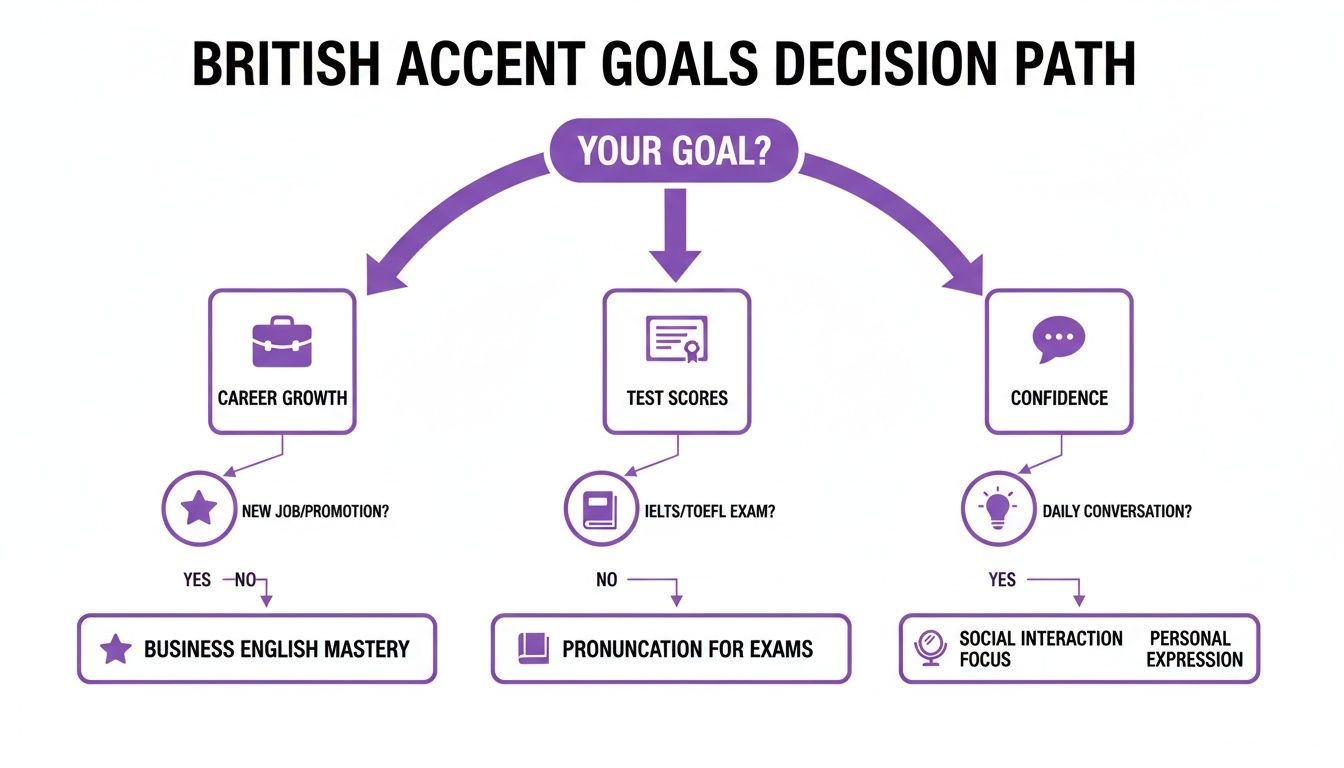
As you can see, someone aiming for a quick promotion might lean toward private coaching for fast results. On the other hand, if your goal is general confidence, a group class or even self-study could be a perfect fit.
Comparing British Accent Class Formats
To make sense of it all, here’s a quick breakdown of the most common formats. This table compares the key features of each learning style to help you weigh the pros and cons based on what matters most to you.
| Format | Best For | Average Cost | Pros | Cons |
|---|---|---|---|---|
| Private Coaching | Actors, executives, and anyone needing fast, targeted results. | £50 - £150+ per hour | Fully personalized curriculum, immediate feedback, and rapid progress. | Most expensive option; requires a consistent time commitment. |
| Group Classes | Learners who enjoy social interaction and peer practice; a good middle-ground option. | £15 - £40 per class | More affordable, builds confidence through group work, learn from others. | Less individual attention, pace is set by the group, not you. |
| Self-Paced Courses | Independent learners with unpredictable schedules or tight budgets. | £10 - £100 for a full course | Highly flexible, learn anytime, anywhere; very cost-effective. | No live feedback, requires strong self-discipline to stay on track. |
| Apps & AI Platforms | Casual learners and those needing supplementary practice on the go. | Free - £20 per month | Convenient, often gamified and fun, great for bite-sized practice. | Can lack depth, feedback may be generic without a human touch. |
Ultimately, the best format is the one you'll actually stick with. Think honestly about your motivation, your schedule, and how you learn best before making a decision.
Private One-on-One Coaching
This is the gold standard for personalized learning. You get to work directly with an accent coach who designs a program entirely around you—your specific goals, your native language's influence, and your unique pronunciation quirks. If you need to see results and see them fast, this is your best bet.
Of course, all that dedicated attention comes at a price, making it the most expensive route. But for an actor prepping for a role or a business leader about to give a career-defining speech, the investment is often a no-brainer. Every single minute of the session is laser-focused on your improvement.
Group Classes
Group classes, whether you find them online or in person, offer a great blend of structured learning and social interaction. There’s a certain energy that comes from practicing with other people who are on the same journey. It’s motivating, you learn from their questions, and it’s a fantastic way to build confidence in a supportive, low-pressure environment.
The trade-off? You get less one-on-one time with the instructor. A good teacher will make sure everyone gets feedback, but their attention is naturally divided. It’s worth thinking about what kind of ideal learning environment helps you thrive.
Self-Paced Online Courses and Apps
For anyone juggling a hectic schedule or a tight budget, self-paced learning is a game-changer. These online courses and apps give you the freedom to learn whenever you can squeeze it in—on your commute, during your lunch break, or late at night. They are easily the most affordable way to get started.
The biggest challenge with self-study has always been the lack of a feedback loop. It's one thing to listen and repeat, but how do you know if you're getting it right? Without an expert to catch subtle mistakes, it's easy to accidentally practice the wrong thing.
This is where modern technology is really stepping up. AI-driven platforms like TalkEasy are bridging the gap by offering instant, detailed feedback on your speech. They combine the convenience of an app with the kind of specific guidance that, until recently, you could only get from a human tutor. This makes self-study a far more powerful option than it ever was before.
What You Will Actually Learn in an Accent Course
Stepping into a British accent class for the first time can feel a bit mysterious. You might wonder if you'll just be repeating phrases over and over. The reality is far more structured and, frankly, more scientific. It's about building your skills from the ground up, much like a musician learns scales before they can play a symphony.

A good course will start with the absolute fundamentals: phonetics. You’ll be introduced to the 44 phonemes—the individual sounds—of the English language. From there, you'll learn how to physically produce the specific vowel and consonant sounds that define a British accent.
This gets very practical. It’s all about mastering the precise placement of your tongue, lips, and jaw. For example, you’ll work on the difference between the short 'a' in 'cat' (common in American English) and the broader 'a' sound you hear in 'bath' (a hallmark of Southern British English).
Moving Beyond Individual Sounds
Once you have a solid feel for the basic sounds, the focus shifts to how they all connect in natural, flowing speech. This is where the real artistry begins, as you move from pronouncing isolated words to communicating with authentic rhythm and melody.
A well-designed course introduces these more advanced concepts systematically, making sure each new skill builds on the last. You can explore some of these foundational ideas in our guide to English accents training.
Here are the key areas you’ll almost certainly cover:
- Intonation and Pitch: This is often called the "music" of the language. You’ll practice the rising and falling tones that distinguish British questions from statements.
- Stress Patterns: It's not just what you say, but how you say it. You'll learn which syllables to emphasize in words and which words to stress in a sentence to convey the right meaning.
- Connected Speech: This is the secret to sounding smooth and natural. You'll learn how native speakers link words together using techniques like assimilation (where sounds change) and elision (where sounds disappear entirely).
Tackling Common Hurdles
Every learner brings their own unique set of challenges, usually rooted in their native language. A good instructor knows this and provides targeted exercises to help you overcome those specific hurdles.
For instance, a Spanish speaker might need extra practice distinguishing between the 'sh' and 'ch' sounds, while a Mandarin speaker might focus on mastering the 'th' sound. A great course anticipates these issues and builds solutions right into the syllabus.
The demand for this kind of focused training is consistently high. At many language schools, accent-focused courses make up 10–20% of all offerings, which shows just how many international learners are looking for these specialized skills. For more detail, you can read the full report on language trends.
Ultimately, a good accent course provides a clear roadmap. It guides you from the basic mechanics of sound to the subtle nuances that make an accent sound truly authentic.
How to Choose a Class That Delivers Results
Finding the right British accent class is a lot like picking a personal trainer. The "best" one really depends on you—where you're starting from, what you want to achieve, and how you learn best. Taking the time to choose wisely is probably the single most important thing you can do to get that clear, confident accent you're after.
Before you hand over your hard-earned cash, you need to look past the flashy marketing. Think of it like a little investigation. A few key areas will tell you everything you need to know about the quality of a program or a coach.
Check Out the Instructor’s Credentials
First things first, look into the instructor's background. Are they a native speaker? What are their actual qualifications? You should be looking for credentials in fields like linguistics, speech therapy, or phonetics. This isn't just about sounding fancy; it shows they have a deep, technical grasp of how speech sounds are physically made. That's a world away from just hiring someone who happens to have the accent you like.
A truly skilled coach can pinpoint your specific pronunciation hurdles and give you exercises designed to fix them. Without that expertise, you’re often just mimicking sounds without understanding why they sound the way they do, which is a surefire way to slow yourself down. A big part of this is the teaching method itself, including how they go about designing effective learning experiences that actually work for students.
Dig Into the Course Syllabus
A good syllabus is your roadmap. It should lay out, week by week, exactly what you’ll be covering. A solid curriculum for accent training needs to hit these core components:
- Phonetics: Does it get into the nitty-gritty of vowel and consonant sounds that make British English unique?
- Intonation and Rhythm: Will you learn the "music" of the accent? This means things like sentence stress and pitch changes.
- Connected Speech: This is crucial. The course needs to teach you how native speakers naturally link words together so you don't sound robotic.
If the syllabus is vague or seems to focus more on vocabulary than pronunciation, it’s probably not the specialized training you need.
A trial lesson is your best friend here. It’s your chance to see the teaching style in action, ask a ton of questions, and figure out if you actually click with the instructor. Never underestimate how important good chemistry is, especially in a one-on-one setting.
Finally, see what kind of practice and feedback they offer. Will they record you so you can hear yourself? How often do you get direct, personalized corrections from the coach? That feedback loop is where the magic happens. By carefully looking at these points, you can find British accent classes that will genuinely help you speak with confidence.
Exploring Modern Alternatives to Traditional Classes
While a structured British accent class has long been the gold standard, it's certainly not the only game in town anymore. Technology has opened up a whole world of powerful, flexible ways to work on your pronunciation, catering to just about any learning style, schedule, and budget.
Think about self-study apps. Their biggest advantage is convenience—you can run through pronunciation drills on the bus, during your lunch break, whenever. Then there are language exchange partners, which are fantastic for getting a feel for natural conversation and building your confidence. But both of these methods often share the same Achilles' heel: the feedback is either non-existent or not from an expert. It's surprisingly easy to practice a mistake until it becomes a permanent habit without a trained ear to guide you.
This is exactly where AI-powered platforms are making a huge difference. They offer a fascinating middle ground, blending the structure of a formal class with the flexibility of solo practice.
The Rise of AI Accent Coaches
Tools like TalkEasy are designed to be your personal, on-demand pronunciation tutor. The technology listens to you speak and gives you immediate, granular feedback on everything from the way you form a tricky vowel sound to the musicality of your intonation. This creates a tight feedback loop that, until recently, you could only get from a private human coach.
Instead of vague advice, an AI coach can pinpoint the exact issue. It's not just "your 'a' sound is off"; it's a data-driven correction showing you how to fix it. The platform analyzes your speech patterns and serves up exercises specifically designed to strengthen your weak spots, so your learning path is constantly adapting to your real-time progress.
Here’s a glimpse of what it looks like to practice on a platform like TalkEasy.
As you can see, the interface gives you a clear, interactive way to practice speaking and get guidance on the spot. It's this powerful combination of convenience and hyper-detailed feedback that makes AI such a compelling tool for anyone serious about mastering a new accent.
By merging smart technology with proven teaching methods, AI platforms offer an accessible and effective way to support your learning. They provide the kind of structured environment that's essential for productive English speaking practice online, making sure every minute you invest pays off. Whether you use them on their own or to supplement a traditional class, these modern tools are making the goal of a clear British accent more attainable than ever.
Your Top Questions About British Accent Training Answered
Thinking about diving into British accent classes? It’s a great idea, but you probably have a few questions buzzing around. From how long it all takes to whether you'll lose your own accent, let's clear up some of the most common queries we get from students.
How Long Does It Really Take to Sound British?
This is the million-dollar question, isn't it? The honest answer is: it depends. Your starting point (your native language), how often you practice, and the quality of your coaching all play a huge role.
If you're putting in a solid 30-60 minutes of focused practice every day, you'll likely hear a real difference in your clarity and pronunciation within 3-6 months. But getting to a point where the accent sounds completely natural and effortless? That's more of a long-term project, often taking a year or more of consistent effort.
Do I Have to Sound Like the Queen?
Definitely not. The classic "BBC accent" (officially known as Received Pronunciation or RP) is what many people picture, but it's far from your only choice. In fact, most modern accent coaches focus on a more neutral, contemporary sound called Standard Southern British English. It's widely understood and doesn't sound quite as formal.
Ultimately, the right accent comes down to your personal goals. RP can be fantastic for formal business or acting, but if you're moving to Liverpool, picking up some local sounds might help you connect with people far more effectively.
Think of it this way: learning a British accent isn't about erasing your identity. It's about adding a new communication style to your toolbox. You're learning to 'code-switch'—to use the British accent when you need it, while keeping your native voice for every other part of your life.
Can I Just Teach Myself?
You can certainly get started on your own. There are tons of self-study resources out there, from YouTube videos to mobile apps, and they can be great for learning the basic sounds and rhythms of British English.
The biggest hurdle with going it alone, though, is the lack of feedback. It's incredibly hard to hear your own mistakes, and without a trained ear to guide you, you can end up practicing the wrong things over and over. This is where a structured class or a smart AI tool really shines—it gives you that crucial, real-time correction to keep you on the right track.
Will I Forget My Original Accent?
Not a chance. Your native accent is deeply ingrained, and learning a new one is an additive skill, not a replacement. It's more like learning to play the guitar—it doesn't make you forget how to play the piano.
You'll simply gain the flexibility to choose how you want to sound in different situations. Your original accent is part of your story, and accent training just gives you more ways to tell it.
Ready to practice with a tool that gives you instant feedback and lessons tailored just for you? TalkEasy uses smart AI and proven teaching techniques to help you build a confident British accent in just 15 minutes a day. Find out more and start your first practice session at https://www.talk-easy.com.