
Secrets to Becoming Fluent in a Language
Discover what it truly means to be fluent in a language. This guide covers realistic timelines, effective strategies, and daily habits to speak with confidence.


When someone says they’re "fluent" in a language, what do they actually mean? It’s not about perfection or sounding exactly like a native speaker. It’s about being able to express your thoughts and feelings smoothly and confidently, without constantly getting stuck searching for words.
At its core, fluency is about effective and comfortable communication, even if you still make the occasional mistake.
What It Really Feels Like to Be Fluent
Many learners get hung up on the idea that fluency is some distant, flawless finish line—a point where you know every single word and never make a grammar error. Honestly, that idea of perfection is the biggest myth in language learning. Real fluency is much more practical and, frankly, much more achievable.
Think of it like learning to play an instrument. A beginner can play a song they've rehearsed by reading sheet music note-for-note. But a fluent musician? They can improvise. They understand the music's structure so deeply that they can create new melodies on the spot, express themselves freely, and recover smoothly even if they hit a wrong note.
Shifting Your Goal from Perfection to Connection
The real aim shouldn't be to eliminate every error but simply to communicate what you mean. Fluency is the ability to navigate a conversation with ease, tell a story, explain a complex idea, or just chat without feeling like you're running a mental marathon. It’s about flow, not flawlessness.
Fluency is the state where the language is no longer the obstacle, but the tool. You stop translating in your head and start thinking and feeling in the new language, allowing for spontaneous and authentic expression.
Once you make this mental shift, it's incredibly liberating. It takes the pressure off to be perfect and reframes your learning around a much more motivating goal: genuine connection with other people.
Key Characteristics of a Fluent Speaker
So, what does this look like in the real world? A fluent speaker can generally:
- Express themselves spontaneously: They can jump into a conversation without needing to plan out what to say ahead of time.
- Understand nuances and context: They get the jokes, the sarcasm, and the cultural references that don’t have a literal translation.
- Handle communication breakdowns: If they can’t think of a word, they can easily describe it or find another way to get their point across without derailing the conversation.
- Speak with a natural rhythm and pace: Their speech flows smoothly, even if they have an accent that isn't native-like.
Getting your head around this more realistic definition is the first, most important step. It turns an intimidating mountain into a series of manageable hills. For more on what practical communication looks like, explore our guide on achieving fluency in English speaking and how to build real confidence. This foundation sets you up not just for learning a language, but for truly using it in your life.
Understanding Fluency vs. Proficiency
In the world of language learning, two words get tossed around all the time: fluency and proficiency. People often use them interchangeably, but they actually mean very different things. Nailing down this difference is the first step to setting goals that actually make sense and keep you motivated.
Think of it like this: fluency is all about your flow, while proficiency is about your accuracy.
Fluency is how smoothly you can get your point across. It’s about keeping a conversation moving without long, awkward pauses while you search for the perfect word. It's the art of communication in real-time. Proficiency, on the other hand, is your technical mastery—your command of grammar, the size of your vocabulary, and how "correct" your sentences are.
The Driver Analogy
Let's make this crystal clear with an analogy I love.
- Fluency is like driving a car through rush-hour traffic. You're merging, changing lanes, and reacting to other cars without really thinking about it. You get where you’re going smoothly. You probably don't know your engine's torque specs, but who cares? You're a confident driver.
- Proficiency is like acing the written driver's test. You can name every road sign, explain the mechanics of a four-stroke engine, and quote the traffic laws verbatim. But all that knowledge doesn't guarantee you won't freeze up the first time you have to parallel park on a busy street.
You can be incredibly proficient—a walking dictionary with flawless grammar—but still sound robotic in a real conversation. And on the flip side, someone can be wonderfully fluent, chatting away with natural rhythm and confidence, even if they make a few grammar mistakes here and there. For most people, focusing on fluency first makes learning feel less like a chore and more like a breakthrough.
This is why we often see that confidence and clear communication are the real cornerstones of feeling fluent, not some impossible standard of perfection.
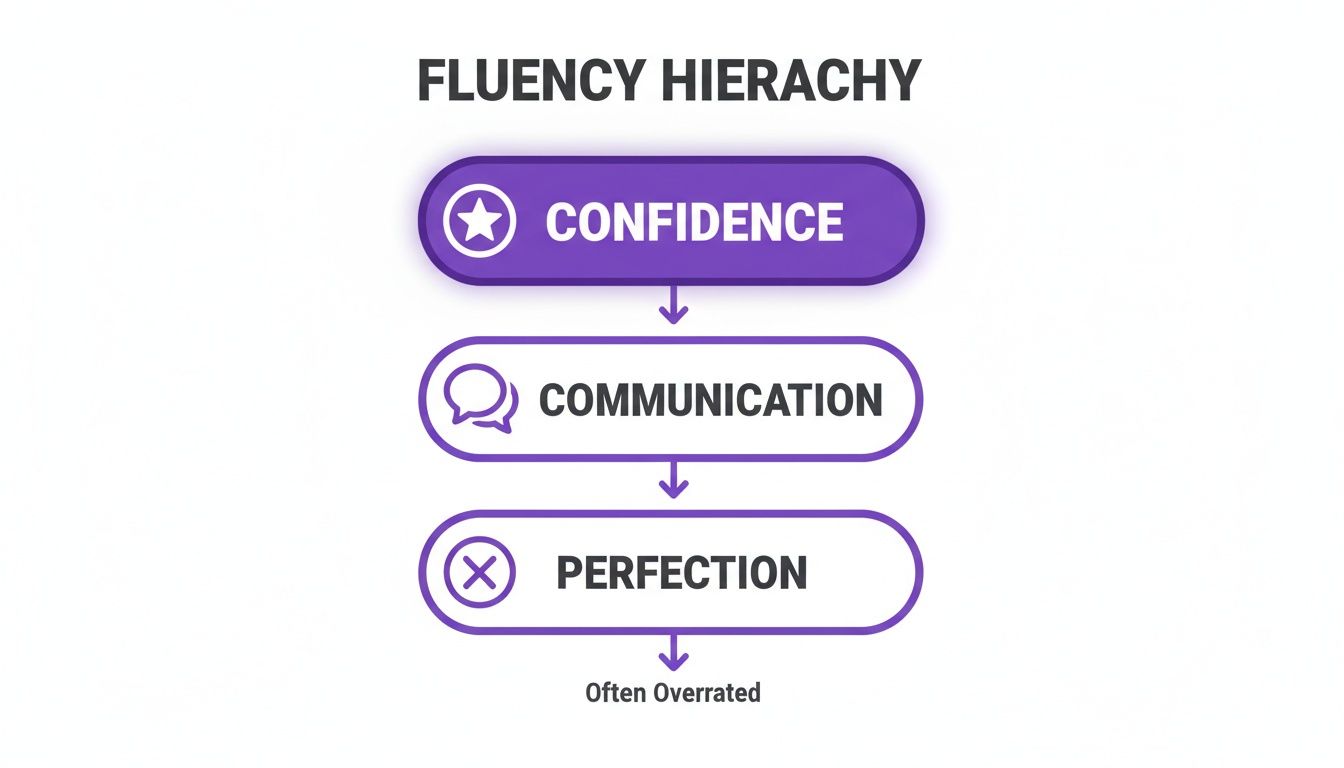
As you can see, it's about building from a foundation of simply being understood and feeling good about it.
How Language Skills Are Measured
So, if fluency is about flow and proficiency is about precision, how do experts actually measure where you are on your journey? A few standardized frameworks exist to give learners a roadmap. They help you pinpoint your current level and see what skills you need to tackle next.
These frameworks aren't just for passing exams. They turn the vague goal of "getting fluent" into a series of concrete, achievable steps. It’s like having a map for your language-learning road trip.
There are several systems out there, but you’ll most often run into the CEFR, ACTFL, and IELTS scales. Here’s a quick look at what their levels mean in the real world.
Language Skill Measurement Frameworks at a Glance
| Framework | Beginner/Novice Level (e.g., A1/A2) | Intermediate/Advanced Level (e.g., B1/B2) | Proficient/Mastery Level (e.g., C1/C2) |
|---|---|---|---|
| CEFR | Can handle basic introductions and simple, everyday tasks (ordering coffee, asking for directions). Relies on memorized phrases. | Can manage most travel situations and discuss familiar topics with some spontaneity. This is where most people start feeling "conversationally fluent." | Can use language flexibly and effectively for professional or academic purposes. Can express complex and nuanced ideas with ease. |
| ACTFL | Communicates with single words and short, rehearsed phrases. Can answer very simple, direct questions on familiar topics. | Can create with language, connecting sentences to tell simple stories or handle a routine problem (like a mix-up with a hotel reservation). | Can support opinions, argue a point, and discuss abstract topics in depth. Can handle linguistically unfamiliar situations with confidence. |
| IELTS (Speaking Band) | Bands 4-5: Can talk about familiar topics but with frequent pauses and errors. Communication often breaks down. | Bands 6-7: Can speak at some length and handle complex communication, despite some hesitation or occasional inappropriacies. | Bands 8-9: Speaks fluently with only rare, unsystematic errors. Has a full and flexible command of the language, much like a native speaker. |
These scales give you a common language to talk about your abilities and set clear targets for what you want to achieve next.
The CEFR Framework: A1 to C2
The Common European Framework of Reference for Languages (CEFR) is the global gold standard, especially in Europe. It neatly organizes language ability into six levels, from total beginner to near-native mastery.
- A1 (Beginner): You can introduce yourself and use very basic, everyday phrases.
- A2 (Elementary): You can get by in simple, routine situations and exchange information on familiar topics.
- B1 (Intermediate): You can handle most situations you'd encounter while traveling and talk about your experiences, hopes, and dreams.
- B2 (Upper-Intermediate): You can chat with native speakers with a good degree of spontaneity, without causing strain for either of you. Many people consider B2 the real threshold for being conversationally fluent.
- C1 (Advanced): You can use the language flexibly and effectively for academic, social, and professional life.
- C2 (Mastery): Your command of the language is on par with an educated native speaker. You can understand and express even the most subtle shades of meaning.
The ACTFL Scale: Novice to Distinguished
Developed in the United States, the scale from the American Council on the Teaching of Foreign Languages (ACTFL) is heavily focused on what you can do with the language in real-world scenarios. It breaks down into five major levels.
- Novice: You communicate using memorized words and short phrases.
- Intermediate: You can create your own sentences, ask and answer questions, and navigate simple, straightforward conversations.
- Advanced: You can tell stories and describe things in the past, present, and future. You can handle unexpected problems or complications with confidence.
- Superior: You can discuss abstract topics, support your opinions with detailed arguments, and even hypothesize.
- Distinguished: You use the language with a high level of precision and cultural nuance, much like an educated native speaker would.
Knowing where you fit within these frameworks is empowering. It helps you stop thinking "I'm bad at this language" and start thinking, "Okay, I'm at an A2 level, and my next goal is to be able to tell a simple story about my weekend." It's all about making progress one step at a time.
Setting a Realistic Timeline for Fluency
One of the very first questions that pops into every learner's head is, "So, how long until I'm fluent?" It's a fair question, but the internet is awash with wild promises like "Speak Like a Native in 3 Months!" Let's get real for a moment: reaching a point where you feel truly comfortable and fluid in a new language is a marathon, not a sprint.
Setting a timeline that actually works means tossing out those "get-fluent-quick" fantasies. Your progress is tied to a handful of personal factors, and getting to know them is the secret to building a learning plan that you can actually stick with, one that won't leave you feeling burnt out.
Key Factors That Shape Your Timeline
Your path to fluency is yours alone. While there’s no magic number, we can absolutely look at the variables that speed things up or slow them down. A great reference point comes from the U.S. Foreign Service Institute (FSI), which estimates it takes an English speaker around 600-750 classroom hours to get professionally proficient in languages like Spanish or French. For tougher ones like Japanese or Arabic? That number jumps to over 2200 hours.
This brings us to the first major factor: language distance.
- Language Proximity: How close is your target language to the one you already speak? An Italian speaker picking up Spanish has a huge advantage with all the shared words and grammar. An English speaker tackling Korean, on the other hand, is starting from a completely different foundation. Getting a clear roadmap to Korean fluency can really help set expectations for that kind of journey.
- Intensity of Practice: How much time are you really putting in each day? An hour of focused practice every single day will get you much further, much faster, than a two-hour cram session on a Sunday. Consistency beats cramming, every time.
- Your Learning Method: Are you just passively watching movies, or are you in the trenches, actively trying to have conversations? Methods that push you to speak and use the language from day one build practical, real-world fluency far more effectively than memorizing grammar charts.
Setting Achievable Expectations
Instead of getting fixated on some far-off, perfect end-point, it's so much more productive to think in milestones. Maybe your goal isn't C2-level perfection. Maybe it's hitting a solid B2, where you can handle most work meetings and social chats with confidence. That is an incredibly powerful and achievable goal.
It’s also motivating to remember just how many people have done this before you. Just look at English—an estimated 1.5 billion people speak it, which is about 17% of the world's population. The overwhelming majority of them are non-native speakers who got there through steady, consistent effort. It's proof that this is entirely possible.
The journey to fluency isn't about crossing a finish line. It's about consistently putting one foot in front of the other, celebrating the small wins, and building a system that weaves the language into your daily life.
Once you understand these factors, you can build a timeline that's both ambitious and grounded in reality. Forget the three-month fantasy. Focus on what you can do today, and tomorrow, and the day after that. That’s how real fluency is built.
Practical Strategies to Build Speaking Fluency
Knowing the theory behind fluency is great, but the real magic happens when you put it into practice. To actually speak a language with that smooth, natural flow, you have to move past passive learning—like endlessly scrolling through vocabulary apps—and start actively using what you know. It's all about training your brain to grab words and build sentences without thinking, creating that effortless rhythm we're all after.
Making that leap from knowing a language to using it can feel like a huge challenge, but it’s completely doable with the right approach. It’s less about locking yourself away for marathon study sessions and more about weaving smart, focused speaking exercises into your everyday life.

Thankfully, modern tools have made it incredibly easy to get this practice in a low-pressure way, targeting the exact skills you need for real-world conversations.
Get Your Speaking Muscles Moving
Listening to podcasts or binge-watching shows in your target language is fantastic for your comprehension, but it won’t build your speaking skills on its own. To get fluent, you have to actually produce the language. Here are a few powerful techniques that get you talking.
- Shadowing: This is a classic for a reason. You listen to a native speaker and repeat what they say almost simultaneously, trying to match their pronunciation, rhythm, and intonation. Think of it like tracing a drawing—you’re training your mouth and mind to copy the natural patterns of the language.
- Storytelling: Start small. Just try to describe your day or recount the plot of a movie you just watched. This pushes you to link ideas, use transition words, and string together more complex sentences, getting you beyond simple, robotic answers.
- Thinking in the Language: This one’s a game-changer. Try narrating your daily actions to yourself, but in your target language. "Okay, I'm making coffee now. I need to find the sugar." This simple habit builds the mental pathways for spontaneous thought and cuts down on the habit of translating everything in your head first.
These methods are designed to actively close the gap between what you understand and what you can actually say.
Find a Safe Space to Practice
Let’s be honest: one of the biggest things holding learners back is the fear of messing up in front of someone. This is where technology today gives you a massive advantage. Low-pressure environments let you practice without an audience, build confidence, and get comfortable speaking before you jump into higher-stakes conversations.
The secret to rapid fluency is frequency, not duration. Consistent, short bursts of practice are far more powerful than occasional, long study sessions. They build a sustainable habit and keep the language fresh in your mind.
AI conversation partners, like TalkEasy, are built for exactly this. They create a judgment-free zone where you can talk about anything you want. You can stumble over words, correct yourself, and try out new phrases without the anxiety that can come with talking to a human tutor.
This kind of tool fits neatly into a busy life. Just 15 minutes of daily conversation can make a huge difference in your speaking flow, helping you build that crucial habit of using the language every single day. For more tips on building a solid practice routine, check out our guide on how to practice English speaking.
Learn to Love Your Mistakes
So many learners see mistakes as failures. Fluent speakers? They see them as data. Every error you make is a little signpost telling you exactly what to focus on next. Messed up a verb tense? Great—now you know which one to review. Couldn't find the right word? Perfect—that’s a new vocabulary item to add to your list.
Adopting this kind of growth mindset is everything for long-term progress. Here’s how to do it:
- Expect to Make Mistakes: Nobody speaks perfectly, not even native speakers. Accept that errors are a normal, even necessary, part of the journey.
- Focus on Communication: Did the other person get your point, even with the mistake? If so, you succeeded. That’s a win!
- Correct with Curiosity, Not Criticism: Instead of beating yourself up over an error, get curious. Why did you make that mistake? What's the right way to say it? This simple shift turns a negative feeling into a productive learning moment.
When you embrace imperfection, you dismantle the mental block that stops so many people from ever speaking at all. This change in perspective is often the most important step you can take toward true fluency. For a deeper look at different methods, this practical guide on how to become fluent in a language is an excellent resource.
By combining these strategies—active techniques, low-pressure practice, and a positive mindset—you create a powerful system for building real, functional speaking skills.
Building Your Daily Fluency Routine
Fluency doesn't happen overnight. It’s not about one heroic, all-night study session or a week-long cram before a trip. True fluency is built brick by brick, through small, consistent habits that weave language practice right into the fabric of your everyday life.
The secret is to stop seeing language learning as this monumental task looming over you. Instead, think of it as a natural part of your day, just like making coffee or checking your email. This mindset shift makes the whole process feel manageable and, believe it or not, enjoyable.
You don't need to magically find an extra hour in your day. It’s all about finding those little pockets of time—the commute, the queue at the grocery store, the five minutes before a meeting—and putting them to good use.
The Simple Fluency Formula
So, how do you build a routine that actually sticks? The most effective approach balances three core activities. Think of it as a simple formula designed to build well-rounded skills without leading to burnout.
A solid routine should include a daily dose of:
- Active Speaking (15-20 minutes): This is the non-negotiable part. It’s when you’re actually producing the language, forming sentences on the fly, and training your mouth and mind to work together in real-time.
- Passive Listening (20-30 minutes): This is how you tune your ear to the natural rhythm, intonation, and speed of the language. It’s about soaking it all in.
- Focused Vocabulary Building (10-15 minutes): This is your targeted effort to learn and review the words and phrases that give you the power to express yourself.
This simple structure gives you a clear road map. Now, let’s see how this plays out in the real world for different kinds of learners.
Sample Routines for Different Lifestyles
Let's be realistic: a routine that works for a university student with a flexible schedule won't work for a professional juggling back-to-back meetings. The key is to find a rhythm that feels sustainable for you.
Consistency trumps intensity every single time. A daily 15-minute conversation is far more powerful for building long-term fluency than a single two-hour study session once a week. It keeps the language fresh and turns practice into a reflex.
Here’s what this might look like in practice.
For the Busy Professional
Your time is your most valuable asset, so every minute counts. The goal here is high-impact activities that slot neatly into the gaps of your day.
- Morning Coffee (15 mins): Kickstart your day with a quick AI-powered conversation on TalkEasy. It’s a low-pressure way to get your active speaking in before the chaos of the workday begins.
- Commute (30 mins): Turn your drive or train ride into a classroom. Listen to a podcast or an audiobook in your target language to nail your passive listening goal.
- Lunch Break (10 mins): Instead of scrolling through social media, spend a few minutes with a flashcard app or read a short news article. It’s a quick mental reset that keeps you in the zone.
For the Dedicated Student
With a bit more flexibility, you can create a more immersive environment. Your focus is on maximizing exposure and finding more opportunities for genuine interaction.
- Morning (30 mins): Start the day by journaling in your target language. Just a few sentences about your plans or thoughts is a fantastic way to activate your vocabulary.
- Afternoon (1-2 hours): Dive deeper. Find a language exchange partner for a real conversation or watch a movie without subtitles to really challenge your listening skills.
- Evening (20 mins): Wind down by reading a few chapters of a book or hopping on a language-learning app to chat with other learners.
Finding the right mix of strategies is what will keep you moving forward. For a deeper dive into effective habits, our article on the best way to learn English offers principles you can apply to any language. By building a routine that actually fits your life, you turn learning from a chore into a rewarding daily ritual.
The Brain-Boosting Perks of Your Fluency Journey
Most people start learning a language for practical reasons—to travel without a phrasebook or to get a leg up in their career. Those are great goals, but the real prize is what happens inside your head along the way. Think of it as one of the best workouts you can give your brain, literally rewiring it to be stronger, faster, and more flexible.
This isn't just about self-improvement; it's a direct investment in your long-term cognitive health. Pushing yourself toward fluency is like sending your brain to the gym. You're building up mental muscle that pays dividends for years to come.
How a Second Language Sharpens Your Mind
The mental gymnastics of switching between two languages gives your brain a constant, low-grade workout. This consistent effort strengthens the dorsolateral prefrontal cortex, which is basically your brain's command center. It’s the part that handles problem-solving, switching between tasks, and keeping you focused.
Because of this, people who speak more than one language often get a nice cognitive upgrade in a few key areas:
- Better Multitasking: They find it easier to juggle different tasks and switch gears without getting mentally tripped up.
- Sharper Problem-Solving: Seeing the world through the lens of two different language systems encourages more creative and out-of-the-box thinking.
- Stronger Memory: Research shows that bilinguals tend to have a better working memory, making it easier to remember things like a list of items or a sequence of directions.
The benefits even show up decades down the line. Studies have found that lifelong bilingualism can delay the onset of dementia and other forms of cognitive decline by several years, creating what scientists call a "cognitive reserve."
This mental boost is a fantastic side effect of all your hard work. Every hour you spend practicing is another deposit into your brain's long-term health and performance account.
You're Joining a Massive Global Club
Beyond the personal brain gains, becoming fluent connects you to a huge, ever-expanding global community. It's a passport not just to new places, but to new cultures, new friendships, and entirely new ways of seeing the world. And you’re in good company.
Being able to speak two languages fluently is quickly becoming the new normal. Today, at least 50% of the world's population speaks more than one language. That number is only growing, especially with younger generations who have grown up in a digitally connected world. You can dig into more fascinating figures by checking out these bilingualism statistics on preply.com.
Ultimately, the path to fluency is about so much more than memorizing vocabulary. It’s about unlocking your brain’s potential, building a sharper mind, and finding your place in a world that’s more connected than ever. Every conversation you have and every new phrase you master is a step toward a much richer life.
A Few More Questions On Your Mind
Even with the best roadmap, a few questions are bound to pop up on the journey to fluency. Let's tackle some of the most common ones I hear from learners.
Can I Get Fluent Just by Using Apps?
Language apps are brilliant for what they do—drilling vocabulary, sorting out grammar rules, and getting you comfortable with the basics. But on their own, they won't get you to true speaking fluency. Think of it like this: you can read all the books on how to swim, but you only learn to swim by getting in the water.
To build that conversational muscle, you need to be actively forming sentences and responding in real-time. That's where tools built for conversation or practice with real partners come in. Use apps as a powerful supplement, not your only strategy.
Is It Possible to Lose My Fluency?
Unfortunately, yes. Language skills are like any other skill: if you don't use it, you lose it. The official term for this is language attrition, and it's a real thing. If you stop using the language, you might find your recall getting slower and your vocabulary shrinking over time.
The good news is, maintaining your fluency doesn't have to be a chore. Weave it into your daily life. Listen to podcasts on your commute, watch a show in the evening, or have a quick chat online. A little bit of consistent exposure goes a long way.
What’s the Difference Between Being Bilingual and Fluent?
It's easy to mix these two up, but they describe different things. Bilingualism usually refers to someone who grew up speaking two languages or can operate in two languages at a very high level, often from an early age.
Fluency, on the other hand, is all about how smoothly and effectively you can communicate in a specific language. You can absolutely become fluent in a language as an adult without ever being considered a native or bilingual speaker. The goal isn't to rewrite your personal history with the language; it's to communicate clearly and with confidence.
Ready to build a consistent speaking habit and see real progress? TalkEasy provides a judgment-free space to practice conversation for just 15 minutes a day. Start speaking with confidence by visiting https://www.talk-easy.com and begin your journey today.