
How Can I Improve My English Speaking Skills for Real Fluency
Stuck asking 'how can i improve my english speaking skills?' Discover a practical guide with actionable exercises and daily habits to build real confidence.


If you're serious about improving your English speaking, forget about cramming. The real gains come from building small, consistent habits that fit into your everyday life. It’s about creating a powerful learning loop: practice a little each day, actively use what you learn in real conversations, and get smart feedback to iron out the kinks.
Just 15 minutes of focused effort daily can completely change how naturally and confidently you speak.
Your Action Plan for Speaking English Confidently
So many learners get bogged down trying to memorize massive vocabulary lists or nail every single grammar rule. While those things have their place, the actual secret to speaking better English is much simpler: you have to use the language. It's less about what you know and more about what you can do with it.
Instead of staring at the mountain of "learning English," let's break it down into small, manageable steps. This isn't a textbook theory; it's a real-world action plan designed to get you speaking from day one.
The Three Pillars of Fluency
When you get right down to it, real progress in spoken English stands on three core pillars. If you focus your energy here, you'll create a cycle of improvement that delivers results much faster than just studying on your own.
- Daily Practice: This is non-negotiable. You have to make speaking English a part of your daily routine, even if it's just for a few minutes. Consistency is what builds the muscle memory for speaking without thinking. Think of it like going to the gym—short, regular workouts are far more effective than one marathon session once a month.
- Active Engagement: It's time to get off the sidelines. You have to move beyond just listening or reading and start producing the language yourself. This could mean talking with a native speaker, practicing with an AI partner like TalkEasy, or even just narrating your daily activities out loud. The goal is to make your mouth and brain work together.
- Meaningful Feedback: Mistakes are your best friends on this journey. Seriously. But a mistake is only useful if you learn from it. You need a way to get feedback on what you’re doing wrong—whether that’s from a teacher, a patient friend, or an AI tool that can gently correct your pronunciation and grammar.
The goal isn't perfection; it's communication. Shifting your mindset from "I must not make any mistakes" to "I want to express my ideas clearly" is the first and most important step toward becoming a confident English speaker.
This whole approach is about weaving smart, targeted practice into your actual life. We're not adding another stressful chore to your to-do list. We're going to build a sustainable routine that turns small daily actions into massive long-term confidence.
Quick-Start Daily English Speaking Habits
To get you started right away, here are a few high-impact habits you can adopt. They're designed to be quick, easy, and incredibly effective.
| Daily Habit | Time Commitment | Primary Benefit |
|---|---|---|
| Shadow a Podcast Clip | 5 minutes | Improves your rhythm, intonation, and pronunciation by mimicking native speakers. |
| Describe Your Surroundings | 3 minutes | Builds active vocabulary and helps you think on your feet in English. |
| Record a 1-Minute Voice Memo | 1 minute | Gets you comfortable hearing your own voice and tracks your progress over time. |
| Practice One Role-Play | 5 minutes | Prepares you for specific real-world situations, like ordering coffee or a job interview. |
| Review Feedback from TalkEasy | 1 minute | Reinforces learning by focusing on correcting one or two specific mistakes from a prior session. |
Picking just one or two of these to start with can build incredible momentum. The key is to just start and stay consistent.
Your Power-Packed 15-Minute Daily Speaking Routine
So many learners think improving their English speaking means carving out huge chunks of their day for study. I've found the opposite to be true. When it comes to real progress, consistency always wins over intensity. The secret isn't finding more time; it's about mastering the small windows of time you already have.
A focused 15-minute session every day will do more for your fluency than a two-hour cram session once a week. This isn't just about talking more; it's about deliberate practice—using highly structured activities to attack your specific weak spots.
What Is Deliberate Practice, Really?
It’s the difference between just chatting and training with a clear purpose. Instead of randomly talking, every session has a goal. Maybe today's goal is to nail five new phrasal verbs. Tomorrow, it might be perfecting that tricky "th" sound. Or perhaps you want to practice how to politely interrupt someone in a business meeting.
This kind of targeted effort is what actually moves the needle. Research consistently shows that short, focused practice sessions built around clear goals, repetition, and immediate feedback yield far better results than just unstructured exposure. I've seen students who commit to just 15–30 minutes of this kind of focused speaking make steady, noticeable gains in as little as 8–12 weeks.
Designing Your Week for Maximum Impact
Doing the same thing every day is a recipe for boredom. To keep things fresh and effective, you need variety. A good routine works on all the different muscles of speaking: pronunciation, vocabulary, natural flow, and, of course, confidence.
Here’s a sample schedule I often recommend. Feel free to adapt it to fit your own life. Each activity is designed to take about 15 minutes.
- Monday - Monologue Day: Pick a simple topic—your favorite movie, what you did over the weekend—and record yourself talking about it for three minutes straight. The goal isn't perfection; it's just to keep talking and get your thoughts flowing.
- Tuesday - Shadowing Session: Find a short audio or video clip of a native speaker. A podcast, a TED Talk, even a scene from a TV show works perfectly. Listen to one sentence, pause the clip, and repeat it aloud. Try to copy the speaker’s exact rhythm, intonation, and pronunciation.
- Wednesday - Real-World Role-Play: This is where a tool like TalkEasy comes in handy. Run through a practical, real-world scenario. You could practice ordering food, handling a customer service call, or asking for directions in a new city. This is how you build confidence for the conversations you'll actually have.
The process of building fluency really comes down to three things: practice, engagement, and feedback. They all feed into each other.
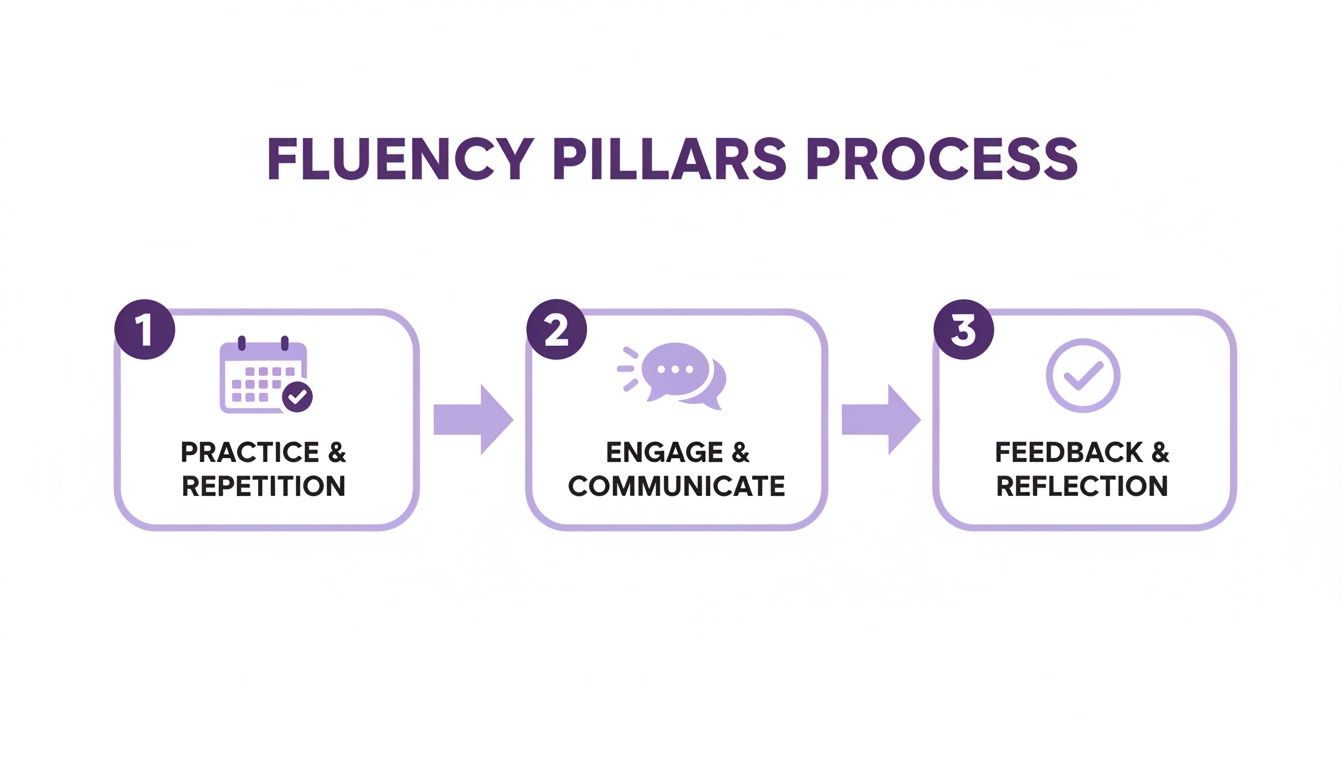
As this shows, consistent practice is what leads to active engagement, which in turn gives you the feedback you need to actually improve. It's a powerful cycle.
- Thursday - Vocabulary in Action: Choose three new words or phrases you’ve learned this week. Your mission for the day is to use each one in a spoken sentence. You can just say them out loud to yourself or try to weave them into a practice conversation.
- Friday - Fluency Drill: Set a one-minute timer. Pick a random object in your room—a lamp, a book, a coffee mug—and talk about it nonstop until the timer goes off. The point isn't to say anything profound; it's to train your brain to speak continuously without pausing to search for words.
- Saturday - Review and Reflect: Go back and listen to your monologue recording from Monday. What do you notice? Are there any grammar mistakes you keep making? Any words you consistently mispronounce? This self-correction step is absolutely critical for progress.
- Sunday - Rest or Fun Day: Give yourself a break! Or, if you’re feeling motivated, do something fun in English, like singing along to a song or watching a movie without subtitles.
The best routine is the one you actually stick with. If this schedule feels like too much, start with just three days a week. The goal is to build a sustainable habit that turns small, consistent efforts into big wins.
This structured approach makes sure you’re not just speaking more, but speaking better. By focusing your limited time on targeted activities, you make every single minute count. Our guide on the best way to learn English dives deeper into other powerful habits you can build into your day. This method can transform the intimidating task of improving your English into a manageable—and even fun—part of your daily life.
Practical Speaking Exercises That Actually Deliver Results
A solid routine is your foundation, but the specific exercises you do are what truly build the skill. The real secret to improving your English speaking isn't just theory—it's using proven techniques that train your brain and mouth to finally work together.
Let’s get into a toolkit of exercises designed for real-world results.

These aren't just random activities; think of them as targeted workouts for your spoken English. We'll focus on three powerful methods—shadowing, role-playing, and fluency drills—that each tackle a different part of the speaking puzzle.
Master Natural Flow with Shadowing
Ever notice how native speakers have a certain "music" to their speech? That rhythm and intonation are often the biggest things that make a non-native speaker stand out. Shadowing is the most direct way to fix this.
It’s pretty simple: you mimic a native speaker's speech in real-time, just like an echo. This exercise trains your mouth to make English sounds more naturally and tunes your ear into the flow of the language. It’s less about understanding every word and more about capturing the melody.
Here’s an easy way to get started:
- Find your audio: Pick a short, clear audio clip (1-2 minutes) of a native speaker. A podcast clip, a short news segment, or a TED Talk are all fantastic options.
- Listen first: Play the clip once just to get a feel for the speaker's pace and tone.
- Shadow in bursts: Now, play it again. This time, start speaking along with them, just a second or two behind. Don't stop the audio—just try to keep up.
- Focus on sound, not sense: Your goal isn't perfect comprehension at first. It's to match the speaker's intonation (the rise and fall of their voice), rhythm (the pattern of stressed syllables), and pacing.
It will feel weird at first, but that's a good sign! Even 5 minutes of shadowing a day can make your pronunciation sound much more natural over time.
Build Confidence with Real-World Role-Playing
Knowing vocabulary is one thing. Actually using it under pressure is something else entirely. Role-playing is the bridge between knowing a word and being able to use it in a real conversation.
This is especially powerful for situations that make you nervous, like a job interview or trying to sort out a problem with customer service. Platforms like TalkEasy are even built around this idea, offering AI-powered scenarios that feel incredibly real without the real-world pressure.
To get the most out of role-playing:
- Define the scenario: Get specific. Don't just practice "ordering at a restaurant." Instead, try "ordering a coffee with a complicated request and paying with a credit card that might not work."
- Prep key phrases: What vocabulary will you need? For that coffee shop scenario, think of phrases like, "I'd like a...", "Can I get that with...?", or "Do you take card?"
- Act it out: The most important part is to speak out loud, whether you’re practicing by yourself, with a partner, or using an AI tool.
By rehearsing these situations, you're not just memorizing lines. You're building mental templates that your brain can grab automatically in a real conversation, which is key to reducing that "oh no, what do I say?" panic.
Train Your Brain for Speed with Fluency Drills
Fluency isn't about using big, impressive words. It’s about speaking smoothly, without those long, awkward pauses while you search for the perfect grammar. Fluency drills are designed to stop you from overthinking and train your brain to produce speech more automatically.
One of the best drills is the "non-stop speaking" exercise. It's incredibly simple but works wonders.
- Pick a topic: Choose something easy and familiar. "My desk," "my favorite food," or "what I did this morning" are perfect.
- Set a timer: Start with just 60 seconds.
- Speak without stopping: Hit start and just talk about your topic until the timer goes off. The only rule is: you cannot stop talking. If you get stuck, say whatever pops into your head ("um, I'm not sure what to say next, but...") until a new thought arrives.
This exercise forces your brain to connect ideas faster and rely on the English you already have, building the muscle memory you need for effortless, natural speech.
Comparing English Speaking Exercises
Not every exercise is right for every goal. Choosing the right tool for the job makes all the difference in your progress. Here’s a quick breakdown of what each exercise does best, helping you pick the perfect one for your daily practice.
| Exercise | Main Skill Developed | Best For |
|---|---|---|
| Shadowing | Pronunciation, Rhythm, Intonation | Learners who sound robotic or want to reduce their native accent. |
| Role-Playing | Situational Confidence, Vocabulary | Preparing for specific events like interviews, meetings, or travel. |
| Fluency Drills | Automaticity, Speaking Speed | Overcoming hesitation and the habit of translating in your head. |
By mixing these exercises into your routine, you'll be targeting your weaknesses from every angle. Shadowing makes you sound right, role-playing makes you feel ready, and fluency drills make you speak smoothly. Together, they create a powerful system for real improvement.
Finding People and Tools to Practice Speaking With
You can't learn to speak English by reading a textbook. That's like trying to learn to swim from a manual—it just doesn't work. Speaking is a physical skill, an action, and it demands real, consistent practice. For most learners, the biggest roadblock isn't a lack of words; it's finding someone to actually talk to on a regular basis.
To really get fluent, you need to increase your "conversation frequency." This means you need reliable partners and tools that fit into your life. Let's look at the best ways to find them, weighing the good and the bad of each so you can build a routine that works for you.
The Power of Human Connection
There's something irreplaceable about talking to another person. It’s spontaneous. It's real. You learn to read social cues, navigate unexpected questions, and handle the natural rhythm of a live discussion.
- Language Exchange Partners: Think of this as a "you teach me, I teach you" setup. You find a native English speaker who wants to learn your language, and you help each other. Apps like Tandem or HelloTalk are great for this. It’s free and authentic, but be prepared to spend just as much time teaching as you do learning.
- Community Groups and Meetups: Websites like Meetup are full of local groups for English learners or international communities. These are perfect for practicing in a low-pressure social setting. While you'll definitely build confidence, you might not get a lot of specific corrections on your grammar.
- Professional Tutors: A good tutor is like a personal trainer for your English. They create a plan just for you, pinpoint your exact mistakes, and give you targeted exercises to improve. This is easily the most effective path, but it's also the most expensive.
Using Technology for On-Demand Practice
The trickiest part about practicing with people is lining up your schedules. This is where technology really shines, giving you a way to practice whenever and wherever you want.
AI-powered tools offer a judgment-free zone. You can stumble over words, repeat phrases, and build confidence without worrying about what someone else thinks. They are built for quick, frequent practice sessions without the headache of coordinating with another person.
Here's a look at the simple interface of an AI-powered practice tool.
The design is all about getting you into a conversation quickly. You can choose a real-world scenario and start practicing for it immediately—a huge plus when you only have a few minutes to spare.
The goal isn’t to replace human interaction, but to supercharge it. Use an AI tool for your daily drills, and then connect with a human partner for a longer chat once a week. This combination creates a powerful, well-rounded routine.
Finding the Right Mix for You
Ultimately, the best strategy is a blended one. The most important thing is consistency. The data is clear: learners who boost their practice to 3–5 sessions per week with advanced partners see much faster progress. Some platforms have even found that students who increased their weekly speaking time from under 60 minutes to over 240 minutes saw significant gains in confidence and accuracy within just 6–10 weeks. You can read more about these global English proficiency findings.
For a lot of people, an AI tool is the perfect way to get started. An English conversation practice app helps you build a solid foundation by getting you comfortable with different types of conversations and providing instant feedback.
This practice prepares you to get the absolute most out of your time when you finally do connect with native speakers. It's all about turning every spare moment into an opportunity to speak.
How to Correct Mistakes and Actually See Your Progress
Let’s get one thing straight: making mistakes in English isn't just okay—it's essential. Every error is a signpost pointing directly to what you need to work on next. But the real growth kicks in when you stop just making mistakes and start actively learning from them. This is how you finally break through that feeling of being stuck.
The goal isn't to become flawless overnight. It’s about building a simple, repeatable system for catching your own errors, understanding why you made them, and actually seeing your improvement over time. Let's dig into some practical ways to turn your mistakes into your most powerful learning tools.
Become a Mistake Detective
First things first, you have to get better at noticing your own patterns. So many learners repeat the exact same mistakes for months, or even years, simply because they aren't consciously aware of them. The easiest way to fix this is with an 'error log.'
This doesn't need to be anything fancy. A small notebook or a note on your phone is perfect. After you practice speaking, take just two minutes to jot down any mistakes you noticed or that a speaking partner pointed out.
- Pronunciation: Did you stumble over a tricky word like "through" or "world"? Write it down.
- Grammar: Did you mix up prepositions like "in" and "on" again? Log it.
- Vocabulary: Did you grab for a word and use the wrong one for the context? Make a note.
After just a couple of weeks, you'll start to see your most common challenges pop up again and again. This focused awareness is the first real step toward correcting them for good. You can see how your own log stacks up against our guide on common grammar mistakes in English and spot the overlap.
Using Feedback Without Feeling Discouraged
Feedback is a gift, but let's be honest, it can sometimes sting like criticism. The secret is to reframe it as data, not judgment. Whether you're getting pointers from a friend or instant corrections from an AI tool, your mindset makes all the difference.
When someone corrects you, their feedback isn't a comment on your intelligence—it's a shortcut to your next level of fluency. Treat every piece of advice as a valuable clue on your improvement journey.
With human partners, you can guide the feedback by saying something like, "Hey, I'm really working on my tenses. If you hear me mess up the past tense, could you let me know?" This directs their help to where you need it most. Tools like TalkEasy provide a more private way to get that feedback, offering instant corrections without the pressure of a live audience.
Make Your Progress Visible (and Measurable)
Feeling like you aren't improving is one of the biggest motivation killers out there. That’s why tracking your progress isn't just a nice-to-have; it's a critical part of staying in the game. You need to create your own proof of how far you've come.
The absolute best way to do this is by recording yourself. It might feel a little awkward at first, but it provides undeniable evidence of your growth.
- Record a Baseline: Today, pull out your phone and record a one-minute audio clip. Just talk about a simple topic, like your daily routine or a favorite hobby.
- Save and Forget: Save the file with today's date and then resist the urge to listen to it.
- Repeat Monthly: At the end of each month, do it again. Record yourself talking about the exact same topic for one minute.
After three months, go back and listen to all three recordings in order. The difference will probably shock you. Your pronunciation will be sharper, you'll hesitate less, and your word choice will be more natural. This isn't just a feeling; it's data-driven proof that your hard work is paying off.
Setting SMART Goals for Speaking
Vague goals like "I want to speak better" are impossible to measure and lead to frustration. To really track your success, your goals need to be Specific, Measurable, Achievable, Relevant, and Time-bound (SMART).
Ditch the fuzzy goals and try something like this instead:
- Specific: "I will reduce my use of filler words like 'um' and 'uh' when talking about my job."
- Measurable: "I will have one 15-minute conversation with a native speaker each week without switching back to my native language."
- Achievable: "This week, I will learn and correctly use three new phrasal verbs related to business in my practice sessions."
- Relevant: "To prepare for my job search, I will practice answering common interview questions in English."
- Time-bound: "By the end of this month, I will be able to explain my professional background in a two-minute monologue without reading from a script."
This structured approach turns your learning from a random walk into a focused march toward clear milestones you can actually celebrate. It gives you a roadmap for how you can improve your English speaking skills in a way you can see and feel.
Quick Wins for High-Stakes English Conversations
Daily practice is your long-term game plan, but what about when you need to speak clearly and confidently right now? High-stakes situations—an important job interview, a key client meeting, or navigating a foreign country—don't wait for you to be perfectly fluent.
These moments can feel intense, but a few smart strategies can help you handle them with poise. Think of these as your go-to tactics for immediate impact.

Let's break down how to approach three common high-pressure scenarios.
Ace That Job Interview
When you're nervous in an interview, structure is your lifeline. It keeps your answers focused and prevents you from rambling. For those classic "Tell me about a time when..." questions, the STAR method is a simple, brilliant framework.
- Situation: Set the scene. ("In my last role, we had a major project deadline approaching.")
- Task: Define your role. ("My task was to coordinate with three different departments to finalize the report.")
- Action: Explain what you did. ("I organized daily check-in meetings and created a shared tracking document.")
- Result: Share the outcome. ("As a result, we submitted the report 24 hours ahead of schedule.")
Speak Up in Professional Meetings
Jumping into a fast-paced meeting can be intimidating. The key is to have a few phrases in your back pocket so you can contribute without feeling like you're interrupting rudely.
Here are a few ways to gracefully enter the conversation:
- "If I could just add one thing..."
- "That's a great point. To build on that..."
- "May I jump in here for a moment?"
Of course, speaking is only half the battle. To really contribute, you need to understand the conversation's flow. Honing your listening abilities is just as important, which is why incorporating strategies for improving active listening skills can be a game-changer.
Communicate Confidently While Traveling
When you're on the road, your goal is simple: be understood. Whether you're asking for directions or dealing with a hotel mix-up, there's no need for fancy grammar. Keep it simple.
In high-pressure situations, clarity beats complexity. Use simple sentence structures and essential vocabulary. Your goal is to be understood, not to sound like a poet.
Before your trip, jot down a few "survival phrases." Think about what you'll realistically need. Questions like, "Could you please show me on the map?" or "Is there a pharmacy nearby?" can save you a lot of stress. Having these ready to go lets you handle important interactions with much more confidence.
Common Questions About Improving English Speaking Skills
As you work on your fluency, you'll probably run into a few common roadblocks. Trust me, you're not alone. Let’s tackle some of the questions I hear most often from English learners.
How Can I Start Thinking in English?
This is a huge milestone, and it’s all about building new habits. The simplest way to start is by becoming your own narrator.
As you go about your day, describe what you're doing in your head—but do it in English. Instead of thinking in your native language, switch to, “Okay, I’m making a cup of tea. Where’s the milk?” It feels a bit silly at first, but this simple exercise forces your brain to build the connections needed for spontaneous speech.
Another great trick? Ditch the bilingual dictionary. When you come across a new word, look it up in an English-to-English dictionary. This keeps you immersed in the language and helps you define concepts in English, rather than constantly translating back and forth.
Why Do I Understand Everything but Can’t Speak Well?
Ah, the classic frustration. If you’ve ever felt this way, you're in good company. Listening and speaking are fundamentally different skills—one is receptive (taking information in), and the other is productive (creating something new).
You've likely spent countless hours absorbing English through movies, music, and podcasts, building a massive "passive" vocabulary. But speaking requires you to pull those words and grammar rules out of your memory on the spot. It’s a completely different mental muscle.
Many learners grapple with this common challenge of understanding but not speaking. The only way to close that gap is to actively practice speaking, even when it feels clunky or slow.
The moment you start speaking is the moment you start improving. Don’t wait for a "perfect" time. Every conversation, even with yourself, builds the active skill of production and moves you closer to real fluency.
This is exactly why that daily 15-minute practice session is so important. It’s designed specifically to train your productive skills, turning what you know into what you can confidently say.
Ready to turn your knowledge into confident speech? TalkEasy provides a judgment-free space to practice real-world conversations anytime, anywhere. Start your journey to fluency today at https://www.talk-easy.com.