
How to Answer Behavioral Interview Questions: Master the STAR Method
Learn how to answer behavioral interview questions with a proven STAR framework, real-world examples, and tips to ace your next interview.


To really nail behavioral interview questions, you need a game plan. The secret isn't just saying you have the skills—it's proving it. You do that by sharing specific, compelling stories from your work history. That's what makes your answers stick.
Why Interviewers Ask Behavioral Questions
Ever walked out of an interview feeling like you just told a bunch of disconnected stories? Those questions like, "Tell me about a time you faced a tough challenge," aren't random. They're designed to get to the heart of who you are as a professional.
Hiring managers lean on these questions because of a simple, powerful belief: past performance is the best predictor of future behavior. They're digging for concrete evidence. After all, anyone can claim to be a "great team player," but a story about how you navigated a tricky conflict between two colleagues? That’s proof.
Beyond Technical Skills
Your technical chops are just one part of the equation. Companies need people who can also:
- Solve messy problems: What do you do when the plan goes completely off the rails?
- Work with others: Can you find common ground with different personalities to get the job done?
- Bounce back: How do you handle failure, tough feedback, or a high-stakes deadline?
These questions open a window into your soft skills. These are the traits that really determine if you’ll mesh with the team and thrive in the company culture.
This isn't a new trend, either. It's now the industry standard. As of 2025, around 67% of employers use behavioral questions, and a whopping 72% of hiring managers say they prefer them. For job seekers, this presents a real challenge; 60% of candidates admit these are the hardest questions to answer. You can dive deeper into interview trends and data to see just how critical this skill has become.
The big idea here is that employers aren't just hiring a résumé; they're hiring a person. Behavioral questions help them see how you think, act, and react when things get real.
Once you grasp the "why," your whole mindset can shift. You're not on trial. You're being given a platform. Each question is a chance to show your value, highlight a win, and prove you're the right person for the job. That simple change in perspective can turn interview jitters into confident storytelling.
Mastering The STAR Method Framework
When an interviewer asks, "Describe a time you had to handle a tight deadline," the absolute worst thing you can do is give a vague, rambling answer. To really connect and stand out, you need a way to turn your past experiences into compelling, easy-to-follow stories.
That’s where the STAR method comes in. It’s your secret weapon.
STAR stands for Situation, Task, Action, and Result. It’s a beautifully simple framework that helps you build a clear, concise, and memorable answer every single time. Instead of just winging it, STAR forces you to focus on the details that prove you have the skills they’re looking for.
Breaking Down The STAR Components
Think of each part of STAR as a beat in a mini-story. You're setting the stage, introducing the conflict, explaining what you did, and then delivering the satisfying conclusion.
- Situation: Start by painting a quick picture. What was the context? Who was involved? Give just enough background—one or two sentences—so the interviewer understands the setting.
- Task: Next, explain your specific mission. What was the challenge you were facing or the goal you needed to hit? This clarifies your exact role in the story.
- Action: This is the heart of your answer. Detail the specific steps you personally took. Always use "I" statements, not "we." They're interviewing you, so they need to know what your contribution was.
- Result: Finally, land the plane. What was the outcome of your actions? This is where you bring it home with concrete, quantifiable achievements. What changed for the better?
Recruiters and hiring managers lean on this structure to see how you operate. They want to connect your past performance to the future challenges their team is facing.
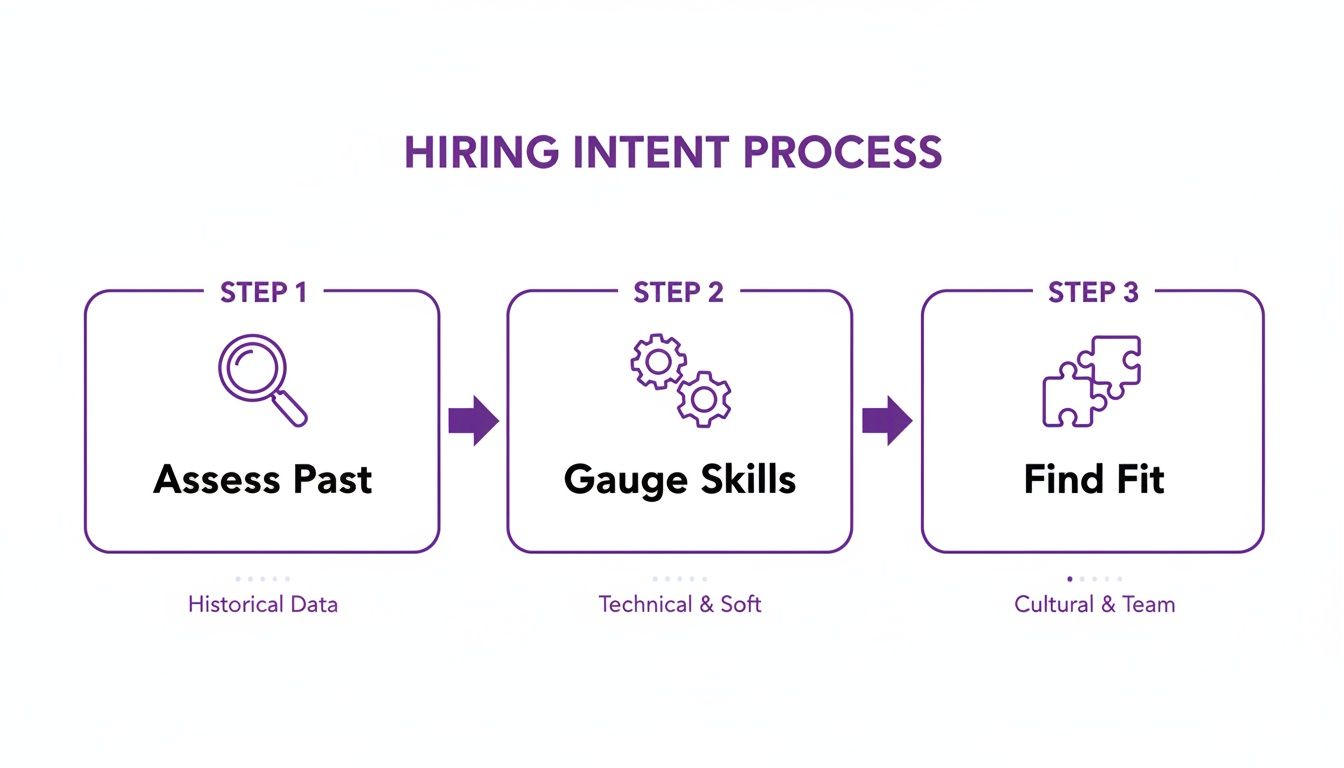
This process shows exactly how interviewers translate your stories into a hiring decision. Your past actions become the evidence they need to bet on your future success.
The Power Of Quantifying Your Results
The "Result" is easily the most critical—and most often forgotten—part of the STAR method. A weak answer just trails off after the "Action" part, leaving the interviewer thinking, "Okay... so what?" A powerful answer always closes the loop with a measurable outcome.
Don't just tell them what you did; show them why it mattered. The Result is your proof of impact. It’s what makes your story stick.
For instance, instead of saying, "I improved our checkout process," you can make it unforgettable by adding numbers: "I led a redesign of the checkout flow that reduced cart abandonment by 15% in Q3, directly contributing to an extra $50,000 in revenue."
Numbers have weight. They prove your value in a way general statements never can.
Weak Answer vs Strong STAR Answer
Let's see this in action with a classic question: "Tell me about a time you had to learn a new skill quickly." The difference between a generic response and a structured STAR answer is night and day.
| Component | Weak Answer Example | Strong STAR Answer Example |
|---|---|---|
| S | "Yeah, in my last job, I had to learn new software because the company switched over." | "(Situation) Last year, my company decided to replace our old project management system with a new, more complex platform, and the migration deadline was just four weeks away." |
| T | (Not defined) | "(Task) My role as project lead required me to become the team’s subject matter expert. I was tasked with not only mastering the software myself but also creating a training guide to onboard my five teammates before the deadline." |
| A | "It was a bit of a challenge, but I got the hang of it and managed my projects just fine." | "(Action) I dedicated two hours each evening to completing the platform’s official certification course, finishing it in one week. I then created a five-page quick-start guide and hosted two lunch-and-learns to walk my team through the new process." |
| R | "Everyone on the team eventually learned it." | "(Result) As a result, our team fully migrated three days ahead of schedule. My guide was adopted by two other departments, and our team’s project reporting errors decreased by 25% in the first month." |
The first answer is forgettable. The second one? It’s a compelling story that showcases initiative, leadership, and a direct, positive impact on the business. That’s the kind of answer that gets you hired.
Building a library of these stories is a core part of any successful job search. To take your preparation even further, see our comprehensive guide on job interview preparation tips. Mastering this storytelling technique is your first and most important step.
Building Your Personal Story Bank
The best answers to behavioral questions don't just magically appear in the middle of an interview. They’re built on a foundation of solid preparation. The secret is to create what I call a "story bank"—a go-to collection of 5-7 of your most powerful career experiences that you can adapt to almost any question they throw at you.
Think of it this way: instead of fumbling for an example under pressure, you’ll have a curated list of your greatest hits ready to perform. It's the ultimate confidence booster.
Start by Playing Detective with the Job Description
First things first: print out the job description for the role you want and get out a highlighter. Your mission is to decode what the hiring manager really wants.
Comb through the text, looking for clues disguised as responsibilities and qualifications. Phrases like these are gold:
- "Proven ability to lead cross-functional projects" (Translation: They need Leadership.)
- "Thrives in a fast-paced, ambiguous environment" (Translation: They want Adaptability and Resilience.)
- "Experience resolving complex customer issues" (Translation: Show me your Problem-Solving and Conflict Resolution skills.)
- "A self-starter who takes initiative" (Translation: They're looking for someone with a strong sense of Ownership.)
Once you've highlighted these, you have a clear roadmap. You know exactly which skills your stories need to showcase.
Mine Your Career for Winning Stories
With that list of target skills in hand, it's time to brainstorm. Think back through your past roles—the projects, the challenges, the wins, and even the failures. Don't filter yourself at this stage; just get every potential story down on paper.
Jog your memory with prompts like:
- When did you lead a team or a project, even if you weren't the official manager?
- When did you crack a tough problem that had everyone else stumped?
- How did you handle a tense situation with a difficult coworker or client?
- What about a time you failed? What did you learn and how did you bounce back?
- Think of a moment you went above and beyond what was expected of you.
This isn't just about finding stories; it’s about proving you have the skills that matter right now. According to the World Economic Forum's 2025 Future of Jobs Report, analytical thinking is the most in-demand skill for employers globally. Close behind are resilience, flexibility, and leadership—all competencies that come to life through storytelling. You can dig deeper into these future-proof skills and their importance.
Structure Each Story for Maximum Impact
Okay, you've got a solid list of potential experiences. Now, pick the top 5-7 and let's give them some structure so they're easy to recall and deliver. This isn't about writing a script to memorize word-for-word; it's about creating a flexible framework for each story.
A story bank isn't about memorizing lines; it's about internalizing your wins. When you know your stories inside and out, you can deliver them with natural confidence.
Here’s a simple but effective way to organize each story in your bank:
- The Question It Answers: Think about the likely prompt, like, "Tell me about a time you showed leadership."
- Situation: A single sentence to set the stage. "Our team was falling behind on a critical Q3 product launch."
- Task: One sentence on your objective. "I needed to get the project timeline back on track and remotivate the team."
- Action: A few bullet points detailing what you specifically did. "I immediately set up daily stand-ups to improve communication. I re-prioritized the task list to focus only on critical-path items. I also negotiated a later deadline for a non-essential feature."
- Result: The big finish, with numbers if possible. "As a result, we launched on schedule, and the new feature boosted user engagement by 15% in the first month."
Organizing your stories this way guarantees you’ll always have a clear beginning, a compelling middle, and an unforgettable, results-driven ending.
Navigating Common Behavioral Questions
Once you’ve got your story bank put together, the real trick is learning how to adapt those stories on the fly. While an interviewer can phrase a question in a dozen different ways, most behavioral questions boil down to a handful of core themes.
If you can learn to spot the underlying theme, you'll never be caught off guard. Instead of fumbling for a pre-rehearsed script, you can confidently pull the right story from your collection and frame it to show the interviewer exactly what they’re looking for.
Questions About Teamwork and Collaboration
When you hear, "Tell me about a time you had a conflict with a coworker," your first instinct might be to cringe. But they aren't digging for gossip. What they really want to know is how you handle professional disagreements.
They're trying to figure out:
- Can you put the team's success ahead of your own ego?
- Do you actually listen to other points of view?
- Are you capable of finding common ground and moving forward?
The secret here is to make the resolution the hero of your story, not the conflict itself. Focus on the steps you took to de-escalate and solve the problem. Maybe you pulled the colleague aside for a one-on-one chat to understand their perspective, found a shared goal you could both agree on, and then worked together to find a compromise. That’s what a great answer looks like.
Questions About Problem-Solving and Initiative
A question like, "Describe a situation where you had to solve a difficult problem," is a test of your resourcefulness. The interviewer is trying to see how you operate when you don't have a clear set of instructions.
They want to know:
- How do you break down a big, messy problem?
- Do you take ownership and act, or do you wait to be told what to do?
- Can you get creative when you don't have all the resources you need?
Your goal is to walk them through your thought process. Show them you have a method. For example, you could talk about a time you noticed a recurring inefficiency in a team process. Your STAR answer would cover how you diagnosed the root cause, designed a simple spreadsheet to fix it, got your manager’s approval, and then trained the team.
The key is to demonstrate a logical process. Your answer should walk the interviewer through how you diagnosed the problem, evaluated potential solutions, and then took decisive action.
The perfect ending? A quantifiable result. Something like, "After we implemented the new template, it led to a 20% reduction in time spent on that task each week." That’s how you prove your impact.
Questions About Handling Failure and Setbacks
Let's be real: everyone messes up. Interviewers know this. So when they ask, "Tell me about a time you made a mistake or failed at a task," they aren't trying to trick you. They’re looking for accountability, self-awareness, and resilience.
What they're really asking is:
- Do you own your mistakes, or do you make excuses?
- What did you actually learn from the experience?
- How did you use that lesson to do better next time?
The formula here is simple: be honest, but be strategic. Acknowledge the mistake briefly, then pivot quickly to what you learned and how you grew from it. A powerful answer shows you can turn a setback into a genuine learning opportunity, something we explore more in our guide to common interview questions and how to answer them.
Mastering these themes is a game-changer no matter your industry. If you're aiming for a top-tier consulting job, for example, knowing the specific nuances they look for is crucial. This is a great resource that digs into the top consulting behavioral interview questions and what firms are really screening for.
Turning Practice into Confident Delivery
You can have the most brilliant story written down in your notes, but if it comes out as a jumbled, uncertain mess during the actual interview, it’s useless. This is where practice becomes your secret weapon. It’s the bridge between knowing your stories and delivering them with genuine confidence.
The goal isn't to memorize your answers word-for-word—that just makes you sound like a robot. Instead, you're building "muscle memory" for your voice, your pacing, and your overall presence. A simple 15-minute daily routine is all it takes to move your best stories out of your head and into natural, articulate conversation.

When you internalize your key points this way, you free up mental energy. You can then focus on what really matters: connecting with the interviewer, not just struggling to remember your next line.
Your 15-Minute Daily Practice Routine
Trust me, consistency beats cramming every single time. A short, focused practice session each day is far more powerful than a frantic, multi-hour panic session the night before your big interview.
Here’s a simple routine to get you started:
- Vocal Warm-up (2 minutes): Grab a book or an article and just read a paragraph out loud. This simple step gets your voice ready and shifts your brain into "speaking mode," focusing on clear articulation.
- Story Rehearsal (10 minutes): Pick just one story from your bank. Tell it out loud, keeping an eye on the clock to make sure you stay under the two-minute mark. Repeat it three times, each with a different focus: first for clarity, then for confidence, and finally for a natural, conversational flow.
- Quick Review (3 minutes): Pull out your phone and record yourself answering one random behavioral question. Listen back without judging yourself—just notice your tone, your energy, and your pacing.
This little routine systematically builds your verbal fluency. For a deeper dive, our article on how to improve speaking confidence offers some great additional techniques.
Use AI Practice Tools to Get Ahead
Today, you can use technology to seriously speed up this process. AI-powered tools like TalkEasy create a safe, judgment-free space to rehearse your answers out loud. It’s a huge step up from practicing in a mirror because an AI partner can give you instant, specific feedback on how you sound.
Practicing with an AI communication coach is like having a personal interview trainer on call 24/7. It gives you endless reps to refine your answers until they feel completely natural.
These platforms are great at spotting those pesky filler words—the "ums" and "uhs"—and can also check your speaking pace to make sure your message comes across clearly. This kind of repeated, targeted practice builds the mental pathways you need to stay calm and articulate under pressure. It ensures your great answers land with the impact they deserve.
While mastering behavioral questions is critical, a holistic approach to job interviews means looking at the bigger picture. For a broader perspective, check out this comprehensive guide on how to improve interview skills.
Answering Your Burning Behavioral Interview Questions
So you've got the STAR method down and a few solid stories ready to go. That's a great start. But what about those tricky situations that always seem to pop up? Let's tackle some of the most common questions I hear from candidates.
"What If I Don't Have a Work Example for That?"
This is a classic, especially for recent grads or career changers. Don't sweat it. The interviewer is looking for evidence of a skill, not a specific work setting.
Think beyond the 9-to-5. A complex group project from your degree, a tough fundraising goal you hit for a volunteer organization, or even a freelance gig that went sideways—all of these are fair game. The key is to structure the story using STAR, proving you have the chops, regardless of where you learned them.
"How Long Should I Talk?"
Ah, the million-dollar question. You want to be thorough, but you don't want to see the interviewer's eyes glaze over.
Aim for the 90-second to two-minute mark. That’s the sweet spot. It's just enough time to hit all the points of the STAR method without rambling. If you find your answers are creeping past three minutes, you're probably spending too much time setting the scene. Cut the fluff from the "Situation" and get straight to what you did.
Your goal is to be thorough but brief. A two-minute answer feels comprehensive, while a five-minute answer feels like a monologue. Respect the interviewer's time by keeping your stories focused and punchy.
"Can I Use the Same Story More Than Once?"
Ideally, you'll walk in with a solid bank of 5-7 unique stories. Variety is always your best bet.
That said, sometimes a single, really complex project can be a goldmine for different examples. A product launch story, for instance, could showcase your leadership in one answer and your crisis management skills in another.
The trick is to never tell the exact same story twice. If you have to revisit a project, shine a spotlight on a completely different angle. Frame it differently to directly answer the new question. This ensures each response feels fresh and relevant.
Ready to turn practice into confidence? TalkEasy gives you a safe space to rehearse your interview stories until they roll off the tongue. Start speaking with our AI coach today and walk into your next interview feeling unstoppable. Find out more at https://www.talk-easy.com.