
How to Ask Questions in English and Sound More Natural
Learn how to ask questions in English with confidence. This guide covers grammar, word order, polite phrasing, and real-world examples to improve your fluency.


If you want to get really good at speaking English, you need to think beyond just grammar rules. Knowing how to ask questions in English is one of the most powerful skills you can learn. It’s what turns a simple exchange into a real conversation, helping you build connections and speak with confidence.
Why Asking Good Questions Is Your Key to Fluency

Learning to ask questions well is about so much more than just getting an answer. It’s the engine that drives a good conversation. When you ask thoughtful questions, you’re showing you’re interested, you’re building rapport, and you’re able to steer any discussion with a lot more ease.
I know what many learners worry about—mixing up the word order or accidentally sounding rude. Those fears are completely normal, and trust me, you can get past them.
This guide is your roadmap. We’ll break down everything you need to know, starting with the basic structures like yes/no and 'Wh-' questions and moving on to the finer points of asking things politely at work or with friends.
Think about it this way: focusing on this one skill can completely change how you communicate. It’s the difference between just translating a thought from your native language and actually connecting with someone in a natural, engaging way.
This isn't just a feeling; the impact is real. The number of people learning English has jumped to around 1.75 billion worldwide, which is a massive 30% increase in just the last ten years. For fluent speakers, a strong grasp of the language, including question forms, often leads to a 30% wage premium. For entire countries, higher English proficiency can even contribute to a national GDP that's up to 40% higher.
This shows that asking questions isn't just about passing a grammar test—it's a genuine gateway to opportunity. If you're curious about the bigger picture, you can find more stats on the global impact of English learning from sources like Global English Test.
Building Blocks for Confident Communication
Think of asking questions as a toolkit. The more tools you have and the better you know how to use them, the more effectively you can build relationships and get things done.
This skill is a game-changer for so many people:
- Professionals: In a meeting, clear questions like, "What are the next action items?" or "Could you clarify that point?" show you're engaged and help prevent costly misunderstandings down the road.
- Students: Class becomes a lot less intimidating when you can confidently ask, "Can you explain that concept again?" or "Where can I find more resources on this topic?"
- Newcomers and Travelers: Getting around a new city or culture is all about asking questions. Being able to ask, "Which way is the train station?" or "Do you have any recommendations for local food?" just makes life so much easier.
My goal here is to help you move your English from just functional to genuinely fluent. By the time you finish this guide, you won't just know the rules; you'll feel confident enough to use them in any conversation that comes your way. Let’s dive in.
The 5 Essential Question Types for Any Conversation
Think of asking questions in English like having a toolkit. You wouldn't use a hammer to saw a piece of wood, right? The same logic applies to conversations. To really get what you need—whether it's information, confirmation, or just a good connection—you need to pick the right tool for the job.
Mastering these five core question types will give you the flexibility to handle any discussion, from a quick coffee chat to a high-stakes business negotiation. They're the foundation of confident, fluent English.
Yes/No Questions: The Quickest Way to an Answer
These are your go-to for getting a simple, direct answer. Use them to confirm information, make a quick request, or check if someone agrees with you.
The magic happens when you start the sentence with an auxiliary verb (like do, be, have) or a modal verb (like can, should, will).
The basic pattern is: Auxiliary/Modal Verb + Subject + Main Verb?
Let's look at how this works in practice:
- Do you have the report? (Instead of the less direct: You have the report?)
- Is she joining the meeting? (Much clearer than: She is joining the meeting?)
- Can we reschedule for tomorrow?
That simple flip—moving the verb to the front—is the signal that a "yes" or "no" is all you need.
Wh- Questions: For When You Need the Details
When a simple "yes" or "no" just won't cut it, you need your information-gathering power tools: the Wh- questions. These questions use words like Who, What, Where, When, Why, and How to open up the conversation and invite the other person to share details.
The structure builds on the yes/no format, just with the Wh- word leading the way: Wh- Word + Auxiliary Verb + Subject + Main Verb?
Here are some real-world examples:
- Who is leading this project? (Asks about a person)
- What are the main goals for this quarter? (Asks about an idea or thing)
- When is the deadline? (Asks about a time)
- Why did the client go with that option? (Asks for a reason)
- How can we make this process smoother? (Asks about a method)
Getting these question forms right is a huge step in sounding fluent. It’s no wonder the global language learning market is expected to reach $187.69 billion by 2028. The best digital tools focus on these interactive question drills because they work—practicing these structures can improve your retention by up to 15%. For a deeper dive into these numbers, you can explore the latest language learning statistics from Kent State University.
Tag Questions: The Secret to Sounding Natural
Want to sound less like you're reading from a textbook? Start using tag questions. These are short little questions tacked onto the end of a statement to confirm something you're pretty sure is true or to invite agreement.
The golden rule is simple: if the statement is positive, the tag is negative. If the statement is negative, the tag is positive.
- Positive Statement, Negative Tag: "The presentation went well, didn't it?"
- Negative Statement, Positive Tag: "You haven't seen the final draft, have you?"
This small change makes you sound more connected and less assertive. You're not just stating a fact; you're pulling the other person into the conversation with you.
Choice Questions: A Great Way to Offer Options
Also called "alternative questions," these are what you use when you want to present two or more options. You'll always spot them by the word "or" connecting the choices.
They give the other person a say in the matter, which makes you seem more collaborative.
- Do you prefer meeting in the morning or the afternoon?
- Would you rather talk about this now or wait until next week?
- Is the problem with the software or the hardware?
Choice questions are also fantastic for keeping things moving, especially when you need to make a decision. Having a few options ready is also a lifesaver in small talk. If you're stuck for ideas, check out our guide on finding good conversation topics for adults.
By mastering these five question types, you’re not just learning grammar—you're learning how to steer a conversation. You can confirm info, gather details, build rapport, and guide decisions, all by choosing the right kind of question.
Negative Questions: For Expressing Surprise or Persuasion
Finally, we have negative questions, which start with a negative verb like Don't, Isn't, or Haven't. These are surprisingly versatile. You can use them to show surprise, confirm something you thought was true, or gently nudge someone toward your point of view.
- Don't you think we should look at the numbers again? (This sounds more like a suggestion than a command.)
- Isn't that the new project manager over there? (A great way to seek confirmation.)
- Haven't you finished the report yet? (Shows surprise or implies an expectation.)
A word of caution: watch your tone. Delivered the wrong way, these can sound a bit critical. But when used with care, they add a real touch of sophistication to your English.
How to Ask Polite and Indirect Questions

Getting the grammar right is one thing, but truly connecting with people is another. Once you've nailed the technical side of forming questions, the next step is to understand the culture behind the language.
In many English-speaking cultures, especially at work or in public, firing off a direct question can come across as blunt, demanding, or even a bit rude. This is where the art of the indirect question comes in. It's a total game-changer for sounding natural and respectful, making people far more willing to help you out.
Why Direct Questions Can Be Risky
Imagine walking up to a stranger and asking, "Where is the bathroom?" Sure, it’s grammatically perfect, but it can feel a little abrupt. In a professional setting, asking your boss, "When is the report due?" might sound more like a demand than a simple query.
The problem isn't the words themselves; it's the lack of a "softener." A softener is a simple phrase that cushions the request, showing that you recognize you're asking for someone's time or effort. It’s a subtle but powerful part of mastering English conversation.
Indirect questions use these introductory phrases to frame your request more gently. This tiny adjustment can completely change how you’re perceived.
Your Go-To Phrases for Polite Questions
Think of these phrases as your secret weapon for getting friendly, helpful responses. They signal that you're being considerate and respectful.
Here are some of the most common and effective starters:
- Could you tell me... (A classic, all-purpose phrase that always works.)
- Do you know... (Great for asking for information you think they might have.)
- I was wondering if... (A very gentle and common way to make a request or ask for a favor.)
- Would you mind... (Perfect for when you're asking someone to do something.)
- Do you happen to know... (Excellent when you aren't sure if the person has the answer, showing extra politeness.)
See how these phrases shift the focus? Instead of a direct demand, you're framing it as a simple thought or wonder. That small change makes all the difference.
Direct vs. Indirect Questions in Action
Let's put this into practice. Seeing the difference side-by-side really makes it click.
| Direct (Can Sound Blunt) | Indirect (Polite and Respectful) |
|---|---|
| What is your name? | Could you tell me your name, please? |
| Where is the train station? | Excuse me, do you know where the train station is? |
| Send me the file. | I was wondering if you could send me the file. |
| When is the deadline? | Do you happen to know when the deadline is? |
The indirect versions aren't just longer; they're socially smarter. They build rapport and increase your chances of a positive interaction, whether you're dealing with a client, a coworker, or someone on the street.
The goal of an indirect question is not just to get information but to maintain a positive relationship. It shows that you value the other person as much as the answer you're seeking.
Knowing When to Use Each Style
Of course, you don't always have to be so formal. The key is reading the room and understanding your relationship with the person you’re speaking to.
- With close friends or family: Direct questions are totally fine. "What time are we leaving?" is perfectly normal.
- In a professional setting: When in doubt, lean towards indirect questions. This is especially true with managers, new colleagues, or clients. "Could you clarify what the next steps are?" sounds far more professional than "What are the next steps?"
- When asking strangers for help: Always start politely and indirectly. "Excuse me, would you mind telling me how to get to the library?" will get you a much warmer response than just "Where is the library?"
Mastering this skill is about developing social awareness. You learn to gauge the situation and choose the right level of formality, ensuring you always sound approachable and respectful. It’s a key step in moving from simply speaking English to truly communicating effectively within its cultural nuances.
Getting Your Word Order Right Every Time
Figuring out the grammar of English questions can feel like you're trying to solve a puzzle. You have all the right words, but if they're not in the perfect order, the whole thing falls flat. The good news is, there’s a simple, reliable pattern that cuts through the confusion.
Just remember QUASM: Question Word - Auxiliary Verb - Subject - Main Verb. This little acronym is your secret weapon for building grammatically sound questions almost every single time. It stops you from having to guess what goes where.
Let's look at how it works in real sentences:
- (Q) Where (A) do (S) you (M) work?
- (Q) Why (A) did (S) she (M) leave?
- (Q) How (A) will (S) they (M) finish?
Once you start spotting this QUASM pattern, you'll find it much easier to put your own questions together on the fly, no matter what tense you're using.
Sidestepping Common Word Order Mistakes
Even with a handy formula, it’s all too easy to slip back into old habits. Two of the most common trip-ups I see are forgetting the auxiliary verb entirely or not inverting the subject and the verb.
Dropping the auxiliary verb often comes from translating directly from your native language. You might say something like, "Why you go?" But to sound natural in English, you need that little helper word: "Why did you go?"
The other classic mistake is forgetting to flip the word order. A statement like "You are going to the store" becomes a question by simply swapping the subject and auxiliary verb: "__Are you going to the store?" Without that flip, it just sounds like you’re making a statement, but with a questioning tone.
Mastering question structure is a huge milestone for English learners everywhere. With 1.75 billion people learning the language globally, it’s a shared challenge. In fact, curricula in top-performing European countries often focus on conversational questioning from an early age, which helps the 96% of EU secondary students studying English build a strong foundation. You can read more about these global English learning trends and stats.
To help you catch these mistakes before they happen, I've put together a quick reference table.
Common Word Order Mistakes and How to Fix Them
This table breaks down some of the most frequent errors learners make. Pinpointing why something is wrong is the first step to getting it right next time.
| Common Mistake | Why It's Incorrect | Correct Version |
|---|---|---|
| What you want? | The auxiliary verb 'do' is missing. You need it to form most Wh- questions in the present simple tense. | What do you want? |
| She is working today? | The subject and auxiliary verb aren't inverted. For a yes/no question, the verb 'is' has to come before the subject 'she'. | Is she working today? |
| Why they did leave? | After using the auxiliary 'did', the main verb must return to its base form ('leave'), not stay in the past tense. | Why did they leave? |
| How much it costs? | The word order is off. The auxiliary 'does' must come before the subject 'it' to form a proper question. | How much does it cost? |
Running through these common errors is a fantastic way to sharpen your skills. It helps you avoid the small mistakes that can make your English sound a little unnatural.
Understanding Subject vs. Object Questions
One last point that often trips people up is the difference between subject and object questions. It sounds academic, I know, but the concept is actually pretty straightforward.
An object question asks about the receiver of an action. These questions follow the standard QUASM formula we've been practicing.
- Example: What did you buy? (Here, the answer—"a book," for example—is the object.)
A subject question, however, asks who or what did the action. For these, we get to break the rules a bit—we don't use an auxiliary verb like do, does, or did. The question word (Who or What) takes the place of the subject.
- Example: Who bought the book? (The answer—"Maria," for instance—is the subject.)
See how much simpler that structure is? No inversion, no extra helper verb. Remembering this little exception will help you navigate one of the trickier parts of English grammar with a lot more confidence.
Using Intonation to Sound More Natural
Getting the grammar right is a fantastic foundation, but if you want to sound truly natural when asking questions, you have to master the "music" of English. This is called intonation—the way your voice rises and falls as you speak. The pitch you use is often just as important as the words themselves, signaling to the listener what kind of answer you’re looking for.
Think of it as adding an extra layer of meaning. The right vocal tune makes your questions feel clear and engaging. The wrong one can cause confusion or make you sound flat and robotic. Getting this right is a game-changer for fluency.
The Two Key Intonation Patterns
In English, questions generally follow one of two main "tunes." Once you get the hang of the pattern, knowing which one to use becomes second nature.
- Rising Intonation (↗): Let your voice travel up at the end of the sentence. This is the classic pattern for Yes/No questions. It’s like a verbal cue telling your listener you're expecting a simple "yes" or "no."
- Are you coming to the meeting? (Your voice should rise on "meeting.")
- Did you finish the report? (Your voice should rise on "report.")
- Falling Intonation (↘): Here, your voice goes down at the end. Use this for Wh- questions (who, what, where, when, why, how). A falling tone signals that you're asking for new information, not just confirming something.
- Where is the meeting? (Your voice should fall on "meeting.")
- When is the deadline? (Your voice should fall on "deadline.")
Actively practicing these two patterns will make your questions sound much more authentic. If you're serious about taking your spoken English to the next level, our guide on English accents training dives even deeper into the nuances of pronunciation.
Of course, intonation works hand-in-hand with proper sentence structure. This simple chart shows the building blocks of a solid English question.
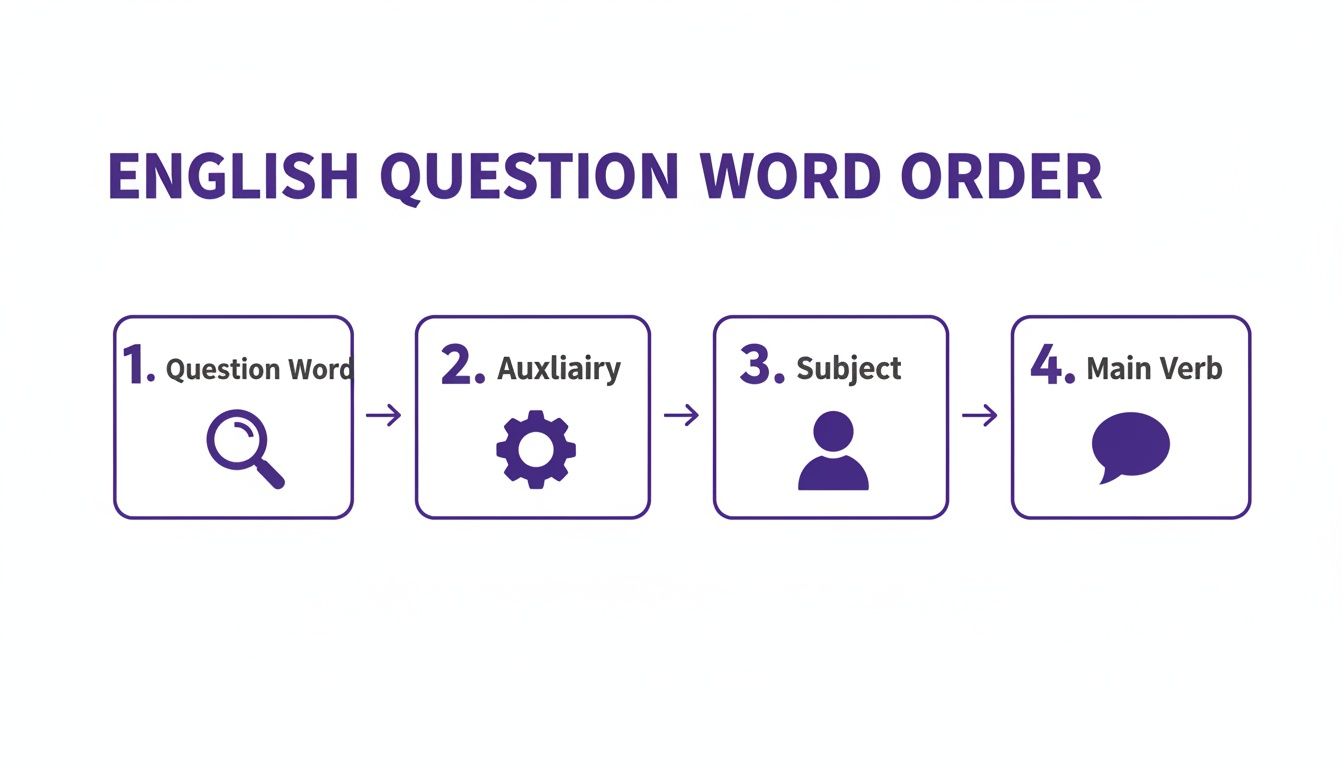
It’s a great visual reminder of how the Question Word, Auxiliary, Subject, and Main Verb fit together.
How Word Stress Changes Everything
Beyond the rise and fall of your voice, the specific word you emphasize—or stress—can completely shift the focus of your question. Stressing a word just means saying it a little louder, longer, and with a slightly higher pitch than the words around it.
Let's see how this works with one question: "Did you write that email?"
- "Did you write that email?" (The stress on "you" asks if it was you specifically, and not somebody else.)
- "Did you write that email?" (The stress on "write" questions the action—did you write it, or did you just read it?)
- "Did you write that email?" (The stress on "that" points to a specific email, as opposed to a different one.)
This is an incredibly powerful tool for adding nuance. It lets you guide the listener's attention exactly where you want it, making sure your meaning comes across perfectly.
Intonation isn't just about sounding "good"—it's a critical communication tool. It helps you convey meaning, emotion, and intent, transforming your questions from simple requests for information into dynamic parts of a natural conversation.
By consciously practicing these vocal patterns—rising for yes/no, falling for Wh- questions, and strategically stressing key words—you add a layer of sophistication to your spoken English. It's that final polish that takes you from just knowing the words to truly mastering the conversation.
Putting It All into Practice with Real-World Scenarios
Knowing the grammar rules for asking questions is one thing. Actually using them in a real, live conversation without fumbling? That’s a whole different ball game. This is where practice becomes your best friend, bridging the gap between theory and fluid, confident communication.
Think of this section as your personal training ground. We’re moving beyond dry grammar charts and diving into sample dialogues and exercises that reflect the kinds of situations you run into every day. When you practice in context, you’re training your brain to pull up the right question and structure on the fly, making it second nature.
Scenarios for Everyday Life
Let's look at a few common situations where being able to ask the right question can completely change the outcome.
- You're in a Work Meeting: Instead of just listening, you can steer the conversation and show you're engaged.
- To clarify a point: "Could you walk me through what you mean by 'streamlining the workflow'?"
- To confirm what's next: "So, just to be clear, my main task is to analyze the data, right?"
- To offer a new idea: "What if we tried approaching the problem from this angle?"
- You're Making Small Talk: At a networking event or a casual get-together, good questions are the key to keeping a conversation alive.
- An open-ended starter: "What’s the most interesting part about what you do?"
- A natural follow-up: "That sounds fascinating. How did you get into that?"
- A light choice question: "Morning person or night owl?"
The trick is to get past generic, textbook exercises. Actually role-playing these specific scenarios, even if it's just by yourself, gets you ready for the real thing. It helps your responses sound natural, not like you're reading from a script.
Modern Tools That Can Help
It's no secret that interactive practice makes learning stick. Just look at the numbers: English is the top language studied in 135 countries on Duolingo in 2024. This isn't just a trend for hobbyists; in formal education, a staggering 96% of EU students start learning English by age 7.5. Why? Because solid communication skills are directly linked to economic success—nations with high English proficiency see a 40% boost in GDP. You can dig into more of these fascinating global statistics on EC English.
So, how can you tap into this? Modern tools offer a fantastic way to get conversational practice without the pressure. AI-powered platforms provide a safe space to try out new phrases and structures. To learn more about this, it's worth reading up on the role of GPT chatbots in language learning and education.
And if you're looking for more ways to polish your skills, our guide on how to practice English speaking for free is packed with ideas.
Got More Questions? We've Got Answers
Even when you've got the basics down, certain tricky situations can still trip you up. Think of these details as the final polish on your journey toward asking questions like a native speaker. Let's tackle some of the most common stumbling blocks I see students encounter all the time.
How Do I Ask About Something That Already Happened?
When you need to form a question in the past tense, your best friend is the word "did." It does all the heavy lifting.
Just follow this simple recipe: (Question Word) + did + Subject + the main verb in its original form.
So, instead of saying, "What you ate for lunch?", which is a common mistake, you'd ask, "What did you eat for lunch?" See how "ate" goes back to its simple base form, "eat"? The word "did" already tells us it's in the past. For simple yes/no questions, just pop "Did" at the beginning: "Did you finish the report?"
When Do I Use 'Do' vs. 'Are'?
This one confuses almost everyone at some point, but the difference is actually straightforward once you see it.
- Use "do" (or does/did) when you're asking about an action. Think of "doing" verbs like work, go, like, play. For instance, "Do you work here?" or "When does the train leave?"
- Use "are" (or is/am/was/were) when you're asking about a state of being—a description, identity, or condition. This usually involves nouns and adjectives. For example, "Are you tired?" or "Is he the new manager?"
Here’s a simple trick I tell all my students: 'Do' is for doing things, and 'Are' is for being something. Burn that into your brain, and you'll get it right almost every time.
What's the Real Difference Between 'Can I' and 'May I'?
Ah, the classic question of permission. Both work, but they carry a different tone.
"Can I...?" is your everyday, go-to phrase. It's casual and friendly, perfect for situations like asking a coworker, "Can I borrow your pen?" No one will bat an eye.
"May I...?" is a bit more buttoned-up. It’s more formal and polite, which makes it the better choice in professional settings or when you're speaking to a superior or someone you've just met. Asking, "May I ask a question?" in a meeting shows a little extra respect.
While "can" is universally understood and accepted, using "may" can add a subtle touch of professionalism. For other common inquiries or help, you might also find answers in these general FAQs.
Ready to put all this into practice? TalkEasy lets you have real-time spoken conversations with an AI tutor that feels completely natural. You get instant, friendly feedback to help you build fluency in just 15 minutes a day. Start speaking with confidence by visiting https://www.talk-easy.com.