
Turn Complaints into Loyalty How to Handle Customer Complaints
Learn how to handle customer complaints with proven techniques. Turn angry customers into loyal fans with our guide on de-escalation, resolution, and follow-up.


When a customer comes to you with a problem, it’s a critical moment. The way you respond can either cement their loyalty for life or send them straight to your competition. The secret isn't just about fixing the issue; it’s about following a clear, human-centered approach: listen without interrupting, offer a genuine apology, work with them to find a solution, and always, always follow up.
Why Getting This Right Is a Non-Negotiable Skill

Let's cut right to the chase. Mishandling a customer complaint isn't just a minor slip-up; it's a direct hit to your revenue and reputation. Every single unresolved issue is a crack in your company's foundation. This isn't just about "customer service"—it's a core business strategy.
The numbers are staggering. Globally, poor customer experiences are costing businesses a jaw-dropping $3.7 trillion every year. That's not just a statistic; it's lost revenue from customers who got fed up and walked away.
Think about it: 65% of customers have abandoned a brand entirely over a bad service experience, and 70% say they'd switch to a competitor after just one negative interaction. Their biggest frustrations? Having to repeat their problem over and over to different people and not getting immediate answers.
Protecting Your Revenue and Reputation
You need to reframe how you see complaints. Each one is an opportunity to defend your business from churn. A solid grasp of how to improve customer service is the bedrock of not just handling complaints, but building a resilient company. It’s your chance to stop a customer from leaving and, instead, make them feel heard and valued.
If you don't get it right, the fallout is predictable and damaging:
- Lost Revenue: It's not just the customer you lose. They'll tell their friends, family, and anyone who will listen online.
- Damaged Brand Image: In the age of social media and instant reviews, a single mishandled complaint can go viral, eroding trust you've spent years building.
- Soaring Costs: We all know it costs far more to attract a new customer than it does to keep a current one happy.
The real challenge isn't just fixing the immediate problem; it's about repairing the relationship and using the feedback to prevent the issue from happening again. Every complaint is a free consultation on how to make your business better.
Throughout this guide, we're going to break down a simple yet powerful framework you can start using today. Your very next customer interaction could be the one that saves you a valuable relationship or costs you a customer for life. Let's make sure it's the former.
Before we dive deep, here's a quick look at the core framework we'll be exploring. This table provides a high-level overview of the process, so you can see how each piece fits together.
The Complaint Resolution Framework at a Glance
| Phase | Objective | Key Action |
|---|---|---|
| 1. Receive & Listen | Make the customer feel heard and understood. | Actively listen without interruption; repeat their concerns back to them. |
| 2. Empathize & Apologize | Validate the customer's feelings and de-escalate tension. | Offer a sincere, specific apology for their frustration and inconvenience. |
| 3. Find a Solution | Resolve the immediate problem fairly and effectively. | Collaborate with the customer to agree on a mutually acceptable resolution. |
| 4. Follow Up | Ensure satisfaction and rebuild the relationship. | Contact the customer after the resolution to confirm the issue is fixed. |
This table is your roadmap. Now, let's get into the nitty-gritty of each step, starting with the art of truly listening.
The Art of Listening and Showing You Genuinely Care
Before a customer will even consider a solution, they need to feel one thing above all else: heard. This isn’t just about passively hearing their words. It’s about actively showing you get their frustration on a human level. Honestly, this is the single most important moment where you can start turning a bad experience around.
A lot of old-school customer service guides will tell you to say, "I understand." I’m telling you now, that phrase can be a landmine. For a customer who is genuinely upset, it can feel incredibly dismissive, as if their problem is just another ticket in your queue. It can sound like you've heard it all before and are just going through a script.
Instead, you need to validate their specific situation and their feelings. True empathy isn’t saying you feel their pain; it's about acknowledging that their pain is real and completely valid. This tiny shift in your approach can change the entire dynamic of the conversation.
Phrases That Build Bridges, Not Walls
You have to ditch the generic, robotic responses. When a customer is upset, they’re coming from an emotional place. Your job is to meet them there first, long before you start talking about logical solutions.
Here are a few powerful alternatives to "I understand" that show you’re actually listening:
- "That sounds incredibly frustrating. I really appreciate you bringing this to my attention so we can figure this out."
- "I can only imagine how disappointing that must have been, especially when you were expecting..."
- "It's clear this has been a major inconvenience for you. Let’s walk through this together and find a way forward."
See the difference? Each one names the emotion (frustration, disappointment, inconvenience) without automatically admitting fault. You're simply validating their experience, which is the psychological key to unlocking a productive conversation.
The real issue is rarely just the technical problem. It’s the feeling of being ignored, dismissed, or undervalued. Address the emotion first, and you turn the customer into an ally, not an adversary.
Reading Between the Lines
What a customer says is often just the tip of the iceberg. The real issue might be a missed deadline that made them look bad at work, or a faulty product that ruined a family celebration. Listening for those emotional cues helps you get to the heart of what they actually need.
This is a core part of building stronger, more effective communication skills in the workplace, and it's absolutely essential in any customer-facing role. When you show you care about the impact of the problem, you build a foundation of trust that makes everything that follows so much smoother.
Practice This Scenario with TalkEasy
Let's try a quick role-play to build that muscle memory. Picture this: a customer calls, absolutely furious that their guaranteed next-day delivery for a birthday gift showed up two days late.
Your Goal: Acknowledge and validate their emotional distress before you even think about mentioning tracking numbers or warehouse logistics.
- Weak Response: "I understand. Can I have the order number?"
- Strong Response: "Oh no, that is awful. I am so sorry we let you down and the birthday gift arrived late. That must have been incredibly frustrating and disappointing for you. Let me pull up your details right now and see how I can make this right."
Running through this kind of empathetic opening on TalkEasy helps it become a natural, automatic response when you’re in a high-pressure situation.
Your Practical Toolkit for De-Escalating Angry Customers
When a customer is genuinely angry, it can feel like walking on eggshells. But you don't have to wing it. Having a clear, reliable strategy can transform a tense moment into a chance to show your customer you're on their side.
My go-to framework for this is a simple acronym: H.E.A.T.
- Hear: Let them talk. Don't jump in with solutions or defenses. Just give them your full, uninterrupted attention and let them get everything off their chest.
- Empathize: Put yourself in their shoes. Acknowledge how frustrating, inconvenient, or upsetting their experience must have been. This is about validating their feelings, not necessarily agreeing with every detail.
- Apologize: Offer a genuine apology for the situation. It’s not about admitting fault; it’s about taking ownership of the fact that they've had a bad experience with your company.
- Take Action: This is where you become the problem-solver. Work with them to figure out the best path forward. What can you do right now to make things right?
Think of it as a roadmap. It keeps you grounded when things get heated and guides you toward a productive resolution.
Spotting the Triggers That Make Things Worse
Knowing what to do is only half the battle. You also have to know what not to do. I’ve seen countless interactions go sideways because of a few common, easily avoidable mistakes.
Be on the lookout for these classic escalation triggers:
- Making them repeat themselves: This is a huge one. It screams, "I wasn't listening," and it's incredibly frustrating for someone who's already upset.
- Using dismissive language: Phrases like "Calm down" or "It's not that big of a deal" are like pouring gasoline on a fire. They invalidate the customer's feelings instantly.
- Sounding like a robot: People want to connect with a person, not a script. If you sound detached or are just rattling off canned responses, they'll feel like you don't genuinely care.
Steering these difficult conversations is a real skill. For managers, teaching your team how to have tough conversations is one of the most valuable investments you can make in your team's development.
The stakes are higher than ever. Back in 2015, customer interactions were generally tamer. Fast forward to 2023, and a study found 43% of customers raised their voices during complaints. With U.S. companies losing an estimated $75 billion a year due to poor service, getting this right isn't just nice—it's essential for your bottom line.
Knowing When to Call for Backup
Part of handling these situations effectively is recognizing your own limits. Knowing when to escalate a complaint to a manager isn't a sign of failure; it’s a smart, strategic move that protects both you and the customer.
This decision tree shows just how much impact a small shift in your language can have, steering the conversation toward either disconnection or a genuine connection.
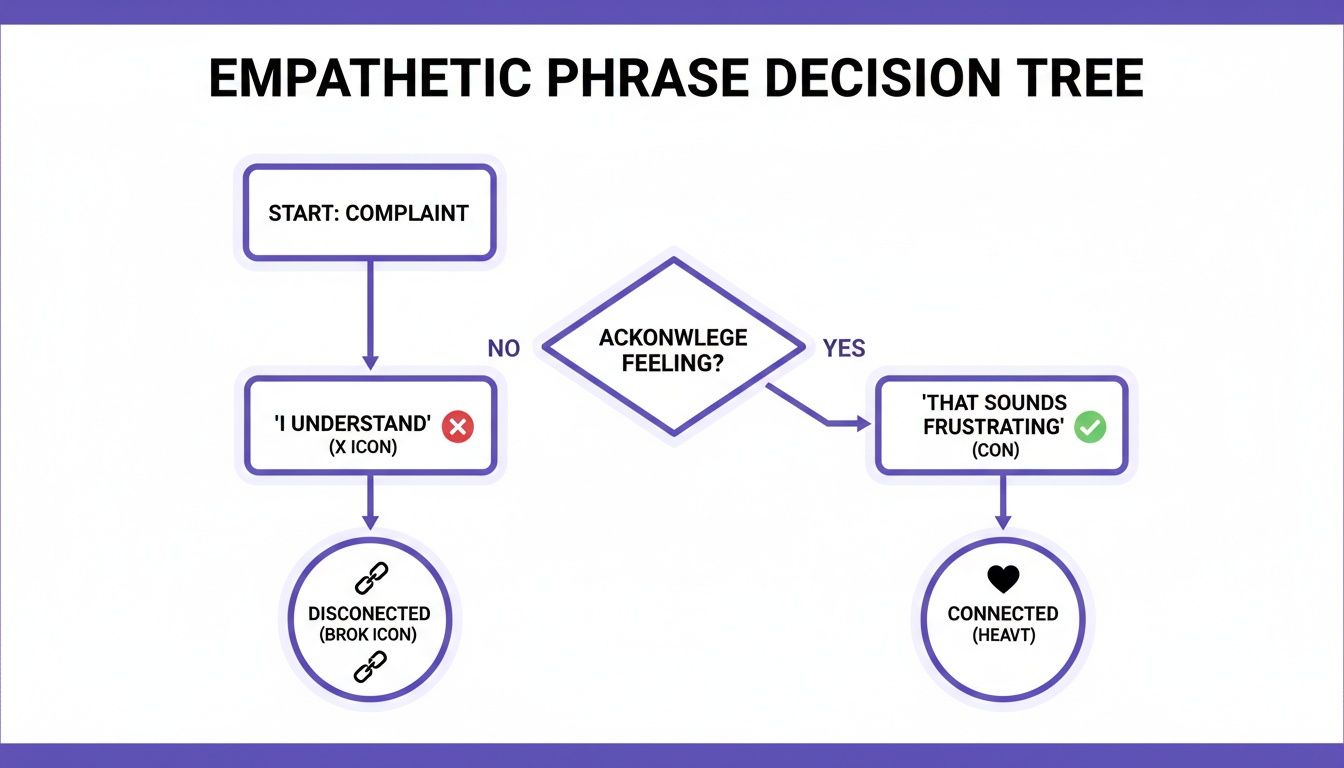
As the graphic shows, generic, placating phrases tend to fall flat. What really works is validating the customer's specific feelings and experience.
Your team needs clear, simple rules for when it's time to bring in a supervisor. Here are the non-negotiables:
- The customer uses threatening or abusive language. Your safety comes first.
- They directly ask to speak with a manager or supervisor.
- The solution they're asking for is beyond your authority (like a high-value refund or a special exception to a policy).
Having these clear boundaries empowers your team. They know they have the autonomy to solve problems, but also the support to fall back on when a situation requires it. For more tactics on handling challenging customers, you might find our guide on how to handle rude customers helpful.
Finding the Right Fix and Taking Action
Okay, the customer has calmed down, and the initial fire is out. Now comes the most critical part: actually solving the problem. This is where you pivot from being a patient listener to an effective problem-solver. The goal isn't just to patch the immediate issue; it's to find a resolution that genuinely rebuilds their trust in your company.
The absolute worst thing you can do here is jump to a conclusion. Before you even think about offering a solution, you have to be rock-solid certain you understand the root cause of the problem. That means asking the right questions.
Diagnose Before You Prescribe
Put on your detective hat for a moment. Your job is to gather all the facts, so you don't waste time solving the wrong problem. It's amazing how often a simple surface-level complaint is just the tip of the iceberg.
Here are a few questions I've found incredibly useful for digging deeper:
- "To make sure I'm following you perfectly, could you walk me through exactly what happened, step-by-step?"
- "When this happened, what was the specific outcome you were hoping for?"
- "Have you already tried anything on your own to fix this?"
Asking these questions does more than just get you information. It proves to the customer that you're being thorough and taking them seriously. This methodical approach is a huge part of learning how to improve customer service skills and makes sure the solution you offer is the one that will actually stick.
Present Options and Put Them in the Driver's Seat
Whenever it's possible, try to offer a couple of viable solutions instead of just dictating one. This is a game-changer. It instantly makes the customer feel like a partner in the process, shifting the dynamic from you telling them what's going to happen to you collaborating on the best path forward.
For instance, instead of a flat, "I've issued you a refund," try framing it like this:
"We can definitely make this right. I have two options for you. We can either process a full refund right now, which should hit your account in 3-5 business days, or I can get a replacement sent out with complimentary express shipping. What would you prefer?"
Giving them a choice restores the sense of control they likely felt they lost when the problem first occurred. This is a big deal, especially when you remember that 90% of consumers say getting their issue resolved is their top priority. Finding the right resolution is everything.
How to Deliver Bad News Without Starting Another Fire
Let's be real—sometimes, what the customer wants just isn't in the cards. This is easily one of the most delicate conversations you'll have. The trick is to be direct but empathetic, and immediately pivot to what you can do instead of dwelling on what you can't.
Never use blunt, shutdown phrases like, "We can't do that." Instead, calmly explain the limitation and immediately follow up with a proactive alternative.
- Scenario: A customer is demanding a refund for an item that was clearly marked "final sale."
- Response: "I completely understand why you're asking for a refund, and I've looked into this for you. While our policy on final sale items doesn't allow for a return, what I can do right now is issue you a store credit for the full amount, and I'll add an extra 20% on top of that for all the trouble this has caused."
By framing the outcome around a positive action, you keep the conversation moving forward and show you're still on their side. Mastering this is vital. After all, 73% of consumers will jump ship to a competitor after a few bad experiences, but handling a complaint well can earn you a valuable second chance. You can find more data on building loyalty in the latest customer experience research.
Turning Feedback into Your Greatest Asset

The conversation doesn't really end once you've found a solution. The moments just after a complaint is "resolved" are where you can turn good service into a truly memorable experience. This is how you build real loyalty and make your entire business smarter, but it's a step that most companies skip entirely.
Think about it: a simple follow-up is one of the most powerful retention tools you have. It sends a clear message that you didn't just rush to close a ticket and forget about the customer. This one small gesture shows you genuinely care about their experience and want to be sure the fix actually stuck.
In fact, for many customers, getting their complaint handled in under five minutes is enough to make them willing to spend more with you in the future. A quick, thoughtful check-in cements that positive outcome and starts rebuilding any trust that was shaken.
Following Up the Right Way
A follow-up doesn't need to be complicated. All it takes is a short, personal email sent about 24-48 hours after you’ve resolved the issue. This little bit of breathing room gives the customer time to confirm everything is working as it should while the interaction is still fresh.
Here’s a simple template you can make your own:
Subject: Just checking in about your recent experience
Hi [Customer Name],
This is [Your Name] from [Company Name]. I'm just following up on our chat from [Day] about [briefly mention the issue].
I wanted to personally check in and make sure everything is now working to your satisfaction. Your feedback was incredibly helpful, and we really appreciate you giving us the chance to make things right.
If you need anything else at all, please feel free to reply directly to this email.
Best,
[Your Name]
An email like this can completely reframe a negative event, turning it into a standout positive memory. It reinforces that your company is one that listens, acts, and truly cares.
Turning Complaints into Business Intelligence
Every single complaint is a piece of free, high-value consulting on how to improve your business. The absolute worst thing you can do is treat each one as a one-off fire to be put out. The reality is that 91% of unhappy customers will never complain; they just walk away. The ones who take the time to speak up are handing you a gift.
You need a system to capture, sort, and analyze this feedback.
Start by creating a simple process to track what customers are telling you:
- Log Everything: Every complaint, big or small, gets logged in a central place. This could be your CRM, a helpdesk platform, or even just a well-organized spreadsheet.
- Categorize and Tag: Use consistent tags to group issues together (e.g., "shipping damage," "billing error," "product bug"). This is how you'll spot recurring problems before they get out of hand.
- Share the Insights: Pull together a simple monthly report summarizing the top complaint categories and share it across departments. The marketing team needs to know if an ad campaign is setting the wrong expectations. Your product team definitely needs to hear about that bug that keeps popping up.
This approach transforms customer service from a reactive, firefighting department into a proactive engine for growth. By systematically learning from what goes wrong, you can fix the root causes and prevent thousands of future complaints.
Lingering Questions on Handling Tough Customer Complaints
Even with a solid framework, you'll inevitably run into situations that don't fit neatly into a box. Let's tackle some of the most common and tricky questions that pop up when you're in the trenches, so you can handle them with confidence.
What if the Customer Is Just Plain Wrong?
We’ve all been there. A customer is absolutely convinced of something that isn't true. The key here is to remember your goal: resolution, not winning a debate.
Arguing the facts will only escalate things. Instead, focus on validating their feelings. Try phrases like, "I can absolutely see how you arrived at that conclusion," or "I completely understand why you're so frustrated with this situation."
That simple shift in focus can change the entire dynamic. Once they feel heard, you can pivot to a solution by asking, “Setting the details aside for a moment, what can we do to make this right for you?” A small gesture of goodwill almost always preserves the relationship, which is far more valuable than proving a point.
Should We Apologize if We Weren't at Fault?
Absolutely. Every single time. A sincere apology isn't an admission of legal guilt; it's a powerful acknowledgment of the customer's negative experience. You’re apologizing for their frustration and inconvenience, not for being "wrong."
A simple, "I am truly sorry for the frustrating experience you've had," can instantly lower a customer's defenses. It validates their emotions and builds a bridge to a productive conversation, regardless of who is technically at fault. Taking ownership of their feelings is one of the best de-escalation tools you have.
When Is the Best Time to Follow Up After a Resolution?
Timing is everything. The sweet spot for a follow-up is within 24 to 48 hours after you've implemented the solution. This gives the customer enough time to see that the issue is truly fixed, but it's soon enough that the positive interaction is still fresh in their mind.
A quick email or phone call shows you genuinely care about their satisfaction beyond just closing a ticket. If the issue was particularly complex, a second check-in about a week later can be a knockout move that builds serious, long-term loyalty.
How Should I Handle Complaints on Social Media?
When a complaint goes public, you need to act fast and take it private. Your first public reply should be immediate, empathetic, and to the point.
For instance, you could post: “We're so sorry to hear about this and we absolutely want to help. Could you please send us a DM with your contact details so our team can look into this for you right away?”
This approach accomplishes two things at once: it shows the public you're responsive, and it protects the customer's privacy by moving the sensitive details out of the public eye. Never, ever get into a back-and-forth argument in a public forum.
Getting better at handling customer complaints comes down to one thing: practice. With TalkEasy, you can run through real-world scenarios and fine-tune your responses in a supportive space. It's the perfect way to build the muscle memory and confidence you need to turn any tough conversation into a positive outcome. Start speaking more clearly and confidently today.