
How to Improve My English Speaking Skills: Quick Daily Practice
Discover how to improve my english speaking skills with a practical 15-minute routine that boosts confidence and fluent conversation.


The secret to actually improving your spoken English isn't about cramming for hours on end. Forget the long, overwhelming study sessions that lead to burnout. Instead, commit to one simple, powerful habit: practice speaking for just 15 minutes every single day.
This small, manageable goal is the key to building real momentum. You'll be surprised how quickly you see and feel the results.
Your Path to Fluency Starts with 15 Minutes a Day
So many learners get stuck because they think fluency demands a massive time commitment. It's a myth. The real breakthrough happens when you shift from passively studying grammar rules to actively, and consistently, speaking the language.
This guide gives you a practical plan to do just that. We'll show you how to turn that 15-minute daily slot into a powerful habit that fits into even the busiest schedule, making practice feel like a natural part of your day, not another chore.
Why A Little Bit Every Day Beats A Lot Sometimes
The idea that small, daily actions create huge results isn't just a nice thought; it's backed by solid evidence. When it comes to learning a language, a consistent, conversation-first approach is far more effective than occasional, marathon study sessions.
In fact, learners who engage in targeted speaking exercises for 15 minutes a day have been shown to improve their accuracy and ability to speak on the fly 30–50% faster than those who just study grammar for the same amount of time. This daily investment builds the "muscle memory" for speaking, making your responses feel more automatic and less like a constant mental translation.
I've put together a simple, balanced routine to show you what this can look like in practice. This workout ensures you hit all the key areas needed for well-rounded speaking skills.
Your Daily 15-Minute English Speaking Workout
A balanced daily routine to maximize speaking improvement in just 15 minutes.
| Time Slot (Minutes) | Activity Focus | Example Task |
|---|---|---|
| 0–5 | Pronunciation & Warm-Up | Use an app to shadow native speakers, focusing on challenging sounds or intonation patterns. |
| 5–12 | Active Speaking Practice | Do a conversation simulation on a specific topic. Try to use 3 new vocabulary words. |
| 12–15 | Review & Correction | Listen back to a recording of yourself. Pick one grammatical error to focus on for the next day. |
This structure gives you a clear target for each session, making every minute count. It's not about being perfect; it's about being consistent.
The secret to getting ahead is getting started. The secret of getting started is breaking your complex overwhelming tasks into small manageable tasks, and then starting on the first one. - Mark Twain
This approach is all about building confidence right from the start. If you're just kicking off your fluency journey, knowing how to effectively begin your English language studies is crucial. By focusing on what you can accomplish today, you create a positive cycle that keeps you motivated.
For a deeper dive into building a robust learning strategy, be sure to check out our detailed guide on the best way to learn English.
Building Your Core Speaking Skills
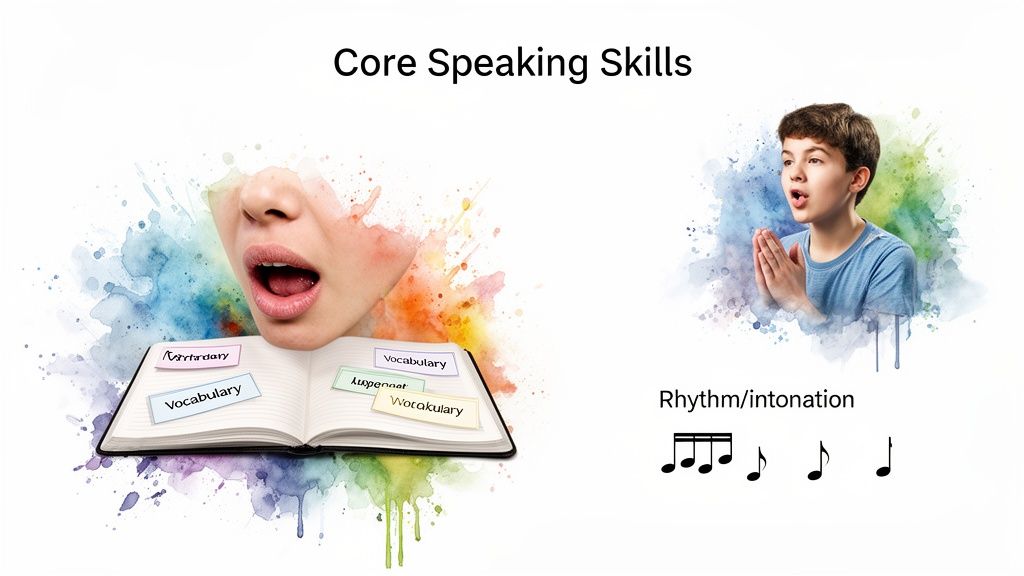
Real fluency isn't just about knowing a ton of words. It's about how you use them—clearly, correctly, and with a natural rhythm. If you truly want to get better at speaking English, you have to nail down the three pillars: pronunciation, vocabulary, and grammar.
Think of these as the foundation of a house. Without a solid base, everything you build on top will be shaky. These are the core skills that will support every single conversation you have.
Master the Music of English Pronunciation
So many learners get stuck on individual sounds, but here’s a secret: clear pronunciation has much more to do with the melody and rhythm of the language. English has its own kind of music, and it’s all about intonation (how your voice rises and falls) and sentence stress (the words you punch a little harder).
When you get this right, you become so much easier to understand. It’s what makes you sound natural.
A fantastic way to practice this is with shadowing. You listen to a native speaker and repeat what they say almost instantly, like you're their echo. You’re not just copying words; you're trying to capture their entire delivery—the pauses, the feeling, the flow. If you want to dive deeper, you could even explore some specific English accents training to really hone your sound.
Another really effective exercise is practicing with minimal pairs. These are simply words that are separated by just one tiny sound, like "ship" and "sheep." Drilling these helps your mouth and ears learn to make and hear the crucial differences.
Here's a little mindset shift that helps: Stop aiming for perfection. Aim for clear communication. The real goal is just to be understood, not to sound like you were born in a specific city. This takes the pressure off and makes your practice far more productive.
Build a Vocabulary You Can Actually Use
Memorizing random word lists is one of the slowest ways to improve your speaking. The real trick is to learn words in context and zero in on common phrases you'll actually use in daily life.
So, instead of just memorizing the word "delicious," learn the entire chunk: "That smells delicious, what are you cooking?" This immediately connects the new word to a real situation, which makes it ten times easier to remember and use when you're actually talking to someone.
Here’s a simple, practical way to make new words stick:
- Hear it: Catch a new word or phrase while listening to a podcast or watching a video.
- Define it: Quickly look up what it means and, more importantly, see a few examples of how it's used.
- Use it: Make it a mission to use that new phrase in your next speaking practice. For example, challenge yourself to use it three times during your 15-minute routine.
This active process is what shifts vocabulary from your passive memory (words you kind of recognize) into your active speaking toolkit (words that come out of your mouth without thinking).
Make Grammar Automatic, Not Academic
When it comes to speaking, you don't need to be a grammar nerd who can label every single tense. What you really need is for correct sentence structures to become an automatic reflex. The goal is for good grammar to just happen, without you having to pause and mentally sort through rules.
A great way to do this is with sentence pattern drilling. You take one common structure and just riff on it.
Let's try the "used to" structure for talking about past habits:
- "I used to play soccer every weekend."
- "She used to live in a small town."
- "We used to watch that show all the time."
By repeating the pattern with different details, you're building a mental shortcut. It trains your brain to produce the structure correctly and quickly, making your speech smoother and more accurate without getting lost in theory. These quick, focused drills are perfect for cementing the core skills that hold every conversation together.
Mastering Real-World Conversations

It’s one thing to know grammar rules from a textbook, but it’s a whole different ball game using them in a live conversation. This is where so many English learners get stuck—that frustrating gap between what you know and what you can actually say.
So, how do you bridge that gap? You have to practice for the real world. It's about moving past drills and into practical simulations of life, building the "muscle memory" you need to handle any situation, from a casual chat at a coffee shop to a high-stakes job interview.
Simulating Everyday Scenarios
If you want to get better at speaking English in real life, you have to practice for real life. It's that simple. Think about the situations you'll actually face and start rehearsing them.
Are you looking for a new job? Don't just think about interview questions—practice answering them out loud. Planning a trip abroad? Rehearse ordering food, asking for directions, or checking into your hotel. Make it specific to your life.
The key is to turn abstract knowledge into active, usable skill. By rehearsing specific scenarios, you are not just practicing English; you are practicing your life in English, which makes the language feel relevant and easier to retain.
This is exactly what tools like TalkEasy are built for. You can jump into unlimited conversation simulations with an AI partner in a completely safe, judgment-free zone. Need to rehearse for a big presentation? You can do it 10 times in a row without worrying about what anyone thinks.
The Art of Keeping a Conversation Going
A good conversation isn't just about taking turns talking. It’s a dance. Learning a few key techniques can turn a clunky exchange into a smooth, natural one. A huge part of this is mastering active listening so you can respond thoughtfully.
Here are a few skills I always tell my students to focus on:
- Starting and Ending: Have a few simple phrases ready to go. A friendly "Hi, how's your day going?" is perfect for starting, and a warm "Well, it was great chatting with you!" makes for a smooth exit.
- Asking Follow-Up Questions: This is a game-changer. When someone answers your question, don't just nod. Dig a little deeper. If they say they saw a movie, ask, "Oh, nice! What'd you think of it?" or "What was it about?"
- Using Conversational Fillers: Every native speaker uses fillers like "um," "well," and "you know." Sprinkling them in makes you sound more authentic and buys you a crucial second to think.
Sounding More Natural with Fillers
Let's look at a quick example of how fillers can make your speech sound less robotic.
Without Fillers:
- Question: "What did you do this weekend?"
- Answer: "I went to the park. I read a book. I cooked dinner."
With Fillers:
- Question: "What did you do this weekend?"
- Answer: "Well, let's see... I went to the park for a bit. And, you know, I also started reading a new book. Oh, and I cooked a really nice dinner on Sunday."
See the difference? The second response feels so much more relaxed and authentic. By practicing these small but powerful techniques, you'll see your confidence in real-world conversations skyrocket. For even more strategies, check out our guide to English conversation practice online.
Turning Mistakes Into Your Greatest Strength
Let's be honest. For most of us learning English, the biggest hurdle isn't the grammar rules or a long list of vocabulary words. It's the sheer terror of saying something wrong.
That fear can be paralyzing. It stops you from joining conversations and getting the real-world practice you know you need. But what if we could flip the script on mistakes? What if, instead of signs of failure, they became your most effective learning tools?
Every single error you make is a bright, flashing arrow pointing directly to what you need to focus on next. Getting comfortable with this idea is a massive step forward for anyone serious about improving their spoken English. It takes the pressure off, turning practice from a scary performance into a simple, low-stakes experiment.
Find and Fix Your Recurring Error Patterns
To make progress, you first have to know where you're slipping up. Are you constantly mixing up "he" and "she"? Maybe you always forget which preposition to use after certain verbs, or verb tenses are a consistent headache.
The first step is just to pay attention. A surprisingly powerful trick is to record yourself speaking for a minute or two. When you listen back, don't judge—just notice. What patterns pop up?
- Pronunciation: Are there a few specific sounds that always trip you up? Make a list.
- Grammar: Do you forget the "-s" on verbs in the third person (like saying "he go" instead of "he goes")?
- Vocabulary: Do you fall back on the same basic words when you know a more specific one would sound much better?
This kind of self-awareness is your starting line. Instead of just vaguely trying to "speak better," you now have concrete, manageable things to work on.
The real growth in language learning happens at the edge of your comfort zone. Mistakes aren't just part of the process; they are the process.
The Magic of Immediate, Gentle Feedback
Catching your own mistakes is great, but getting corrected right in the moment is a total game-changer. The best time to fix an error is the second you make it, long before it has a chance to become a bad habit you can't shake.
This is why combining active speaking with instant feedback leads to such quick improvements. In fact, research shows that learners who get corrective feedback during speaking exercises can boost their accuracy by around 15–25% over several months compared to those who get delayed corrections or none at all. You can dive deeper into the data by checking out these English language learning statistics.
This immediate feedback loop is exactly what AI tutors like TalkEasy are built for. The AI gently corrects you on the spot, creating a safe space to mess up and learn without the pressure or embarrassment you might feel with a person. By embracing this positive, proactive approach, you'll find your speaking anxiety starts to fade, replaced by the resilience you need to become a genuinely confident English speaker.
How to Track Your Progress and Stay Motivated
Consistency is what drives your progress, but let's be honest—motivation is the fuel that keeps the engine running. Without a clear sense of how far you’ve come, it’s all too easy to lose steam and feel like you’re just spinning your wheels. Learning to speak English well is a marathon, not a sprint, and keeping an eye on your journey is the only way to stay in the race.
The good news? This doesn't have to be some complicated, spreadsheet-heavy task. A few simple, smart techniques can make your improvement obvious, creating a powerful feedback loop that makes you want to keep going, especially on those days when you feel totally stuck.
Make Your Progress Visible
One of the most powerful motivators is having concrete proof of your growth. When you can actually see or hear the difference between "you now" and "you a month ago," it’s nearly impossible to believe you aren't getting better.
Here are a few practical ways to do this:
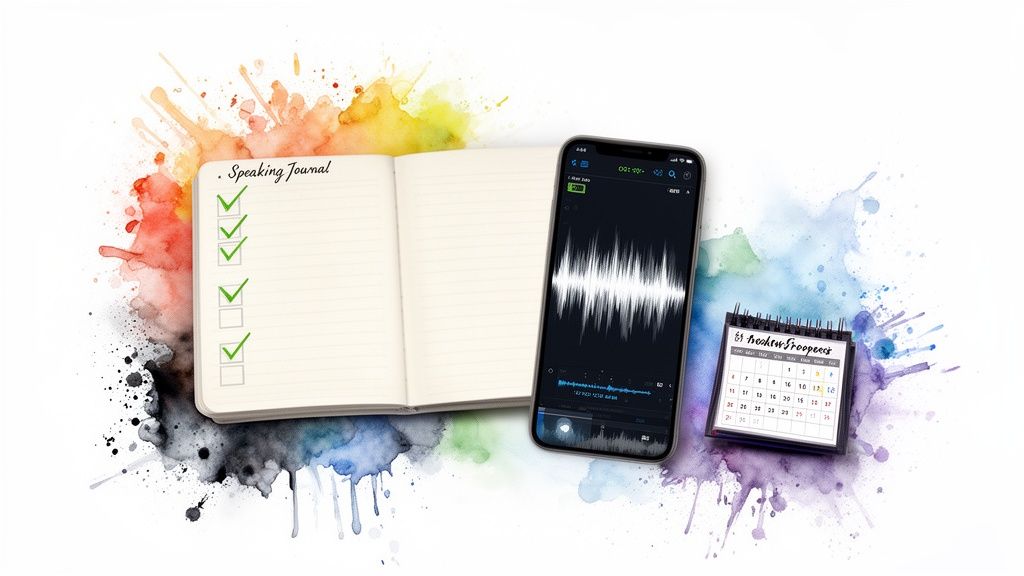
- Keep a Speaking Journal: After a practice session, just jot down a note or two. What new phrase did you finally use correctly? Which topic felt a little less scary to talk about? This isn’t about writing perfect sentences; it's about logging your small wins.
- Record Weekly Audio Snippets: Pick one day a week and record yourself talking about the same simple topic, like "What I did this weekend." Save each file with the date. After just one month, go back and listen to your first recording and then your latest one. The improvement in your flow and confidence will likely surprise you.
- Set Micro-Goals: Ditch vague goals like "get fluent." Instead, set tiny, achievable targets. For this week, maybe it's using three new idioms in conversation. Or perhaps it's speaking for two straight minutes without pausing to look up a word. Ticking these off gives you that constant, satisfying sense of accomplishment.
Use Technology to Build Momentum
Modern apps are built with human psychology in mind. Features like daily streaks and progress reports aren't just for show; they're there to help you build habits. Seeing a 7-day or 30-day streak pop up on your screen gives you a real reason not to skip a session.
For example, inside an app like TalkEasy, you can see tangible metrics, like how many minutes you've spoken or how many new phrases you’ve practiced. This kind of data gives you objective feedback on your effort, turning practice from a chore into a rewarding game.
Your motivation is directly linked to whether you believe you're making progress. When you stop guessing and start tracking, you replace doubt with data. That's a powerful reason to stick with your routine.
Pushing Through the Plateaus
Every single language learner hits a plateau. It's that frustrating period where you feel like you've just stopped improving. This is a completely normal part of the process, and the trick is knowing how to navigate it without giving up.
When you feel stuck, go back to your "why." What was the core reason you started this journey? A better career? The ability to connect with people from other cultures? Traveling without a language barrier? Reconnecting with that initial spark can be an incredibly powerful shot of motivation.
And finally, don't forget to celebrate the small victories. Did you successfully order coffee and make small talk without stumbling? Did you actually get the punchline of a joke in an English movie? Acknowledge these moments. They’re the real stepping stones on the path to fluency.
Frequently Asked Questions
As you start working on your spoken English, some questions are bound to pop up. Everyone asks them. Here are some straightforward answers to the most common hurdles you might face, designed to give you the clarity you need to keep pushing forward.
How Long Until I See Real Improvement?
This is the big one, isn't it? While fluency is a marathon, not a sprint, you'll start noticing real changes faster than you probably expect. If you stick to a focused practice of just 15 minutes a day, you should feel a genuine boost in your confidence and how easily you recall words within a few weeks.
Honestly, the secret isn't about cramming for hours. It’s all about consistency. Short, daily sessions build strong speaking habits far more effectively than long, sporadic study-fests.
Should I Practice with a Native Speaker or an AI Tutor?
Both are fantastic tools, but they serve different purposes. Talking with a native speaker gives you that authentic, real-world conversational flow and cultural nuance that you just can't get anywhere else. It’s invaluable.
But for your daily grind, an AI tutor like TalkEasy offers some unique advantages that are perfect for building a solid foundation.
Think about it this way. An AI partner offers:
- 24/7 Availability: Got a spare 10 minutes at midnight? Your AI tutor is ready. No scheduling, no fuss.
- A Pressure-Free Zone: This is a safe space. You can stumble over words, try out new phrases, and make a total mess of a sentence without any fear of being judged.
- Instant Feedback: You get gentle, immediate corrections on the spot. This helps you fix small mistakes before they turn into bad habits.
The best approach? Use both. Build your core skills and confidence with an AI tutor every day, then put those skills to the test in real conversations with native speakers.
The goal is to communicate, not to be perfect. Every single conversation—whether it's with a person or an AI—is a win. The more you open your mouth and speak, the better you'll get. It really is that simple.
What If I Have Nothing to Talk About?
I hear this all the time, and it's a completely normal feeling. But here’s a little secret: the topic doesn't really matter. The act of speaking is what counts. When you feel stuck, just lean on the simple stuff.
Try one of these to get the ball rolling:
- Walk through your day, from the moment you woke up.
- Talk about a hobby you love and explain why it's so great.
- Recap a movie or a TV show you just watched.
- Describe your job or what you’re studying to someone who knows nothing about it.
The whole point is just to get your mouth moving and your brain firing in English. You'll be surprised how often a simple start blossoms into a full-blown conversation.
How Can I Improve My Pronunciation Alone?
You can absolutely make massive progress on your pronunciation by yourself. One of the best techniques I know is shadowing. Find a short audio clip or video of a native speaker and just try to copy them. Don't just repeat the words—mimic their rhythm, their tone, the music of their speech.
Another game-changer is recording yourself. I know, it feels a bit cringey at first, but listening back is like holding up a mirror to your speech. You’ll hear things you never noticed before. Compare your recording to the original speaker and you can pinpoint exactly which sounds or words need a little more work. That kind of self-awareness is gold.
Ready to put these answers into practice? TalkEasy gives you that judgment-free space to have conversations, get instant feedback, and build real confidence in just 15 minutes a day. Start speaking more clearly and naturally by giving it a try today at https://www.talk-easy.com.