
How to Improve Your English Speaking Skills with Daily Practice
Learn how to improve your English speaking skills. Discover practical, daily habits and proven methods to speak English fluently and with confidence.


If you really want to improve your spoken English, the secret isn't just listening more—it's shifting from passively consuming the language to actively producing it. You need to get into a consistent daily habit, even if it's just for 15 minutes, where you're deliberately practicing through structured exercises, real-world simulations, and a bit of self-correction. This is how you build real confidence and fluency, much faster than just watching another Netflix series.
Why Speaking Is So Much Harder Than Listening (And How to Fix It)
Ever get that frustrating feeling? You can follow along with a movie or a podcast just fine, but when it's your turn to speak, the words just… get stuck. It feels like there's a disconnect between what you know and what you can say.
If that sounds familiar, you're not alone. This gap between understanding (input) and speaking (output) is the single biggest hurdle for most English learners.
In fact, it's a worldwide issue. The EF English Proficiency Index, which tested 2.2 million adults across 123 countries, found that speaking is the weakest English skill in more than half of the nations surveyed. That's right—over 61 countries struggle most with actually talking. It’s a huge sign that the old ways of learning often miss the most important part. You can see the full global English proficiency report and check out how different countries compare.
It's Time to Go from Passive to Active
The heart of the problem is how we practice. Binge-watching shows and listening to podcasts are great, but they are forms of passive learning. While they certainly help with vocabulary and comprehension, they don't train the muscles in your mouth or the brain pathways you need for spontaneous speech.
Think of it this way: you can watch a master chef cook a five-course meal all day. You might understand every single step, but you'll never be able to recreate that dish until you pick up the knife and start chopping yourself. Speaking is no different.
To genuinely get better at speaking, you have to become an active participant. This really just means three things:
- Actually Producing Language: Consciously form sentences and say them out loud. Yes, even if you're just talking to yourself.
- Embracing Mistakes: Stop seeing errors as failures. Think of them as data points that show you exactly where you need to improve.
- Building Muscle Memory: You have to train your tongue, lips, and jaw to move in new ways to create English sounds smoothly.
Your Path to Speaking with Confidence
Here's the good news: fixing this doesn't mean you need to lock yourself away for hours of tedious study. The real solution is a consistent, structured routine built on small, daily actions. This guide is your roadmap to transforming your speaking skills by focusing on practical techniques you can start using today.
The goal isn't perfection; it's communication. The moment you shift your focus from sounding flawless to simply being understood, you take the first and most powerful step toward genuine fluency.
We'll break down exactly how to build a powerful speaking habit in just 15 minutes a day using a simple framework of micro-practices. You’ll also see how you can use modern tools, like the AI-powered conversation practice at TalkEasy, to create a safe space to build confidence without any fear of judgment.
Let's reframe the problem and get you speaking.
To get you started, here is a quick summary of the core actions you can take to start improving your spoken English today. Think of this table as your go-to blueprint for building a solid daily practice.
Your Daily English Speaking Practice Blueprint
| Practice Type | Time Commitment | Key Benefit |
|---|---|---|
| Micro-Practices | 2-3 Minutes | Builds consistency & trains pronunciation muscle memory. |
| Structured Exercises | 5-7 Minutes | Improves grammar, vocabulary, and sentence structure in speech. |
| Role-Plays & Scenarios | 5-10 Minutes | Prepares you for real-world conversations and reduces anxiety. |
| Error Correction | 2-3 Minutes | Turns mistakes into learning opportunities for faster progress. |
This table lays out a simple but effective structure. By combining these different types of practice, you cover all your bases—from the mechanics of speaking to the confidence needed for real-life interactions.
Build a Daily Speaking Habit in Just 15 Minutes
Let's clear up a common myth: you don't need hours of free time to get better at speaking English. The truth I've seen time and again is that consistency beats cramming every single time. A focused, sustainable speaking habit of just 15 minutes a day is not only possible—it’s actually more effective than a long, draining session once a week.
This small, daily commitment works because it fits into even the most chaotic schedules. A short burst of practice keeps the language fresh, builds momentum, and helps you avoid the burnout that often derails more ambitious plans.
Creating Your Weekly 15-Minute Plan
Vague advice like "just practice more" won't get you very far. To see real improvement, you need a structured plan that hits different aspects of speaking. A varied routine keeps things interesting and makes sure you're building a well-rounded skill set, not just getting good at one type of exercise.
Here’s a sample weekly schedule you can steal and adapt:
- Monday Pronunciation Focus: Fire up a pronunciation app or a YouTube channel for 15 minutes. Pick one or two tricky sounds (like 'th' or the difference between 'ship' and 'sheep') and really drill them in different words.
- Tuesday Shadowing Session: Find a 1-2 minute clip of a clear speaker—maybe from a podcast or a TED Talk. Play one sentence, pause it, and then repeat it back. Try to mimic the speaker's intonation, rhythm, and stress as closely as you can.
- Wednesday Vocabulary in Context: Grab five new words you’ve learned this week. For 15 minutes, your only job is to create and say aloud different sentences using each word. This is how you pull vocabulary from your passive memory into your active speaking toolkit.
- Thursday AI Conversation: This is the perfect time for a low-pressure chat. Hop on a tool like TalkEasy for a 15-minute conversation about something you actually enjoy, like movies or travel. The goal here is simply to communicate and get comfortable speaking freely.
- Friday Freestyle Speaking: Set a timer for 15 minutes and just... talk. You can describe your day, explain your weekend plans, or summarize a book you're reading. The topic is less important than the act of speaking continuously, which is what really builds fluency.
This kind of structured variety ensures you’re not just going through the same motions every day. It helps solidify your learning across all the different skills that make up spoken English.
The secret to a lasting habit isn't finding more time; it's making the most of the time you already have. Fifteen focused minutes, done consistently, will always outperform two hours of half-hearted effort on a Sunday.
Harness the Power of Micro-Practices
Beyond your dedicated 15-minute block, you can sprinkle tiny speaking exercises, or micro-practices, throughout your day. These are quick 1-2 minute activities that take almost no planning and can be done just about anywhere.
The point is to increase your total speaking time and make thinking and speaking in English feel completely normal.
Here are a few micro-practices to try today:
- Narrate Your Actions: Making coffee? Say what you're doing out loud. "I'm opening the cupboard. Now I'm getting a mug. I'm pouring the water." It feels a bit silly at first, but it trains your brain to form English sentences on autopilot.
- The 'What's This?' Game: Look around you and name five objects in English. Then, create one simple sentence for each. "This is my laptop. I use my laptop for work."
- Think Out Loud: Deciding what to have for lunch? Do it in English. "Hmm, should I have a salad or a sandwich? The salad is healthier, but I really want a sandwich today."
The visual below shows the simple, powerful journey from just listening to actually speaking.
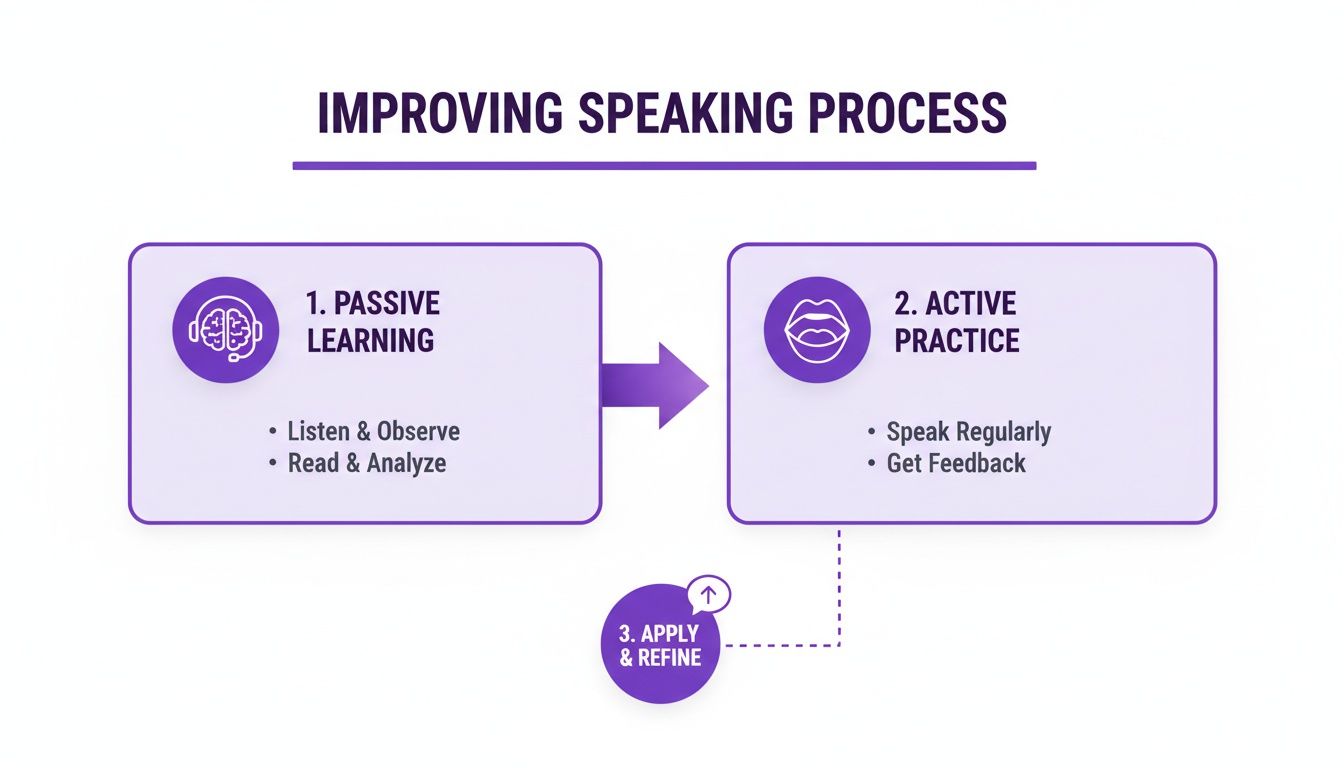
This flowchart really captures the essential shift you need to make: moving from passively consuming information to actively producing the language yourself.
This small daily commitment can lead to big results. In fact, some studies show that adults who practice speaking for just 15-30 minutes daily can improve their fluency by up to 25% in three months. It's a pattern seen in countries with high English proficiency. You can read more about these global language insights to see how consistency really is the key.
These short, focused sessions are exactly where AI conversation partners shine. Platforms like TalkEasy are built for this, giving you a speaking partner on-demand. You can jump in for a quick chat without the pressure or scheduling headaches of finding a real person, making it so much easier to stick to your daily habit and finally improve your English speaking skills.
Nail Your Pronunciation and Find Your Flow
Feeling understood is about so much more than just knowing the right words—it's about how you say them. Your pronunciation, the rise and fall of your voice, and your rhythm are what turn a string of words into clear, confident communication. Getting this flow right is a huge leap forward, and luckily, modern tools make it easier than ever to practice.
It's one thing to know a word in your head and a totally different ball game to get your mouth to say it correctly in the middle of a conversation. That's where targeted exercises come in. They help build the muscle memory you need to speak without second-guessing every sound.
Fine-Tune Your Speech with Classic Drills
Before we get into the high-tech stuff, let's look at two incredibly powerful, low-tech methods that build a solid foundation. Think of these as a workout for your mouth.
First up is shadowing. This is a classic for a reason. You simply listen to a short audio clip of a native speaker and repeat exactly what they say, right after they say it. The goal is to mimic everything—their pronunciation, speed, and intonation.
A simple shadowing routine could look like this:
- Find a good clip: Grab a 1-2 minute snippet from a podcast or a TED Talk where the speaker is clear and not talking a mile a minute.
- Just listen first: Play the clip once to get a feel for the rhythm and what they're talking about.
- Shadow sentence by sentence: Now, play the first sentence, hit pause, and repeat it out loud. Really try to match the "music" of their speech—where their voice goes up and down.
- Rinse and repeat: Go through the whole clip this way. Don't stress about being perfect! The real goal is to get your mouth moving and your ears tuned to the natural sounds of English.
Another fantastic exercise? Tongue twisters. I know they seem a little silly, but they are a phenomenal workout for your mouth, especially for tricky sound combinations.
Struggling with the "sh" and "s" sounds? The old classic "She sells seashells by the seashore" forces your tongue and lips into the exact positions you need for clear pronunciation.
Get Instant Feedback with an AI Tutor
While those classic drills are great, technology gives us an amazing edge: immediate, personalized feedback. AI-powered tools can act like a private coach, listening to your speech and offering specific pointers without the pressure of a live audience. This is your chance to fix mistakes in private and build a really solid base.
This screenshot from TalkEasy shows just how this works. You can jump into a conversation on almost any topic, which creates the perfect low-stakes environment for practice.

When you can chat with an AI about something you actually find interesting, like music, practice stops feeling like a chore.
Platforms like TalkEasy make it easy to apply what you're learning in simulated, real-world chats. If you're looking for more options, we've put together a guide on finding great https://www.talk-easy.com/blog/english-speaking-practice-online-free.
The data really backs this up. AI tools have been shown to make a significant difference. For instance, some users see their pronunciation accuracy jump by 40% in just a single session with an AI tutor. This kind of instant feedback loop is incredibly effective at closing the gap between what you can understand and what you can say.
Pronunciation is the bridge between the words in your head and the understanding in your listener's mind. Building that bridge is the key to confident communication.
Learn the Music of English
At the end of the day, sounding natural isn't just about making the right sounds; it's about the melody of your speech. This is where you get into flow and rhythm. To really nail that natural sound, it helps to understand what prosody in speech is and why it matters—it’s the rhythm, stress, and intonation that give sentences their meaning.
Actively listening for this "music" is just as important as practicing your pronunciation. Start paying attention to which words native speakers emphasize and how their pitch changes to show emotion. Shadowing is perfect for this, too, as it trains your ear to catch these subtle but vital patterns.
When you combine these techniques, you move beyond just saying words correctly and start speaking English with a genuine, natural flow.
Turn Practice into Real-World Conversation Skills
So, you’ve been drilling your pronunciation and vocabulary every day. That’s fantastic—it builds the foundation. But the real goal is to actually use your English, right? This is where a lot of learners hit a wall. The jump from practicing safely by yourself to having a spontaneous chat with a real person can feel massive.
Don't worry, there's a bridge for that gap. It's all about using structured exercises and role-playing to get you ready for the real thing. The trick is to shift from repeating single words or short phrases to simulating entire conversations. By preparing for specific situations, you start building a mental playbook of what to say, which makes thinking on your feet so much less stressful.
Prepare for Life with Role-Playing Scenarios
Role-playing is hands-down one of the best ways to activate what you know. It lets you rehearse the exact conversations you're likely to have, which builds both your skills and your confidence for when it really matters.
Pick a common, everyday scenario to start. But don't just think about it—actually say both sides of the conversation out loud. This forces you to anticipate what the other person might say and have a response ready.
Here are a few practical prompts to get you started:
- Ordering at a Restaurant: Go beyond just "I want a coffee." Start with, "Hi, I'd like to see the menu, please." Practice asking natural questions like, "What do you recommend?" or "Does this dish contain nuts?" Then, place your order: "I'll have the grilled chicken salad, please."
- Participating in a Work Meeting: Picture yourself needing to give an update. Kick it off with phrases like, "Good morning, everyone. Just a quick update on the marketing campaign..." or jumping in with, "To add to what Maria said, I think we should also consider..."
- Handling a Customer Service Call: Imagine your internet is down. You could start with, "Hello, I'm calling because my internet isn't working," and then ask, "Could you please tell me when a technician can come?"
For any scenario you choose, scribble down a few key phrases you’ll need. This little bit of prep makes a huge difference. If you want to take it a step further, digging into effective communication skills training can give you strategies that apply to any language.
The goal of role-playing isn't to memorize a script. It's to build comfort and familiarity with a situation so that when it happens in real life, you feel prepared, not panicked.
Find and Structure Conversations with Language Partners
Solo practice is great, but nothing beats the real back-and-forth of talking to another person. Finding a language exchange partner is an amazing way to get live conversation practice, and you get to learn about another culture at the same time.
You can find partners on platforms like HelloTalk or Tandem. The idea is to find a native English speaker who's learning your language, so you can help each other. The secret to making this work is to add a little structure so it’s not just a casual, aimless chat.
To get the most out of every exchange, try this simple framework:
- Set a Goal: Before you talk, decide on a topic or skill. Maybe you want to discuss a news article you both read or practice using past tense verbs correctly.
- Split the Time: Keep it fair. Agree to speak for 15 minutes in English and 15 minutes in their language. This way, you both win.
- Ask for Specific Feedback: Instead of a vague "How was my English?" ask targeted questions. Try, "Did I use prepositions correctly when I talked about my weekend?" or "Was there a more natural way to phrase that sentence?"
Consistent practice with a real person is a total game-changer. For a deeper dive into making these sessions count, check out our complete guide on English conversation practice online.
Simulate Real Life with AI Tools
Let's be honest—sometimes the pressure of talking to a real person is what holds us back. That’s where AI conversation tools like TalkEasy are incredibly helpful. You can run through the exact same real-world scenarios but in a completely judgment-free zone.
Need to rehearse a job interview five times in a row? Want to practice small talk before a party? An AI partner is ready 24/7. This lets you build up your confidence on your own terms, making the leap to real conversations feel a lot less intimidating.
This kind of deliberate, structured practice is proven to work. Just look at an organization like Toastmasters International—with over 14,000 clubs worldwide, they report that members gain 20% more confidence in public speaking within just six months. Whether you're working with a human partner or an AI tool, consistent, focused practice is what gets you to fluency.
Overcome Your Nerves and Actually See Your Progress
Let's be honest: the road to fluent English isn't a straight line. There will be bumps, moments of self-doubt, and days you feel like you're not making any progress at all. This is completely normal. The real trick is learning how to navigate these challenges, because that’s what separates the learners who succeed from those who get frustrated and quit.
The biggest hurdles are almost always in your head. It’s that fear of making a mistake, the dreaded feeling of your mind going blank, or the frustration of hitting a plateau. But with the right mindset and a few practical techniques, you can push right through them.

From Fear to Feedback: The Error Log Technique
First, let's tackle the biggest barrier: the fear of making mistakes. This fear can be paralyzing, stopping you from even trying to speak. The key is to completely reframe how you see errors. They aren’t failures—they’re data. Each mistake is a signpost showing you exactly what to work on next.
This is where the Error Log comes into play. It’s a simple but incredibly powerful way to turn your mistakes into your greatest learning tool.
Instead of cringing at an error, you start treating it like a detective finding a clue. After a conversation, take a quick moment to jot down mistakes you remember making or moments you felt stuck. Your log doesn't need to be fancy; a note on your phone or a small notebook works perfectly.
Here’s a simple way to structure it:
| The Mistake I Made | The Correction | Why I Made It |
|---|---|---|
| "I am agree with you." | "I agree with you." | I forgot 'agree' is a verb. |
| "He don't like coffee." | "He doesn't like coffee." | Third-person singular verb error. |
| Couldn't remember "efficient" | Had to say "works well" | Need to review work-related adjectives. |
This process transforms that negative feeling of messing up into a constructive, proactive step. It’s a crucial move in learning how to improve your english speaking skills because it makes your practice targeted and effective. Dealing with the anxiety of speaking is often the biggest battle, and we have a full guide dedicated to overcoming the fear of public speaking that can give you even more strategies.
Never Go Blank Again With Simple Frameworks
The second major hurdle is that "blank mind" feeling. You're mid-sentence, and suddenly... nothing. This often happens when you're trying to translate directly from your native language or you just don't have a simple structure to hang your thoughts on.
The fix? Use simple frameworks to organize what you want to say. Think of them as mental maps that give your thoughts a clear path.
One of the easiest and most effective is the PREP method:
- P - Point: State your main idea clearly and directly. ("I think remote work is a great option.")
- R - Reason: Explain why you believe that. ("Because it offers far more flexibility.")
- E - Example: Give a specific, concrete example. ("For instance, I can adjust my schedule to work when I'm most productive.")
- P - Point: Restate your main point to wrap it up. ("So, that's why I believe remote work is so beneficial.")
Having a simple structure like this in your back pocket means you always have a way forward in a conversation, which dramatically cuts down on the anxiety of going blank.
Progress isn't about never making mistakes; it's about making new ones. When you can see your own improvement, motivation takes care of itself.
See Your Progress with Concrete Metrics
Finally, let's talk about that feeling of being stuck on a plateau. When you practice every day, it can be tough to notice the small, incremental improvements. This is why tracking your progress with concrete metrics is so vital—it gives you tangible proof that your hard work is actually paying off.
After all, you can't improve what you don't measure. Here are a few dead-simple ways to track how far you've come:
- Record Yourself Weekly: This is non-negotiable. Use your phone to record yourself speaking for just one minute on the same topic each week. When you listen back to a recording from a month ago, you'll be stunned by the improvements in your speed, confidence, and hesitation.
- Count New Words: After a conversation, try to recall how many new vocabulary words or phrases you successfully used. Aim to work one or two new words into each chat. It's a small goal that adds up fast.
- Time Your Fluency: Time yourself speaking on a random topic for one minute. Count the number of "ums," "ahs," or long pauses you make. As you track this number week over week, you’ll literally see it go down as your fluency goes up.
These simple metrics give you the positive reinforcement you need to stay motivated. They show you, in black and white, that you really are getting better every single day.
Where Do You Go From Here?
Look, improving your spoken English isn't some far-off destination you might reach someday. It's a journey you build brick by brick with consistent, active practice. We've walked through a clear path in this guide, showing you how to move from just listening to actually speaking with confidence.
The big takeaway is this: small daily actions lead to massive results. It’s all about building a 15-minute daily habit that you can actually stick with. When you use a tool like TalkEasy, you’re giving yourself a safe, no-judgment zone to practice real-life conversations.
This kind of consistent exposure is exactly why countries like the Netherlands see 90-95% of their population speaking English fluently—they start early and practice often. It's a proven model. If you're curious, you can discover more insights about global language shifts and see just how effective this approach is.
Here's something to remember: fluency is about connection, not perfection. The real goal is to get your ideas and personality across, not to sound like you just swallowed a grammar textbook.
Your journey is an ongoing process, one of constant improvement. So, pick one small thing from this guide to start with. Just one. Maybe it's shadowing a podcast on your commute, trying some self-talk while making coffee, or jumping into a five-minute AI chat.
That first step is the one that matters most. Take it today.
Frequently Asked Questions
Got questions? You're not alone. Here are some of the most common things learners ask when they're trying to get better at speaking English, along with my straight-to-the-point advice.
How Long Does It Take to Become Fluent in English Speaking
This is the classic "how long is a piece of string?" question. There's no magic number because everyone's starting point, native language, and practice habits are different.
But here's what I've seen work. With a consistent 15-minute daily practice routine focused on active speaking, most people feel a real jump in their confidence and flow within 3 to 6 months. The secret isn't locking yourself away for hours; it's about making small, consistent efforts every single day.
Should I Focus on Grammar or Fluency First
When you’re starting out, go for fluency and clear communication every single time. Hands down.
The fear of making a grammar mistake is probably the single biggest reason people just don't speak. But the goal is to be understood, not to be perfect.
Communication first, perfection later. Just focus on getting your thoughts out and building that initial confidence. You can always polish the grammar once you're comfortable speaking, but you can't polish silence.
This is where a tool like TalkEasy really helps. It gives you a safe space to just talk without worrying about being judged, which is exactly what you need to break through that initial barrier.
Can I Improve My English Speaking Skills by Myself
Absolutely. In fact, a lot of the real progress happens when you're practicing on your own. While talking with another person is great, solo practice is where you can really hone your skills without pressure.
Here are a few solo drills I always recommend:
- Shadowing: Find a short audio clip of a native speaker and try to mimic their speech exactly—the rhythm, the pitch, the pauses. It's fantastic for your intonation.
- Reading Aloud: This is like a workout for your mouth. It trains the muscles to make English sounds that might not exist in your native language.
- Self-Recording: Use your phone to record yourself talking for a minute or two. When you listen back, you'll hear things you never noticed before.
- AI Conversation Apps: Tools like TalkEasy are perfect for this. You get to have a conversation whenever you want, simulating the real thing.
These techniques are your secret weapon for building a solid foundation in pronunciation and flow.
What Is the Fastest Way to Improve English Speaking
If you want the fastest route, you need to combine two things: high-frequency, active practice and immersion. It's that simple.
That means you have to speak every day, even for just 15 minutes. Then, you layer on simple immersion tactics. Change your phone's language to English. Listen to an English podcast on your way to work. Narrate your daily tasks in your head in English. Active use will always beat passive learning for speed.
Ready to turn all this practice into real confidence? Start your journey with TalkEasy and get the daily conversation practice you need to finally speak fluently. Begin your first conversation on https://www.talk-easy.com today!