
Beginner Guide: how to make friends in america for newcomers
Essentials on how to make friends in america: practical steps to start conversations, join communities, and sustain lasting friendships.


Making friends in America really boils down to two things: getting a feel for the local culture and being willing to put yourself out there. It’s not about changing who you are, but about learning the local "language" of friendship and confidently taking the first step. Think of it as a skill, and like any skill, you can get better with practice.
Why Making Friends in America Can Feel So Hard
If you're struggling to build deep, lasting connections in the U.S., let me start by saying: it's not just you. Many people—Americans included—are trying to figure out how to connect in what some experts have dubbed a "friendship recession." This isn't a personal failure; it's a massive social shift that’s making it harder for everyone to find their people.
Realizing this is the first, most important step. It helps you stop asking, "What's wrong with me?" and start asking a much more productive question: "Okay, so what can I do about it?"
The Friendship Recession Is Real
That feeling of isolation you might be experiencing isn't imaginary—it's backed by some pretty sobering data. The way Americans socialize has fundamentally changed over the past few decades. The traditional community structures are weaker, and our lives are often more siloed between work, family, and digital bubbles.
The numbers really tell the story. Back in 1990, about 33% of U.S. adults reported having 10 or more close friends. Fast forward to 2021, and that number plummeted to just 13%. Even more telling, the percentage of adults with zero close friends jumped from 3% to 12% in that same period. You can dig deeper into these trends and what they mean over at the Survey Center on American Life's original report.
This infographic gives you a clear visual of just how much American social circles have shrunk.
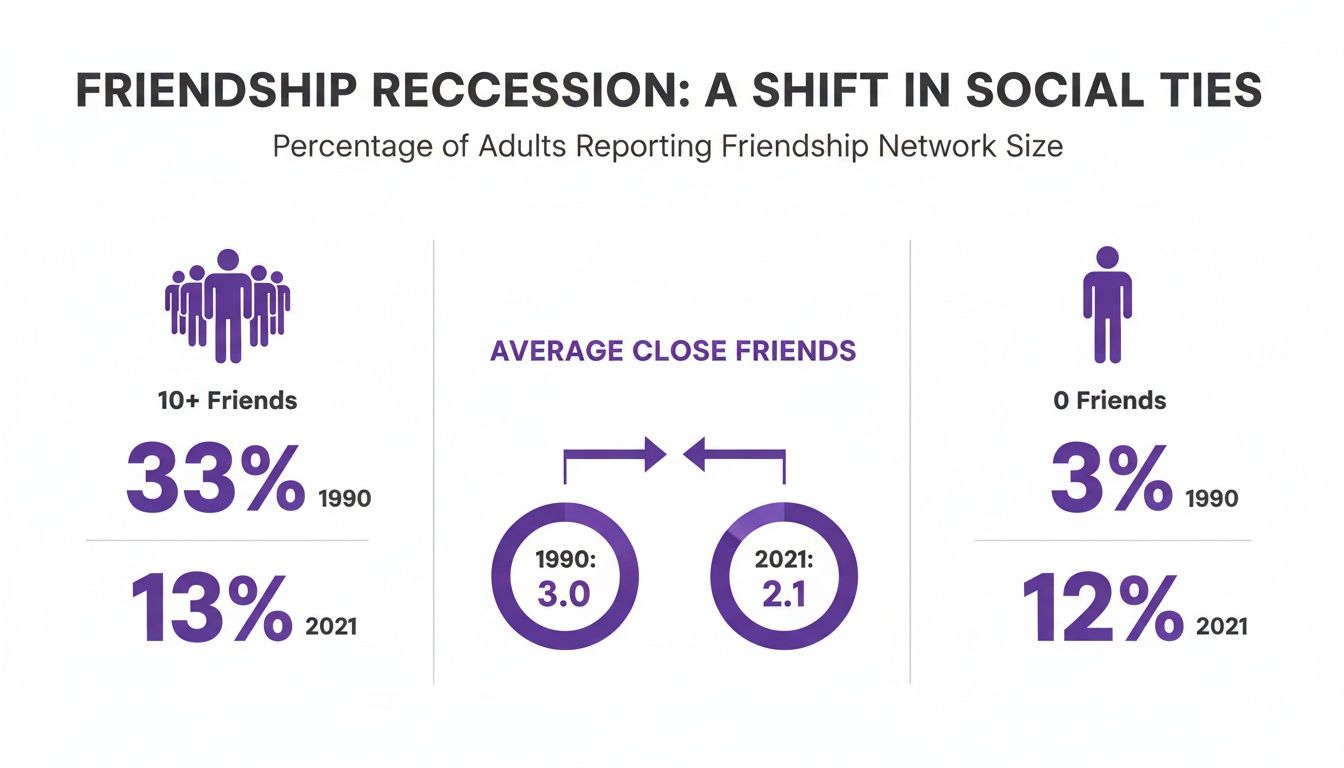
What this all means is that fewer people have big support networks to fall back on. It also means that being intentional about making friends is no longer optional; it's essential.
Quick Guide to Making Friends in America
Making friends in the U.S. comes down to understanding the culture and taking initiative. Here's a quick look at the core principles we'll explore in this guide.
| Strategy | What It Means | Why It Works |
|---|---|---|
| Be Proactive | Don't wait for others to invite you. Be the one to suggest a coffee, a walk, or a hangout. | Americans often have busy, structured lives. Direct invitations cut through the noise and show genuine interest. |
| Master Small Talk | Learn to enjoy light, casual conversations about weather, sports, or weekend plans. | It's the social lubricant of American culture. It’s a low-pressure way to test the waters and build rapport. |
| Follow Up | If you have a good conversation, get their contact info and send a follow-up text. | This turns a one-time encounter into a potential connection. It shows you're serious about getting to know them. |
| Join a "Third Place" | Find a place outside of home and work—a gym, club, or volunteer group—where you see the same people regularly. | Repeated, informal interactions are the foundation of friendship. It creates familiarity and opportunities for connection. |
These strategies aren't complicated, but they do require a conscious effort. The rest of this guide will break down exactly how to put them into practice.
Building Your Proactive Plan
Knowing that you're not alone in this can feel like a weight off your shoulders. It allows you to shift from self-blame to a more constructive mindset focused on a practical plan. You can’t change a societal trend, but you can absolutely control your own actions.
This guide is your roadmap. We’re going to move past the "why" and dive straight into the "how." You’ll get actionable advice on:
- Understanding Cultural Nuances: Decode the unwritten rules of American social life, from making plans to appropriate follow-ups.
- Finding Your People: Discover the best places to meet like-minded individuals, from hobby groups to local community events.
- Practicing Conversation: Build your confidence with practical exercises and conversation starters that actually work.
The goal here isn't just to meet a bunch of people. It’s to build the skills and self-assurance you need to turn those first hellos into real, meaningful friendships. It’s all about being intentional.
Treat this like learning any other valuable skill, whether it’s a new language or a sport. It takes a bit of learning, a lot of practice, and the willingness to stumble a few times. With the right approach, you can absolutely build the social life you want here.
Cracking the Code of American Social Norms

Before you can build real connections in the U.S., you need to get a handle on the unwritten rules of American social life. It's incredibly easy to misread the signals, especially when you're coming from a different cultural background.
What feels like a deep connection might just be casual friendliness. An abrupt-sounding conversation could simply be someone being direct. Learning to decode these subtle cues is the key. This kind of cultural fluency gives you the confidence to engage authentically and sidestep the common misunderstandings that can stop a friendship in its tracks.
Friendliness vs. Friendship: The Great Divide
One of the biggest lessons for anyone new to the States is learning to tell the difference between American friendliness and genuine friendship.
That barista who asks about your day with a huge smile? The person at the gym who compliments your shoes? They aren't necessarily trying to become your new best friend. This kind of outward warmth is often the cultural default—it’s just a way to make brief encounters pleasant for everyone.
Think of it as a social welcome mat. It’s an invitation for a quick, positive interaction, not an open-door policy to their inner circle. Knowing this helps you manage your expectations and keeps you from feeling disappointed when a cheerful chat doesn't turn into an immediate invitation to hang out.
Real friendship, on the other hand, is built over time through repeated, intentional contact. It’s what happens when conversations move from public spaces to personal ones, and from casual chats to shared experiences. That transition almost always starts when one person takes the initiative to suggest something more.
Don't Underestimate the Power of Small Talk
I get it. For many people, American small talk feels superficial. Who really cares about the weather, last night's game, or weekend plans? But here, small talk serves a vital purpose: it's a low-risk way to test the waters and find some common ground.
The topic itself is rarely the point. It's the act of connecting that matters. By engaging in these light, easy conversations, you're signaling that you're open, approachable, and willing to play the social game. It’s the first rung on the ladder that leads to a real relationship.
Small talk is the appetizer, not the main course. Its job is to create a comfortable space where a more meaningful connection might have a chance to grow.
Personal Space and Plain-Spoken Language
Americans tend to prefer a larger bubble of personal space than people from many other cultures. A good rule of thumb is to keep about an arm's length distance in social situations. Getting too close too fast can make someone uncomfortable, even if you mean well. Watch for non-verbal cues—if someone takes a small step back as you're talking, it's a gentle hint to give them a bit more room.
At the same time, American communication is often surprisingly direct. If someone says, "We should totally get coffee sometime!" that's often just a polite way to end a conversation. But if they say, "Are you free for coffee next Tuesday morning?"—that's a concrete plan in the making.
Learning to appreciate this directness will save you a lot of confusion. Don't be afraid to be specific when you want to make plans. Vague ideas tend to get lost, but a clear proposal forces a clear "yes" or "no." This straightforwardness also applies to the language itself, and getting familiar with a few common American expressions can make social cues much easier to read.
The Art of Making the First Move
So, how do you get from a friendly chat to an actual hangout? You have to take the initiative. In American culture, if you sit around waiting for an invitation, you might be waiting for a very long time. More often than not, the person who suggests the next step is the one who turns an acquaintance into a potential friend.
Here’s how you can do it without feeling awkward:
- Tie it to your conversation. Just talked about a shared love for hiking? Say, "There's a great trail I've been wanting to check out. Would you be interested in going this weekend?"
- Keep the pressure low. Suggesting something casual and short, like grabbing a coffee or walking through a local market, is far less intimidating than proposing a full dinner.
- Be specific with your timing. Instead of a vague "let's hang out," try something like, "I'm planning to hit the farmers market on Saturday morning. Want to join?"
This proactive approach shows you're genuinely interested and makes it easy for the other person to say yes. Ultimately, making friends in America often comes down to being brave enough to take that one small, crucial step forward.
Finding Your People in Everyday Places
Alright, you’ve got a handle on the cultural side of things. Now, let's get practical. Making friends in America is less about waiting for an invitation and more about proactively putting yourself in situations where connections can spark. The real secret is finding places where you'll see the same faces again and again. That's how a casual "hello" turns into a real conversation.
Forget sitting around and waiting for friends to magically appear. Your journey starts right where you spend most of your time.
Turn Workplace Connections into Friendships
Your job is a goldmine for potential friends, but you have to know how to navigate it. The trick is to gently shift professional courtesy into genuine personal connection. It starts by showing you’re interested in your colleagues as people, not just as job titles.
Instead of eating lunch at your desk, try inviting a coworker to a nearby cafe. If you overhear someone chatting about a show you love or a hike they took over the weekend, that's your opening. Something as simple as, "Oh, you watch that too? What did you think of the finale?" can completely change the dynamic.
Be the one who initiates the shift from work talk to life talk. It’s a clear signal that you see them as more than just someone who sits in the next cubicle.
Don't underestimate after-work events. Suggesting a casual happy hour after a tough week or organizing a team volunteer day builds a sense of camaraderie in a much more relaxed setting. Friendships are often forged in these moments, far away from the pressure of deadlines and meetings.
Leverage Shared Interests in Your Community
There's no better way to bond than over a shared hobby or passion. When you're doing something you enjoy, you're naturally more relaxed and open, which makes conversation flow a whole lot easier. Look for activities that involve meeting regularly.
- Local Workshops: Signing up for a weekend pottery class, a coding bootcamp, or a photography workshop immediately puts you in a room with people who get your interests. The activity itself is the perfect icebreaker.
- Community College Classes: Taking a non-credit class—maybe a new language, a cooking course, or even public speaking—is a fantastic way to meet locals. You'll have an instant reason to connect outside of class to study or work on projects together.
- Language Exchanges: These meetups are a brilliant option for newcomers. You get to practice your English in a supportive environment while helping others, creating a win-win situation where friendships can easily grow.
Embrace the Power of Neighborhood and Local Groups
Even though Americans can seem busy, the pull of community is still strong. Research shows that while most neighbors exchange greetings, only about 25% of people actually become friends with them. These connections often start at shared events like dinners (24%) or holiday parties (23%). Why not be the person who gets one started?
This is also where volunteer groups and local sports leagues really shine. When you join a crew to clean up a local park or sign up for a recreational soccer team, you’re part of a team with a shared goal. That sense of common purpose removes all the pressure of trying to make small talk. If you're ever stuck for what to say, you can always check out our guide on interesting conversation topics for adults.
When you're ready to get involved, a great place to start is to discover practical community building activities for adults that foster real friendships. It’s these small, consistent efforts right in your own backyard that make the biggest difference.
Using Apps to Bridge the Digital Divide
Let's be real, technology can be a huge help in meeting people, but only if you use it the right way. Apps like Meetup or Bumble BFF are designed to connect you with people who share your interests, taking some of the guesswork out of it.
The key is to move from chatting online to meeting in person fairly quickly. Endless texting can make the connection fizzle out before it even starts. Once you've exchanged a few messages and feel a good vibe, suggest a casual meetup in a public place.
Here’s a simple script you can adapt:
"It's been so fun chatting with you! It sounds like we both love trying new coffee shops. I was planning to check out [Cafe Name] this Saturday morning. Any chance you’d want to join?"
This approach is direct, safe, and built around a shared activity. It’s the perfect way to turn a digital match into a real-life opportunity for friendship.
Mastering the Art of American Conversation

So, you’ve found the right places and you're starting to meet people. That’s a huge step, but it's really only half the battle. The real key to turning a casual "hello" into a genuine connection is knowing what to say—and just as importantly, how to say it.
This is where you shift from just being in the room to actually building a relationship. Mastering the rhythm of American conversation isn't about memorizing a bunch of scripts. It's about getting a feel for the natural back-and-forth that sparks real, engaging discussions.
Your Go-To Conversation Starters
That feeling of dread when you don't know what to say? It’s completely normal. The best way to beat it is to have a few simple, reliable openers in your back pocket for different situations. Think of these as your keys for unlocking the door to a longer chat.
At a casual party or get-together:
- Point out something around you: "This is a great playlist! Do you happen to know who this artist is?" or "I love the vibe of this place. Have you been here before?"
- Find a common link: "So, how do you know [the host's name]?" This is a classic for a reason—it instantly gives you both a starting point.
At a work event or workshop:
- Focus on goals: "What are you hoping to get out of the event today?" or "Which speaker are you most excited to hear?"
- Talk shop (lightly): "I saw on your name tag that you're with [Company Name]. I'm really curious about what you all do there."
In an everyday spot, like a coffee shop or park:
- Keep it simple and direct: "That book looks interesting. Would you recommend it?" or a genuine "Your dog is adorable! What kind of dog is it?"
These openers are great because they're low-pressure. They invite a simple answer that makes it easy for the other person to respond and get the ball rolling.
How to Move Beyond Small Talk
The opener gets you in the door, but the real connection happens when you move past the weather. This is the transition from "small talk" to "real talk," and it all comes down to asking better questions and actually listening to the answers.
Instead of asking questions that get a quick "yes" or "no," try open-ended questions that invite a story or an opinion.
| Instead of This (Closed) | Try This (Open-Ended) | Why It Works |
|---|---|---|
| "Do you like hiking?" | "What are some of your favorite places you've hiked around here?" | It prompts a much more detailed answer and opens the door for follow-up questions. |
| "Are you from this city?" | "What's your story? What brought you to this city?" | This is personal without being too intrusive, letting them share as much as they want. |
| "Did you have a good weekend?" | "What was the best part of your weekend?" | It focuses on a positive highlight, encouraging a better response than just "it was good." |
When you ask more thoughtful questions, you're showing you’re genuinely curious. That makes people feel seen and valued, which is the foundation of any real friendship.
The Give-and-Take of a Good Conversation
A great conversation is a two-way street. After you ask a question, your next job is to listen—and I mean really listen—for things you can connect with. Pay attention to their answers and look for shared interests or experiences.
When you find one, that’s your cue to share a small, relatable story of your own. This technique, sometimes called reciprocal sharing, is what builds trust and a feeling of closeness.
For example, if they mention they just adopted a puppy, you could jump in with:
"That’s amazing! I remember when I got my dog a few years ago. The first few weeks were pure chaos, but so worth it. What's been the biggest surprise for you so far?"
See what happened there? You validated their experience, shared a tiny piece of your own story, and then turned the conversation back to them with another open-ended question. This back-and-forth is the heartbeat of a deepening friendship. For a deeper dive into these dynamics, there are some great resources on how to develop social skills.
Build Your Conversational Muscle Memory
Knowing these techniques is one thing, but feeling comfortable enough to use them in the moment takes practice. This is where you can actually rehearse a bit to build up what I call "conversational muscle memory," which makes real-life interactions feel way less intimidating.
If you find this part difficult, you’re not alone. A 2022-2023 American Friendship Project survey found that 51% of adults say it's hard to make new friends. The good news? Only 1.8% of people considered themselves completely friendless when they included family and partners. The desire to connect is definitely there.
This is where you can get a little strategic. With a bit of effort, you can significantly improve your English conversation skills through targeted exercises.
Platforms like TalkEasy are designed for this exact purpose. They let you simulate real-world conversations—from ordering coffee to chatting with a coworker—in a safe, judgment-free space. This kind of practice helps you internalize the flow of American conversation so that when you’re face-to-face with a potential new friend, your responses feel natural and confident, not like you're reading from a script.
From Casual Acquaintance to True Friend

Meeting someone new is just the first step. The real art lies in what comes after that initial 'hello.' If you want to turn a pleasant chat into a genuine friendship, you have to be willing to take the next step, something that's a huge part of American culture: taking the initiative.
You can’t just sit back and wait for an invitation to fall into your lap. Being the one to suggest a hangout shows you're actually interested in building a real connection. In the U.S., people's schedules are often jam-packed, so a clear, direct invitation is the best way to cut through the noise. It’s the bridge between a one-time encounter and something more meaningful.
Making the First Move Without the Pressure
Asking someone to hang out for the first time can feel a little intimidating, I get it. But it doesn't have to be a big, formal affair. The secret is to keep it casual, be specific, and connect it to something you’ve already talked about. This makes the whole thing feel natural and low-stakes.
Here are a few easy, low-pressure ways to put yourself out there:
- Bring up a past conversation. "Hey, I was just thinking about that new coffee shop you mentioned. I’m free on Saturday morning if you'd like to check it out together."
- Suggest a group thing. "A few of us are planning to go bowling on Friday night. It's super casual, and it would be great if you could join!"
- Propose something short and sweet. "I'm heading to the park to walk my dog around 5 pm. Want to come along for a quick stroll?"
The goal of that first hangout isn't to become best friends overnight; it's just to spend a little more time together. A 30-minute coffee or a walk is often a better starting point than a full dinner because it’s a smaller time commitment for both of you.
How to Handle a 'No' Gracefully
Look, not every invitation is going to get a 'yes,' and that is perfectly okay. A 'no' is almost never a personal rejection. Most of the time, it's just about a scheduling conflict or some other commitment they already have. The way you respond is what really matters for keeping the door open.
If someone can't make it, the best thing you can do is be gracious and positive. A simple, "No worries at all! Maybe another time," shows you're easygoing and understanding. This takes away any potential awkwardness and makes it much more likely they’ll be up for it next time.
Maintaining Momentum for a Lasting Connection
Building a solid friendship is a marathon, not a sprint. The bond deepens over time with shared experiences and consistent effort. Once you've had that first successful hangout, don't let the momentum just fizzle out.
A simple follow-up text like, "I had a great time today! Let's do it again soon," keeps the connection warm. Then, in a week or two, you can suggest another activity. In-person time is so important; research shows that even with all our digital tools, 36% of people struggle to maintain friendships without face-to-face interaction. You can dive deeper into the challenges of modern friendship in this insightful report from the American Survey Center.
For anyone learning English, these real-world interactions are pure gold. Platforms like TalkEasy give you a space to practice these exact social scenarios—from asking someone out for coffee to sending a casual follow-up text—so you feel way more confident when it really counts. That consistent practice is what builds the fluency and self-assurance you need to turn new acquaintances into true friends.
Your Questions Answered About Making Friends in the US
Jumping into the social scene in a new country can feel like navigating a maze. As we wrap up this guide on building friendships in America, I want to address some of the most common questions and worries that pop up. Think of this as a quick-reference cheat sheet for those tricky "what do I do now?" moments.
Sometimes, just getting a few straightforward answers is all it takes to build the confidence you need. Let’s tackle some of the situations you're likely to run into.
What If My English Isn't Perfect?
This is easily one of the biggest fears I hear, but in reality, it’s rarely the deal-breaker people think it is. Most Americans genuinely appreciate the effort you're making to communicate in their language. They're usually far more patient and understanding than you'd expect.
Don't let the fear of a grammatical slip-up stop you from saying hello. Focus on getting your point across, not on flawless sentence structure. A warm smile and a real effort to connect speak volumes.
Authenticity is so much more important than fluency. People connect with you—your personality, your sense of humor, your kindness—not your ability to nail the past perfect tense every time. Just be yourself. The right people will get it.
How Do I Know If Someone Genuinely Wants to Be Friends?
This is a tough one, especially since casual friendliness is so common in the U.S. The key is to look for reciprocity and consistency. True friendship is a two-way street.
Here are a few green flags to watch for:
- They make an effort, too. Are you always the one sending the first text or suggesting plans? A potential friend will start reaching out to you as well.
- They follow up. After you spend time together, they might shoot you a message saying they had fun or bring up an inside joke from your last conversation. That's a great sign.
- They bring you into their world. When someone starts introducing you to their other friends, they're showing you that they see you as a real part of their life.
Is It Okay to Talk About Personal Topics?
Absolutely, but it's all about the timing. In the U.S., friendships tend to deepen over time, moving from "safe" topics like hobbies, work, or what you're watching on Netflix to more personal territory. Early on, it's probably best to steer clear of sensitive subjects like politics, religion, or how much you earn until you've built a solid foundation.
A good way to gauge this is to let the other person take the lead. If they open up about something more personal, it's often a signal that they feel comfortable enough for you to do the same. But remember, you never have to share anything that makes you uncomfortable.
How Often Should I Be Following Up?
There's no single right answer, but a good rule of thumb is to show interest without being overwhelming. After you meet someone and have a great conversation, sending a text within a day or two is perfect. If you want to suggest getting together again, maybe give it a few days to a week.
This pacing lets them know you're keen to connect again without making you seem too pushy. Life gets busy for everyone, so a little patience goes a long way. The goal is to find a natural rhythm that works for both of you.
Practicing these social skills is the fastest way to build your confidence. With TalkEasy, you can jump into simulated real-world conversations and get instant, helpful feedback in a completely private space. Start speaking more naturally today by visiting the TalkEasy website.