
A Practical Guide on How to Improve Listening Comprehension
Learn how to improve listening comprehension with proven techniques. This guide offers actionable advice for understanding spoken English with confidence.


To really improve your English listening, you need to switch from passively hearing the language to actively, focused practice. This isn't about marathon study sessions; it's about consistently engaging with spoken English in short, targeted bursts that challenge how you process speed, accents, and new vocabulary.
Why Your Listening Skills Feel Stuck
Does this sound familiar? You've spent years drilling grammar rules and reading English texts, but the moment you're in a real-world conversation, it all falls apart. If so, you're not alone. It's an incredibly common plateau for learners when their reading ability soars past their listening skills.
This gap often comes down to the way English is traditionally taught. Think about it: most formal education leans heavily on reading and writing, leaving listening as an afterthought. An OECD analysis actually confirmed this, finding that classroom instruction is much better at building reading proficiency than listening skills. You can see the details of these educational findings on oecd.org.
The result is a common, yet fixable, problem. Your brain gets fantastic at processing English visually through text, but it hasn't developed the necessary "muscle" for processing the same information auditorily, especially at the speed of natural conversation.
The Hearing vs. Comprehending Gap
The real heart of the issue lies in the difference between simply hearing sounds and actively comprehending their meaning. Hearing is passive. Comprehension, on the other hand, is an active, complex mental workout.
When you're listening to a native speaker, your brain is juggling several tasks at once:
- Decoding Sounds: Distinguishing individual words and phonemes from a stream of noise.
- Processing Grammar: Making sense of sentence structures as they're spoken.
- Interpreting Vocabulary: Grasping the meaning of words and idioms in context.
- Following the Main Idea: Piecing it all together to track the speaker's core message.
If just one of those links in the chain breaks, your understanding can completely collapse. This is especially true if you find yourself mentally translating everything back into your native language—a habit that adds a huge delay to your processing time. If you do this, learning how to think in English directly can be a game-changer.
The goal is to close the gap between your passive vocabulary (words you recognize when reading) and your active listening vocabulary (words you understand instantly when spoken).
The good news is that this is a totally trainable skill. You don't need to dedicate hours to boring drills. What you need are small, consistent efforts using the right methods.
Modern tools can make a huge difference here. For example, AI-powered platforms like TalkEasy give you a way to get affordable conversation practice that feels like the real thing, helping you build comprehension and confidence at the same time. The rest of this guide will lay out a clear roadmap to help you do exactly that.
First, Figure Out What's Actually Holding You Back
To get better at listening, you have to play detective first. You can't fix a problem if you don't know what it is. Just practicing randomly might get you somewhere eventually, but if you zero in on your specific weak spots, you'll improve so much faster.
This isn't about passing or failing a test; it's about collecting clues. Your mission is to find the exact moments where your understanding breaks down. Is it the speed? A certain accent? Or do you get tripped up by slang and idioms?
Think of it this way: you wouldn't tell a doctor you just "feel sick" and expect the right medicine. They need to know the specific symptoms. The same goes for your listening skills—we need to find the right cure.
Create a Quick Diagnostic for Yourself
To get a real sense of your skills, you need to listen to more than just one type of audio. A slow, perfect news report won't tell you the whole story. You need to test yourself with a mix of real-world material.
Here’s a simple way to build a personal test. Just grab three different types of audio—this variety is key to uncovering where you really struggle.
- Something Slow and Clear: Start here. Find a short clip from a source known for clean, deliberate speech, like a news report from VOA Learning English or a simple educational video. This is just to get your baseline.
- A Natural Conversation: Next, find a two-minute scene from a TV show or movie. Sitcoms are great for this because the dialogue is fast and feels like a real, everyday conversation, interruptions and all.
- Something Fast-Paced: Finally, push yourself. Find a clip from a speedy podcast or a native speaker’s vlog on a topic that interests you. This will show you how well you handle information at a natural, often rapid, pace.
Listen to each clip just once. Then, honestly rate your understanding from 1 to 5 in three areas: did you get the main idea, catch specific details, and understand the key words? This simple rating will immediately highlight the gaps.
Analyze the Gaps in Your Understanding
Okay, you've done your listening test. Now it's time to look at the results. Are there any patterns?
Maybe you scored high on understanding the main idea but consistently missed the details. Or perhaps the slow news report was a piece of cake, but the podcast left you completely lost. This is how you move from a vague feeling of "my listening is bad" to a specific, fixable problem.
Identifying your precise obstacles—whether it's speed, accents, or vocabulary—is the most critical step. It allows you to stop wasting time on exercises that don't address your actual needs and start focusing your practice where it will have the greatest impact.
To really nail down the issues, listen to the clips again, but this time with a transcript. This is where the magic happens. It’s incredibly useful to see the exact words on the page, and you can easily get YouTube video transcripts to compare what you thought you heard with what was actually said. As you read along, you’ll pinpoint the exact words or phrases that tripped you up.
Don't just do this once. Make this little diagnostic check a regular habit, maybe every few weeks. It's the best way to track your progress and make sure your practice plan is always targeting what you need to work on most.
Build a Daily 15-Minute Listening Habit
You don't need to clear your calendar for hours on end to see real improvement in your listening skills. The secret isn't cramming; it's consistency. Believe it or not, you can make huge strides in just 15 minutes a day.
This short, focused burst of practice is easy to stick with and prevents that feeling of being overwhelmed. Over time, these brief sessions add up, rewiring your brain to process spoken English more naturally. The goal is to make it as automatic as your morning coffee.
Your 15-Minute Daily Listening Workout Plan
To get the most bang for your buck, you should switch up your focus each day. This builds a well-rounded skill set, from catching the main idea to picking up on tiny details. A varied routine also keeps things fresh and interesting.
Think of it like a workout plan for your ears. A great way to start is by choosing your audio material based on its difficulty, working your way up from easier content.
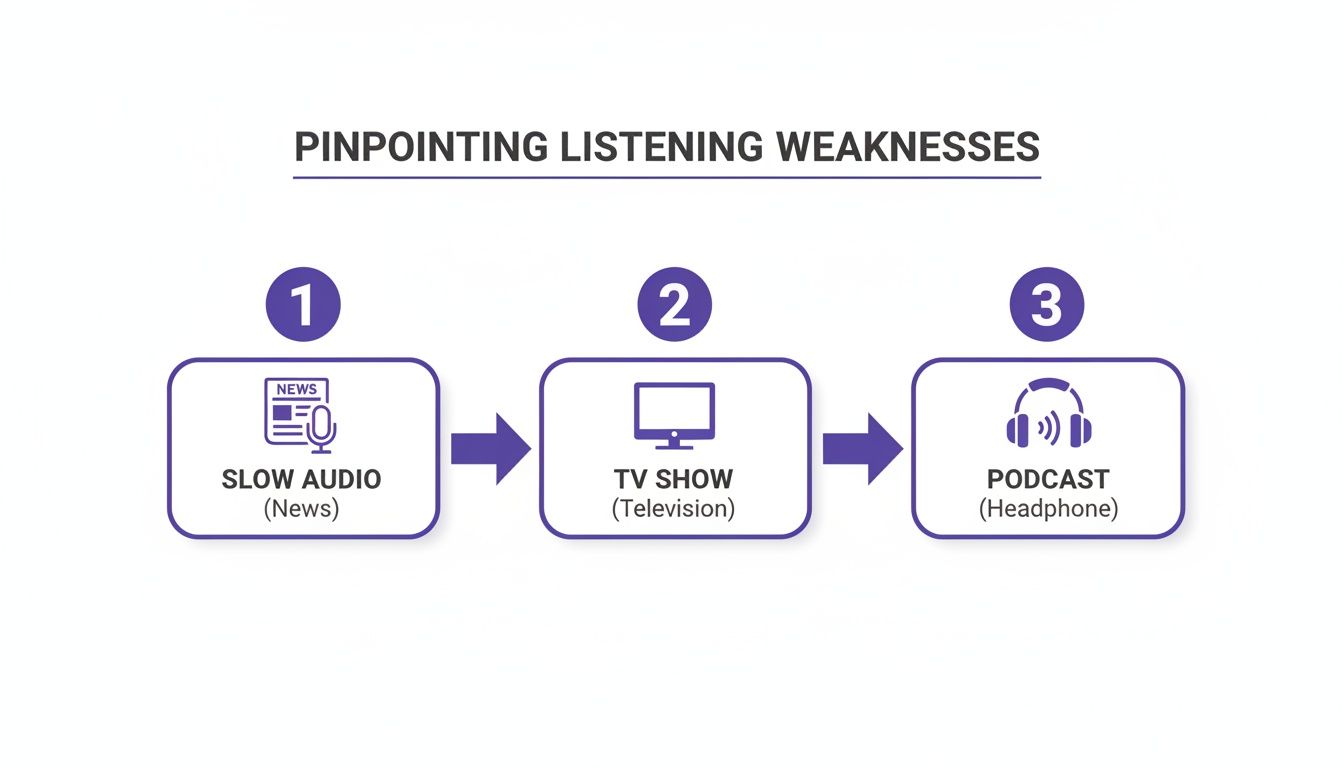
This simple progression—from slow news to natural TV dialogue and then to faster-paced podcasts—is a proven path to building confidence.
Here’s a sample weekly schedule you can adapt to build a powerful listening habit.
Your 15-Minute Daily Listening Workout Plan
This simple weekly schedule is designed to build a consistent listening habit with focused, daily exercises that target different sub-skills.
| Day of the Week | Focus Skill | 15-Minute Activity Example |
|---|---|---|
| Monday | Main Ideas | Listen to the first 2-3 minutes of a news summary. Afterward, just try to state the main point in one sentence. |
| Tuesday | Specific Details | Play a short scene from a TV show. Listen for specific details like names, numbers, or places mentioned. |
| Wednesday | Vocabulary in Context | Find a podcast on a topic you love. Listen for 1-2 new words and try to guess their meaning from how they're used. |
| Thursday | Pronunciation & Flow | Try "shadowing": repeat a 1-minute audio clip from a clear speaker, mimicking their rhythm and intonation. |
| Friday | Fun & Immersion | Listen to an English song and write down the chorus lyrics, or watch a movie trailer without any subtitles. |
| Saturday | Inference | Listen to a short story or dialogue. Try to figure out the speaker's mood or the relationship between people. |
| Sunday | Review & Relax | Re-listen to one of the week's clips. Notice how much more you understand now, or just relax with an English-language podcast. |
Sticking to a plan like this ensures you’re covering all your bases without practice ever feeling like a chore.
Making Your Practice Stick
The key is to move beyond just passively hearing English. Active engagement is what truly builds skill.
Remember, the goal isn't just to hear the audio. It’s about actively wrestling with what's being said. That’s where the real learning happens.
If you want to quickly check your comprehension after a session, you can use tools that let you chat with YouTube video AI to get summaries or ask questions about the content. It’s a great way to get instant feedback on what you understood.
For adults juggling a busy schedule, these focused, daily habits are a game-changer. If you’re looking for more ways to fit learning into your life, our guide on how to learn English for adults has plenty of other practical tips.
By breaking down the big goal of "improving my listening" into these small, daily wins, you build unstoppable momentum and see progress you can actually feel.
Master Active Listening Techniques
If you really want to see your listening skills jump forward, you have to move beyond just having English audio playing in the background. Passive hearing is one thing, but true comprehension comes from active, focused engagement. It’s the difference between hearing noise and actually processing a message.
Think of it as a mental workout. These techniques force you to interact with what you’re hearing, helping you grasp not just the words but the speaker’s full meaning, context, and intent.
Predictive Listening: Guess What Comes Next
One of the most powerful ways to keep your brain locked in is what I call predictive listening. It’s simple: you pause the audio and guess what the speaker will say next. This small act is surprisingly effective because it forces you to process what you’ve already heard and anticipate the logical next step in the conversation.
It’s a fantastic exercise for getting a feel for conversational structure, tone, and common phrases. Don't worry about being right every time—that’s not the point. The goal is to train your brain to think ahead, which is a critical skill for keeping up with fast, natural speech.
How to Practice Predictive Listening:
- Find some audio: Grab a podcast episode or a short news segment on a topic that interests you.
- Listen and pause: Play the audio for about 30 seconds, then hit pause, ideally at the end of a sentence or a complete thought.
- Make a prediction: Ask yourself, "Where is this going?" Base your guess on the context, the speaker's argument, or even their tone of voice.
- Check your guess: Press play and see how close you were.
This little game sharpens your focus and gets you tuned into the natural rhythm of spoken English. It's a huge step forward.
Shadowing: Mimic What You Hear
Shadowing is another incredible technique that connects the dots between listening and speaking. The idea is to listen to a short audio clip and repeat what you hear in real-time, just a fraction of a second behind the speaker.
Forget about perfect pronunciation, at least at first. The real goal here is to mimic the speaker’s cadence, intonation, and sentence stress—the music of the language. Shadowing builds crucial muscle memory for the sounds and flow of English, making it so much easier to recognize those patterns when you hear them in the wild.
- Try This: Find a one-minute clip from a TED Talk. Play it and try to repeat the words as you hear them, focusing on matching the speaker’s speed and the rise and fall of their voice. Do this a few times with the same clip until it starts to feel more comfortable.
Focused Note-Taking and Critical Questioning
Listening with a purpose always yields better results. Two techniques that go hand-in-hand are focused note-taking and critical questioning. Forget trying to write down every single word—that’s a recipe for frustration. Instead, aim to summarize the core ideas.
As you listen, jot down just the main points, new vocabulary, or important details like names and numbers. This forces your brain to filter what's essential from what's just filler.
While you're taking notes, get in the habit of asking yourself a few critical questions:
- Who is speaking, and who are they talking to?
- What is their main point or argument?
- Why is this information important?
- How do they support their claims?
This combination turns listening from a passive reception of sound into an active, analytical process. You’re no longer just hearing words; you’re deconstructing the message to understand how it’s built.
The power of this kind of consistent, immersive listening isn't just theory—it's backed by research. For instance, one study found that university students who used podcasts for just 22 hours over 11 weeks saw their listening comprehension efficiency skyrocket to 88.51/86.59. That score blew past the 80/80 benchmark for proficiency. You can read more about these English language learning statistics on simonandsimon.co.uk. This just goes to show how targeted, active methods can produce results that passive learning can't touch.
Turn Listening Skills into Speaking Confidence
All the listening drills in the world build a fantastic foundation, but there's a final, crucial step: putting it all into practice. This is where you cross the bridge from passively understanding English to actively communicating with confidence.
Think about it—real-time conversation is the ultimate test. There’s no pause button, no rewind, and no time to look up a word you just missed.
This forces you to process what you hear on the spot and immediately form a response. It’s this rapid-fire loop of hearing, understanding, and replying that truly cements your skills. It makes the learning stick in a way that simply watching a movie or listening to a podcast never can.
Speaking isn’t some separate skill you bolt on later. It’s the very thing that reinforces everything you've been working on. Every successful chat, no matter how small, proves your hard work is paying off and builds the momentum to keep going.
The Power of Low-Pressure Conversation Practice
For most learners, the biggest roadblock isn't a lack of vocabulary; it's the fear of making a mistake. This is why finding a safe, low-pressure environment to practice is absolutely essential. You need a space where it's okay to stumble over words, try out a new phrase, and correct yourself without the anxiety of a high-stakes business meeting.
This is exactly the problem platforms like TalkEasy were built to solve. They give you a private space to speak with an AI partner that understands your meaning, waits patiently for you to finish your thought, and offers zero judgment.
This setup removes the social pressure that can make your mind go blank. It frees you up to focus purely on the mechanics of listening and responding. The goal here is to build your fluency and self-assurance, so when you finally walk into that real-world conversation, you feel ready.
How AI Conversation Builds Real-World Skills
Don't think of AI conversation partners as simple bots. Modern AI interacts using natural speech patterns, different tones, and a wide range of vocabulary. This mimics the unpredictability of a genuine conversation, training your ear to adapt to different speakers and scenarios.
For example, an AI tutor can run you through simulations you'll actually face in your career and daily life:
- Job interviews: Practice nailing your answers to common questions and get a feel for the nuances of professional language.
- Client meetings: Get comfortable discussing project details, navigating objections, and even making a bit of small talk.
- Daily interactions: Rehearse everything from ordering a coffee to asking for directions, building your confidence for the small moments that make up life.
Platforms like TalkEasy offer a practical way to get this practice anytime, anywhere.
The interface is designed to be simple and focused on the conversation, so you can jump right in without any fuss.
The core idea is simple but powerful: Consistent speaking practice is the most effective way to improve listening comprehension. It trains your brain to anticipate, process, and react to spoken English in real time, which is the definition of fluency.
What truly makes this method work is the instant feedback. You say something, the AI responds, and you know right away if you were understood. This immediate reinforcement forges a stronger connection between what you hear and how you should reply, speeding up your progress significantly. It's an accessible and affordable way to get the conversational reps you need, often for a fraction of what a human tutor might cost.
To dive deeper, our guide on how to improve English conversation skills offers even more strategies to help you speak with clarity and confidence.
Got Questions About Listening? Let's Tackle Them.
As you start getting serious about improving your listening, you're bound to hit some snags or have a few questions pop up. That’s perfectly normal—it’s a sign you're pushing your boundaries. Here are some of the most common questions I hear from learners, along with some practical advice to get you unstuck.
Listening vs. Reading: Why Does One Feel So Much Harder?
It’s a common frustration: you can read a complex article just fine, but following a fast-paced conversation feels impossible. While they both involve understanding language, listening and reading are surprisingly different beasts. Research suggests they only share about 40% of the same cognitive wiring.
Think about it. When you read, you're in complete control. You set the pace. You can pause, go back and re-read a tricky sentence, or look up an unfamiliar word.
Listening is a whole different ball game. It happens in real-time, and you can't hit a pause button in a live conversation. Your brain is forced to decode sounds, process grammar, and pull up vocabulary all at once, which puts a massive strain on your working memory. That real-time pressure is what makes it feel so much more demanding.
Why Can I Understand American TV But Not a British Podcast?
The short answer? Exposure. If you've spent most of your time listening to American English, your brain has become an expert at its specific rhythms, vowel sounds, and intonation patterns.
When you suddenly encounter a British, Australian, or Scottish accent, your brain has to scramble to map those new, unfamiliar sounds to the words it already knows. It’s like trying to unlock a door with a slightly different key—it takes some jiggling.
The fix is straightforward but requires a conscious effort: diversify your listening diet.
- Binge-watch shows from the UK, Australia, or Canada.
- Find podcasts with hosts from different English-speaking regions.
- Go down a YouTube rabbit hole of creators from all over the world.
Slowly but surely, you’ll train your ear to be more flexible, and those "difficult" accents will start to sound much clearer.
The Great Subtitle Debate: On or Off?
Ah, the classic dilemma. Should you use subtitles? The answer isn't a simple yes or no. It really depends on what you're trying to achieve in that moment. Subtitles can be a fantastic learning aid, but they can also become a crutch, turning your listening practice into reading practice.
The trick is to use subtitles strategically, not passively. Instead of just leaving them on by default, turn them into an active tool for checking your understanding and spotting your weak points.
Try this simple three-step method next time you watch something:
- First pass, no subtitles: Just listen. Try to get the gist of what’s happening and catch what you can. Don't stress about missing things.
- Second pass, subtitles on: Now, re-watch it with the subtitles enabled. This is your chance to connect the sounds you heard with the words on the screen. Pay special attention to the parts you misunderstood.
- Final pass, no subtitles again: Watch it one last time without them. You’ll be amazed at how much more you comprehend now that your brain knows what to listen for.
This turns a passive activity into a powerful, active learning session.
How Long Until I Actually Notice a Difference?
Language learning is never a straight line up—it’s full of little peaks, plateaus, and sudden breakthroughs. While there's no magic timeline, most learners who put in a consistent 15-20 minutes every day start to feel a real shift in their confidence and comprehension within a few weeks.
Consistency is a far bigger deal than intensity. A short, daily practice is infinitely more effective than one long, exhausting cram session on the weekend. You’re building new neural pathways, and that requires regular, repeated exposure.
And remember to redefine what "progress" looks like. It’s not about suddenly understanding 100% of everything overnight. It's about feeling a little less anxious when someone speaks to you. It's about catching the main idea of a podcast where before you felt lost. It's about recognizing a word you just learned. Celebrate those small victories—they're the clearest signs you're on the right track.
The quickest way to bridge the gap between understanding and speaking is to actually speak. TalkEasy gives you a safe space to practice with an AI partner, letting you turn what you hear into words you can say without any judgment. See how much progress you can make in just 15 minutes a day by visiting https://www.talk-easy.com.