
A Practical Guide to Learn English for Adults in 15 Minutes a Day
Tired of language apps that don't work? Learn English for adults with a practical 15-minute daily routine focused on real-world conversation skills.


As an adult, learning English isn't like being back in school. It's not about grades or memorizing grammar rules for a test. It’s about connection—with new people, different cultures, and fresh opportunities.
The real key to making progress is finding your personal reason for learning and then building a small, consistent habit around it. You'd be amazed at what just 15 minutes of focused practice each day can do, especially when you prioritize real-world conversation from the get-go.
Setting Your English Speaking Goals

Unlike learning in a classroom, your reasons for learning English now are deeply personal. You're investing in yourself, whether that means leading your team's weekly meeting with confidence, making small talk with a barista on your next trip, or finally watching your favorite movies without subtitles. These specific, tangible goals are the best motivators you'll ever have.
Before you jump in, it’s helpful to get an honest sense of where you are right now. This isn't about slapping a formal label like "B1" or "C2" on your skills. Think in practical terms. Can you order a coffee? Can you explain a simple problem you're having at work? Knowing your starting point isn't about judgment; it's about drawing a realistic map to get you where you want to go.
Define Your "Why"
Your motivation is the fuel that keeps your engine running, especially on days when you're tired or busy. A vague goal like "get better at English" is easy to put off. Specific goals, on the other hand, are much easier to stick with.
Think about what you really want to accomplish.
- For your career: Maybe you want to contribute your ideas in international Zoom calls without feeling nervous.
- For your social life: You might want to chat comfortably with other parents at your child's school.
- For travel and culture: It could be as simple as wanting to ask for directions and have a basic conversation on your next trip to London.
This kind of clarity turns a wish into a real, actionable plan. When you feel that commitment, you start to see the broader benefits of learning a foreign language as a direct investment in your own life.
The table below can help you connect your personal goals to the specific skills you'll need to develop.
| Your Goal | Why It Matters for You | Key Skills to Focus On |
|---|---|---|
| "Confidently present my project update in a team meeting." | "I want to be seen as a competent leader and share my ideas clearly." | - Vocabulary: Business and project-specific terms- Pronunciation: Clear articulation of key points- Grammar: Present and future tenses |
| "Make small talk with colleagues during lunch." | "I want to build better relationships and feel more included." | - Phrases: Common questions and conversation starters- Listening: Understanding fast, informal speech- Confidence: Overcoming shyness to initiate chats |
| "Travel through an English-speaking country without a translator." | "I want to feel independent and have authentic cultural experiences." | - Vocabulary: Travel, food, and direction-related words- Speaking: Asking for help and information clearly- Listening: Understanding directions and answers |
Take a few minutes to fill this out for yourself. Seeing it on paper makes it real.
The Power of a 15-Minute Daily Habit
Forget trying to cram for hours on the weekend. For busy adults, consistency beats intensity every single time. A focused 15-minute daily speaking habit is far more effective than a long, draining study session once a week.
Why? Because it builds muscle memory. It keeps English at the front of your mind and, most importantly, it’s a small enough commitment to fit into almost any schedule.
This small daily effort creates a powerful compounding effect. Over a month, that’s over seven hours of focused practice. That kind of momentum is something that longer, less frequent sessions just can't match.
With over 1.5 billion speakers worldwide, English is the most studied second language for a reason. Proficiency opens doors. This consistent daily effort is exactly what platforms like TalkEasy are built for, helping you become fluent in a language through practical, everyday use.
Building Your Daily 15-Minute Speaking Habit
When it comes to learning English as an adult, nothing beats consistency. I've seen it time and time again: a short, daily practice session builds momentum that a long, once-a-week cram session just can't touch. The real goal is to make speaking English a natural part of your routine, almost like brewing your morning coffee.
This isn't about magically finding an extra hour in your already packed schedule. It's about finding just 15 minutes you can carve out and protect. For some people, that’s the morning commute. For others, it might be during an evening dog walk.
The trick is to use a technique called "habit stacking"—tethering your new English practice to something you already do without thinking. Always make a cup of tea around 3 PM? That's your new cue to open an app and start talking.
Finding Your Perfect Practice Time
The best time to practice is simply the time you’ll actually do it. There's no single right answer, so you’ll need to experiment a bit and see what works with your personal rhythm and energy levels.
Look for these little pockets of opportunity in your day:
- The Morning Commute: Instead of mindlessly scrolling, you could have a quick, focused conversation about your plans for the day ahead.
- Your Lunch Break: Step away from the desk for 15 minutes and chat about a movie you just saw or a favorite hobby. It’s a great way to reset your brain.
- While Doing Chores: Pop in your earbuds while you’re washing dishes or folding laundry. Try describing what you’re doing out loud.
Once you find a slot that feels right, guard it. Put it on your calendar if you have to. When you treat this small commitment as non-negotiable, you're laying the foundation for a habit that lasts.
Choosing Topics That Matter to You
Let's be honest: the fastest way to kill a new habit is boredom. If your practice topics feel like a chore, you'll find every excuse in the book to skip them. The secret is to tie your conversations directly back to the goals you set for yourself.
Think of your daily practice as a dress rehearsal for your real life. When you talk about things that are genuinely interesting and relevant to you, you're not just memorizing words—you're building practical skills you can put to use right away.
For example, if your main goal is to advance your career, don't waste your time talking about the weather. Try something more targeted:
- Rehearse a quick summary of a project you're working on.
- Practice breaking down a complex idea into simpler terms.
- Role-play asking a colleague for help or clarification on a task.
If you’re learning for travel, your topics could be asking for directions, ordering food at a restaurant, or making small talk about local sights. This kind of focused practice makes every minute count.
Making Practice Effortless
One of the biggest roadblocks for adults is simply finding someone to talk to. Trying to schedule time with a tutor can be a logistical and financial headache, and finding a native speaker for a daily chat is often just not realistic.
This is where the right tool can make all the difference.
An AI-powered platform like TalkEasy gives you an on-demand conversation partner, ready to go 24/7. There’s no scheduling, no pressure, and zero judgment. You just get the freedom to speak whenever and wherever you want. That kind of instant access is what turns a good intention into a solid, daily habit.
A Better Way to Learn: The Conversation-First Method
Let’s be honest. Most language apps teach you lists of words, but they don’t actually teach you how to talk. The conversation-first method flips that old, tired model completely on its head. Instead of just memorizing vocabulary, you use speaking as the primary tool to drive your learning forward.
This is all about learning by doing. It’s a far more natural and effective way to learn English as an adult because it prepares you for the one thing that actually matters: real-world conversations.
Start with Active Speaking, Right Now
You don't need a classroom or a stack of textbooks to get going. You can start building real fluency today with a few simple techniques that turn everyday moments into powerful learning opportunities. These methods are fantastic for building the "muscle memory" you need for spontaneous conversation.
Here are a couple of my favorite techniques to get you started:
- Thinking Aloud: This is exactly what it sounds like. As you go about your day—making coffee, walking to the bus stop, tidying your desk—just describe what you're doing. Do it out loud, in English. It feels a little awkward at first, but it’s an incredible way to train your brain to form English sentences without hesitation.
- Shadowing: This one is a game-changer for your accent. Find a short audio or video clip (just a minute is fine) of a native speaker. Listen once, then play it again and try to speak along with them. Your goal is to mimic their pronunciation, rhythm, and intonation as closely as you can.
These exercises shift your focus away from chasing perfect grammar and toward practical communication. The real goal here is just to get comfortable producing the sounds and flow of English without getting stuck overthinking every single word.
To make this a daily habit, you can follow a simple three-step flow to give your practice some structure.
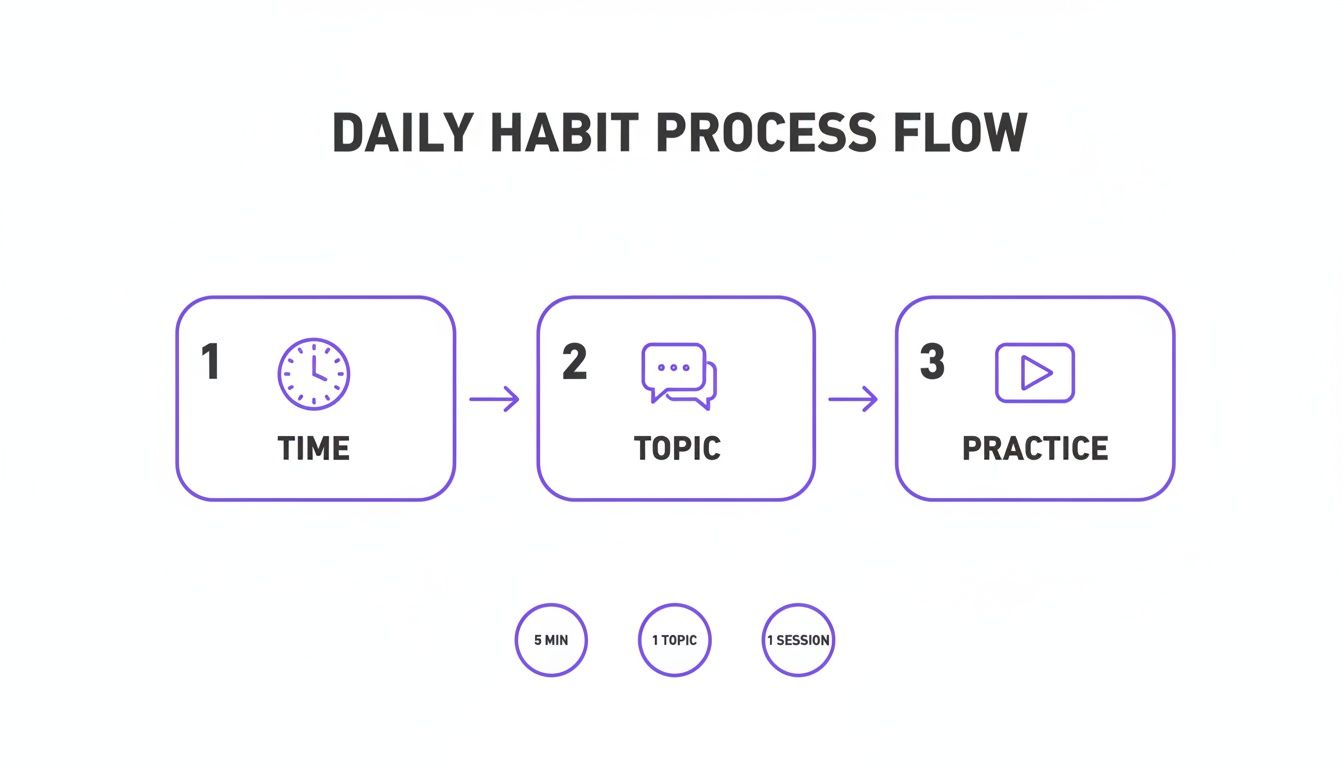
This just breaks down the daily habit into finding the time, picking a topic that’s actually relevant to you, and then diving into your practice.
The Power of a Judgment-Free Practice Partner
One of the biggest hurdles for any adult learner is the fear of making mistakes. It can be paralyzing. This is where practicing with an AI partner is so incredibly helpful. It gives you a completely safe, judgment-free space to try out new words and phrases without any pressure.
You can stumble, mispronounce things, and rephrase a sentence ten times if you need to. An AI partner never gets impatient or critical. It’s just there to give you instant, friendly feedback to help you get better.
This kind of consistent, low-stakes practice is what truly builds confidence. Unfortunately, speaking is a skill that lags behind globally. The EF English Proficiency Index 2025 found that speaking was the weakest skill in over 50% of the 123 countries surveyed. That’s a huge gap that traditional learning methods clearly aren't filling.
By committing to daily conversation, you're directly tackling that gap. You’re not just learning English; you’re learning how to use it. For a deeper dive into getting started, check out our guide on English conversation practice online. This focused effort is what builds the unshakable confidence you need for real-life interactions.
Tying It All Together: A Four-Skill Approach to Fluency
While speaking is our north star, it’s not an isolated island. The other three core language skills—listening, reading, and writing—are the essential bridges that lead you to speaking fluency. When you learn to weave them together, you create a powerful cycle where each skill fuels the others.
Think of it as building a complete communication engine. This integrated approach is what separates struggling learners from truly well-rounded, confident English speakers. It’s about more than just making sounds; it’s about genuinely understanding and commanding the language.
From Passive Hearing to Active Speaking Fuel
We all listen to English, whether it's through music, movies, or podcasts. That’s a great start, but it’s mostly passive. The real magic happens when you switch to active listening. This is where you intentionally engage with what you hear and immediately use it as raw material for your own speaking practice.
Here’s a simple but incredibly effective technique to try:
- Find a short audio clip, like a podcast segment or a news report. Two or three minutes is all you need.
- Listen to it once, just to get the gist.
- Play it again, but this time, hit pause after about 30 seconds.
- Now, say what you just heard out loud, but in your own words.
This small exercise is a game-changer. It forces your brain to process natural English sentence structures and vocabulary, not just recognize them. You're bridging the gap between comprehension and production—the very heart of fluent communication.
Mine Your Reading for Words You Can Actually Use
Reading is hands-down one of the best ways to build a vocabulary that goes beyond the basics. The trick is to read about things you genuinely care about. It could be articles on your favorite sports team, a blog about your professional field, or that novel you've always wanted to tackle.
But here’s the crucial step most people miss: when you find a new word or a cool phrase, don’t just highlight it and move on. Write it down and make a promise to yourself to use it in your very next speaking session. For instance, if you read an article about productivity and learn the phrase "deep work," your mission is to explain that concept out loud later that day.
This simple "find it, use it" habit is how you transfer words from your passive vocabulary (words you understand) to your active vocabulary (words you can pull out in a conversation). It makes what you read immediately useful.
You can see how modern tools are built for this kind of direct application. The homepage of TalkEasy, for example, is designed to get you speaking right away—the perfect environment to test-drive the new vocabulary you just picked up.
The interface removes friction and encourages you to jump right into a conversation, which is exactly where you can practice those new words and phrases.
Cement Your Skills with a Little Bit of Writing
You don't have to become a novelist to get huge benefits from writing. In fact, for improving your speaking, short and focused writing exercises are far more powerful than long essays.
Try this simple daily habit: Before you go to bed, write just one or two sentences in English that summarize your day. "I had a productive meeting" or "The weather was surprisingly warm."
This tiny act forces you to consciously think about grammar—verb tenses, word order, prepositions—in a very practical way. It’s a low-stress method for reinforcing the building blocks you need to speak clearly, making it an essential part of any adult's English learning journey.
Overcoming Speaking Anxiety and Tracking Real Progress

Let's be honest. For many adult learners, the single biggest obstacle isn't verb conjugation or tricky prepositions—it's the cold, paralyzing fear of sounding foolish. This anxiety can kill a conversation before it even starts, keeping all your hard work locked inside your head.
The only way to break that cycle is to create a safe space. A place where you can practice, stumble, make mistakes, and build genuine confidence without a live audience watching. This is where a non-judgmental partner, like an AI tutor, becomes your secret weapon. It gives you a private arena to try out new words and phrases, risk-free. There's no embarrassment, just the freedom to fail forward.
Strategies to Build Unshakeable Confidence
Confidence isn’t something you just find one day; it’s something you build, one conversation and one mindset shift at a time. Before a big moment—a job interview, a presentation, or even just a phone call you’ve been dreading—a few simple mindfulness tricks can make a world of difference.
Give this quick breathing exercise a try:
- Find a quiet corner for just one minute.
- Breathe in slowly through your nose for a count of four.
- Hold that breath for a count of four.
- Exhale slowly through your mouth for a count of six.
Doing this just a few times resets your nervous system and pulls your focus away from the "what ifs." For some people, the pressure to learn English for adults can be especially intense, sometimes even overlapping with symptoms of social anxiety disorder. Recognizing that connection can be a powerful first step. If you want to dig deeper into managing these feelings, our guide on https://www.talk-easy.com/blog/overcoming-fear-of-public-speaking has more practical strategies you can use right away.
View mistakes not as failures, but as valuable data points. Each error is simply feedback showing you exactly what to work on next. This shift in perspective transforms anxiety into a constructive part of your learning journey.
How to Track Progress That Actually Matters
Feeling more confident is great, but seeing hard proof of your improvement is what keeps you going for the long haul. It's time to move beyond just "feeling" more fluent and start looking at concrete evidence that shows how far you've come.
This data-driven approach gives you something solid to hold onto. When you can see the numbers moving in the right direction, staying committed to your daily routine becomes a whole lot easier.
Here are a few key metrics you can start watching:
- Average Conversation Length: Are your practice sessions getting longer? This is a great sign of growing comfort and stamina.
- Vocabulary Variety: Make a mental note of how many new words you're successfully weaving into your conversations each week.
- Correction Frequency: Are you needing fewer corrections over time? A downward trend here is a massive win.
Tools like TalkEasy make this incredibly simple by tracking your session data automatically. This objective feedback replaces doubt with certainty, showing you that your daily 15 minutes are creating real, measurable change.
Frequently Asked Questions About Learning English as an Adult
Thinking about learning English as an adult always brings up a few big questions. How long will it take? Is it even possible? What's the best way to practice? It's completely normal to want some straight answers before you dive in.
Let’s tackle some of the most common concerns I hear from adult learners.
How Long Does It Take to Become Fluent?
This is usually the first question people ask, and the most honest answer is: it really depends. Fluency isn't a destination you suddenly arrive at; it's a moving target. Things like your native language, how much time you can realistically spend, and the methods you use are all part of the equation.
But here’s what I can tell you from experience: consistency is everything. A dedicated 15-minute daily practice session will get you much further, much faster, than trying to cram for hours every weekend. Forget about some vague notion of "fluency" for now. Instead, set small, achievable milestones, like being able to hold a simple five-minute chat without reaching for a translator. That's real progress.
Is It Harder to Learn a Language as an Adult?
It's different, but not necessarily harder. Sure, kids seem to soak up languages like sponges, but adults have some serious advantages of their own. You have life experience, a solid grasp of how grammar works in your own language, and a powerful "why" driving you forward.
The real hurdle for most adults isn't a lack of brainpower—it's the fear of sounding silly or making mistakes. That’s why finding a comfortable, low-pressure way to practice is absolutely critical. When you remove the anxiety of being judged, you can fully tap into your mature learning abilities.
You might be surprised to learn that while adults often take a bit longer to nail a perfect accent, research shows they can pick up new vocabulary and grammar rules much faster than kids. It all comes down to their more developed cognitive skills.
So, with the right approach, you can actually learn very efficiently.
Human Tutor vs. AI Tutor: Which Is Better?
This is a big one. Both human tutors and AI platforms have their place, and the "better" option often comes down to your personal situation—your budget, your schedule, and what makes you feel most comfortable.
A great human tutor can offer incredible cultural insights and highly personalized feedback. But let's be real: they can be pricey, and finding a consistent time to meet can be a logistical headache.
This is where an AI conversation partner like TalkEasy comes in. It offers a completely different, yet powerful, advantage: you get unlimited practice, anytime you want, without any of the scheduling hassles.
Let's break down the practical differences.
Comparing a Human Tutor with an AI Platform like TalkEasy
When you're weighing your options, seeing a side-by-side comparison can make the choice much clearer. Here's a look at how traditional tutoring stacks up against a modern AI conversation partner.
| Feature | Human Tutor | TalkEasy AI Platform |
|---|---|---|
| Availability | Limited by schedule | 24/7 on-demand |
| Cost | High, often hourly | Low monthly subscription |
| Feedback | Delayed, subjective | Instant, objective |
| Consistency | Varies with tutor | Uniformly patient and supportive |
| Judgment | Potential for pressure | Zero judgment, safe to fail |
The truth is, you don't have to choose just one. Many of the most successful learners I know use a hybrid approach. They use an AI platform for their daily speaking reps—building that crucial muscle memory—and then check in with a human tutor every so often for deeper, more nuanced discussions. It’s a powerful combo.
Ready to turn your goal into a confident speaking habit? With TalkEasy, you can start having real-world conversations in just 15 minutes a day. Your AI partner is always available, endlessly patient, and ready to help you build practical fluency, fast.
Start your journey at https://www.talk-easy.com today.