
A Practical Guide to Improving English Communication Skills
Unlock fluency and confidence with this actionable guide to improving English communication skills. Discover practical routines and real-world exercises.


Improving your English communication skills boils down to one simple truth: consistent, daily speaking practice beats long, infrequent study sessions every single time. By weaving short, focused exercises into your day, you build the confidence and muscle memory you need for real-world conversations.
Why Mastering English Is Your Career Superpower

Picture yourself leading a meeting with your global team or networking with international colleagues, feeling completely at ease. This isn't just about learning another language—it's about opening doors to career-defining opportunities on a global scale. When you genuinely focus on improving your English communication skills, you’re building a bridge to a much wider professional world.
This guide isn’t about abstract theories. We're here to give you a practical, actionable plan that fits into your already busy schedule, turning the massive goal of fluency into a series of small, achievable daily wins.
Connect with a Global Audience
In today's interconnected economy, communicating clearly in English isn't just a "nice-to-have" skill; it's a must-have asset. It gives you the power to share your ideas, lead projects, and build relationships with people you otherwise couldn't reach.
Think about the sheer scale of it all. Over 1.5 billion people speak English worldwide, and a huge portion—more than 750 million—are learning it specifically for better career prospects. This points to a critical insight for anyone serious about improving their English communication skills: consistent practice is what separates the best from the rest. You can see how this plays out in detailed English language learning statistics that highlight the global impact.
From Theory to Practical Application
It's completely normal to feel stuck or overwhelmed when learning a language. So many people get trapped in a cycle of studying grammar rules and memorizing vocabulary, only to freeze up when it's time to actually speak. The secret is to pivot from passive learning to active speaking.
The goal isn't perfection; it's clear communication. Every conversation, no matter how small, is a step forward. Making mistakes is not a sign of failure but an essential part of the learning process that builds resilience and fluency.
This guide is designed to help you make that crucial shift. We'll walk you through how modern tools and targeted daily exercises can make a massive difference. By embracing smart, consistent practice, you can turn your English skills from a source of anxiety into a genuine professional superpower. Let's get started.
Your Daily 15-Minute Speaking Habit
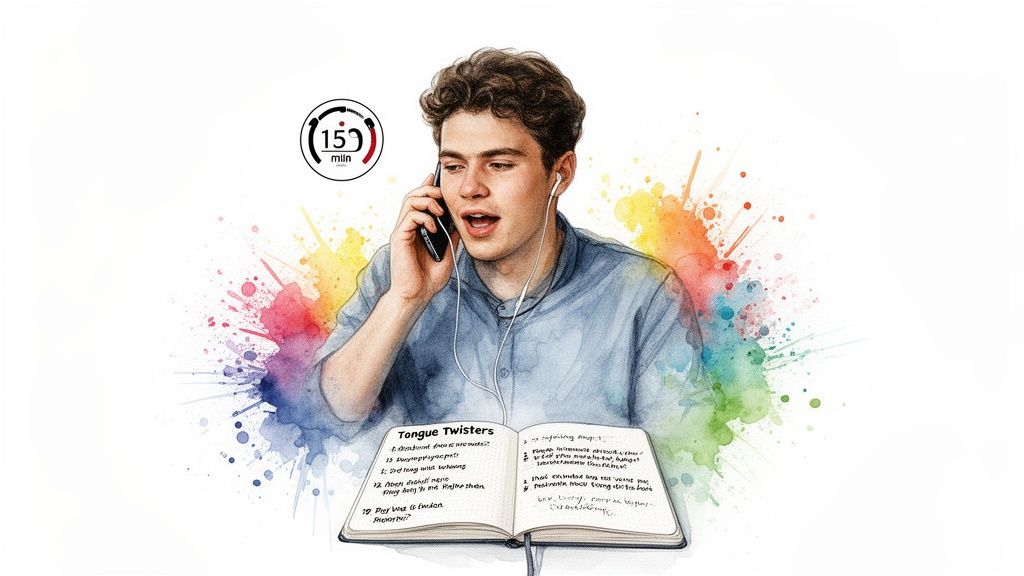
When it comes to getting better at speaking English, consistency always beats intensity. I’ve seen it time and time again. The idea of blocking out hours for practice is a fast track to burnout. A far better way is to build a small, manageable habit you can actually stick with.
So, let's forget about those marathon study sessions. Instead, we're going to build a simple, powerful 15-minute routine you can do every single day. This small investment of time adds up fast, building the muscle memory you need to make speaking English feel second nature.
This routine is broken into three distinct, five-minute blocks. Each one sharpens a different aspect of your spoken fluency, creating a well-rounded practice that gets results without overwhelming your schedule.
First 5 Minutes: The Pronunciation Warm-Up
Just like an athlete stretches before a game, you need to warm up your mouth for English. Many sounds in English probably don't exist in your native language, so physically preparing the muscles in your tongue, lips, and jaw is a critical first step.
This is where tongue twisters shine. They aren’t just silly phrases; they are targeted drills that strengthen your ability to nail tricky sounds and transitions. Just five minutes a day can make a massive difference in your clarity and accent.
Try repeating these a few times. Focus on making each sound clean and crisp.
- For 'th' sounds: "The thirty-three thieves thought that they thrilled the throne throughout Thursday."
- For 'sh' and 's' sounds: "She sells seashells by the seashore."
- For 'p' and 'b' sounds: "Peter Piper picked a peck of pickled peppers."
Here's a pro tip: don't aim for speed. Go for precision. Slow down and really exaggerate the mouth movements at first. This is how you build the deep muscle memory needed for clearer speech in real conversations.
Next 5 Minutes: Active Speaking Practice
Alright, you're warmed up. Now it’s time to move from drills to actually speaking. This five-minute block is all about producing spontaneous speech and putting your vocabulary to work without a script.
You don't need some complex topic. In fact, starting with simple subjects right in front of you is the best way to build confidence. This trains your brain to find words and string sentences together on the fly—exactly what you need for real-world communication. If you're looking for more ways to make your practice stick, check out our guide on the best way to learn English.
Here are a few prompts to get you started:
- Describe an object: Grab something from your desk—a coffee mug, a pen, a book—and describe it out loud in as much detail as you can for two minutes. Talk about its color, texture, shape, and what it's used for.
- Summarize an article: Find a short news story online. Read it once, then put it away and try to explain the main points out loud in your own words.
- Use a tool like TalkEasy: Fire up a short, simulated conversation. You can practice ordering a coffee, making small talk at a party, or asking for directions in a completely safe, low-pressure environment.
This is where the magic happens. This is how you turn all those words you know into words you can actually use.
Final 5 Minutes: Self-Review and Reflection
The last five minutes are easily the most important for making real, long-term progress. This is your chance to step back and honestly assess your own performance. Without feedback, you're just practicing in the dark.
The easiest way to do this? Record yourself. Just use the voice memo app on your phone during your active speaking practice. I know, it feels a little strange at first, but listening to yourself speak is one of the most powerful learning tools you have.
As you listen back, don't try to fix everything at once. Just look for one or two specific things to work on in your next session. This creates a focused, effective feedback loop that drives real improvement.
During your review, ask yourself these questions:
- Clarity: Did I mumble? Were there any specific words or sounds I stumbled over?
- Pacing: Did I talk too fast out of nervousness, or too slow? Did it sound natural?
- Fillers: How many times did I say "um," "ah," or "like"? Be honest!
- Vocabulary: Did I keep repeating the same basic words? Could I have used a more interesting or precise term?
By wrapping up your daily 15 minutes with this quick review, you stop just repeating yourself and start practicing with real purpose. It’s this simple habit that turns random effort into a clear path toward fluency.
Getting Ready for Real-World Conversations

A daily solo routine builds a solid foundation, but true confidence is forged in the fire of real conversations. The whole point of improving your English is to handle life's situations with ease—whether you're in a high-stakes job interview or just making small talk at a coffee shop.
This is where task-based exercises make all the difference. Instead of just speaking into the void, you practice for specific, practical scenarios you'll actually face. This targeted approach prepares you for the pressure and spontaneity that come with professional and social interactions.
Mastering High-Stakes Scenarios
Let's be honest, some conversations carry more weight than others. Job interviews, team meetings, and networking events are make-or-break moments where your communication can directly impact your career. Preparing for these situations ahead of time takes the fear out of the equation.
Consider this: employers in 38 countries assess English skills in 98.5% of hires, giving a huge advantage to candidates who can communicate well from day one. And the data shows that learners who put in just 15-30 minutes of daily conversational practice can boost their proficiency by 20-30% in six months. That's a massive return on a small investment of time.
The key is to move beyond just knowing the words to knowing how to use them under pressure. Role-playing these key moments is like a dress rehearsal for your career—it ensures you're ready when the spotlight is on you.
How to Practice for Job Interviews
The job interview is often the biggest hurdle. You need to sound confident, articulate your value, and build rapport, all while your nerves are screaming. The best way to get ready is to practice your answers to common questions out loud.
Don't just think about your answers; speak them. This simple act helps you fine-tune your wording, check your timing, and sound far more natural.
Common Interview Questions to Role-Play:
- "Tell me about yourself." Your goal is to craft a compelling, two-minute professional story.
- "What are your greatest strengths and weaknesses?" Have specific, real-world examples ready for both.
- "Why do you want to work for this company?" Show them you've done your homework by connecting your skills to their mission.
- "Describe a time you faced a challenge at work." Practice using the STAR method (Situation, Task, Action, Result) to structure a clear, impactful story.
Simulating this with a tool like TalkEasy gives you a safe space to get it wrong. You can run through your answers again and again, get feedback on your clarity, and build the muscle memory you need to walk into the real interview feeling prepared, not panicked.
Navigating Team Meetings and Presentations
Contributing effectively in a team meeting isn't just about what you say, but how and when you say it. You need to know how to pitch an idea clearly, listen to others, and even interrupt politely without derailing the conversation.
Try practicing these specific phrases to build your confidence for your next meeting:
- To present an idea: "I have a suggestion that might help here..." or "Building on what [colleague's name] said, I think we could also..."
- To ask for clarification: "Could you explain what you mean by [specific term]?" or "I want to make sure I understand. Are you saying that...?"
- To politely interrupt: "If I could just jump in for a second..." or "Sorry to interrupt, but I have a quick point on that."
Of course, sounding natural and engaging is crucial. This excellent guide on how to speak conversationally offers some great tips.
Perfecting the Art of Small Talk
Small talk is the glue of professional relationships, but it can feel incredibly awkward if you’re not prepared. Whether you're at a networking event or just waiting for a meeting to start, being able to kick off a simple, friendly chat is a powerful skill.
The secret? Have a few go-to topics and open-ended questions in your back pocket. This takes the pressure off having to think of something clever on the spot.
Small Talk Practice Prompts:
- Initiate a conversation: Practice walking up to a simulated person and starting with, "Hi, I'm [Your Name]. What brings you to this event?"
- Ask follow-up questions: When they respond, keep it going with questions like, "That sounds interesting, tell me more about that," or "How did you get started in that field?"
- Gracefully exit a conversation: Prepare a simple exit line. Something like, "It was great chatting with you. I'm going to go grab a drink, but I hope we can connect on LinkedIn," works perfectly.
By using task-based exercises, you aren't just learning English; you are learning how to use English to achieve your goals. This practical, focused approach is the fastest way to build real-world confidence and turn your language skills into one of your greatest assets.
How to Track Progress and Get Instant Feedback
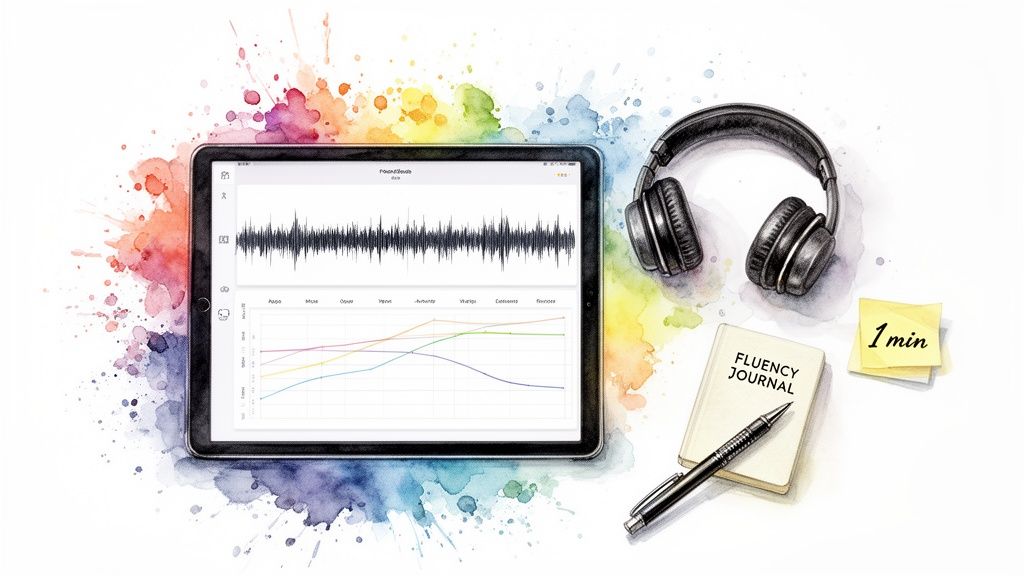
Practice is the engine of progress, but how do you know if you're actually getting better? Without feedback, you're just flying blind, potentially reinforcing the very mistakes you're trying to fix. This is where a smart system for tracking your journey and getting immediate corrections comes in.
It’s the difference between just "speaking more" and truly "speaking better." Seeing your growth in black and white keeps you motivated and shows you exactly where to focus your energy for the biggest wins.
Let Technology Be Your Instant Correction Coach
Gone are the days of waiting for a weekly class to get your pronunciation checked. Today's technology gives you a powerful feedback loop that can seriously speed up your learning by catching mistakes the moment they happen.
Think of AI-powered apps like TalkEasy as your on-demand conversation partner. As you work through a role-play or practice exercise, the AI is right there with you, analyzing your speech in real time. It can instantly flag slip-ups in grammar, awkward word choices, or pronunciation issues, giving you a chance to self-correct right on the spot.
This kind of instant feedback is a game-changer. It helps you build accurate speaking habits from the ground up instead of letting small errors become ingrained.
Fine-Tune Your Flow with Shadowing
Beyond apps, one of the most powerful self-correction techniques is an old-school one: shadowing. It’s a simple but incredibly effective method where you mimic a native speaker to train your ear and mouth for the natural rhythm and intonation of English.
Here’s the basic idea:
- Find a short audio clip. A podcast, an audiobook, or a scene from a movie works great. Just make sure the speaker is clear and talking at a comfortable pace.
- Listen once. Just get a feel for the content and the speaker's cadence.
- Listen and repeat simultaneously. Now, play it again, but this time, speak along with the narrator. Try to match their speed, pitch, and intonation as closely as you can.
Don’t get hung up on understanding every single word. The real goal is to copy the music of the language. This is what helps smooth out a robotic delivery and makes your speech sound much more natural.
Make Your Progress Tangible
Feeling like you're getting somewhere is a huge motivator. To keep that fire lit, you need simple ways to see how far you've come. Two of my favorite tools for this are weekly recordings and a fluency journal.
The greatest barrier to fluency is often not a lack of knowledge, but a lack of confidence. Tracking your small wins makes your progress undeniable, building the self-assurance you need to tackle more complex conversations.
To get a clear, written record of your speech, you might want to check out this Google Docs voice typing guide. This tool can transcribe what you say, making it easy to spot recurring errors you might otherwise miss.
Weekly Audio Snapshots
Once a week, record yourself talking for just one minute. Pick a consistent topic—your goals for the week, a summary of a show you watched, anything.
After a month, listen to your first recording and your latest one back-to-back. The difference will probably shock you. Hearing the improvement in your confidence, vocabulary, and flow is one of the best ways to stay inspired.
Your Fluency Journal
A simple notebook can be one of your most powerful learning tools. Use it to:
- Log new phrases: Jot down new words or expressions and use them in a sentence right away.
- Note your wins: Briefly write about a conversation that went well. What made it successful?
- Track your struggles: Make a note of words you fumbled over or grammar points that tripped you up.
This journal becomes a personalized roadmap of your journey. It helps you celebrate victories and gives you a clear to-do list for your next English speaking practice online session.
Weaving TalkEasy Into Your Personal Learning Plan
All these ideas we've talked about—the daily habits, the task-based exercises, the instant feedback—really come to life when you put them into a structured plan. It's the difference between randomly kicking a ball around and following a focused training regimen. This is how you can use a tool like TalkEasy not just as a practice app, but as your own personal language coach.
When you build a learning path around your own life, every minute you spend practicing is directly tied to a real-world goal. It's incredibly efficient. Whether you're chasing a promotion, trying to ace your classes, or just want to feel more at home in a new country, a targeted plan is your fastest route to success.
For Ambitious Professionals
If you're a professional, your time is gold. Your English practice needs to pay off in the real world by getting you ready for those high-stakes moments at work. You're not just aiming for general fluency; you need to speak with authority and clarity in your specific field.
With TalkEasy, you can skip the generic conversations and jump straight into scenarios that feel like your actual workday.
- Drill Industry-Specific Roleplays: Forget ordering coffee. You can rehearse a sales pitch, deliver a project update to stakeholders, or practice navigating a tricky conversation with a client.
- Sharpen Your Professional Vocabulary: Use the app to get comfortable with industry jargon in a natural context. That way, it rolls off the tongue when you’re in an actual meeting.
- Build Confidence for Meetings: Run through simulations where you practice how to interrupt politely, present your ideas concisely, and defend your point of view.
This isn't just about learning English; it's about mastering the language of your career.
For Dedicated Students
As a student, you're facing a whole different set of communication hurdles. You need to jump into classroom discussions, deliver formal presentations, and write academic papers. The English required here is far more structured than what you'd use in a casual chat.
The biggest breakthroughs I've seen in students often come once they can articulate complex ideas clearly and without hesitation. Practicing for these specific moments takes away the fear of speaking up in a high-pressure academic setting.
Here’s a glimpse of how you can find and select relevant practice scenarios right from your dashboard in TalkEasy.
The interface makes it simple to pick exercises that match what you’re actually doing in school.
Your focus should be on building the specific skills you need to succeed.
- Get Ready for Academic Debates: Use the role-playing exercises to build an argument, present your evidence, and learn how to handle counter-arguments on the fly.
- Rehearse Your Presentations: Practice delivering a presentation on a topic from your field. The AI feedback will help you get your pacing, clarity, and word choice just right.
- Master Classroom Discussions: Work on the key phrases you'll need for agreeing, disagreeing politely, and asking for clarification in a group discussion.
Your Weekly TalkEasy Practice Plan
To give you a clearer picture, here’s what a structured week of practice might look like. This sample plan ensures you're hitting different communication skills each day, all within a quick 15-minute session.
| Day | Focus Area | TalkEasy Exercise (15 Mins) |
|---|---|---|
| Monday | Professional Communication | Role-play: Presenting a Project Update to a Manager |
| Tuesday | Spontaneity & Small Talk | Scenario: Making Conversation at a Networking Event |
| Wednesday | Persuasion & Argumentation | Role-play: Negotiating a Deal with a Client |
| Thursday | Everyday Practical English | Scenario: Scheduling a Doctor's Appointment |
| Friday | Clarity & Conciseness | Exercise: Summarizing a News Article in Your Own Words |
| Saturday | Social Fluency | Scenario: Meeting a Friend's Family for the First Time |
| Sunday | Review & Refine | Review feedback from the week and redo one challenging exercise. |
Think of this as a starting point. The real power comes from swapping in exercises that directly address your personal weak spots and upcoming challenges.
For Newcomers in English-Speaking Countries
If you’ve recently moved to an English-speaking country, your first goal is simple: navigate daily life and build connections without feeling constant stress. Your practice needs to be laser-focused on the practical, everyday conversations that help you feel settled and confident. Mastering these is absolutely fundamental for anyone looking to improve their English communication skills in a new place.
Your learning plan should revolve around functional language that makes day-to-day tasks feel easy.
- Nail Your Daily Conversations: Practice scenarios like calling to make a doctor's appointment, speaking with a landlord, or just asking for directions at the grocery store.
- Build Social Connections: Use the small talk scenarios to get comfortable starting a conversation with a neighbor or another parent at your child's school.
- Handle Public Services: Rehearse the kinds of interactions you’d have at a bank, post office, or government office to take the anxiety out of it.
Ultimately, turning your weaknesses into strengths is all about consistent, focused effort. If you're looking for more ways to speed up your progress, our guide on how you can speak fluently in English offers some more great tips. By shaping your TalkEasy plan to fit your life, you create a direct and powerful path to communicating with confidence.
Answering Your Top Questions About Learning English
Starting any new learning journey brings up questions. When it comes to improving your English, you're probably wondering about how long it will take, how to get over the fear of speaking, and what methods actually work. Let's get straight to the answers for the most common concerns I hear from learners.
How Long Until I See Real Improvement?
This is the big one, and the honest answer is, "it depends." But I can tell you what I've seen work time and time again. Learners who commit to just 15 to 20 minutes of focused, active speaking practice every single day usually feel a real shift in their confidence and flow within three to six months.
The secret isn't locking yourself away for hours on the weekend. It's the daily consistency—those small efforts that build on each other. You'll have weeks where you feel like you're making huge leaps and other weeks where it feels like you've hit a wall. That's completely normal.
Fluency is a marathon, not a sprint. The real goal is consistent, smart practice. This is where a tool that gives you instant feedback, like TalkEasy, can be a game-changer. It helps you catch and fix mistakes right away, so they don't become bad habits.
A simple trick to keep yourself motivated is to track your progress. Try recording yourself speaking for one minute on the same topic every week. After a month or two, listen back to the first recording. The improvement will be undeniable, and it’s a fantastic motivator.
What's the Best Way to Get Over My Fear of Speaking?
For so many people, the fear of making a mistake is the single biggest hurdle. It’s a totally normal feeling, but you have to push past it to make progress. The most effective way to do that is to practice in a safe space where you know you won't be judged.
This is where AI conversation partners are incredibly helpful. A platform like TalkEasy lets you run through dozens of real-life scenarios—from a tough job interview to simply ordering a coffee—without the anxiety of a live audience. You can mess up, try again, and build that confidence on your own terms.
Here’s another simple but powerful technique: just talk to yourself. Out loud.
- Walk around your room and describe everything you see.
- Just finished a movie? Summarize the plot out loud.
- Cooking dinner? Explain the steps as you do them.
This builds what I call "mouth muscle" memory, getting you comfortable with the physical act of forming English words and sentences. Always remember the goal: communication, not perfection. Every fluent speaker you admire made thousands of mistakes to get there. It’s just part of the process.
Can I Get Better Just by Watching Movies and TV?
Watching shows and movies in English is a fantastic—and fun—way to improve your listening skills and pick up new vocabulary. You get exposed to natural speech, slang, and a variety of accents. But it’s a passive activity.
To actually improve your own speaking, you have to move from passive listening to active speaking. You can't learn to swim by watching videos of swimmers; eventually, you have to jump in the pool. The same logic applies here. Language learning needs both input (listening) and output (speaking).
The best strategy is to combine the two. Turn that passive screen time into an active practice session.
- Try "Shadowing": After a character says a sentence, pause and repeat it. Try to match their exact pronunciation, rhythm, and emotion.
- Summarize a Scene: Watch a short scene, then pause and explain what just happened in your own words.
- Use It or Lose It: Heard a new word or a cool phrase? Don't just write it down. Challenge yourself to use it in your next conversation practice. That’s how you make it stick.
Media is a great supplement, but it can never be a substitute for the essential work of speaking the language yourself.
Ready to turn practice into real-world confidence? TalkEasy gives you a judgment-free zone to rehearse real conversations, get instant feedback, and build the speaking skills you need. See for yourself how 15 minutes a day can transform your English. Start your free trial of TalkEasy today.