
How Can I Speak Fluent In English By Building Daily Habits And Using TalkEasy
Learn how can i speak fluent in english with daily immersion, focused practice, mindset shifts, and AI tools like TalkEasy in simple, actionable steps.


If you’ve ever felt tongue-tied in a conversation, starting small can spark big improvements. I still remember squeezing in a few minutes of English every day—those micro-habits transformed my confidence and clarity in just weeks.
Four Pillars—immersion, targeted practice, confidence boosts, and smart AI support—are the building blocks that made my journey feel manageable and even enjoyable.
Roadmap To Speak Fluent English
You don’t need a huge block of study time. A handful of focused habits, woven into your routine, can move the needle faster than cramming ever will.
- Tune into a 15-Minute English podcast with your morning coffee to grab fresh vocabulary in context.
- Try 5-Minute pronunciation drills after lunch, replaying tricky sounds until they feel natural.
- Run a Quick Confidence script—affirmations or a short self-introduction—right before any chat.
- Spend 10 Minutes chatting with TalkEasy’s AI for instant tips on phrasing and grammar.
Pairing that morning podcast with an afternoon drill helped me remember new words and mimic native rhythms. Then, quick affirmations calmed my nerves so I’d actually speak up.
Pillars Overview
Each habit aligns with one key driver:
- Immersion wraps your mind in English through real audio and articles.
- Practice targets sounds and sentence patterns until they stick.
- Confidence turns mistakes into milestones instead of dead ends.
- AI tools like TalkEasy fill gaps instantly, pointing out slips you’d otherwise miss.
Key Actions For English Fluency
Here’s a compact guide to keep on your desk or phone—a quick look at what to do each day and why it matters.
| Action | Daily Time | Purpose |
|---|---|---|
| Morning Podcast | 15 min | Immerse in natural conversations |
| Pronunciation Drills | 5 min | Sharpen your sound production |
| Confidence Script | 5 min | Build speaking courage |
| AI Chat On TalkEasy | 10 min | Receive instant feedback |
Use this table to track your consistency and adjust times as you progress.
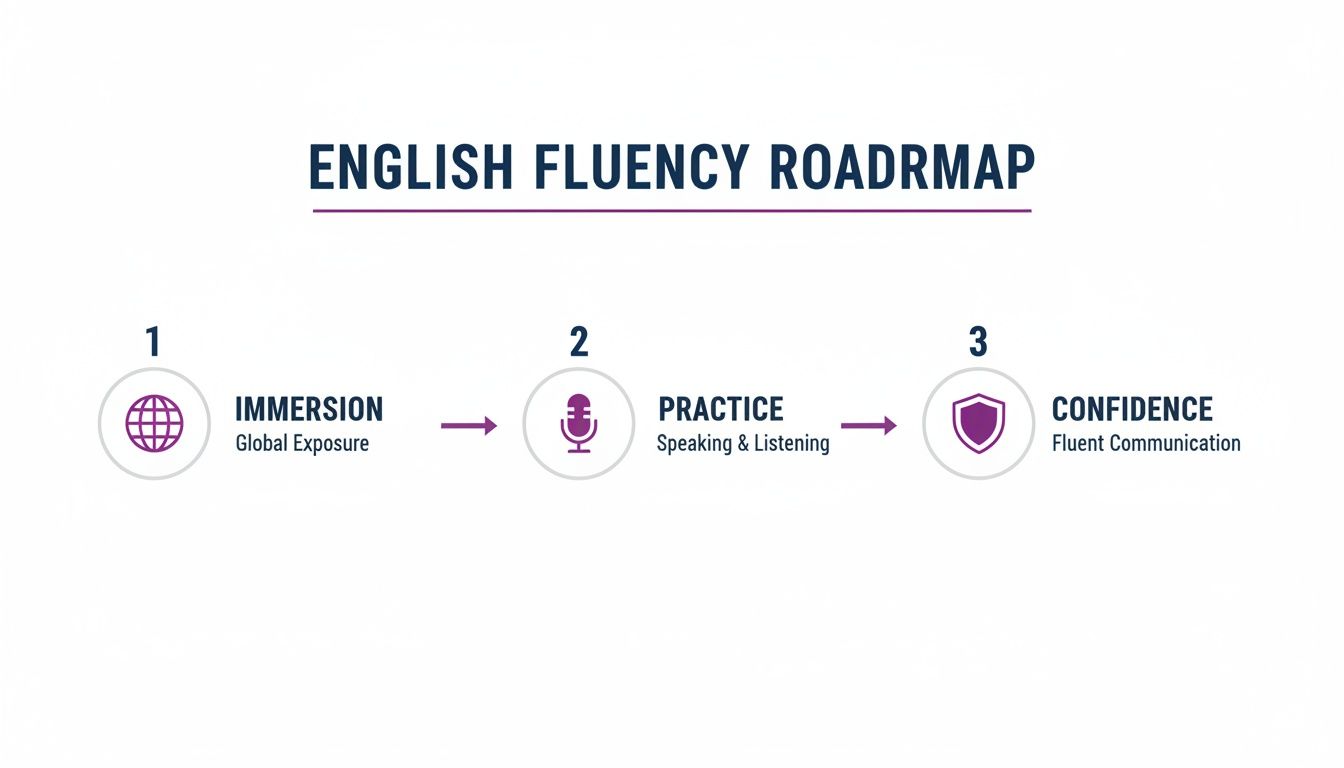
Every habit here fits together: immersion primes you, practice cements it, and confidence keeps you going.
“Consistent exposure and practice outpace long study sessions.”
Choosing Your Next Move
- Identify the pillar you find toughest and commit to a five-minute exercise today.
- Combine your podcast listening with AI chat to double the reinforcement.
- Challenge yourself to a seven-day streak on the TalkEasy blog for public accountability.
Rotate through the pillars each day to keep things lively. Before you know it, those mini habits will feel like second nature—and your English will follow.
Developing Daily Immersion Habits
Immersion doesn’t have to mean enrolling in a course or dedicating extra hours to textbooks. You can embed English practice into the smallest pockets of your day. By tweaking daily routines, you transform familiar tasks into powerful language drills.
For example, flipping your phone’s menu to English turns every tap into a vocabulary exercise. Similarly, plugging in an English podcast during your commute tunes your ear to native speech patterns, all while you’re on the move. These simple shifts make progress feel effortless.
- Switch device language to English so every menu item becomes a learning opportunity
- Follow English-language social media accounts to build reading fluency in real time
- Configure email and calendar alerts in English to absorb useful phrases daily
These habits are invisible study sessions—routine actions that naturally boost your skills.
Swap Phone Settings To English
When your smartphone’s interface is in English, every swipe counts. You’ll find yourself interpreting words like Display, Notifications, or Privacy without extra effort. Over time, you won’t just recognize these terms—you’ll use them confidently in conversation.
For instance, when adjusting brightness or toggling “Do Not Disturb,” the same labels keep appearing. That repeated exposure cements their meaning in your mind. Before long, menu labels feel as familiar as everyday vocabulary.
Listen To English During Commutes
Turning your commute into a listening lab requires nothing more than plugging in headphones. Choose a podcast, radio show, or audiobook that interests you. Ten to thirty minutes of listening practice fits snugly into your journey without disrupting your schedule.
Imagine standing in a bustling Amsterdam café talking about a cheese festival with a friend. That image clicks when you’ve already heard “cheese festival” a dozen times on your morning ride. Over weeks, idioms and recurring expressions stick.
They top the 2025 EF English Proficiency Index with a score of 624 out of 800 in the Very High band. Learn more about EPI findings on EF.edu.
| Scenario | Activity | Benefit |
|---|---|---|
| Morning commute | Podcast playback | Builds listening stamina |
| Lunch break | News clip replay | Reinforces key vocabulary |
| Evening walk | Music with lyrics | Improves word recognition |
Small exposure outperforms marathon sessions.
Join Casual Conversation Meetups
Joining a friendly English conversation group—either locally or online—removes the formality of a classroom. You’ll practice small talk on topics you enjoy, learn cultural nuance, and build confidence without the pressure of tests.
- Prepare a simple question inspired by a recent podcast episode
- Share a short anecdote about your day to invite follow-up remarks
- Keep a notebook handy and ask for meanings when you hear new terms
- Swap contact details for casual follow-up calls or coffee chats
- Jot down three fresh phrases immediately after the session
Each of these steps blends listening, speaking, and reflection—pushing you toward real conversational ease.
Create English Background Soundtrack
What if your favorite shows and daily chores doubled as language practice? Turning on English subtitles for Netflix, or swapping your background playlist for English tracks, can boost vocabulary without extra effort.
Even low-volume news clips or talk shows playing in the background reinforce pronunciation and phrasing as you go about your day. Slot these micro sessions around meals, coffee breaks, or while cooking so English exposure becomes unavoidable.
This approach answers “how can I speak fluent in English” by weaving immersion into every moment. In just a few weeks, passive listening transforms into active vocabulary recall.
Pair these routines with TalkEasy practice sessions for personalized feedback on your pronunciation and phrasing. With consistent immersion and targeted AI support, you’ll notice tangible improvements each month. Small mistakes turn into stepping stones, and before long, English feels like your default soundtrack.
Next, we’ll dive into targeted drills that build on this immersive foundation, sharpening your skills and turning exposure into mastery.
Targeted Practice Exercises

Turning passive understanding into natural speech takes focused drills. Daily mini-sessions—like shadowing, timed storytelling or sound work—can make a big difference. In under three minutes, you’ll simulate real-life scenarios and watch your fluency grow.
Here are a few quick practice ideas:
- Ordering a coffee with smooth, everyday phrasing
- Summarizing your last trip in crisp, clear sentences
- Debating a recent news headline using solid reasons and opinions
Shadowing Exercises
Mimic native speakers by speaking along with short audio clips. Echo their intonation, rhythm and pace to train your ear.
- Choose a 30-second clip on familiar topics with clear pronunciation
- Listen twice before speaking aloud to internalize the flow
- Record yourself, then compare to identify areas to refine
Timed Storytelling
Putting a one-minute limit on your narrative forces you to think fast in English. Summarize a news clip or describe an event under the clock.
- Use a timer and note any pauses or hesitations
- Rinse and repeat until you can deliver smoothly in 60 seconds
Real learners in the Philippines offer a powerful example of consistent practice. Over 60 million Filipinos—92% of the population—speak English fluently thanks to five decades of co-official education, 10,000+ hours of instruction and daily media exposure. This foundation underpins a $30 billion call center industry. Learn more about the Philippines' English proficiency findings
Pronunciation Work With Minimal Pairs
Fine-tune your ear to subtle sound differences with minimal pairs. Practicing these in rapid drills sharpens both listening and speaking.
- Record yourself saying “ship” vs. “sheep” or “pat” vs. “bat” three times each
- Replay and mark which pairs still sound too similar
- Focus on the trickiest sounds in short bursts
Combine these drills with a three-minute accent check, then tie it back to a one-minute news recap for real-world application.Check out our guide on practicing English speaking
Key takeaway: Bite-sized practice sessions build momentum and keep motivation high.
Simulating Real Conversations
Role-playing embeds language in memory by mimicking authentic exchanges. Picture yourself ordering coffee and practice the exact phrases you’ll use.
- Write a brief script for a simple transaction
- Deliver it in front of a mirror, matching gestures with speech
- Turn on a friend or partner to play the barista and swap roles
When you debate a headline, state your position, list two or three supporting points, then switch sides to practice follow-up questions.
Practice Durations And Benefits
| Session Type | Duration | Benefit |
|---|---|---|
| Shadowing | 3 min | Improves rhythm and intonation |
| Timed Storytelling | 1 min | Boosts fluency under time constraints |
| Accent Check | 3 min | Identifies pronunciation weak spots |
| News Summary | 1 min | Links vocabulary to real situations |
Mix and match these sessions to address different skills and keep your routine fresh.
Learning Tip: Rotate exercises daily to cover every speaking muscle consistently.
Putting It All Into A Routine
A simple weekly plan ensures steady, balanced progress:
- Monday: Shadow a short podcast and record your attempt
- Wednesday: Give a one-minute travel recap after watching a quick video
- Friday: Run a minimal-pair accent check, then wrap up with a news summary
Track your streak on a calendar or habit app for a visual reminder of your commitment. After each drill, spend five minutes reviewing feedback from TalkEasy. Immediate pointers on phrasing and pronunciation make every session count.
Remember: Consistency in targeted practice turns small efforts into fluent conversations.
Short drills fit any schedule, whether you have three minutes or fifteen. By rotating shadowing, storytelling and sound work, you’ll bridge the gap between passive understanding and confident, active speech. Next, we’ll dive into the mindset shifts that turn minutes of practice into lasting confidence. Start your drills today and see the difference.
Building A Confident Mindset
Learning to chat in English isn’t about stuffing your head with new words. It’s more like training your mind to turn nervous energy into genuine curiosity. Treat each conversation as a tiny laboratory—every slip-up becomes a clue rather than a setback.
Even a quick “good morning” to a colleague or ordering your favorite latte counts. Those everyday moments often build confidence faster than hours of formal drills.
Celebrating Small Wins
Notice when a once-tricky phrase finally flows without a pause. Maybe you nailed “thank you” with no hesitation—that’s a sign to celebrate. Capturing these little victories helps you build real momentum.
- List three achievements every week, noting how each felt
- Share progress with a language buddy or mentor for extra motivation
- Treat yourself after a streak of comfortable speaking sessions
“Turning small successes into visible proof builds belief.”
As you log these wins, your inner voice shifts from “I can’t” to “I just did that.” If you’ve ever wondered how to speak English without freezing up, this focus on small victories resets your self-talk. Short bursts of recognition keep doubt at bay.
Reframing Mistakes
Fear of errors can bring you to a standstill. In reality, every grammatical or pronunciation slip shines a light on the next skill to tackle.
Build a simple self-talk script to normalize mistakes—try saying, “I learn when I err” before diving into a chat. Then record one-minute audio snippets after practice sessions and replay them with a smile.
A basic script might look like:
| Step | Example Phrase |
|---|---|
| Acknowledge Mistake | “That slipped out wrong” |
| Identify Correction | “I should say ‘schedule’” |
| State Learning Goal | “Next time I’ll stress the ‘sh’ sound” |
Reviewing these snippets helps you spot patterns and celebrate tiny improvements in your accent work. Embrace the cycle of error, reflection, and progress.
Pre Chat Rituals
A quick routine before calls or meetups flips jitters into focus. In under a minute you can:
- Smile and take three deep breaths
- Repeat a positive affirmation like “I speak clearly and confidently”
- Recall one recent win from your confidence log
Walk into each conversation with this mini–warmup, and you’ll notice your nerves shifting into energy you can work with.
Peer Roleplay Sessions
Roleplay with a friend or fellow learner to handle real-life surprises. Pick everyday scenarios—grabbing lunch or giving a brief project update—and run them as if they’re happening now.
- Run a 3-minute shop simulation to practice order and response
- Host a weekly 5-minute video call focusing on casual topics
These low-pressure drills sharpen your ability to think on your feet.
Supportive Tools
TalkEasy’s feedback feature adds a powerful boost. After each AI chat, jot down one suggestion for improvement. Research shows immediate feedback increases learning by 35%.
Check out our guide on improving speaking confidence in our article How To Improve Speaking Confidence.
Community stories often mention that quick, targeted feedback feels like a safety net—encouraging you to push your limits without fear.
When you blend small-win tracking, mistake reframing, peer roleplays, and a fast pre-chat ritual, you create a habit loop that anchors real-world fluency. Keep experimenting, celebrate every tiny triumph, and watch your confidence take off.
Integrating AI Tools Effectively
Adding TalkEasy to your daily routine means having a patient, 24/7 conversation partner. You speak, it listens—and gently points out where your accent drifts or your grammar slips. Over time, those small nudges add up.
Scenario simulations drop you into real-life moments—ordering coffee, pitching a project, or chatting at a meetup. You’ll practice the exact phrases you need, without waiting for a live partner.
- Live Accent Analysis flags phonetic slips the moment you record.
- Grammar Coach offers friendly corrections that fit each sentence.
- Scenario Simulations recreate everyday situations like job interviews or café chats.
Comparison Of AI Language Tools
Below is a side-by-side look at popular AI fluency platforms, their standout features, and ideal use cases.
| Tool Name | Key Feature | Best For |
|---|---|---|
| TalkEasy | Live Accent Analysis and Grammar Coach | Pronunciation and grammar feedback |
| FluentAI | Vocabulary Expansion Games | Building word bank |
| ChatSpeak | Conversation Simulations | Casual chat practice |
Use this table to match each tool’s strengths with where you need the most support.
Sample Daily AI Workflows
Here’s how a three-part routine might fit into a busy day:
- Early Morning DrillRecord a quick two-minute prompt and review real-time accent tips.
- Midday ReviewUpload a short voice memo for grammar feedback and note the top three corrections.
- Evening ReflectionSpeak a one-minute diary entry, then check your progress on the app dashboard.

That dashboard highlights:
- Pronunciation score
- Most frequent grammar slips
- Suggested practice drills
With clear metrics in view, you know exactly which areas to tackle next. For instance, learners who stick to this cycle see a 20% jump in accuracy in just two weeks.
Looking for more ideas? Check out our guide on English Speaking Practice Online.
Best Practices For AI Integration
Small, consistent sessions win every time. Try these tips:
- Set 5-minute reminders so practice slots are non-negotiable.
- Pair deeper midweek reviews with quick daily check-ins.
- Rotate between pronunciation, vocabulary, and flow to keep things fresh.
- Mix AI drills with real conversations for human nuance.
Key TakeawayAI tools shine when you combine them with live speaking and regular review.
Choosing The Right AI Tool
Not every platform fits every learner. If clear pronunciation is your goal, pick one with live accent feedback. When you need more words in your toolkit, go for an app that gamifies vocabulary. A streamlined lineup of two or three tools often beats juggling half a dozen.
Experiment until you find the blend that keeps you motivated, meets your goals, and slots into your life. That’s how you turn daily practice into genuine fluency.
Applying Skills In Real Scenarios
When you move from textbook drills to actual conversations, English comes alive. Imagine steering a team meeting in English—you volunteer updates, answer questions on the fly, and keep the discussion moving. Or think about ordering street food in a crowded market, where every accent and gesture becomes part of your lesson.
These context-driven exercises beat random sentence lists every time. They force you to notice gaps in your preparation and sharpen your ability to recover when conversations veer off script.
- Reviewing sample dialogues reveals sneaky tense traps and common slip-ups.
- Partnering with a friend turns practice into a live rehearsal.
- Role-playing unexpected scenarios—like a customer complaint—builds quick-fix strategies.
Each session uncovers a mistake and points you toward a targeted drill. Missed an article? That’s tomorrow’s focus. Struggled with prepositions? You know exactly what to practice tonight.
Common Dialogue Mistakes
Monotone stress flattens your message and slows comprehension. In rapid exchanges, stress patterns serve as guideposts—miss one, and your listener might lose track.
- Saying “I no understand” instead of “I don’t understand” reduces clarity.
- Using “she go” rather than “she goes” signals tense confusion.
- Overloading your speech with “um” or “uh” breaks the flow.
Mixing up adjective order (like “red big ball”) or dropping prepositions (“discuss about”, “depend of”) sounds off to native ears.
Small errors can become big roadblocks if not caught early.
Spotting these patterns in advance primes you for smoother communication.
Fluent Speaker Recovery Techniques
Native speakers slip in quick corrections to keep conversations rolling. Phrases like “Let me rephrase” or “What I mean is” aren’t just fillers—they’re recovery tools.
- Pause briefly and introduce a correction phrase.
- Restate your thought with cleaner structure.
- Use eye contact or a nod to maintain engagement.
- Move forward without over-apologizing.
| Common Error | Quick Recovery |
|---|---|
| Wrong article usage | Pause, insert “a” or “the”, then restart your phrase |
| Tense confusion | Say “let me rephrase”, then switch to the correct tense |
| Pronunciation misstep | Echo the word with clearer stress before continuing |
By late 2025, 1.5 billion people—20% of Earth’s population—speak English, yet only 20% of non-natives reach full fluency. Top learners log about 1,200 hours in school plus daily immersion, boosting their skills by 20 EPI points a year. This data confirms that targeted practice delivers real progress across cultures. Learn more about global English population stats on elmuralinguistics.com
Integrating Purposeful Practice
Turn your daily routine into a training ground. Carve out two 10-minute slots for a mock meeting update or café order. Record yourself, then compare your performance against a model script.
- Choose work, travel, or social scenarios to keep practice varied.
- Note which phrases flowed smoothly and which moments caused hesitation.
- Adjust your script to avoid known pitfalls.
- Rehearse cultural nuances like local idioms and greetings.
Real-life drills sharpen your response time and build durable fluency.
Keep a simple log of each session to chart your progress and stay motivated. Pair these drills with TalkEasy’s AI feedback for instant corrections, then dive into live conversations to capture that human nuance. Over time, unexpected questions, slang or jokes won’t throw you off balance—they’ll become opportunities to shine.
Revisit these scenarios every month to measure growth and set new targets.
- Celebrate each win, no matter how small.
By weaving these real-world exercises into your routine, you’ll wake up each day ready to answer “How can I speak fluent English?” with a confident, “I already am.”
FAQ
Want to know when you’ll be chatting away smoothly? If you practice every day, you’ll start noticing real improvements in about three months.
Spending just 15 minutes on TalkEasy plus 15 minutes of focused drills can push your conversation skills forward. The platform’s feedback loops sharpen your pronunciation and build confidence faster than you’d think.
You could be holding simple conversations after 90 days of steady habits.
- Beginner to conversational in 90 days with daily immersion
- Conversational to confident in 6 months combining drills and classes
- Confident to fluent in 12 months integrating AI feedback
Study Balance Tips
Juggling self-study and live classes doesn’t have to be overwhelming. A mix of tutor-led sessions and solo AI chats keeps things fresh and stops burnout before it starts.
Try two weekly lessons with a tutor alongside three quick TalkEasy check-ins. That way, you get personalized tips plus flexible, on-demand practice.
“Short, frequent sessions build more fluency than infrequent marathons”
Tracking Tools Comparison
Keeping score of your improvements is a great motivator. Here’s a quick look at useful metrics:
| Metric | Tracking Method |
|---|---|
| Speaking time | TalkEasy dashboard logs |
| Vocabulary learned | Flashcard app totals |
| Pronunciation score | Weekly AI analysis |
If accuracy is your priority, TalkEasy live accent feedback hits the mark. For deeper grammar drills, an online class adds structure. Often, the best results come from blending tech-driven practice with human guidance.
Key strategies often combine technology and human guidance
Setting Weekly Goals
Pinning down weekly targets gives your study sessions real direction. Decide on three conversation themes—maybe work, travel and hobbies—and build your plan around them.
- Schedule two 10-minute AI sessions focused on those themes
- Jot down feedback after each practice and tweak next week’s plan
- Keep a running list of go-to phrases for real-life chats
Over time, you’ll compile a toolkit of ready-to-use expressions.
Handling Learning Plateaus
Hitting a wall is normal—but it doesn’t have to halt your progress. Shake things up and spark fresh momentum.
- Swap your usual podcasts for interview recordings to pick up new words
- Listen to different dialects to sharpen your ear
- Join a language exchange for unplanned conversation twists
- Celebrate even small improvements to stay motivated
Explore more FAQs on our blog for ongoing tips and support.
Boost your English with AI practice using TalkEasy (TalkEasy)