
Mastering Telephone Etiquette in Customer Service
Discover practical telephone etiquette in customer service. Learn proven techniques to handle calls professionally and elevate customer satisfaction.


Excellent telephone etiquette is all about creating a positive, professional, and genuinely helpful experience over the phone. It's so much more than just being polite. It's a finely-tuned skill that blends a professional tone, crystal-clear communication, and active listening to build real trust with customers and showcase the quality of your brand.
Why Great Phone Etiquette Is No Longer Optional
In an age of chatbots and email tickets, a phone call is often a sign of a customer's most urgent or frustrating problem. This single interaction becomes a "moment of truth" for your company. A calm, professional, and empathetic voice on the other end of the line doesn't just fix an issue; it shapes the customer's entire perception of your business. It's the thin line between creating a lifelong fan and sparking a negative online review.
This is exactly why mastering telephone etiquette in customer service has shifted from a soft skill to a core business strategy. It directly impacts customer satisfaction, loyalty, and, ultimately, your bottom line. A polished, patient, and solution-focused approach can transform a frustrated caller into your biggest advocate.
The Psychology of a Great Call
The secret to effective phone communication is getting inside the customer's head and understanding what they truly expect when they dial your number. Speed is king. Research from Salesforce shows that a massive 83% of customers expect to speak with someone immediately when they call.
This is why timeless advice like the "three-ring rule" still matters—answering promptly shows you respect their time. Nothing fuels frustration like being stuck on hold, and you can see call abandonment rates shoot up after just a few minutes of waiting.
But it’s not just about speed. The quality of the conversation is what leaves a lasting impression. A warm opening and a "vocal smile"—that audible cheerfulness in your voice—can completely change a caller's mood and make them far more open to a solution.
A customer doesn't just hear your words; they feel your attitude. Your tone of voice is responsible for transmitting empathy and competence long before you’ve offered a solution.
Foundational Pillars of Phone Support
Great telephone etiquette isn't magic; it's built on a few non-negotiable principles. When these elements work in harmony, they create a consistently positive experience for every single person who calls.
Here's a quick reference to keep these core ideas top-of-mind.
Core Principles of Telephone Etiquette at a Glance
| Principle | Why It Matters | Quick Tip |
|---|---|---|
| Promptness & Preparation | It shows respect for the customer's time and proves you're ready to solve their problem efficiently. | Aim to answer within three rings. Have your CRM and key resources open before you even pick up. |
| Clarity & Tone | A clear, calm, and positive tone conveys professionalism and confidence, especially during tense calls. | Sit up straight and smile when you speak. It genuinely changes the sound of your voice for the better. |
| Active Listening | Truly hearing the customer makes them feel understood and valued, preventing misunderstandings. | Mute your keyboard and focus. Paraphrase their issue back to them to confirm you've got it right. |
| Empathy & Respect | Acknowledging their frustration and showing genuine concern builds rapport and de-escalates tension fast. | Use phrases like, "I can certainly understand why you're upset," to validate their feelings. |
Mastering these foundational skills is the first step toward providing truly exceptional service over the phone. For a deeper dive, you can explore more strategies in our guide on how to improve customer service skills.
Crafting Openings and Closings That Connect
Think about it: the first fifteen seconds of a call can make or break the entire interaction. The last few moments? That's what sticks with the customer long after they hang up. Mastering these two critical parts of any call is the bedrock of excellent telephone etiquette. A great opening builds instant rapport, while a solid closing makes the customer feel heard and respected.
The key is to ditch the robotic, one-size-fits-all scripts. Nobody wants to feel like they're just another ticket in a queue. Your opening should be a genuine, human-to-human connection that quickly accomplishes three things: a warm welcome, clear identification, and an honest offer to help.

Opening the Call With Confidence
A powerful opening doesn't have to be complex, but it does need to be consistent and professional. It instantly reassures the caller that they’ve dialled the right number and that a competent person is ready to solve their problem.
Here’s a simple but effective framework you can easily make your own:
- A Warm Greeting: Kick things off with something friendly and positive. A simple "Good morning," or "Thanks for calling," sets a great tone.
- Clear Identification: Immediately state the company name, followed by your first name. For example, "Thanks for calling TalkEasy, you're speaking with Alex." This gives the caller clarity and a personal touch right away.
- An Offer to Help: Transition smoothly into an open-ended question that gives the customer the floor. "How can I help you today?" is a classic for a reason—it's direct, polite, and service-focused.
When you put it all together, a great opening sounds natural and reassuring: "Good afternoon, thank you for calling TalkEasy. My name is Maria. How can I assist you?" It’s professional, confident, and gets the conversation started on the right foot.
Closing the Call on a High Note
How you end the conversation is just as crucial as how you begin it. A rushed or ambiguous closing can completely unravel all the good work you did. The goal is to wrap things up in a way that confirms the issue is resolved and makes the customer feel genuinely valued.
A great closing isn't just about saying goodbye. It's about summarizing the resolution, confirming satisfaction, and making the customer feel confident that their issue is truly handled.
Before you hang up, make sure you hit these key points for a polished and memorable finish:
- Summarize the Resolution: Quickly recap what you did. Something like, "Alright, Mr. Smith, I’ve successfully updated your billing address, and that confirmation email is on its way to you now."
- Ask if There's Anything Else: This is a non-negotiable step in my book. A simple, "Is there anything else I can help you with today?" empowers the customer and can prevent frustrating follow-up calls about a secondary issue they forgot to mention.
- End With a Positive Sign-Off: Finish with something warm and appreciative. "Thank you for calling TalkEasy, and I hope you have a great rest of your day!" leaves a fantastic lasting impression.
By consistently applying these simple frameworks, you can turn routine calls into genuine opportunities to build loyalty and make a customer's day just a little bit better.
Finding Your Professional Phone Voice
When you're on the phone, your voice is the entire customer experience. It’s all you have to build trust, show you care, and project confidence. Without being able to see your smile or a reassuring nod, the customer hangs on every little detail—your speed, your tone, how you pause. It’s a skill, and like any other, it’s one you can absolutely master.
Think about it: a high, rushed voice can make you sound anxious, while a flat, monotone delivery comes across as bored or unhelpful. You're aiming for that sweet spot—a natural, calm, and clear tone that puts people at ease and makes them feel they’re in good hands.
A trick I’ve seen work wonders is to simply sit up straight and put a slight smile on your face while you talk. It sounds a bit silly, but this simple physical change naturally lifts your tone and makes you sound much more friendly and engaged.
Mastering Pitch, Pace, and Volume
Getting control of your voice isn't about becoming a voice actor; it's about making small, conscious adjustments that have a big impact. Each element plays a huge role in how the customer hears your message and can be the difference between a frustrating call and a fantastic one.
Here are a few practical things you can practice:
- Controlling Your Pace: We all tend to talk faster when we're nervous or trying to get through a lot of information. Before you answer a tough question, take a quick, deliberate breath. Aim for a comfortable conversational speed of around 150 words per minute. This is slow enough for people to easily follow along.
- Varying Your Pitch: Nobody wants to talk to a robot. Your pitch should naturally rise and fall as you speak. A great way to check yourself is to record your voice reading a script. When you play it back, listen for an engaging, varied tone, not a flat line.
- Managing Your Volume: You need to be heard clearly, but not sound like you're shouting. Make sure your headset mic is positioned correctly and consistently. It also helps to read up on practical tips for improving audio quality, as a clear connection is just as important as a clear voice.
Swapping Negative Language for Positive Solutions
The words you choose carry just as much weight as how you deliver them. Negative phrasing immediately creates roadblocks and can make a customer feel defensive. Phrases like "I don't know," "We can't," or "You have to..." are conversation-killers.
The real goal is to pivot from highlighting a problem to offering a solution. Instead of telling a customer what you can't do, always steer the conversation toward what you can do. This small shift makes the entire interaction feel more collaborative and helpful.
It’s all in the framing. Look at the difference here:
Instead of saying: "That product is out of stock and won't be available for three weeks."
Try saying: "That product has been really popular! While it's on backorder right now, I can place an order for you today, and we'll ship it out the moment it arrives in three weeks. How does that sound?"
See the difference? The second option doesn't just pass on information. It reframes the delay positively, confirms the customer's good taste, and gives them a clear, helpful path forward. When you combine that kind of solution-oriented language with a warm, controlled tone, you create an experience where customers feel truly taken care of.
The Art of Truly Hearing Your Customer
You know the difference between just hearing someone and actually listening, right? In customer service, that difference is the whole ballgame. When a customer calls, they aren't just rattling off facts about a problem. They're looking for someone to understand them, to acknowledge their frustration, and to genuinely help. Great telephone etiquette in customer service starts the moment you prove you're really listening.
Active listening isn't just about biting your tongue while the other person talks. It's about being completely present in that conversation. You're not just waiting for your cue to jump in with a solution. You're absorbing every detail—not just the words, but the feeling behind them.
One of the easiest ways to show you're tuned in is by using "verbal nods." These are small acknowledgements that keep the conversation flowing without interrupting the customer.
Think of phrases like "I see," "That makes sense," or "Okay, I understand." They're like little signposts telling the customer, "I'm right here with you, and I'm following along."
From Passive Hearing to Active Understanding
Okay, so you're nodding along. That’s a great start. But the real magic happens when you prove you’ve understood what the customer has said. This is where reflective techniques come in, and they're brilliant for building rapport and showing you genuinely care.
Two techniques are absolute must-haves in your toolkit:
- Paraphrase the Problem: Once the customer finishes explaining, sum up their issue in your own words. Something like, "Okay, so just to make sure I'm on the same page, the payment went through from your bank, but you never got the order confirmation email. Is that right?" This one step can head off so many misunderstandings before they even start.
- Ask Clarifying Questions: Never be shy about digging for more detail. Smart, specific questions show you’re actually thinking about the problem. Ditch the generic "What's the issue?" and try something more focused, like, "Could you tell me the exact error message you saw when you tried to log in?"
These aren't just tricks to get information faster. They're powerful de-escalation tools. As soon as a customer feels confident that you get it, you'll often feel their frustration start to melt away, paving the path for a much smoother resolution. If you want to dive deeper, our guide on how to improve English listening skills has some great exercises.
Putting It All into Practice
Let's see this in action. The difference between a passive and an active listener is night and day.
Scenario: A customer is calling about a late delivery.
Passive Hearing:
- Customer: "Hi, my package was supposed to arrive yesterday, and it's still not here. The tracking number isn't updating."
- Agent: "Okay, what's the tracking number?"
Active Listening:
- Customer: "Hi, my package was supposed to arrive yesterday, and it's still not here. The tracking number isn't updating."
- Agent: "I can definitely understand your concern when a package is late and the tracking isn't giving you any updates. I'm sorry for the frustration. Let's get this sorted out for you. Do you have that tracking number handy?"
See the difference? The second agent immediately acknowledged the customer's frustration and validated their feelings before asking for information. That small shift turns a cold transaction into a supportive, human conversation.
7. Navigating Difficult Calls with Confidence
Sooner or later, it happens to everyone in customer service: you pick up the phone, and on the other end is a truly angry customer. These moments are the ultimate test of your telephone etiquette. Your ability to stay calm and professional isn't just about damage control; it's an opportunity to transform a major negative into a surprising positive.
The first rule, and the most important one, is to not take it personally. The customer's anger is almost always aimed at the situation or the company, not you as an individual. If you can mentally shift to seeing yourself as their ally against the problem, you've already won half the battle.
This begins with truly listening to what they have to say.
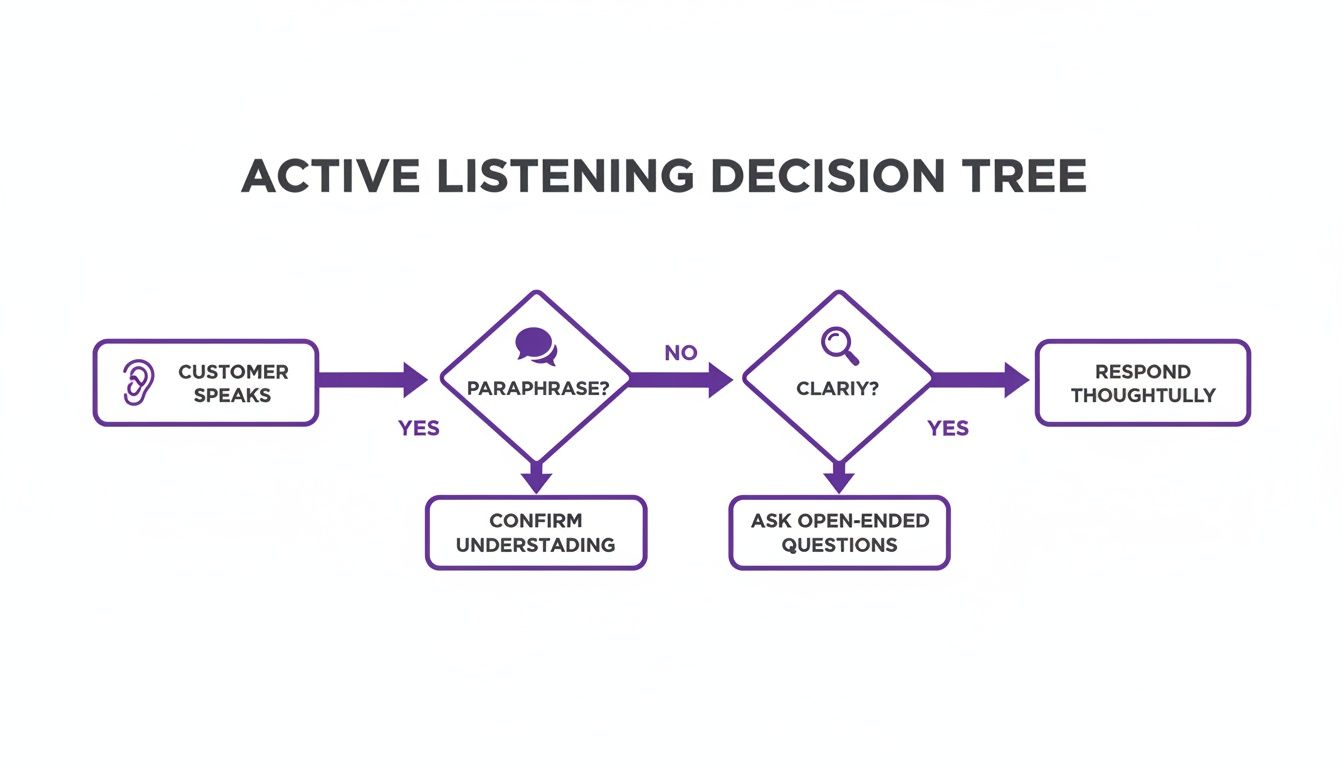
The flowchart above shows a simple but powerful process. After a customer speaks, you have a choice: paraphrase what you heard or ask a clarifying question. This forces you to confirm you've understood them correctly before jumping to a solution.
A Framework for De-escalation
When a call starts with high emotions, you need a plan to steer it back to a productive place. One of the most reliable models out there is the LEAP method: Listen, Empathize, Apologize, and Problem-solve.
- Listen: This is the most critical step. Just let the customer vent. Don't interrupt. Let them get everything off their chest while you provide small verbal cues like, "I see," or "Okay," to show you're fully engaged.
- Empathize: Show them you understand their feelings. Phrases like, "I can absolutely see why you're so frustrated by this," or "It sounds like this has been an incredibly difficult experience," validate their emotions and show you're on their side.
- Apologize: A genuine apology can disarm a tense situation instantly. Remember, you're not admitting personal fault; you're apologizing for the frustrating experience they've had. A simple, "I am so sorry you've had to go through this," works wonders.
- Problem-solve: Only after the customer feels heard and understood can you pivot toward a solution. Make it a team effort. Say something like, "Okay, let's figure out what we can do to make this right."
De-escalation Phrases for Common Scenarios
Choosing the right words is crucial when emotions are high. The wrong phrase can feel dismissive and add fuel to the fire. This table offers some quick swaps to help you navigate tricky conversations.
| Customer Emotion | Ineffective Response (Avoid) | Effective Response (Use) |
|---|---|---|
| Frustration | "Calm down." | "I understand this is frustrating. Let's look at this together." |
| Anger | "I didn't cause the problem." | "I'm so sorry this happened. I'm going to do everything I can to help you." |
| Confusion | "It's not that complicated." | "I can see how that would be confusing. Let me walk you through it step-by-step." |
| Disappointment | "That's just our policy." | "I know this isn't the answer you were hoping for. Let me explain the reasons..." |
Using phrases that validate emotion and express a commitment to helping can completely change the tone of a difficult call.
Managing Your Own Stress
Staying centered during a tough call is a skill you have to practice. These high-stress interactions can drain you, so it's vital to have a few tricks up your sleeve to manage your own emotional response.
One of the best is tactical breathing. Before you respond to a particularly sharp comment, take a slow, deep breath in for four seconds, then out for four seconds. It's a small act that helps regulate your nervous system, keeping your voice even and calm.
It's also smart to develop a quick "post-call reset" routine. After a really difficult call, take 30 seconds. Stand up and stretch, grab a glass of water, or just look out a window. This creates a mental break, preventing the stress from one call from spilling into the next.
The goal isn't to become a robot, but to manage your own emotions so you can stay in control of the conversation. Your calm demeanor is your most powerful de-escalation tool.
By using a clear framework like LEAP and actively managing your own reactions, you can face challenging calls with genuine confidence. You'll not only resolve problems more effectively but also protect your own well-being in the process. For a deeper dive into this topic, explore our guide on how to handle customer complaints with poise and professionalism.
Frequently Asked Questions About Phone Etiquette
Even with the best training in place, some tricky situations inevitably pop up. I’ve seen managers and agents alike get stumped by scenarios that just aren’t in the manual. This section is all about tackling those common, real-world questions head-on.
Consider this your quick reference for those "what do I do when..." moments, helping you keep every single customer interaction on the right track.
What’s the Golden Rule of Phone Etiquette?
If you can only drill one thing into your team, make it this: answer promptly with a positive opening. Seriously. Picking up the phone within three rings and greeting the caller with genuine warmth sets the entire tone for the conversation.
It’s a simple gesture, but it immediately tells the customer, "You're important, and I'm ready to help." That first impression is incredibly powerful and can stop frustration from even starting, making the caller much more collaborative.
How Can We Genuinely Train for Empathy Over the Phone?
You can't teach empathy from a textbook; it has to be practiced. The single most effective way I've found is through role-playing, especially when you use real (but anonymized) call scenarios from your own support logs.
During these sessions, coach your agents to listen for the emotion behind the words—is the customer frustrated, confused, or just plain tired? Then, have them practice using phrases that validate that feeling.
A simple, "I can absolutely see why that would be so frustrating," or "It sounds like this has been a real headache for you," does wonders. It shows you're hearing them as a person, not just processing a ticket. Consistent coaching on tone is what turns this from a script into a genuine habit.
For a deeper dive into how technology is influencing customer communication, you can find some great insights from the Parakeet AI Blog.
How Do You Handle a Customer Who Just Won't Stop Talking?
Ah, the eternal challenge. With a particularly chatty customer, the trick is to strike a balance between letting them feel heard and gently guiding the conversation. Give them a moment to vent or explain, but be ready to interject politely at the first natural pause.
Try a phrase like, "I really appreciate you sharing all this detail. So I can get moving on a solution for you, let me just quickly recap what I’ve got so far..."
This approach validates everything they've said but also gives you the reins to steer the call back toward resolution. You're guiding them, not cutting them off.
What Are Some Quick Practice Drills We Can Use?
You don't need long, drawn-out training sessions to see improvement. Short, consistent drills can be surprisingly effective and are easy to slip into a team huddle or a daily warm-up.
Here are a few of my favorites:
- The Mirror Smile: It sounds silly, but it works. Have agents practice their opening lines or key phrases while smiling into a desk mirror. You can literally hear the smile in their voice, and the shift in tone is immediate.
- The One-Breath Summary: Play a short recording of a complex customer issue. The agent then has to accurately summarize the core problem in a single sentence. This is fantastic for sharpening active listening skills.
- Positive Phrasing Flip: Give your team common negative statements like, "I can't do that for you," or "That's not available." Challenge them to rephrase each one positively. For example, "What I can do is..." or "While that option isn't available, here's a great alternative..."
Ready to help your team master conversations and improve customer interactions? TalkEasy provides AI-powered speaking practice that builds confidence for real-world calls. Give your team the tools they need to sound more professional and handle any situation with ease. Learn more at https://www.talk-easy.com.