
Fluency of english: Master Your Speaking Skills with Confidence
Discover fluency of english with actionable drills, speaking tips, and real-world practice designed to boost confidence and conversation skills.


Let’s be honest, getting to a place of true fluency in English isn't about memorizing the entire dictionary or losing your accent. It’s about something much more practical: the ability to communicate your thoughts smoothly and confidently without getting stuck translating every single word in your head.
It’s the difference between reciting phrases you learned from a textbook and actually having a conversation.
What English Fluency Really Means

First things first, we need to bust a huge myth: fluency does not equal perfection. It’s not some finish line you cross where you suddenly know every word and never make a mistake.
A better way to think about it is like learning to drive a car. Remember those first few times behind the wheel? Every single action—checking the mirrors, gently pressing the gas, turning the wheel—felt so deliberate and required all of your focus. But after a while, it all becomes second nature. You just drive.
That’s spoken fluency in a nutshell. It’s getting to the point where your ideas flow into words without a constant, grinding mental effort. You can jump between topics, explain something complicated, or even correct a small mistake without the whole conversation screeching to a halt. The real goal is clear, effective communication—not trying to sound like you were born in London or New York.
The Shift From Theory to Practice
So many English learners get trapped in the "knowledge" phase. They spend countless hours studying grammar rules and memorizing long lists of vocabulary. While that foundation is important, it doesn't automatically make you a confident speaker. It's like reading books about swimming but never actually getting in the water.
True fluency is measured not by the absence of mistakes, but by the ability to communicate effectively despite them. It’s about connection and clarity, not perfection.
This guide is built for busy professionals and students who need a realistic way to develop this skill. We're going to dive into proven strategies that help you move past the theory and build the kind of natural speaking style that opens doors. It's time to trade those long, awkward pauses for articulate, confident conversations.
For a deeper look into setting practical goals, check out our guide on what it means to be fluent in a language, which offers more context for your journey.
The Three Pillars of Spoken Fluency
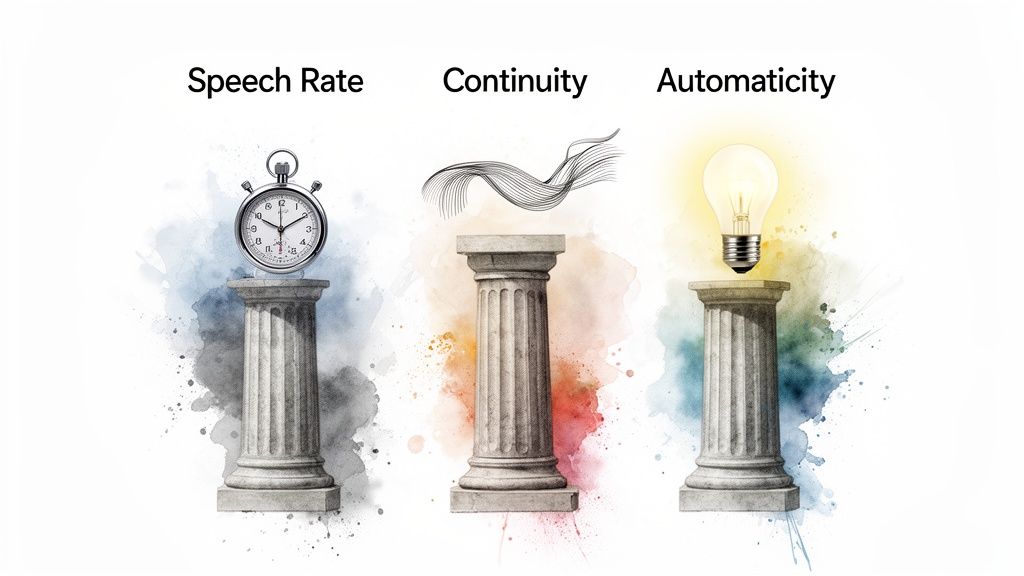
To really get what fluency of English means, we have to look past the grammar rules and vocabulary lists. While those are the essential building blocks, true fluency is about how you use them in the heat of a real conversation. It all comes down to three core pillars that work together to create that smooth, natural-sounding speech we're all aiming for.
Don't think of these pillars as some impossible standard of perfection. Instead, see them as measurable skills you can sharpen with the right kind of practice. The goal here is to turn your spoken English into a reliable tool for sharing your ideas, not a constant source of stress.
Pillar 1: Speech Rate
First up is your Speech Rate—put simply, how fast you talk. This isn't a race to see who can speak the fastest. It’s about finding a comfortable, natural pace that lets your listener easily keep up without feeling like you’re either rushing them or dragging the conversation to a halt.
Speaking too slowly can make conversations feel sluggish, but rattling off words too quickly can cause you to trip over your own tongue and leave your listener completely lost. The sweet spot is a conversational speed that feels effortless and gives you room to express your thoughts clearly.
Pillar 2: Continuity
Next, we have Continuity, which is all about the flow. A fluent speaker can string thoughts and sentences together smoothly, without those long, awkward silences or leaning too heavily on filler words like "uhm," "ah," and "like."
Think of it like a river. A fluent conversation flows steadily. A less fluent one is more like a choppy stream, constantly getting blocked by rocks and debris. When you cut down on those unnatural breaks, you sound more confident and become much easier to understand—a huge win in both professional and social settings.
True fluency is less about the size of your vocabulary and more about the speed and confidence with which you can access and use the words you already know.
Pillar 3: Automaticity
Finally, we arrive at the most crucial pillar: Automaticity. This is that almost magical ability to speak without consciously translating words in your head or digging through your mental dictionary for the right phrase. It's what makes speaking feel intuitive, not like a difficult math problem.
Automaticity is the difference between reciting a memorized script and jumping into a spontaneous chat where you can react and respond on the fly. It’s the sign that your English skills have shifted from something you have to think hard about to an unconscious, automatic habit. This is the ultimate goal, and it's more achievable than you might imagine. In fact, as of 2025, an incredible 1.12 billion non-native speakers have reached fluency, proving this is a well-traveled path. You can find more fascinating global English learning statistics that highlight just how many people are on this journey with you.
How We Measure English Fluency
To actually get better at speaking English, you need a target to aim for. Just saying you want to "get better" is too vague to be useful. That's where global standards come in—they provide a clear roadmap, turning the abstract idea of "fluency" into real, measurable milestones.
The most widely respected system for this is the Common European Framework of Reference for Languages, or CEFR. Think of it as a universal scale for language ability, with levels from beginner (A1) all the way to mastery (C2). It gives you, your teachers, and even potential employers a shared language for answering the question, "So, how good is your English?"
But these aren't just dry, academic labels. Each CEFR level corresponds to practical, real-world skills. It’s like leveling up in a video game; every new level unlocks new things you can do with the language.
What Do These Levels Actually Mean for Speaking?
For most professionals aiming to use English at work, the magic number is B2, often called "Upper-Intermediate." Hitting B2 is a huge milestone because it signifies you've achieved functional fluency. You can comfortably jump into spontaneous conversations, argue your point of view, and follow the main threads of complex discussions without getting lost.
At the B2 level, English stops feeling like a constant struggle and starts becoming a tool you can use effectively in your professional life.
Knowing your CEFR level is like having a GPS for your language journey. It shows you exactly where you are, where you're going, and the best route to get there.
Understanding these levels helps you pinpoint your current abilities and set a clear destination. It transforms your learning from a random walk into a structured, motivating journey.
To give you a clearer picture, here’s a breakdown of what you can actually do with your speaking skills at each CEFR level.
CEFR Speaking Abilities at a Glance
This table breaks down the practical speaking skills associated with each CEFR level, helping learners identify their current proficiency and next steps.
| CEFR Level | Speaking Ability (What You Can Do) | Example Scenario |
|---|---|---|
| A1 (Beginner) | Use basic phrases and introduce yourself. | "Hello, my name is Alex. I am from Germany." |
| A2 (Elementary) | Handle simple, routine exchanges on familiar topics. | Ordering coffee or asking for directions. |
| B1 (Intermediate) | Describe experiences, events, hopes, and ambitions. | Recounting your last vacation to a colleague. |
| B2 (Upper-Intermediate) | Interact with a degree of spontaneity with native speakers. | Debating the pros and cons of a new project in a team meeting. |
| C1 (Advanced) | Express ideas fluently and spontaneously without much searching for words. | Giving a detailed, persuasive presentation to clients. |
| C2 (Proficient) | Express yourself with precision, nuance, and style, even in complex situations. | Moderating a panel discussion on a highly specialized topic. |
Seeing it laid out like this makes it much easier to identify where you are now and what skills you need to build to reach the next level.
A Global Perspective on Proficiency
Another useful benchmark is the EF English Proficiency Index (EPI), which gives us a bird's-eye view of English skills across the globe. Drawing on data from 2.2 million adults in 123 countries, the EPI shows just how much fluency can vary. For instance, the Netherlands has a 'Very High' proficiency score of 624, while the average for Europe is a 'High' 590.
These numbers aren't just statistics; they prove that where you live and how you practice makes a huge difference. You can explore the full English proficiency rankings to see how different countries stack up.
Knowing about these standards helps you set concrete, realistic goals. Maybe you’re aiming for B1 to travel confidently, or you’re pushing for that B2 level to unlock new career opportunities. It turns your desire for better fluency of English from a vague wish into a structured plan.
Actionable Strategies to Build Spoken Fluency
Knowing how English fluency is measured is one thing. Actually improving it is something else entirely. This is where we stop talking theory and start taking real, tangible action. Building spoken fluency isn’t about some secret trick; it's about consistently applying proven methods that get your brain and your mouth working together in sync.
The strategies below are all about building momentum. They're designed to turn the English you know in your head into the English you can use in a conversation, helping you speak with far less hesitation and a lot more confidence.
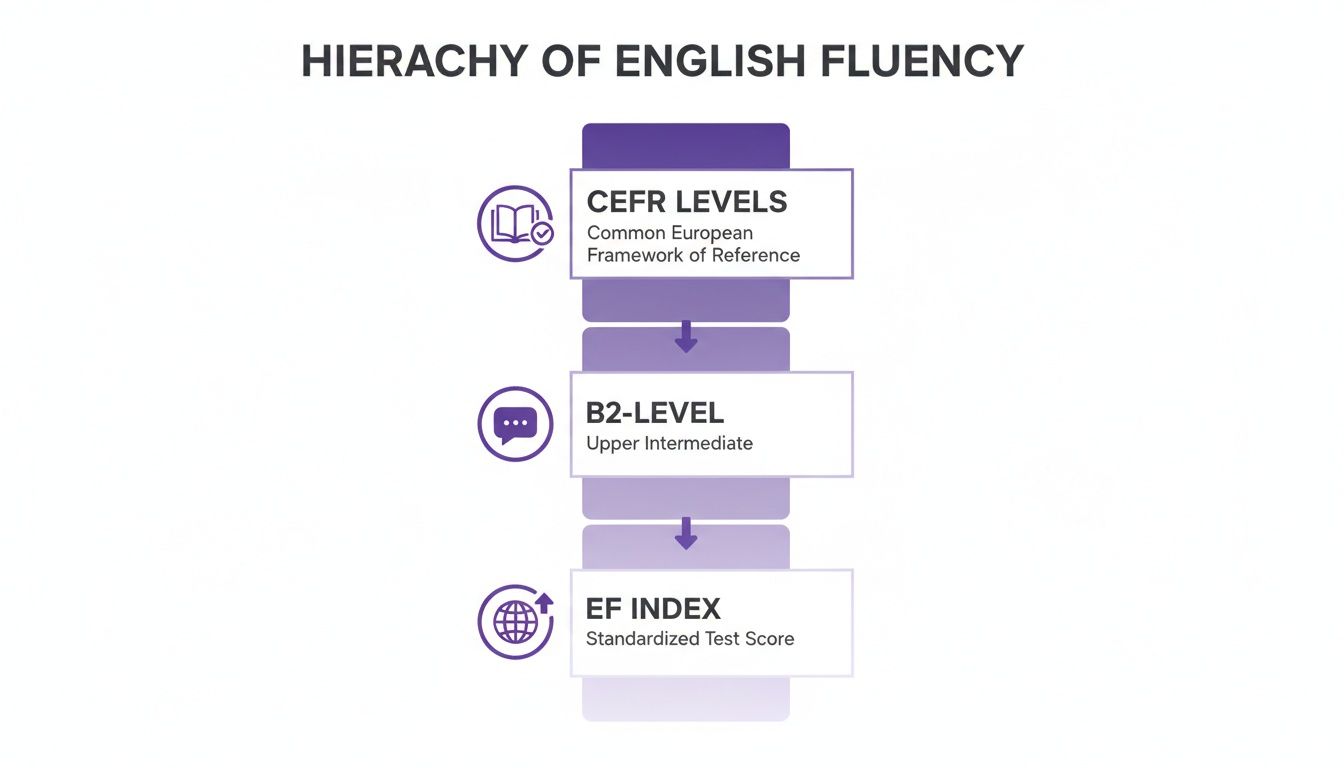
This diagram helps put your goal into perspective. It shows how global standards like the CEFR and benchmarks like the EF Index create a clear map for proficiency. Notice how the B2 level is highlighted—it's widely seen as the point where you hit real, functional fluency. Your goal isn't just a vague idea; it's a measurable skill on a global scale.
The Power of Consistent Daily Practice
The single most effective way to improve your speaking is... well, to speak. It sounds almost too simple, but consistency is what separates learners who make real progress from those who stay stuck. You don't need to block out hours every day. In fact, just 15 minutes of focused speaking practice can create unstoppable momentum over time.
This daily habit builds what experts call automaticity—that amazing ability to speak without constantly translating words in your head. Think of it like training a muscle. A short, consistent workout every single day is far more effective for building strength than one long, exhausting session once a week.
In the professional world, this skill is a game-changer. Fluency is critical in sectors like aviation, finance, and tech, yet only about 20% of over one billion second-language users ever reach true conversational fluency. This creates a massive skills gap, where being bilingual can boost your employability by 30-50%. For a deeper dive into how English skills impact global industries, you can explore the latest EF EPI report.
Master Rhythm and Intonation with Shadowing
Ever notice how native speakers seem to have a certain music to their speech? That natural flow is something you can learn, and the shadowing technique is the perfect way to do it. It’s a straightforward process: listen to a short audio clip of a native speaker and repeat what they say in real-time, doing your best to mimic their pronunciation, speed, and tone.
Shadowing is a lot like tracing a drawing. By carefully following the lines of an expert, you train your own hand to create the same shapes and curves. In the same way, you're training your mouth and vocal cords to produce the natural sounds of English.
This isn't just about getting the pronunciation right. It’s about internalizing the stress patterns and pauses that make English sound authentic and easy for others to understand.
Activate Your Vocabulary with Spaced Repetition
So many learners know tons of words but can't seem to use them in a real conversation. This is the classic gap between passive and active vocabulary. Spaced Repetition Systems (SRS) are scientifically proven tools designed to drag words from your passive memory into active, everyday use.
Here’s the basic idea:
- You review a word or phrase.
- The system quizzes you on it later. If you get it right, the time until you see it again gets longer.
- If you get it wrong, you’ll see it again much sooner.
This simple method forces your brain to retrieve information right at the moment you’re about to forget it, which dramatically strengthens the neural pathways for that word. This makes it far more likely to pop into your head when you're actually speaking.
Create Powerful Feedback Loops
You can't fix a problem if you don't know it exists. A feedback loop is simply a system that shows you where you’re making mistakes so you can correct them. You could record yourself speaking and listen back for errors, or you could use a smart tool like TalkEasy that provides instant, friendly corrections on your grammar and pronunciation.
This kind of immediate feedback is what fuels rapid progress. It stops you from accidentally reinforcing bad habits and gives you a clear, actionable path to getting better. For more practical ideas, check out our guide on how to improve English speaking skills.
Accelerate Your Fluency with AI Practice
While sticking to proven learning techniques is key, most people run into two huge roadblocks: they can't find anyone to practice with, and they're terrified of making mistakes in front of others. This is where technology steps in to offer a real solution, knocking down these barriers and opening the door to quality speaking practice for everyone.
Think about the last time you needed to prepare for a job interview, run through a presentation, or even just rehearse ordering coffee. Now, what if you could do all that with a partner who never gets tired, is available 24/7, and gives you instant feedback without an ounce of judgment? That's no longer science fiction; it's the new reality of learning a language.
A Safe Space to Build Confidence
This is exactly the problem platforms like TalkEasy were built to solve. Instead of feeling self-conscious, you can jump into natural conversations about real-world topics in a completely private setting. It’s a space where you can build real confidence by just speaking, knowing that mistakes aren't failures—they're just part of the process.
The fear of being judged is a massive hurdle that holds so many learners back from improving their fluency of English. Practicing with an AI completely removes that pressure. This freedom is what allows you to take risks, try out new words, and play with different sentence structures—all critical steps for breaking through those frustrating intermediate plateaus.
AI-powered practice gives you the consistency of a dedicated tutor with the privacy of a personal journal. It creates the perfect environment for making rapid gains in fluency.
When you take anxiety out of the equation, you can focus entirely on the mechanics of speaking. You can work on your flow, polish your pronunciation, and finally start using all that vocabulary you've worked so hard to learn. This creates a powerful positive cycle: every successful practice session builds your confidence for the next one.
Efficient, Affordable, and Personalized Feedback
An AI partner offers more than just a willing ear; it provides something incredibly valuable: immediate, personalized feedback. When you get friendly corrections on your pronunciation and grammar right on the spot, you can identify and fix errors before they become ingrained habits. This makes your practice time exponentially more effective than just talking to yourself.
This approach is also unbelievably practical. Getting hours of speaking time with a human tutor can be expensive and a logistical nightmare to schedule. An AI tutor, on the other hand, is ready whenever you are, at a tiny fraction of the cost. It makes consistent practice a genuinely achievable goal.
To see how other tools stack up, you can review some of the best AI study tool options available today. And for more strategies, don't miss our guide on English speaking practice online.
Common Questions About English Fluency
It's completely normal to have questions pop up as you push toward fluency. In fact, it's a good sign—it means you're engaged in the process. Most learners hit the same mental hurdles and practical roadblocks along the way, so let's tackle a few of the most common ones head-on.
Think of these questions less as problems and more as waypoints on your map. They help you clarify your path and adjust your perspective so you can keep moving forward with confidence.
How Long Does It Take to Become Fluent in English?
This is the big one, isn't it? The honest answer is: there's no magic number. How long it takes is a mix of where you're starting from, how much you surround yourself with English, and, most importantly, how consistently you practice. It’s a marathon, not a sprint.
Instead of getting fixated on some far-off, fuzzy goal of "fluency," shift your focus to making small, steady gains you can actually see. With just 15-20 minutes of dedicated speaking practice a day, most learners feel a real difference in their conversational flow and confidence in as little as 3-6 months.
The real secret to fluency isn't about logging a massive number of study hours. It's all about the consistency of your daily speaking. Small, regular efforts compound into huge gains over time.
This is where a tool like TalkEasy really shines. It helps you cut through the noise and focus your time on what truly matters—speaking and getting instant feedback. This targeted approach can get you from an intermediate level to a confident, conversational one much faster than just studying grammar rules or memorizing word lists.
Can I Get Fluent Without Living in an English-Speaking Country?
Absolutely. While jumping into an English-speaking country is a fantastic way to learn, it’s not the only way. Technology has made it possible to build your own immersion bubble, no matter where you live. Your physical location isn't what matters; it's your daily commitment to using the language.
You can get incredibly far by building a solid routine that includes:
- Daily Speaking: Get into conversations, whether with an AI partner like TalkEasy or with language exchange friends.
- Active Listening: Make English podcasts the soundtrack to your commute or your chores.
- Consuming Media: Watch movies, binge a TV series, and follow the news in English. You'll start to internalize the natural rhythm and flow of the language.
The engine that drives fluency is consistent, active use. Speaking, more than anything else, is what turns what you know into what you can do.
Do I Need to Lose My Accent to Be Fluent?
Nope. Not at all. The goal is to communicate clearly, not to erase your accent. Your accent is part of who you are, and there are countless brilliant, successful, and completely fluent English speakers around the world who have accents.
Your energy is better spent on clear pronunciation so people can understand you without straining. An accent only becomes a hurdle if it gets in the way of being understood. Tools that give you specific feedback on pronunciation can be great for ironing out tricky sounds, but always remember the real goal: to be understood and to speak with confidence, not to sound like you're from a specific country.
Why Can I Understand English but Not Speak It Well?
This is such a common—and frustrating—feeling. You're not alone. It’s often called the "knowledge vs. skill" gap. You’ve built up a lot of passive knowledge (you know tons of words and get the grammar), but you haven't yet turned that knowledge into an active skill (speaking).
Here's an analogy: think about learning to play the piano. You can read every book on music theory and watch hundreds of hours of concert pianists, but you’ll never be able to play a single song until you sit down and actually put your fingers on the keys. Speaking is a physical skill, just like playing an instrument. It needs practice to coordinate your brain and your mouth.
The only way across that gap is through consistent, deliberate speaking. Start in a low-pressure space, like practicing with an AI tutor, to build the mental muscle and confidence you need for real-world conversations.
Ready to turn what you know into a skill you can use? TalkEasy gives you the safe, daily practice you need to build real speaking confidence. Start your journey today and see how just 15 minutes a day can completely change your fluency. Begin your first conversation on https://www.talk-easy.com.