
How to prepare for study abroad: A Practical Prep Guide
How to prepare for study abroad: A practical, step-by-step guide with timelines, visas, budgeting, and cultural prep for a smooth start.

Figuring out how to prepare for study abroad can feel overwhelming, but it's really just about breaking a huge, exciting goal into smaller, totally doable tasks. The secret? Start early. I always tell students to begin the process around 12 months before they even think about packing a bag. This gives you plenty of breathing room to sort out everything from finances to visas without that last-minute panic.
Your Study Abroad Preparation Timeline
Deciding to study abroad is, without a doubt, one of the best things you can do in college. It’s an incredible opportunity for personal growth, a huge academic boost, and a chance to see the world from a new perspective. But getting from that "yes!" moment to actually stepping on the plane involves a lot of moving parts—deadlines, paperwork, and logistics. A solid timeline is your best friend here.
Think of it as a marathon, not a sprint. By breaking the journey into distinct phases—like research, applications, and final prep—the whole thing becomes much less intimidating. It helps you focus on what needs to get done now while building momentum as your departure date gets closer.
This timeline gives you a bird's-eye view of the entire process, from early research to locking in your travel plans.
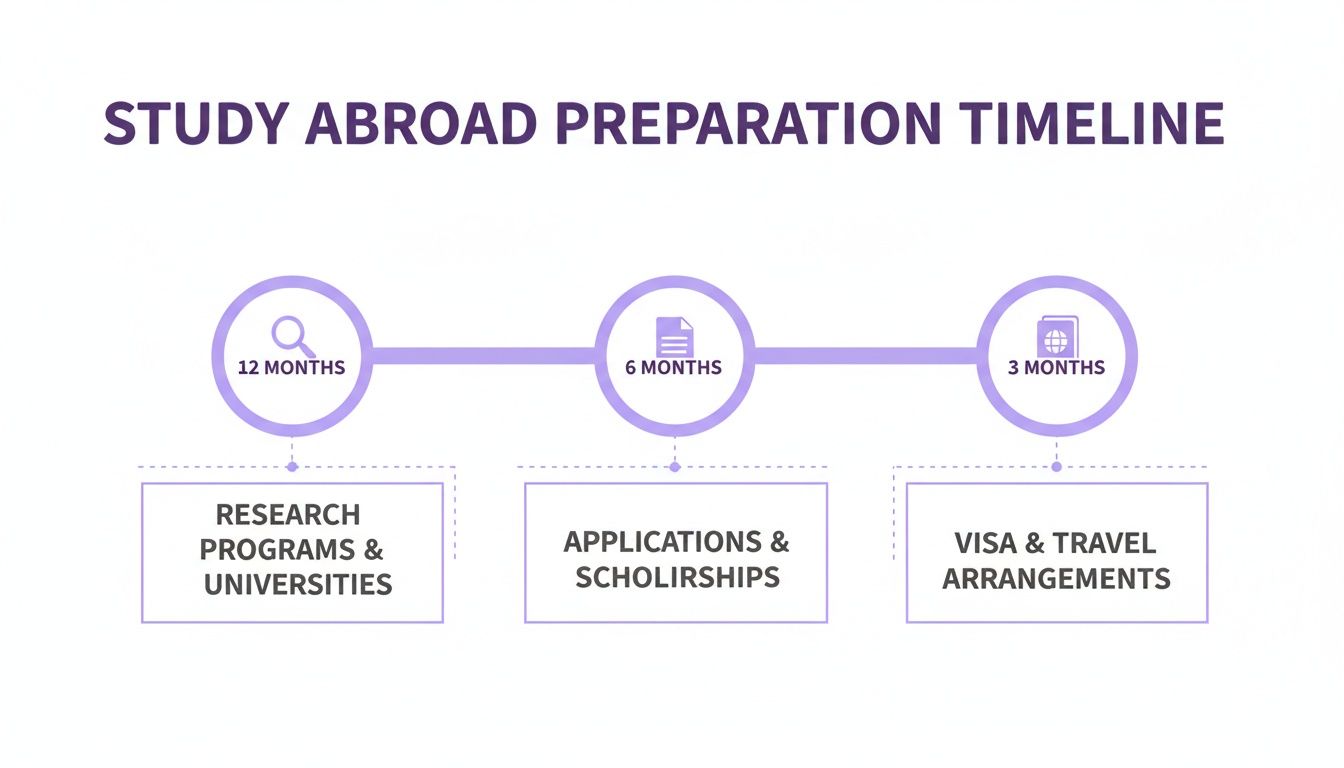
As you can see, starting a year out is all about exploring your options. The six-month and three-month milestones are when you’ll really dive into securing documents and finalizing all the little details.
To make it even clearer, here’s a chronological checklist of what you should be doing and when. This table breaks down the key tasks you need to tackle at each stage of your pre-departure journey.
Study Abroad Pre-Departure Timeline
| Timeframe (Before Departure) | Key Tasks & Milestones | Pro Tip |
|---|---|---|
| 12+ Months | Research programs & countries. Meet with your academic advisor. Draft a preliminary budget. Check your passport's expiration date. | Create a spreadsheet to compare your top 3 programs—include costs, courses, and application deadlines. This makes the final decision so much easier. |
| 9-10 Months | Narrow down your top 2-3 program choices. Start the application process. Request letters of recommendation. Begin writing your personal statement. | Give your professors at least a month's notice for recommendation letters. Provide them with your resume and a link to the program to help them help you. |
| 6-8 Months | Submit your applications before the deadlines. Apply for scholarships and financial aid. Get your passport renewed if it expires within 6 months of your return date. | Many scholarship deadlines are before program application deadlines. Don't wait until you're accepted to start applying for funding! |
| 4-5 Months | Accept your offer of admission! Start the student visa application process immediately. Book your flight. | Visa appointments can fill up months in advance, especially for popular countries. Book your appointment the moment you have your acceptance letter. |
| 2-3 Months | Secure your housing. Register for your courses abroad. Schedule a doctor's appointment for necessary vaccinations and health checks. | Ask your study abroad office if they have a housing portal or can connect you with other students going to the same location. It can save a lot of hassle. |
| 1 Month | Notify your bank of your travel plans. Set up an international phone plan. Purchase travel insurance. Start packing. | Get some local currency before you leave. You'll be grateful to have cash on hand for a taxi or a snack when you first arrive. |
| 1 Week | Confirm your flight and accommodations. Make photocopies of all important documents (passport, visa, etc.). Pack your carry-on with essentials. Say your goodbyes! | Email yourself digital copies of your passport, visa, and flight itinerary. If anything gets lost, you'll have a backup. |
This timeline isn't just a checklist; it's a roadmap designed to keep you on track and minimize stress. By tackling these tasks in order, you'll be well-prepared and ready for an amazing experience abroad.
12 Months Out: The Research Phase
This is where it all begins. Your main goal right now is to dream big and figure out what you truly want from this experience. Don't cut this stage short; the decisions you make here lay the foundation for your entire adventure.
Start by asking yourself what your academic and personal goals are. Are you hoping to finally become fluent in Spanish? Take a niche engineering course you can't get at home? Or maybe just throw yourself into a culture that’s completely different from your own? Your answers will point you toward the right countries and programs.
- Explore Programs and Universities: Dive into researching institutions that fit your major and your vibe. Check out their course catalogs, get a feel for the campus culture, and see what the city is like.
- Consult Your Academic Advisor: This is a non-negotiable step. You need to talk about how your study abroad credits will transfer back and fit into your degree plan. The last thing you want is to find out you're behind on graduation requirements.
- Estimate Your Budget: Get a rough idea of the costs. Look up the cost of living, tuition, and typical flight prices for your top destinations. It’s just an estimate at this point, but it's a crucial first step.
6-9 Months Out: The Application Phase
Okay, you've got your top choices picked out. Now it's time to get serious. This phase is heavy on paperwork and requires you to be on top of deadlines and details.
Start gathering all the documents you’ll need: official transcripts, letters of recommendation, and that all-important personal statement. When asking for recommendations, give your professors at least a month's notice and arm them with your resume and program info so they can write a glowing letter for you.
A classic mistake I see all the time is students underestimating how long it takes to get official documents. Ordering transcripts or renewing a passport isn't instant—it can take weeks. Start these processes as early as you possibly can.
This is also prime time to hunt for money. Look for study abroad scholarships from your home university, your host institution, and any third-party organizations you can find. A lot of these have early deadlines, so the sooner you start looking, the more cash you can potentially line up.
The competition for spots abroad is real. For example, the number of U.S. students studying abroad shot up by 49% in the 2022-2023 academic year, and that's just part of a massive global trend where nearly 5 million students study internationally each year. With so many students going abroad, being prepared and on top of your game is more important than ever. You can find more insights about U.S. study abroad statistics on opendoorsdata.org to understand the trends.
Sorting Out Your Visa, Finances, and Scholarships
Alright, let's talk about the less glamorous—but absolutely critical—side of studying abroad: paperwork and money. Getting your visa and sorting out your finances are probably the two biggest hurdles you'll face before you even pack your bags. But don't let it intimidate you.
Think of it this way: your visa is your non-negotiable entry ticket, and a solid financial plan is the fuel that will keep your adventure running smoothly. Getting these right from the start means less stress and more freedom to enjoy the experience. We’ll walk through it all, step by step.
Making Sense of the Student Visa Maze
The student visa process can feel like you're trying to solve a puzzle in another language, but trust me, it’s a well-worn path. The most important thing to remember is that every country plays by its own rules.
Your first move should always be to go directly to the official embassy or consulate website for your destination country. Seriously, don't rely on some random blog post from three years ago. Go straight to the source for the real requirements.
For instance, if you're headed to the U.S., you'll be dealing with the F-1 visa, which involves the DS-160 form, a SEVIS fee, and an in-person interview. The UK process is mostly online, but you'll still need to visit a special center to provide your biometric information. For Canada, expect to provide very detailed proof of your financial stability.
No matter where you're going, you'll almost certainly need these core documents:
- Your Official Letter of Acceptance: This is the university’s way of telling the government, "Yes, they're really coming here to study."
- Proof of Financial Support: You have to show them the money. Bank statements are key here, proving you can cover tuition and living costs for at least the first year.
- A Valid Passport: Double-check that your passport is valid for at least six months after you plan to come home. This is a common mistake that can trip people up.
- The Application Forms: Fill these out with extreme care. A simple typo—a misspelled name or a wrong date—can send your application to the back of the line.
The visa interview can feel like the final boss battle, but it's usually straightforward. The officer just wants to confirm that you’re a genuine student who plans on returning home eventually. Be ready to talk about why you picked that specific university, how you’re paying for it, and what your post-graduation plans are. Confidence and clarity go a long way.
Building a Realistic Financial Plan
Next up is your money map. This isn't just about paying tuition; it's about figuring out the real, all-in cost of your life abroad, from your flight to your daily coffee. A good budget is the difference between thriving and just surviving.
I always recommend starting with a simple spreadsheet. Make two columns: "Estimated Expenses" and "Funding Sources."
On the expenses side, list everything:
- Upfront Costs: Think visa fees, plane tickets, travel insurance, and any tuition deposits.
- Monthly Costs: Rent, groceries, your phone bill, and local transport.
- Academic Costs: Books, lab fees, and any other supplies you’ll need.
- The Fun Stuff: This is for social outings, weekend trips, and shopping. Don't forget to budget for it!
Then, list your funding sources:
- Personal Savings: Money you or your family have ready to go.
- Financial Aid: Any loans or grants you've secured.
- Scholarships: The best kind of money—free money!
- Part-time Work: Check if your student visa even allows this. Many have strict limitations on working hours.
I've seen it a hundred times: students nail the big-ticket items but get completely blindsided by the small, daily costs. That €4 coffee or £7 sandwich adds up faster than you can imagine. My advice? Track every single penny you spend for the first month. It will show you exactly where your money is going so you can adjust.
And while you're planning, it’s a really good idea to look into a comprehensive travel insurance for students. It can cover unexpected medical bills or trip cancellations, giving you a crucial safety net when you're far from home.
Finding Scholarships and Financial Aid
Scholarships are the best-kept secret for funding a study abroad trip. It’s money you never have to pay back, but you have to be willing to hunt for it. The trick is to start early and cast a wide net.
Don't just go for the huge, well-known scholarships. The competition is fierce. The real gold is often found in smaller, more specific awards.
Here's where to look:
- Your home university’s study abroad office is the best place to start.
- Your host university will often have scholarships just for international students.
- Look for government programs, like the Gilman Scholarship in the U.S.
- Search for organizations related to your major or your destination country.
A great application is key. Don't just send the same generic essay everywhere. Tailor each one to the scholarship's mission. Explain why your goals align with what they value. This is also where a sharp resume can really help you stand out. If yours needs a little polish, our guide on how to write a professional resume has some great, practical tips.
Once you have a handle on your visa and finances, you’re not just planning a trip—you're laying the foundation for an incredible, life-changing experience.
Getting Confident with Everyday English
Your grades are important, but what really makes a study abroad experience unforgettable are the little moments: ordering coffee without a second thought, jumping into a debate with your study group, or actually getting the local jokes. This is where having real-world language confidence changes everything.
Being able to chat naturally is the key to unlocking a genuine connection with your new home. It’s how you’ll make friends outside the international student circle, find your way around town without your phone glued to your hand, and truly feel like you belong. Without it, an incredible adventure can quickly start to feel isolating.

It’s in these daily interactions that you truly sharpen your language skills. By practicing for real-life situations before you go, you’re setting yourself up for the spontaneous conversations that will define your time abroad.
Closing the Gap Between Textbook and Real Talk
Let’s be honest—the English you learn in a classroom and the English people speak on the street can feel like two different languages. Textbooks don't really prepare you for thick regional accents, local slang, or the sheer speed of a casual chat. Bridging that gap is one of the most important things you can do to prepare.
And with more students heading abroad, the need to be prepared is bigger than ever. Projections show that by 2025, a staggering 76% of U.S. students will have plans to study in another country. Since English is the primary language for over 70% of top destinations like the UK and Canada, arriving with shaky conversational skills can put you on the back foot from day one. You can read more about this trend and the rising demand for study abroad on Edify.pk.
"It’s not just about learning the language, it’s about living in it." I love this quote from a seasoned traveler because it gets to the heart of the matter. Language immersion doesn’t start when the plane lands; it starts right now, by building the right habits.
Your One-Month Daily Practice Routine
Consistency beats cramming every single time. Seriously, just 15 minutes a day can build a solid foundation for speaking confidently. The key is to practice conversations you'll actually have, like sorting out your accommodation or making plans for the weekend.
Here’s a simple but effective one-month plan you can follow using an AI conversation partner like TalkEasy:
- Week 1: The Essentials. Nail down the basics until they’re second nature. Practice introducing yourself, asking for directions, ordering at a café, and handling a simple purchase in a shop.
- Week 2: Campus and Social Life. Time to level up. Focus on conversations about joining a club, asking a classmate a question about an assignment, or making plans to hang out with new friends.
- Week 3: Logistics and Life Admin. These are the conversations that can be intimidating. Practice talking to a landlord, figuring out bills with a roommate, setting up a bank account, or making an appointment.
- Week 4: Deeper Connections. Move beyond "survival English." Practice sharing your opinion in a discussion, telling a story about where you're from, and picking up on the cultural nuances that don't show up in grammar books.
This kind of focused practice takes you from just getting by to genuinely connecting. Getting instant, friendly feedback on your pronunciation in a private setting means you can fix mistakes without feeling embarrassed. That’s how you build the courage to speak up when it counts. We’ve seen this work for countless people—for more strategies, check out our guide on how to learn English for adults. You’ll arrive ready to connect, not just to comprehend.
Arranging Your Housing, Health, and Travel Logistics
Once you have that acceptance letter and your visa is approved, the abstract dream of studying abroad suddenly gets very real. Now comes the nitty-gritty: figuring out where you'll live, how you'll get there, and how you’ll stay healthy.
These are the decisions that will truly shape your day-to-day life overseas. Think of housing, health, and travel as interconnected pieces of a puzzle. Your housing location might affect your commute, and booking your flight is the final trigger that starts the real countdown. Let's get these essentials sorted.
Finding Your Home Away From Home
Honestly, securing a good place to live is often the biggest logistical hurdle you'll face. The right spot isn't just a place to sleep; it’s your home base, your community, and your launchpad for adventure. You’ve got a few main paths you can go down.
University-managed dorms are a go-to for many, and for good reason. They offer a ready-made community of other students, which is a massive comfort when you're brand new and thousands of miles from home. Plus, they're typically furnished with bills included, which makes budgeting a whole lot simpler.
The flip side? Dorm life isn't always the most immersive cultural experience. You might find yourself surrounded mostly by other international students, which can make it harder to practice the local language.
My best advice is to figure out your top priority. If you want instant friends and zero hassle, a dorm is a fantastic choice. But if you’re craving deep cultural immersion and more independence, you might want to look at private rentals or a homestay.
Living with a host family throws you right into the deep end of the culture—in the best way possible. You'll be practicing your language skills over the dinner table and getting a truly authentic glimpse into daily life. It can be incredibly rewarding, but it does mean giving up some independence and learning to live by a family's house rules.
Navigating the Private Rental Market
Renting a private flat or a room in a shared house gives you ultimate freedom. You get to live like a local, pick your own neighborhood, and be the master of your own domain. But with great freedom comes great responsibility (and a bit more work).
You'll have to deal with leases, set up your own utilities, and maybe even hunt for furniture. A great starting point is to use online platforms to search for available rooms by area. This can help you get a feel for the market and see what’s available near your university.
A word of warning: be extremely careful about scams. Never, ever send money without seeing the property (a live video tour is the bare minimum) and having a signed contract in hand. A legitimate landlord won't pressure you for an instant deposit before any paperwork is done.
Taking Care of Your Health and Safety
Your well-being is everything. Without it, you can't have a successful or enjoyable time abroad. Your first step should be a full medical check-up with your doctor at least two months before you fly out. This leaves you enough time to get any required vaccinations and sort out prescriptions.
Managing medication abroad can be a real headache. Some drugs aren't available, go by different names, or are even restricted.
- Ask your doctor if you can get a supply to cover your entire stay. It’s the easiest option.
- Always carry a doctor's note detailing your condition and the generic name of your medication.
- Double-check the legality of your specific prescriptions in your host country. What's a common over-the-counter drug at home could be a controlled substance elsewhere.
International student health insurance isn't optional—it's essential. Your policy from home almost certainly won't cover you, and most student visas require you to have proof of adequate health coverage. When comparing plans, look beyond the price and check the details on emergency care, routine doctor visits, and medical evacuation.
Booking Your Flight and Planning Your Arrival
With the other big things in place, it’s finally time to book that flight! I've found that booking two to three months in advance is usually the sweet spot for getting a decent price. Use flight comparison sites and play around with your dates if you can be flexible.
Once that confirmation email hits your inbox, map out your first few hours in the country. How are you getting from the airport to your new home? Many universities offer an airport shuttle for new international students. If yours does, take it. It removes so much stress from that initial arrival.
Your carry-on bag is your survival kit for the first day. Pack it as if your checked luggage is guaranteed to be delayed.
The "Don't Lose This" Carry-On Checklist:
- Critical Documents: Passport, visa, university acceptance letter, housing contract.
- Medications: Your full supply, plus copies of the prescriptions.
- Basic Toiletries: Toothbrush, toothpaste, deodorant—the essentials to feel human.
- One Change of Clothes: Something comfortable to wear after a long flight.
- Electronics & Power: Phone, laptop, and a portable power bank is a lifesaver.
Get Ready for a New Academic and Cultural Scene
A truly life-changing study abroad experience is about so much more than just getting your paperwork in order. It’s about diving headfirst into a new way of learning and living. Getting your head in the game for the academic and cultural shifts ahead is every bit as important as getting your visa stamped.
Think of it as the difference between being a tourist and truly living like a local for a semester. When you understand the classroom dynamics and social cues before you land, your transition will be so much smoother. You'll sidestep awkward moments and build real, lasting connections with the people you meet.
Cracking the Code of a New Classroom
Don't make the classic mistake of assuming your classes abroad will be just like the ones back home. Teaching methods, grading scales, and even how you talk to your professors can be wildly different from country to country. Doing a little homework on this now is one of the smartest things you can do.
In some places, you might find very formal lectures where student participation is rare. In others, you’ll be expected to jump into lively debates or work constantly on group projects. The best place to start is your host university's website. See if you can dig up some old course syllabi—they're a goldmine of information on exam formats, attendance rules, and the kind of workload you should expect.
One of the biggest academic shocks for students is the grading. A 'B' in a European university might be a fantastic mark, while in the U.S., it’s often seen as just okay. Figuring out these little details early on saves a ton of stress down the road.
Mastering Everyday Cultural Etiquette
Every culture operates on a set of unwritten social rules. What's perfectly polite in one country can come off as strange, or even rude, in another. Taking a little time to learn the basics is a huge sign of respect and will make your day-to-day life so much easier.
Start with the simple stuff:
- Greetings: Is a handshake the go-to, or do people kiss on the cheek?
- Tipping: Is it a must, a nice gesture, or something you should never do?
- Punctuality: If you're meeting at 2 PM, does that mean 1:55 PM or closer to 2:30 PM?
- Gift-Giving: If a local family invites you over for dinner, what’s a good host gift to bring?
These small things make a massive difference. They show people you're making an effort to fit in. For a deeper dive into these kinds of nuances, exploring concepts from cross-cultural communication in business can offer some surprisingly useful tips that work just as well in social situations.
Riding the Waves of Culture Shock
Let’s be real: culture shock is a thing. It’s that feeling of being completely out of your element when you're dropped into a totally unfamiliar environment. It's not a sign you're failing; it's a completely normal part of the adventure.
It usually unfolds in a few predictable stages:
- The Honeymoon: Everything is amazing! The food, the sights, the people—it's all new and exciting.
- The Frustration: The novelty wears off. Suddenly, the little differences start to feel like huge, frustrating obstacles.
- The Adjustment: You start to get the hang of things. You build routines, and your new surroundings feel more comfortable.
- The Acceptance: You feel at home. You can navigate your new life with ease and appreciate both your host culture and your own.
Just knowing these stages exist can be a huge help. When you're feeling frustrated, you can remind yourself it's a phase and it will pass. The trick is to strike a balance—keep in touch with friends and family back home, but don't lean on them so much that you forget to engage with where you are.
Your ability to communicate is your superpower in overcoming these hurdles. With a record 6.9 million students studying abroad recently, being able to connect in the local language is more crucial than ever. Studies show that while language anxiety is a real barrier, fluency is directly tied to a better experience—in fact, 70% of students who can connect through language rate their time abroad as "very positive." This is where your prep work really shines. By getting ready for both the academic and cultural challenges, you're setting yourself up not just to study, but to truly connect and thrive.
The Smart Study Abroad Packing List
Packing is that final, frantic step when everything suddenly feels very real. It's not just about cramming clothes into a bag; you're essentially curating a mini-version of your life to take across the world. A well-thought-out packing list is your best defense against overweight baggage fees and the panic of realizing you forgot something critical.
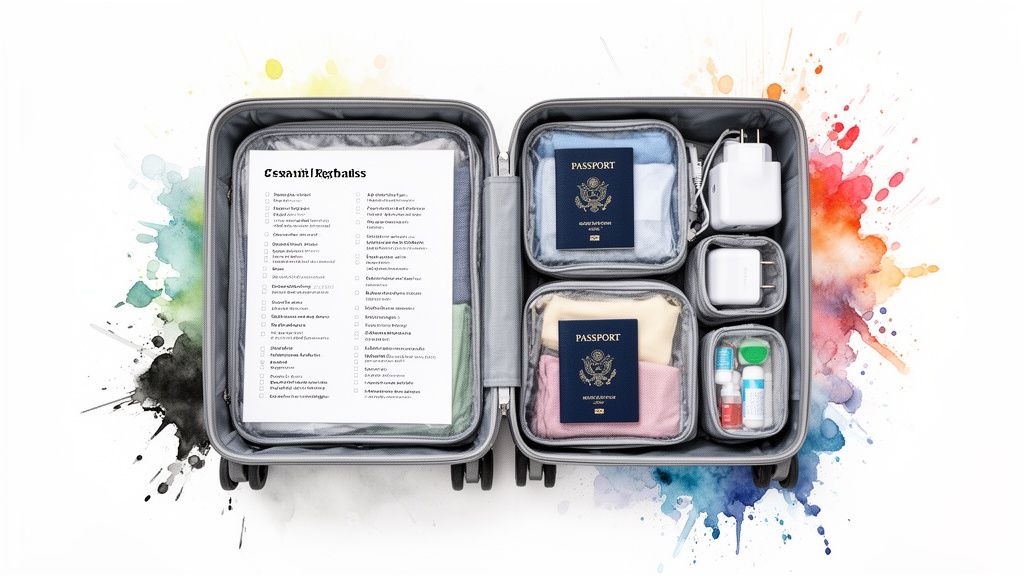
Getting this part right is your secret to a stress-free arrival. By thinking about what to bring versus what you can easily buy there, you’re setting the stage for a much smoother transition into your new home.
Organizing Your Essentials
The best way to avoid that last-minute "just throw it all in" chaos is to break your packing down into categories. Start with the absolute must-haves: your documents. These belong in your carry-on, full stop. Never, ever put them in a checked bag.
Next up, clothing. Do some real research on your destination's climate for the specific seasons you'll be there. Instead of trying to pack for every imaginable weather event, focus on versatile layers you can mix and match. A few good thermal tops, some neutral-colored sweaters, and a reliable waterproof jacket will get you much further than a dozen single-use outfits.
Finally, think through your electronics and personal items. Outlets and voltages are different all over the world. Trust me, a universal adapter with surge protection is one of the smartest, cheapest investments you'll make before you go.
The Carry-On Survival Kit
Think of your carry-on as your 24-hour survival kit. Always pack it with the assumption that your checked luggage might take a little detour. This bag needs to have everything you can't live without.
Here’s a quick rundown of what should be within arm's reach:
- Essential Documents: Passport, student visa, university acceptance letter, housing confirmation, and both physical and digital copies of everything.
- Health Items: A full supply of any prescription meds (with a doctor's note), your glasses or contacts, and a few basic painkillers.
- Electronics: Your phone, laptop, all necessary chargers, a portable power bank, and that universal adapter.
- Comforts: A complete change of clothes, travel-sized toiletries like a toothbrush and deodorant, and headphones for the long flight.
One of the biggest mistakes I see students make is trying to pack every comfort item from home. A couple of small sentimental things are great, but leave the bulky stuff. Towels, bedding, and most toiletries are almost always cheaper and easier to just buy when you get there.
Packing Smart to Save Space and Money
Nothing ruins the airport vibe faster than a surprise overweight baggage fee. The trick is all in how you pack. Packing cubes are an absolute game-changer; they compress your clothes and keep your entire suitcase from descending into chaos.
Another pro tip? Wear your heaviest items on the plane. Yes, you might feel a little bulky in your hiking boots, winter coat, and chunkiest sweater, but it frees up a shocking amount of space and weight in your luggage.
And whatever you do, leave some room! I always recommend leaving about 15-20% of your suitcase empty. You will buy things—souvenirs, new clothes, books. Making sure you have space to bring them home means you won't be scrambling to buy and pay for an extra bag on your return flight.
Got Questions? We've Got Answers
Even with the perfect plan, a few nagging questions can keep you up at night. Let's tackle some of the most common ones I hear from students just like you, so you can feel confident and ready for what's ahead.
How Far in Advance Should I Start Planning?
This is a big one. My honest advice? Give yourself 12 to 18 months. I know that sounds like a lifetime, but trust me, it disappears quickly.
Starting this early gives you breathing room. You can thoughtfully research programs, nail every application deadline without that last-minute panic, and hunt down the best scholarships. It also means you won’t be paying extra for rushed passports or visas. Kicking things off early is the single best way to make smart decisions without the stress.
What's the Best Way to Handle Money Internationally?
Managing money overseas isn't as scary as it sounds. First things first: call your bank back home and give them your exact travel dates. You don’t want your card frozen for a "suspicious" purchase when you're just trying to buy a coffee.
For day-to-day spending, your best bet is to sidestep hefty exchange fees. You can either open an account with a local bank once you arrive or use a multi-currency account from a service like Wise or Revolut.
Pro Tip: Don't rely on just one payment method. I always recommend having a debit card for cash withdrawals, a credit card with zero foreign transaction fees for bigger buys, and a little bit of local cash for those first few hours—enough for a taxi or a quick snack.
How Can I Get Over My Language Anxiety and Make Friends?
It’s completely normal to feel a bit nervous about speaking a new language. The trick is to start practicing before you go, so you land with a bit of confidence in your back pocket.
Once you’re there, just dive in. Seriously. Go to the university orientation events, sign up for a club that looks interesting, and make a point to say "yes" when people invite you to hang out. Nobody expects you to be perfect, and most people will just be happy you're making an effort. The fastest friendships are built on shared experiences, so ask questions and be curious about the people you meet.
What Do I Do if I Start Feeling Homesick?
Listen, feeling homesick or a bit of culture shock is practically a rite of passage for studying abroad. It happens to almost everyone, so don't beat yourself up about it. The first step is just to admit that you're feeling it.
Creating a simple daily routine can be a huge help—it brings a sense of normalcy when everything else feels new and chaotic. It's all about balance. Schedule calls with family and friends back home, but don't let it stop you from living where you are.
A few things that always help:
- Get out and explore a local market by yourself.
- Find a great coffee shop and become a regular.
- Join a sports team or a book club—anything that gets you meeting people.
And remember, your university’s study abroad office is there for you. The advisors have seen it all and can offer some fantastic support. These feelings won't last forever.
Feeling ready to chat with confidence is a game-changer. With TalkEasy, you can practice real-life conversations for just 15 minutes a day and show up ready to connect from day one. Start building your fluency and your confidence right now at https://www.talk-easy.com.