
10 Practical Ways to Improve Workplace Communication in 2026
Discover 10 actionable ways to improve workplace communication. Learn practical strategies, scripts, and daily exercises to speak with confidence at work.


In today's fast-paced, global business environment, the ability to communicate clearly and confidently is more than a soft skill; it's a critical driver of success. From leading team meetings and giving feedback to navigating cross-cultural conversations, effective communication prevents costly misunderstandings, boosts team morale, and accelerates career growth. Understanding the foundational principles is the first step, and further detailed guidance on how to improve communication skills in the workplace can offer additional valuable insights.
Yet, for many busy professionals and English learners, finding the time and methods to practice can feel overwhelming. This article cuts through the noise. We will explore 10 practical, actionable ways to improve workplace communication, focusing on strategies that fit into a demanding schedule. Each method is designed to build real-world fluency, moving beyond theory to provide concrete scripts, daily exercises, and measurement techniques you can implement today. Whether you need to nail a presentation or simply feel more confident in daily stand-ups, these strategies will provide a clear roadmap to becoming a more effective communicator. For those looking to accelerate their progress, tools like TalkEasy offer targeted, AI-powered speaking practice tailored to professional scenarios.
1. Implement Synchronous Conversation Practice Sessions
One of the most effective ways to improve workplace communication is to move beyond theory and engage in structured, real-time speaking practice. Synchronous conversation sessions provide a dedicated space for professionals, especially English learners, to engage in live dialogue. This method directly builds the "muscle memory" needed for spontaneous, confident communication by forcing immediate thinking and response formation, a skill passive learning cannot develop.

Unlike reviewing vocabulary lists, this active practice simulates the pressures of a real meeting or client call. Platforms like TalkEasy offer 15-minute daily sessions with AI for this purpose, while other apps like Duolingo and Babbel incorporate similar interactive features. The goal is to create a low-stakes environment to practice high-stakes conversations. To understand more about the foundational elements of effective dialogue, you can explore this overview on the essentials of workplace communication.
How to Implement This Strategy
- Start Small: Begin with low-pressure topics before tackling complex business scenarios like negotiations or performance feedback.
- Be Consistent: Schedule short, regular sessions (e.g., 15 minutes daily) to build a strong habit.
- Set Micro-Goals: Focus on 2-3 specific objectives per session, such as using transitional phrases or practicing active listening.
- Use Realistic Scenarios: Role-play conversations that mirror your actual job responsibilities, from leading a team stand-up to clarifying project requirements.
- Review and Refine: If possible, record and review your sessions to identify speech patterns, filler words, or areas for improvement.
2. Establish Clear Feedback Mechanisms with Friendly Corrections
One of the most powerful ways to improve workplace communication is to build a system for non-threatening feedback. Many professionals, especially English learners, hesitate to speak up due to a fear of making mistakes. Friendly corrections reframe errors as learning opportunities rather than failures, creating a psychologically safe environment that encourages more frequent and confident participation. This approach focuses on building skills without diminishing motivation.
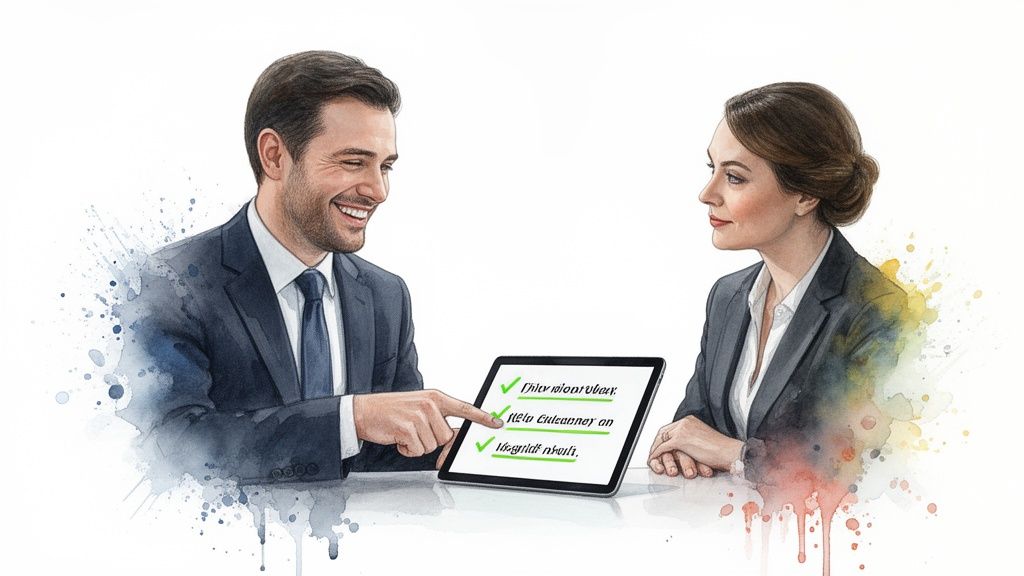
This method moves beyond generic advice by providing immediate, gentle guidance when it's most effective. For instance, platforms like TalkEasy offer instant, friendly corrections during AI-powered conversations, while tools like Grammarly provide tone-aware suggestions. The goal is to correct and guide in the moment, making the learning process seamless and integrated. This is especially crucial in high-stakes scenarios, as detailed in this guide on how to handle customer complaints.
How to Implement This Strategy
- Be Immediate: Deliver corrections right after an error occurs for maximum impact and retention.
- Explain the 'Why': Don't just provide the fix; briefly explain why it's better (e.g., "Using 'could you' sounds more polite than 'can you' in a formal request").
- Use Encouraging Language: Frame feedback positively. Instead of saying "That's wrong," try "A great way to phrase that would be..."
- Prioritize High-Impact Errors: Focus on mistakes that significantly affect clarity, such as business vocabulary or pronunciation, rather than minor grammatical issues.
- Allow for Practice: Give individuals a chance to re-practice the corrected phrase or sentence without penalty to help solidify their learning.
3. Create Personalized Learning Paths Based on Professional Goals
Effective communication training is not a one-size-fits-all solution. Tailoring learning experiences to an individual's specific role, industry, and daily challenges is one of the most powerful ways to improve workplace communication. A customer service representative needs to master de-escalation language, while an engineer must clearly explain technical specifications. Personalized paths ensure every minute of practice directly addresses the real-world obstacles an employee faces, making the learning process far more efficient and relevant.
This targeted approach moves beyond generic business English to focus on job-specific vocabulary and scenarios. Platforms like TalkEasy excel at this by building curricula around a user's professional goals, while LinkedIn Learning and Coursera offer specialized course tracks for different career fields. To develop truly effective learning experiences, understanding key instructional design best practices is paramount. The goal is to make training a direct tool for career growth, not just a general skill-building exercise.
How to Implement This Strategy
- Define Clear Objectives: Start by identifying the top 2-3 communication challenges in the employee’s current role, such as leading team meetings or handling client objections.
- Prioritize Industry Jargon: Create vocabulary lists and practice drills focused on the specific terminology used in their field.
- Use Real-World Scenarios: Develop role-playing exercises that mirror an employee's actual tasks, like presenting a quarterly report or negotiating project deadlines.
- Align Content to Career Goals: If an employee aims to become a manager, incorporate practice for giving feedback and delegating tasks.
- Review and Adjust Regularly: Meet monthly to assess progress and refine the learning path based on new challenges and achievements.
4. Leverage Microlearning for Sustained Engagement
One of the biggest obstacles to skill development for busy professionals is a lack of time. Microlearning overcomes this by delivering focused, bite-sized learning units, typically lasting 5 to 15 minutes, that fit seamlessly into a packed schedule. This approach is one of the most practical ways to improve workplace communication because it prevents cognitive overload and builds powerful habits through daily, consistent practice rather than infrequent, long training sessions.
This method breaks down complex skills into manageable, daily actions. For example, TalkEasy’s 15-minute conversation model allows users to practice specific speaking skills each day, while apps like Duolingo use short daily lessons to build language proficiency. The core idea is to make learning an easily achievable part of your daily routine. By focusing on one small objective at a time, you build momentum and see tangible progress without feeling overwhelmed.
How to Implement This Strategy
- Schedule a Daily Slot: Block out the same 15-minute window each day, like during your morning coffee, to build automaticity.
- Focus on a Single Goal: Ensure each micro-session has one clear objective, such as practicing asking clarifying questions or using stronger verbs.
- Use Progress Streaks: Leverage features in apps that track consecutive days of practice to stay motivated.
- Prioritize Mobile-Friendly Tools: Choose platforms with a seamless mobile experience so you can practice anywhere, anytime.
- Track and Remind Gently: Set up simple reminders to keep your practice on track without creating pressure or stress.
5. Use Role-Play and Scenario-Based Practice
One of the most powerful ways to improve workplace communication is by simulating real-world situations in a controlled, low-stakes environment. Role-play and scenario-based practice move beyond theoretical knowledge, allowing you to build the confidence and "muscle memory" needed to handle authentic professional interactions. This method bridges the gap between knowing what to say and actually saying it effectively under pressure.

This active rehearsal prepares you for everything from client calls and team meetings to more challenging conversations like giving feedback or handling disagreements. Platforms like TalkEasy excel at this by offering guided conversations on real-world topics such as negotiations and customer service. Other tools, like the immersive Mondly VR, use virtual reality to create lifelike practice environments. The core goal is to rehearse for high-stakes moments without the real-world consequences, making you more agile and prepared when they actually happen.
How to Implement This Strategy
- Use Job-Relevant Scenarios: Base role-play situations directly on your day-to-day responsibilities for maximum relevance.
- Include Challenging Situations: Practice navigating disagreements, customer complaints, or ambiguous requests to build resilience.
- Add Context: Provide character backgrounds and specific objectives to make the simulation feel more realistic and engaging.
- Debrief and Analyze: After each scenario, discuss what worked, what didn't, and what you could do differently next time.
- Allow for Multiple Attempts: Re-run scenarios using different communication tactics to discover the most effective approach.
6. Implement Progress Tracking and Visible Metrics
To sustain long-term improvement in workplace communication, it’s crucial to make progress visible and measurable. Tracking specific metrics like fluency scores, vocabulary growth, and speaking time transforms an abstract goal into a tangible journey. This data-driven approach provides clear evidence of growth, which boosts motivation and helps professionals see the return on their time investment. It answers the critical question: "Is this practice actually working?"
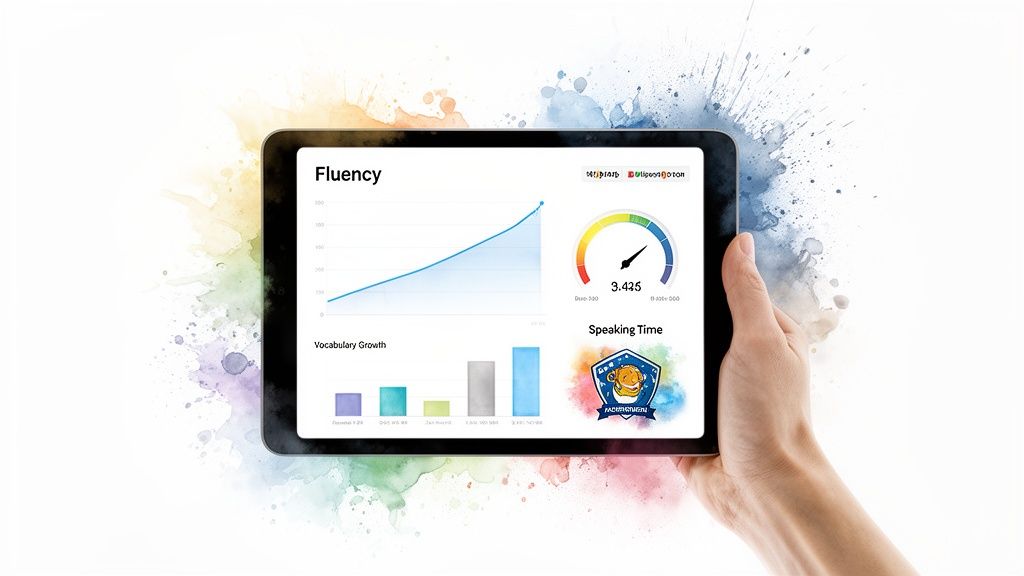
This concept is successfully used by platforms across different industries, from Fitbit’s health dashboards to Duolingo’s XP system. For professional speaking skills, apps like TalkEasy offer detailed progress reports and streaks to keep users engaged and informed about their development. By visualizing improvement, learners can identify strengths and weaknesses, allowing them to adjust their strategies for more effective outcomes. Visible metrics create a powerful feedback loop that fuels continuous learning.
How to Implement This Strategy
- Establish Key Metrics: Define what you want to improve, such as reducing filler words, increasing active speaking time, or expanding professional vocabulary.
- Use Tracking Tools: Leverage apps that provide analytics or keep a simple personal log to note progress after important conversations or practice sessions.
- Celebrate Small Wins: Acknowledge and celebrate minor improvements, like successfully using a new phrase in a meeting, to maintain momentum.
- Review Progress Regularly: Set aside time weekly or monthly to review your metrics. Look for patterns and identify areas needing more focus.
- Focus on Personal Growth: Compare your current performance only to your past performance. The goal is steady personal improvement, not comparison with others.
7. Foster Peer Learning and Community Support
Another powerful way to improve workplace communication is by creating spaces for colleagues to practice and learn from each other. Fostering peer learning and community support turns individual improvement into a team effort. This approach reduces the isolation often felt when learning a new skill, provides diverse conversation partners, and builds accountability through shared goals and social commitment. It transforms skill development from a solitary task into a collaborative and engaging experience.
This method creates a supportive ecosystem where team members can share experiences, offer feedback, and build confidence together. For professionals, particularly English learners, these peer networks are invaluable for practicing in a safe environment before high-stakes client meetings or presentations. Platforms like Tandem and iTalki offer community features, while internal company forums or Slack channels can serve the same purpose. The core idea is to leverage the collective power of the group to accelerate individual growth.
How to Implement This Strategy
- Create Dedicated Spaces: Establish a specific channel (e.g., on Slack or Teams) or a recurring meeting for peer practice sessions.
- Use Structured Prompts: Facilitate discussions with organized prompts to keep conversations focused and productive. For ideas, explore these small talk topics for work.
- Establish Clear Guidelines: Set ground rules for respectful feedback and constructive conversation to ensure a positive and safe environment.
- Recognize Participation: Acknowledge and reward active members to encourage consistent engagement and model supportive behavior.
- Appoint Moderators: Assign team members to moderate discussions, ensuring conversations stay on track and that any shared advice is accurate and helpful.
8. Provide Multilingual Support for Native Language Understanding
To accelerate learning, especially for non-native English speakers, providing explanations in their native language is a powerful strategy. This approach reduces the cognitive load of trying to understand complex communication concepts while simultaneously translating them. By offering key instructions and nuances in a learner's first language, you eliminate a significant barrier to comprehension, allowing them to grasp the core message much faster.
This method focuses on using the native language for foundational understanding, not for practice. Platforms like TalkEasy effectively use this model by providing seamless onboarding in seven major languages, ensuring users understand the "how" and "why" before they begin their English-only speaking sessions. Similarly, apps like Babbel use native language explanations to clarify grammar and vocabulary. This bilingual scaffolding is one of the most efficient ways to improve workplace communication for global teams, ensuring everyone starts with the same clear understanding.
How to Implement This Strategy
- Explain, Don't Interact: Use native language support strictly for instructions, feedback, and explaining complex concepts, while keeping all active practice sessions in English.
- Clarify Cultural Nuances: Use the learner's native language to explain subtle cultural differences in communication styles, such as directness versus indirectness.
- Offer Bilingual Examples: Provide side-by-side scripts or examples in both English and the native language to illustrate how phrases translate contextually, not just literally.
- Gradually Reduce Dependency: As a user's proficiency grows, slowly phase out native language support to encourage full immersion and build confidence.
- Ensure Quality Translation: Use professional, culturally appropriate translations for all support materials to avoid confusion and maintain credibility.
9. Establish Affordable Pricing and Remove Cost Barriers
One of the most significant yet often overlooked ways to improve workplace communication is to make high-quality training financially accessible. Cost is a primary barrier preventing many professionals, especially those in emerging markets or early in their careers, from accessing the tools they need. By removing this hurdle, organizations and individuals can unlock potential that was previously gated by expensive tutoring or premium software.
This approach democratizes professional development, ensuring that skill-building is not a privilege reserved for a select few. When effective communication practice becomes affordable, it empowers a much broader population, including immigrants, students, and remote teams, to participate more confidently in the global workplace. This creates a more equitable and capable workforce, which is a powerful strategy for improving communication at a systemic level.
Platforms like TalkEasy demonstrate this by offering AI-powered practice sessions at a fraction of the cost of traditional human tutors, sometimes up to 50 times cheaper. Similarly, models like Duolingo’s freemium tier or Khan Academy’s completely free resources have proven that accessibility drives widespread skill adoption. This focus on affordability ensures that a commitment to better communication can be met with practical, accessible solutions. You can learn more about how TalkEasy’s affordable model supports professionals on their homepage.
How to Implement This Strategy
- Prioritize Value Over Prestige: When selecting training tools, focus on the return on investment (ROI) and effectiveness rather than just brand name or high price tags.
- Leverage Free Trials: Make full use of free trial periods to evaluate if a tool meets your specific needs before committing financially.
- Seek Transparent Pricing: Opt for services with clear, upfront pricing models that have no hidden fees to ensure you can budget effectively.
- Explore Corporate or Team Plans: If you're part of a team, ask about bulk pricing or corporate plans, which often provide significant discounts.
- Look for Subsidized Options: Investigate if your organization offers a learning stipend or if platforms provide scholarships for underserved groups.
10. Incorporate Mobile-First Design for Workplace Accessibility
One of the most practical ways to improve workplace communication consistently is by ensuring learning tools are accessible anytime, anywhere. Incorporating a mobile-first design for training platforms recognizes that modern professionals learn on the go, during commutes, breaks, or between meetings. This approach ensures that skill development isn't tethered to a desktop computer, making it far easier to integrate into a fragmented daily schedule.
Mobile accessibility transforms communication practice from a scheduled event into an on-demand activity. Platforms like TalkEasy are built with a mobile-friendly interface specifically for this purpose, allowing users to complete a practice session whenever they have a spare 15 minutes. Similarly, apps like Duolingo have proven the model's success, with the vast majority of their user engagement happening on mobile devices. The core idea is to remove barriers to practice, making consistency achievable for even the busiest individuals.
How to Implement This Strategy
- Optimize for One-Handed Use: Design key functions to be easily reachable with a thumb, simplifying interactions during a commute.
- Enable Offline Access: Allow users to practice pronunciation or review vocabulary even without a stable internet connection.
- Minimize Data Consumption: Create a lightweight experience that is mindful of users with limited mobile data plans.
- Test on Various Devices: Ensure the platform functions smoothly on mid-range smartphones, not just the latest flagship models.
- Use Strategic Notifications: Send thoughtful reminders to encourage daily practice, helping users build a strong learning habit without becoming intrusive.
10-Point Comparison: Workplace Communication Improvements
| Approach | 🔄 Implementation Complexity | Resources Required | ⚡ Speed / Efficiency | 📊 Expected Outcomes & ⭐ Effectiveness | 💡 Ideal Use Cases / Tips |
|---|---|---|---|---|---|
| Implement Synchronous Conversation Practice Sessions | High — real-time infra, scheduling constraints | Moderate–High — low-latency platform, AI/peer facilitation, analytics | High ⚡⚡ — rapid fluency gains with repeated practice | Measurable increase in speaking confidence and response speed; Effectiveness: ⭐⭐⭐ | Start with short, low-pressure topics; 15-min daily role-plays |
| Establish Clear Feedback Mechanisms with Friendly Corrections | Medium — UX timing and pedagogy design | Moderate — NLP/correction models, contextual explanation content | High ⚡ — immediate corrections speed learning | Reduces anxiety and prevents fossilized errors; Effectiveness: ⭐⭐⭐ | Correct promptly, explain the "why", prioritize high-impact errors |
| Create Personalized Learning Paths Based on Professional Goals | High — assessment algorithms and content mapping | High — diagnostic tools, role-specific content, ongoing curation | Efficient long-term — faster relevance, slower setup ⚡ | Strong ROI; faster role-specific competence; Effectiveness: ⭐⭐⭐ | Use initial assessments and real job scripts; review monthly |
| Leverage Microlearning for Sustained Engagement | Low–Medium — chunking content & mobile UX | Low–Moderate — short modules, mobile delivery, reminders | Very high ⚡⚡⚡ — fits fragmented schedules, boosts consistency | Higher completion rates and retention for small concepts; Effectiveness: ⭐⭐ | Single-objective 5–15 min modules; use streaks and reminders |
| Use Role-Play and Scenario-Based Practice | Medium — scenario design and branching logic | Moderate — realistic scripts, character profiles, recording tools | High for transfer — builds practical readiness ⚡⚡ | Strong transfer to real workplace situations; Effectiveness: ⭐⭐⭐ | Base scenarios on actual job tasks; debrief after attempts |
| Implement Progress Tracking and Visible Metrics | Medium — analytics and visualization design | Moderate — scoring models, dashboards, exportable reports | Indirectly efficient — motivates sustained use ⚡ | Improves motivation and provides employer evidence; Effectiveness: ⭐⭐⭐ | Present encouraging metrics; compare to learner's past performance |
| Foster Peer Learning and Community Support | Medium — moderation and matching systems | Low–Moderate — forums, matching, volunteer moderators | Variable ⚡ — dependent on availability and moderation | Diverse partners, accountability, lower cost; Effectiveness: ⭐⭐ | Provide guidelines, structured prompts, and rewards for active members |
| Provide Multilingual Support for Native Language Understanding | High — localization and quality translation | High — translators, bilingual content, cultural adaptation | Fast comprehension early on; may slow immersion ⚡ | Speeds initial understanding and reduces dropout; Effectiveness: ⭐⭐ | Use native language for explanations only; phase out over time |
| Establish Affordable Pricing and Remove Cost Barriers | Low–Medium — pricing tiers and billing systems | Low–Moderate — flexible billing tech and subsidy programs | High adoption speed when affordable ⚡ | Broader access and volume growth; Effectiveness: ⭐⭐ | Offer trials, transparent tiers, and corporate bulk options |
| Incorporate Mobile-First Design for Workplace Accessibility | Medium — native apps and responsive design | Moderate — iOS/Android dev, offline capability, notifications | Very high ⚡⚡⚡ — enables practice anywhere, anytime | Increased engagement and consistent daily practice; Effectiveness: ⭐⭐⭐ | Optimize for one-handed use, minimize data/battery use, test on mid-range devices |
Take the First Step Toward Confident Communication
Transforming how you communicate at work isn't about a single, monumental change. Instead, it’s the result of small, consistent actions compounded over time. The journey from uncertainty to confidence is paved with the practical, actionable strategies we’ve explored. Mastering these ways to improve workplace communication is not just an item to check off a professional development list; it's a fundamental shift that can redefine your career trajectory.
The methods detailed in this guide, from synchronous conversation practice to establishing clear feedback loops and leveraging microlearning, all share a common thread: they break down a complex skill into manageable, daily habits. You don't need to block out hours from your already packed schedule. The power lies in focused, intentional practice that mirrors the real-world challenges you face every day.
From Theory to Tangible Results
The core takeaway is that passive learning is not enough. Reading articles and watching videos can provide knowledge, but only active practice builds fluency and confidence. The most effective strategies are those that get you doing:
- Scenario-Based Practice: Engaging in role-plays for difficult conversations or upcoming presentations moves communication skills from theoretical knowledge to an embodied ability.
- Micro-Practice: Integrating short, 15-minute practice sessions into your daily routine makes improvement sustainable and prevents burnout.
- Visible Progress: Using metrics and tracking your growth provides the motivation needed to stay consistent, turning abstract goals into concrete achievements.
By implementing even one or two of these approaches, you begin to build a powerful feedback loop. You practice a specific skill, apply it in a low-stakes environment, receive constructive feedback, and refine your approach. This iterative process is the fastest and most reliable path to not just better communication, but also to stronger professional relationships, increased influence, and greater overall effectiveness in your role.
Your Actionable Next Steps
The ultimate goal is to close the gap between what you want to say and what you actually communicate. This clarity builds trust, prevents misunderstandings, and positions you as a capable and reliable team member. The value extends beyond individual meetings or emails; it enhances team cohesion, accelerates project timelines, and fosters a more inclusive and psychologically safe work environment.
Don't let the scope of improvement feel overwhelming. Your next step is simple: choose one strategy that resonates with you and commit to it for a single week. Whether it's finding a peer to practice feedback scenarios with, dedicating a daily 15-minute slot to a speaking exercise, or exploring a tool designed for this purpose, the key is to start. Consistent, focused effort is the engine of change, and the confidence you build will become your greatest professional asset.
Ready to put these principles into action with a tool built for busy professionals? TalkEasy provides AI-powered, scenario-based speaking practice with friendly corrections, helping you build confidence in just 15 minutes a day. Start your journey toward clearer, more impactful workplace communication by visiting TalkEasy and trying it for yourself.